Belonging to a Monk at Saint-Denis
MAXIMUS the Confessor; Jean PICOT, translator.
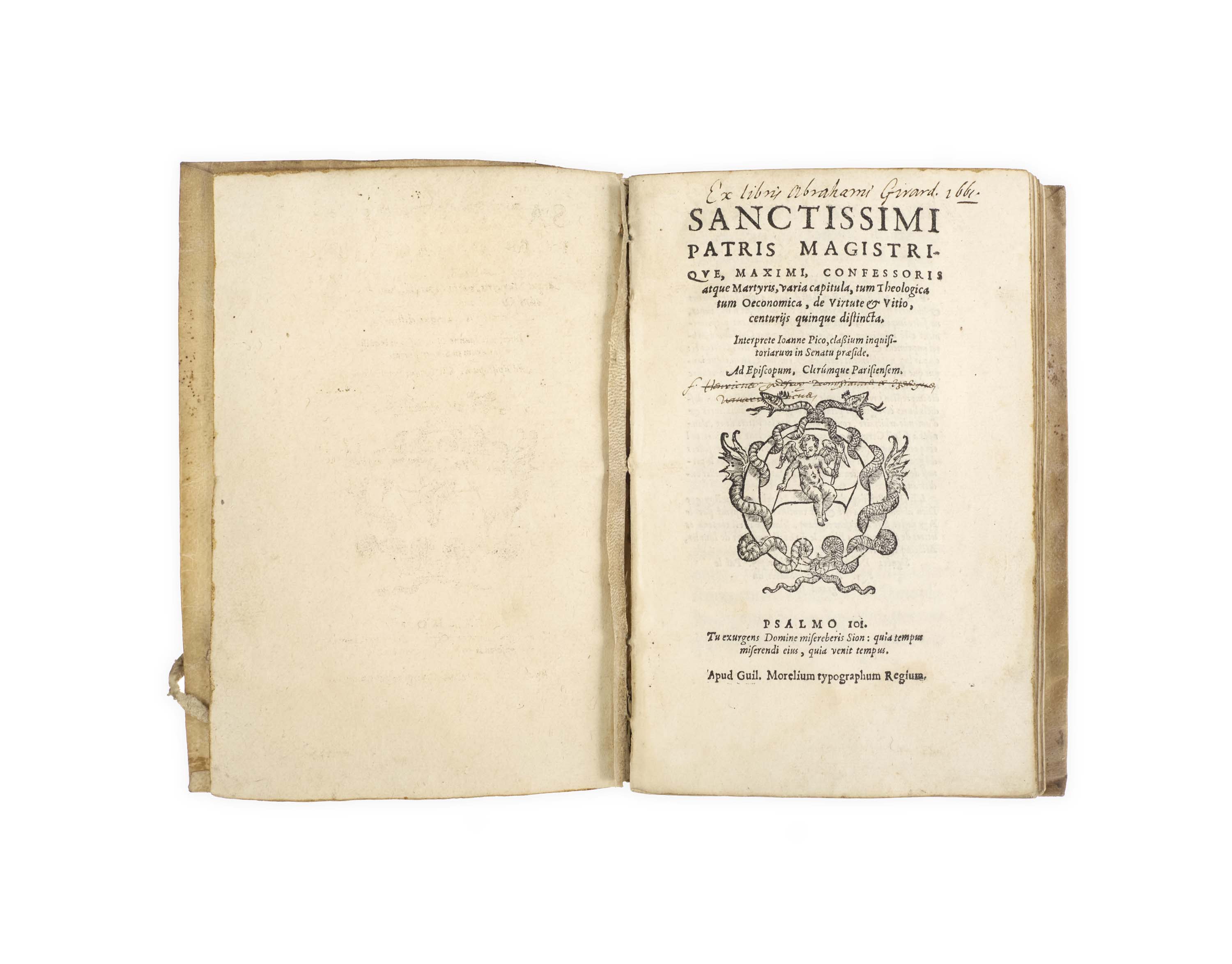
Sanctissimi patris magistrique, Maximi, confessoris atque martyris, varia capitula, tum Theologica tum Oeconomica, de Virtute & Vitio, centuriis quinque distincta. [(Colophon:) Paris,] Guillaume Morel, [1560].
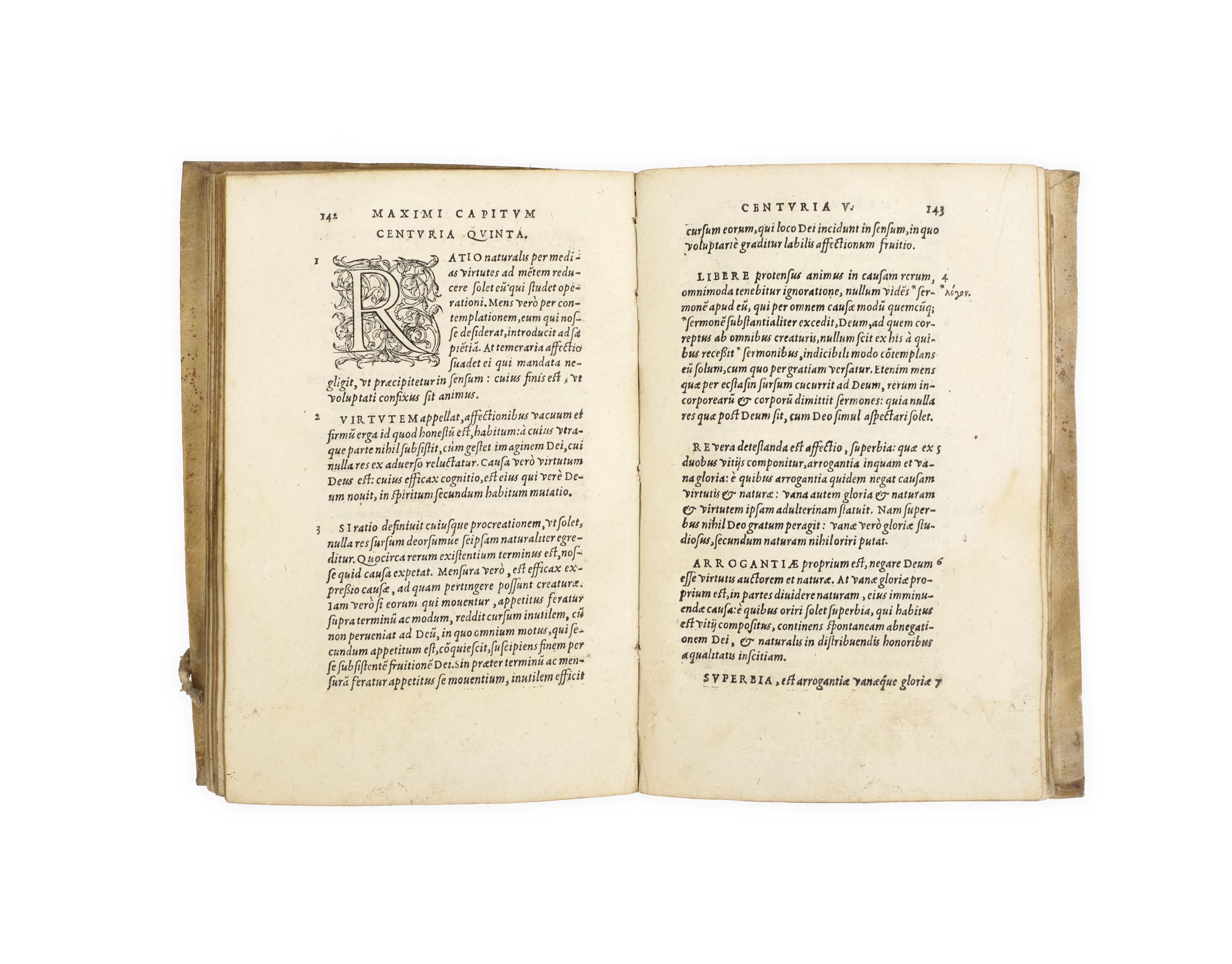
8vo, pp. [viii], 176, [1 (colophon)], [2 (blank)]; woodcut Morel device to title-page, woodcut initials; pale dampstaining at lower corner (a little heavier to quires G–H), but a very good copy; bound in contemporary vellum sewn on 3 tawed thongs laced in, spine lettered in ink, two pairs of tawed ties to fore-edge, yapp fore-edges, endguards of sixteenth-century manuscript waste on vellum; a few small marks to binding; sixteenth-century ink ownership inscription ‘F. Henricus godefroy Dionysianus et theologus navarricus’ to title, neatly deleted in ink with subsequent ink ownership inscription ‘Ex libris Abrahami Girard 1661'.
Added to your basket:
Sanctissimi patris magistrique, Maximi, confessoris atque martyris, varia capitula, tum Theologica tum Oeconomica, de Virtute & Vitio, centuriis quinque distincta.
First edition of Jean Picot’s Latin translation of this Byzantine compilation of extracts from the writings of Maximus the Confessor and others, our copy owned by a sixteenth-century monk at the Abbey of Saint-Denis.
This work is attributed to Maximus the Confessor (c. 580–662 AD), a Byzantine monk and philosopher influenced by Neoplatonism, who regularly made use of this popular Byzantine literary format of chapters (capitula or κεφάλαια), containing short paragraphs or sentences designed to be memorised or grouped together for meditation or study, often assembled together in hundreds. These five centuriae of chapters were most likely compiled in the early twelfth century from genuine writings of Maximus, in particular his question-and-answer compilation addressed to his friend Thalassius.
The Latin translation by Jean Picot (d. 1565) was printed by Morel as a companion to the Greek text, printed in the same year and often found together; the translation was subsequently reprinted in 1562. Picot, conseiller du Roy and the translator of numerous Greek theological works into Latin and indeed French, dedicates his translation to Eustache du Bellay (d. 1565), Bishop of Paris from 1551 to 1563.
Provenance:
1. Early ownership inscription of Henri Godefroy of Navarre, a Benedictine of the Abbey of Saint-Denis, and the author of a book on the relics of Saint-Denis as well as a funeral sermon for Maximilian II of Austria, both printed in 1577; he also owned a book now in the Bibliothèque Mazarine, where his inscription is dated 1573.
2. A subsequent ownership inscription of Abraham Girard (1635–1693), the Cistercian Abbot of Chalivoy in the diocese of Bourges, whose books were not dispersed until the late twentieth century (Drouot, Bibliothèque d’Abraham Girard et à divers amateurs, 9 February 1996).
BM STC French, p. 307; BP16 114838; USTC 152993 (under Valerius Maximus); Adams M 930 (the Greek and Latin texts together); Pettegree and Walsby, French Vernacular Books 89755 (under Valerius Maximus). See Van Deun, ‘Maximus the Confessor’s use of literary genres’ in The Oxford Handbook of Maximus the Confessor (2015), pp. 275 and 280.