Minutes of a Learned Society
ACCADEMIA LABRONICA.
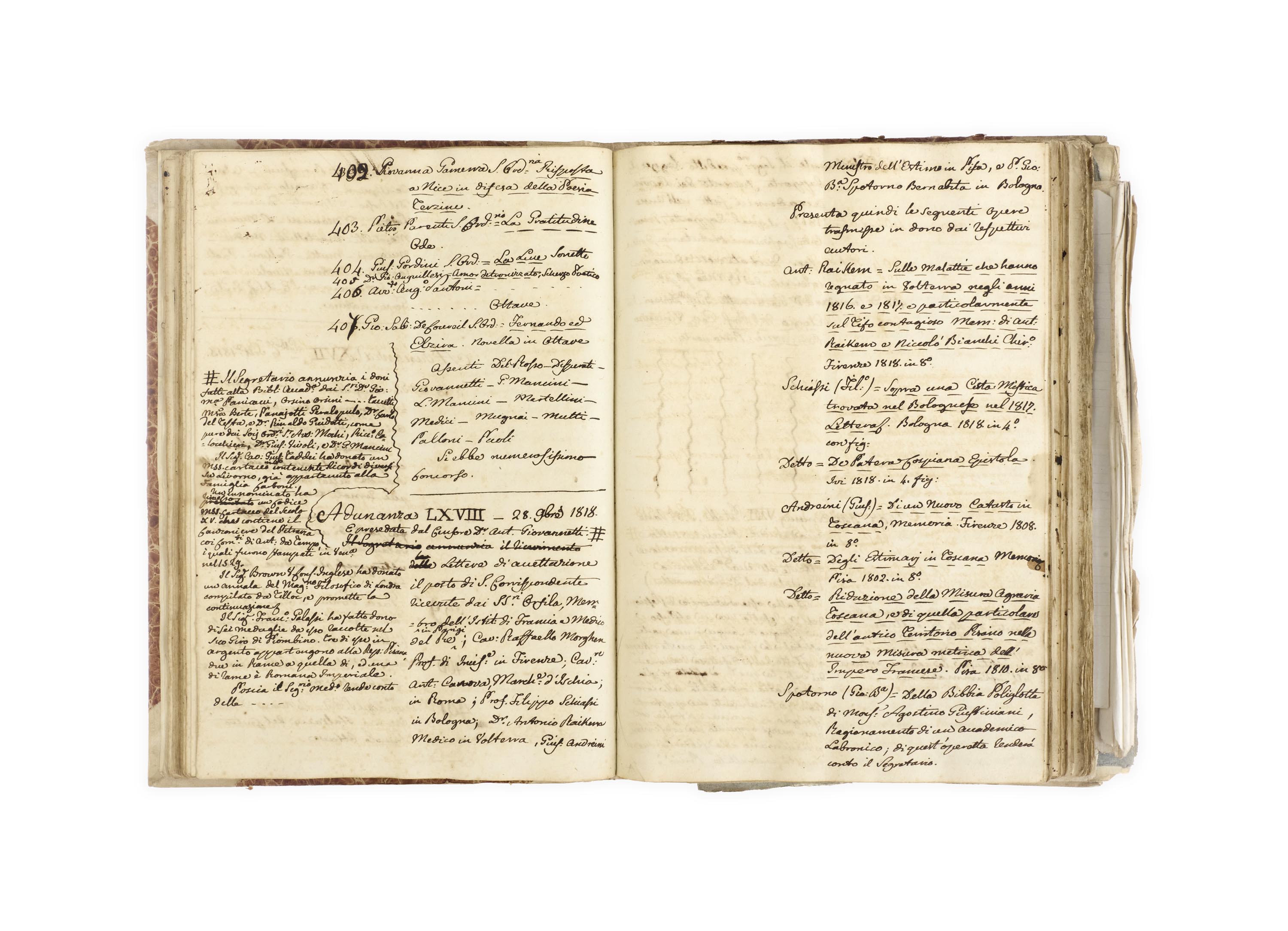
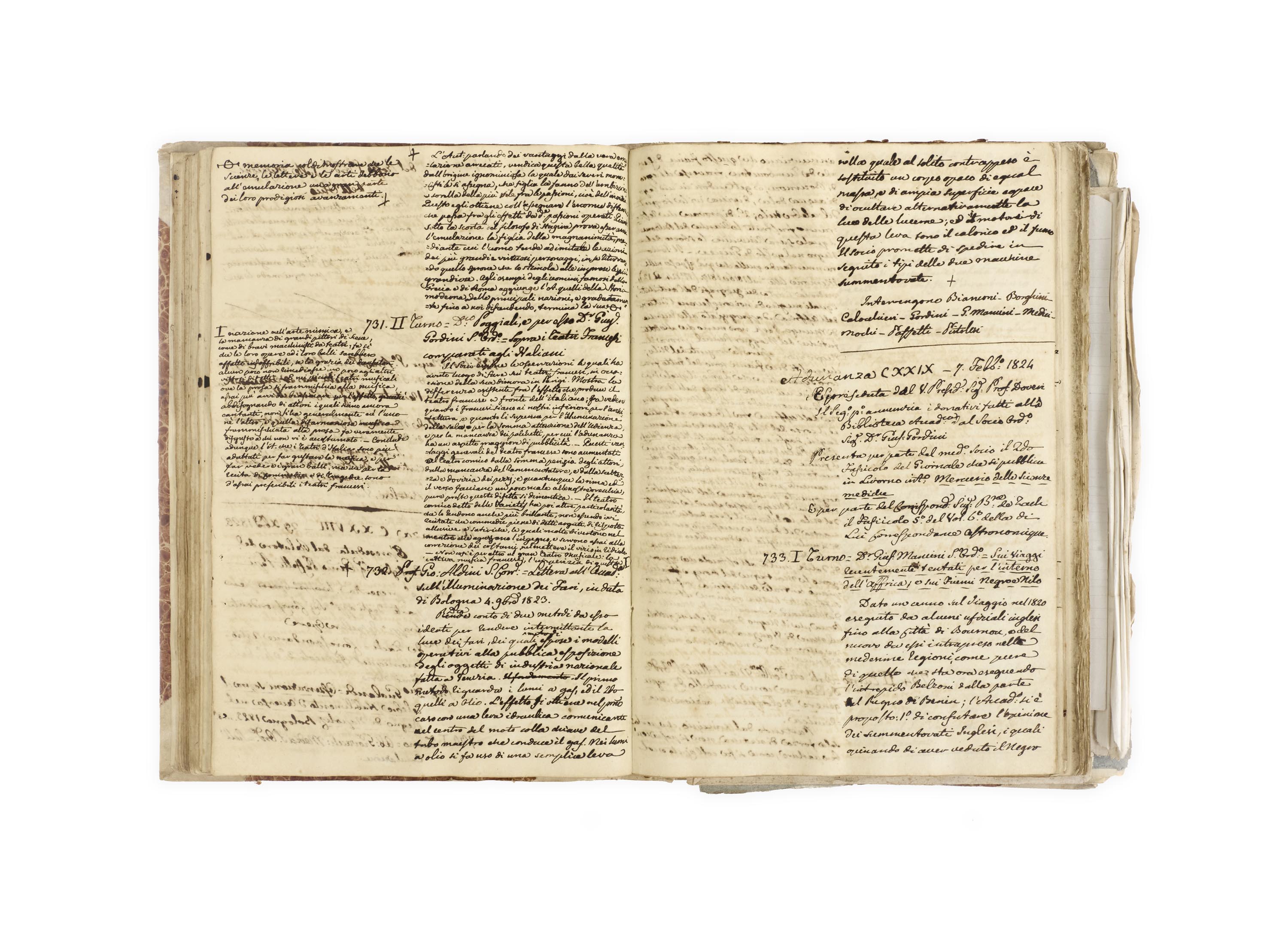
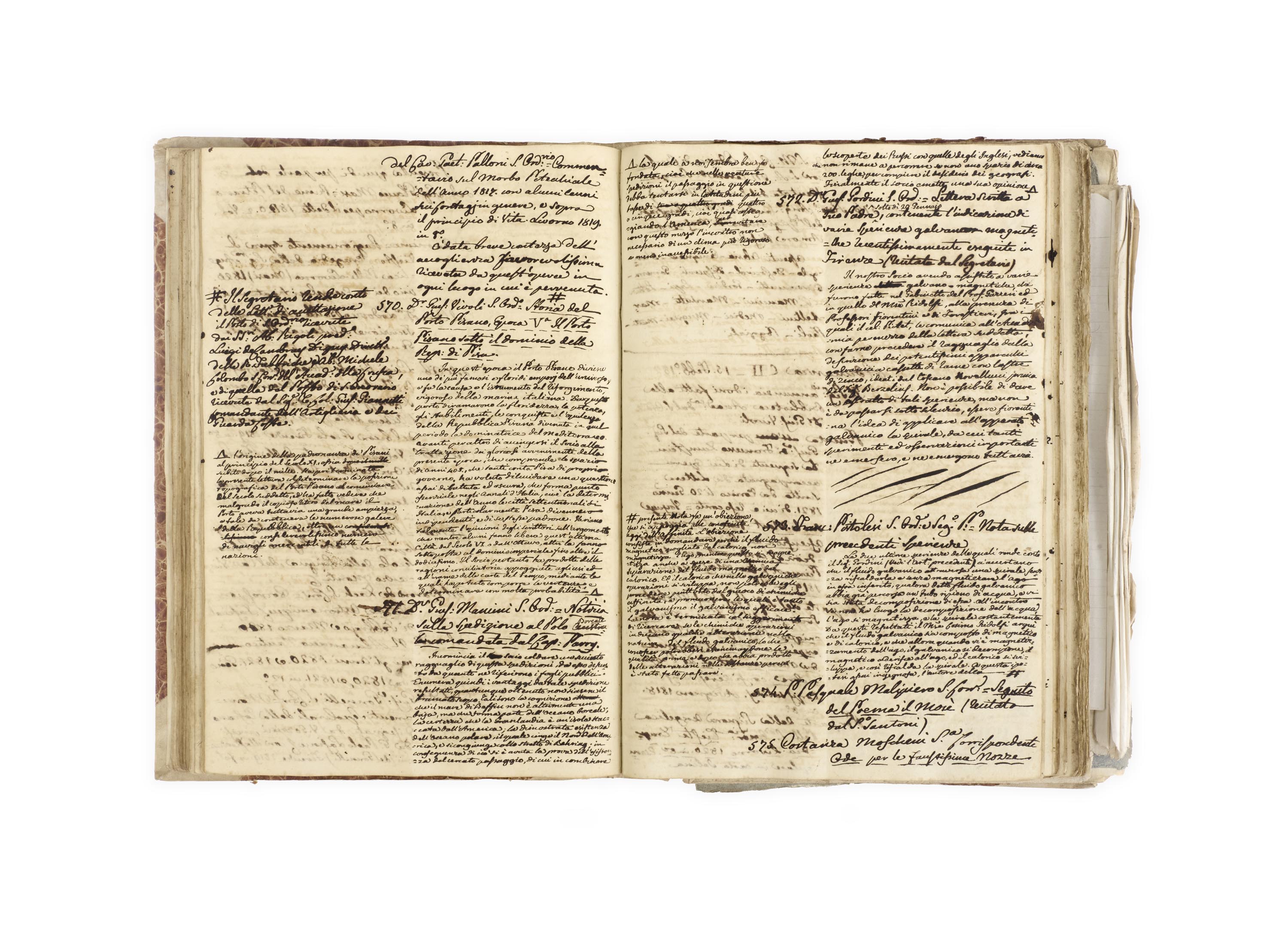
Diario delle adunanze letterarie della Accademia Labronica di Scienze, Lettere ed Arti … tenuto da Francesco Pistolesi … Tomo primo [–secondo]. [Livorno,] 1816–1830.
Manuscript on paper, folio, ff. [183], [34], [5, blank]; with additional manuscript and printed material bound in (see below); written in brown ink in two columns, on laid paper, the main text of the minutes occupying the column on the right, and titling, annotations, corrections and integrations on the left; leaves creased vertically in the centre where folded; edges of some of the additional printed material bound in at the end somewhat creased, the manuscript very lightly toned; in excellent condition, preserved in contemporary half vellum with marbled paper sides, spine lettered in manuscript; spine defective.
Added to your basket:
Diario delle adunanze letterarie della Accademia Labronica di Scienze, Lettere ed Arti … tenuto da Francesco Pistolesi … Tomo primo [–secondo].
An outstanding manuscript record of the first meetings of the Accademia Labronica, a learned society in Livorno devoted to arts, sciences, and public affairs, counting women among its members and with contributions from as far afield as London.
Established in 1816 on the model of the learned societies which had flourished in Italian cities since the Renaissance, the Accademia Labronica’s ideal location, its remarkable number of corresponding members sending contributions from around Europe, and its openness to women’s membership contributed to the prestige and liveliness of the society. The library, which was accrued as a result of donations to the Academy from its members, affiliates, and friends, now forms the nucleus of Livorno’s Biblioteca Labronica.
The present minutes give details of meetings spanning from the inaugural session on 2 May 1816 through to the 190th session in March 1830. They list the contributions presented by members at each meeting and give summaries (sometimes detailed and lengthy) of these contributions, reaching a total of 923 entries. Members’ donations of books are also carefully recorded. Around a hundred and fifty names are mentioned as contributors: among others, Francesco Pistolesi, first Permanent Secretary, and his successor Giuseppe Doveri, Carlo Borghini, Giuseppe Vivoli, Giovanni Inghirami, Enrico Mayer. Among the ‘corresponding members’, we note the presence of Antonio Canova and Alessandro Manzoni.
,b>Three women stand out as regular contributors: Angelica Palli (or Angeliki, 1798–1875), a writer of Greek ancestry who translated Shakespeare, Hugo, and Greek writers, an early feminist who would go on to convene her own literary salon; one of her contributions recorded here is the impromptu, live composition of a tragedy on a theme given to her on the night; Costanza Moscheni (in Arcadia ‘Dorilla Peneia’, 1786–1831), a self-taught poet and renowned educationalist, an advocate for women’s lifelong education; and Giovanna Gamerra, who here submits literary works of verse and drama on Classical themes.
Topics range from education policies to literature, contemporary European historiography (including a critique of Robertson), economics, antiquities, the correspondence of Germaine de Staël, chemistry and current experiments, physics, cultural studies, local enquiries, zoology and exploration, and new technologies including artillery. Considerable space is given to the report of Capt. Sir William Edward Parry’s expedition to the North Pole in 1827, and to the English attempts in the 1820s to explore the course of the river Niger in Africa, including sceptical reference to Giovanni Belzoni’s solo adventure (this memorandum, read in early February 1824, reveals that news of Belzoni’s death in Benin at the end of December 1823 had not yet reached Livorno). The Academy evidently prided itself particularly in its rich exchanges with sister associations in London.
Bound or laid into the volume are a selection of related items including a letter to Francesco Pistolesi (31 May 1833) thanking him for his service of eighteen years as Secretary to the Academy; copies of the Statuti of the Academy for 1816 (heavily annotated), and 1838; and briefer minutes for the meetings of 1832 to 1839 taken by the new secretary Giuseppe Doveri.
Full details of the additional contents are available on request.