Writing in Tuscan From Exile in France
The Duke of Bedford’s Copy
ALAMANNI, Luigi.
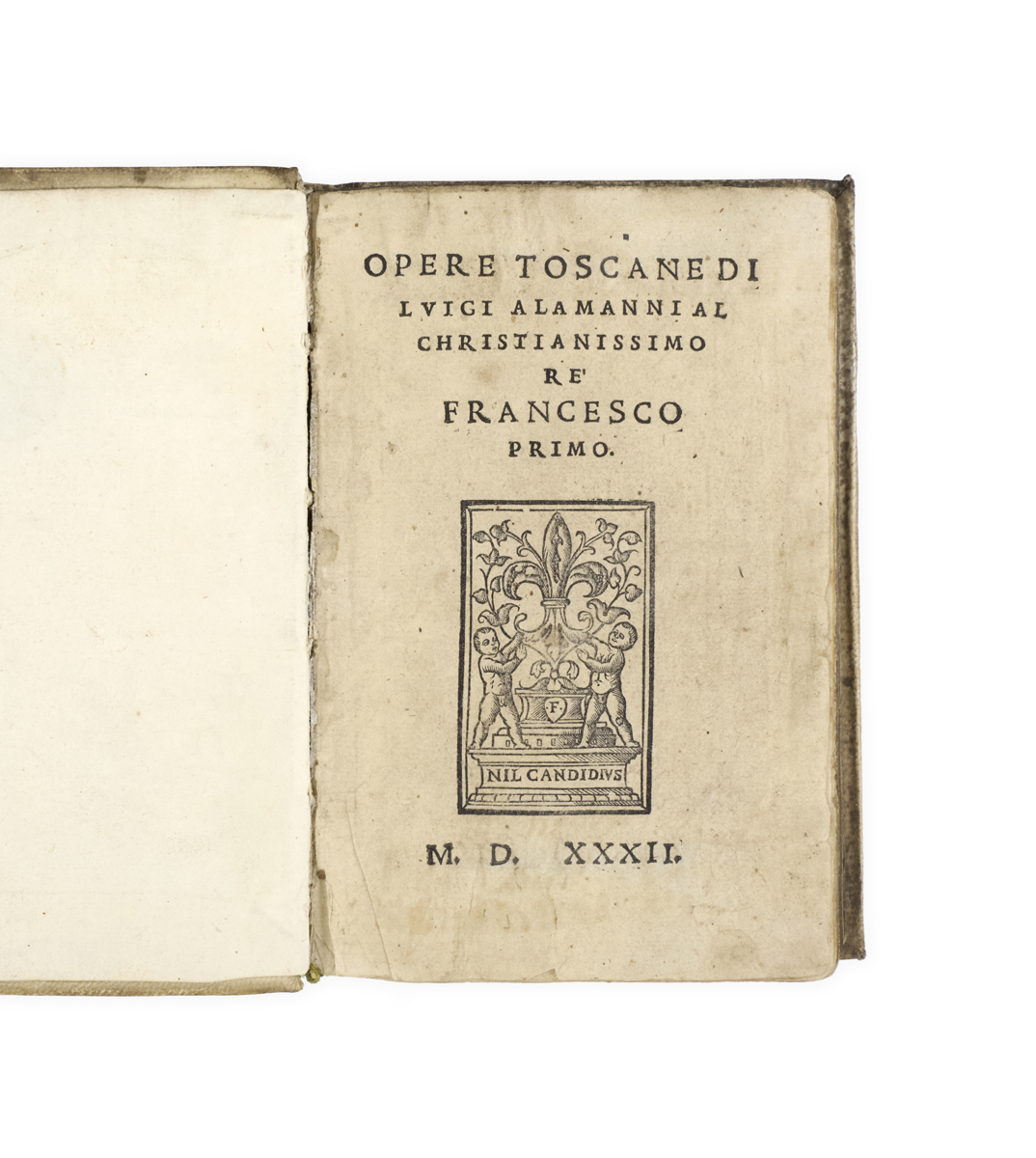
Opere toscane. [(Colophon:) Florence, [Bernardo Giunta], 9 July 1532.]
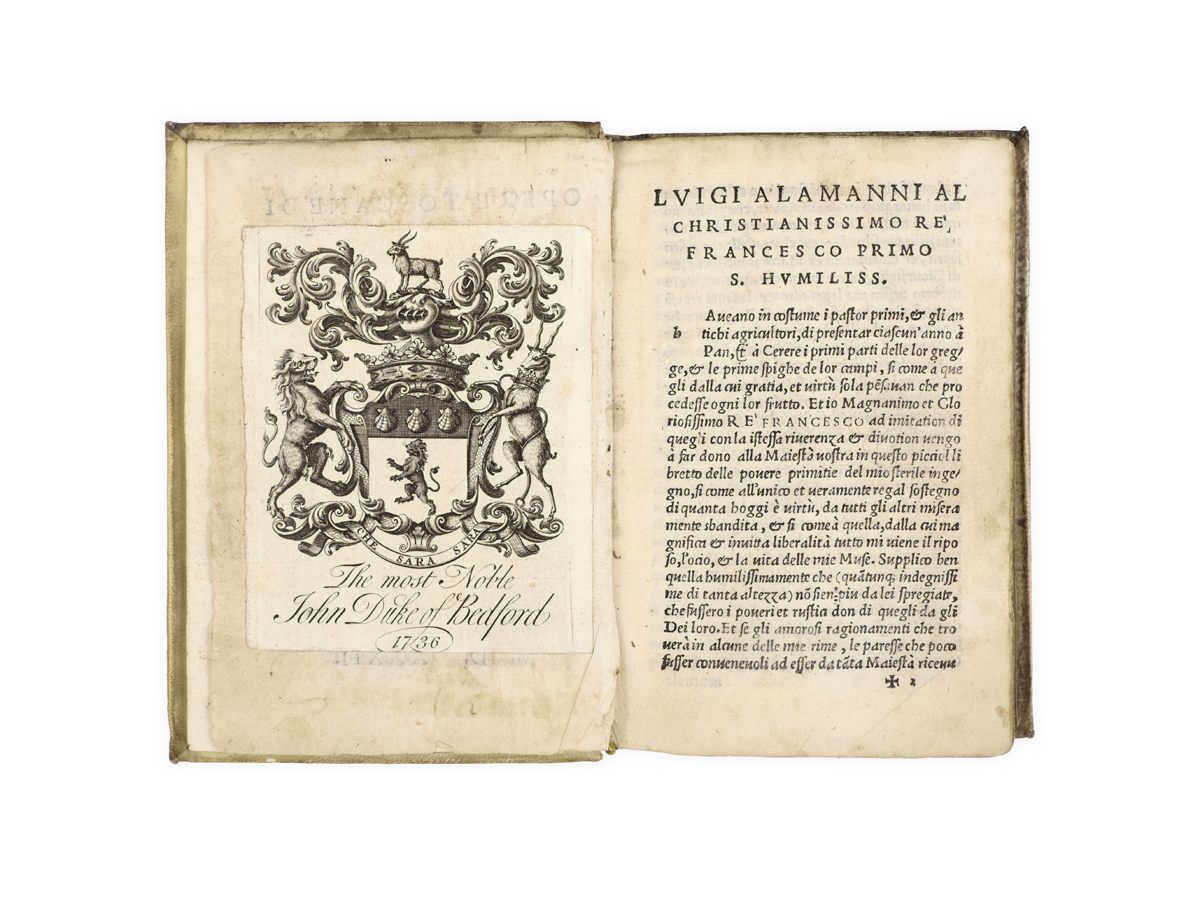
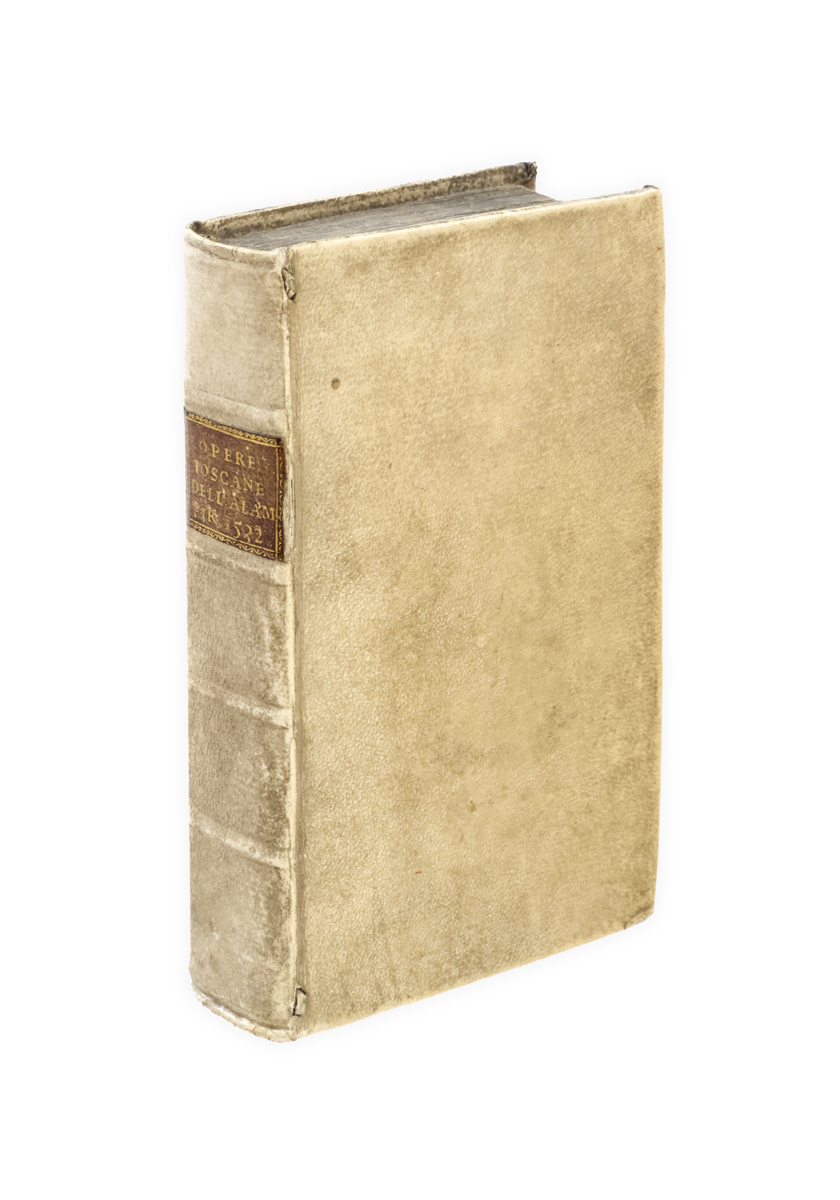
8vo, pp. [vii], [1, blank], 435, [11], [2, blank, printer’s device]; capital spaces with guide letters, woodcut printer’s devices to title and final verso; title a little soiled with slight damage to foot, slight oil-staining to K8–L3, a few words of text struck through in ink on L6v–7r and X7v, lower corner of Z7 torn with loss of a few words on verso; else a good copy in eighteenth-century vellum over boards, gilt morocco lettering-piece to spine, edges speckled blue; large armorial bookplate of John, Duke of Bedford dated 1736 to title verso (Franks 24700), small round book label of Woburn Abbey to front pastedown with shelfmark A.4.94, pencilled note in English to front free endpaper.
First Florentine edition of this collection of vernacular verse, first published in Lyons in the same year, by the influential Florentine poet Alamanni, a friend of Machiavelli mentioned in the Art of War, our copy from the library of the Duke of Bedford at Woburn Abbey.
Luigi Alamanni (1495–1556), who had become acquainted with Machiavelli through meetings of the Accademia Platonica at Bernardo Rucellai’s Orti Oricellari, had left Florence on pain of death after his friend Buondelmonti and a relative of Alamanni’s were respectively exiled and beheaded in a 1522 plot to kill Cardinal Giulio de’ Medici. After moving repeatedly between Italy and France in the following years, he was banished once again by the Medici in 1530 and found himself at the court of François I of France, the dedicatee of the present work, who rewarded Alamanni with 1000 écus du soleil two months after its publication. François I was interested in promoting Italian poetry and culture as well as extending his political influence across the peninsula; Alamanni was one of many Italians at the French court.
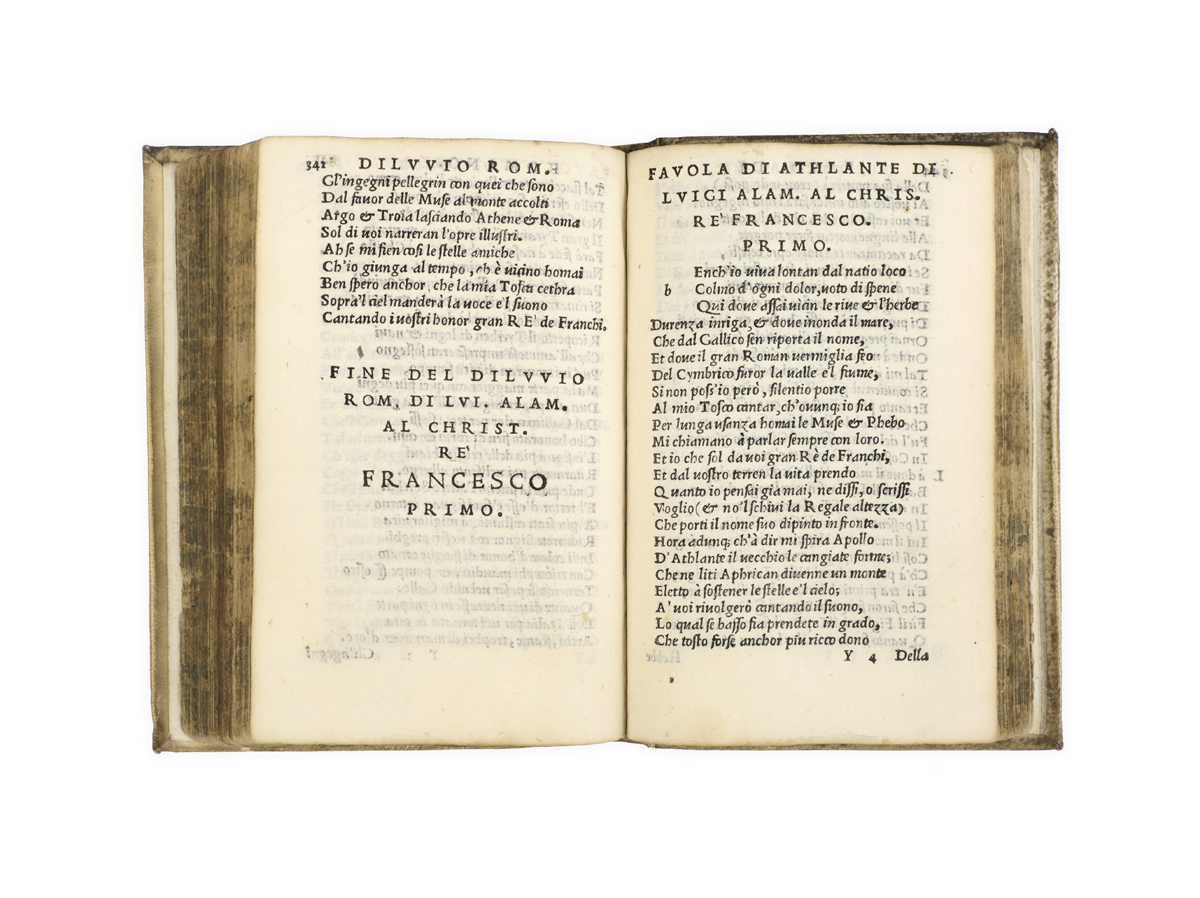
First printed in Lyons in 1532 (with a second volume printed in 1533), the Opere toscane consist of sonnets, elegies in the manner of Tibullus and Propertius, satires in imitation of Juvenal, and eclogues in the manner of Virgil and Petrarch, as well as three longer poems on Narcissus, ‘Il diluvio romano’ (on the flood of October 1530, affecting Rome and Lazio), Atalanta (partly based on Ovid) and Alamanni’s verse translation of the Penitential Psalms. All of these have dedications to François I, whom Alamanni portrays as the saviour of Italy, though earlier versions that circulated in manuscript had different addressees. This edition was printed in Florence, despite Alamanni’s difficulties with the Medici, although Gamba repeats (without much credence) a story that Pope Clement VII – the aforementioned Giulio de’ Medici, who had survived his attempted assassination ten years earlier – had ordered copies of both the Lyons and Florence editions to be burned in Rome.
Alamanni’s advocacy for the use of the vernacular and his explicit mention of Tuscan in the work’s title reflect a wider cultural shift toward the perception of the vernacular as a language of prestige (Bembo’s highly influential Prose della volgar lingua had first been published only seven years earlier). In his dedicatory letter, Alamanni writes that ‘Tibullus and Propertius, my first masters, would rise in my defence, if by chance they had been told that Latin style was naturally more licentious than Tuscan, I believe they would respond in my favour, that all languages are the same’ (trans.). Alamanni was widely read and imitated, both in Italy and abroad; his influence on English poets such as Thomas Wyatt is well attested.
By the mid-eighteenth century this copy was in the library of John Russell (1710–1771), 4th Duke of Bedford, who had been on the Grand Tour as a young man.
BM STC Italian, p. 12; EDIT16 CNCE 596; USTC 808163; Pettas 239; Renouard, Giunta 119.