Burning with Silent Desire
[ALMANACK.]
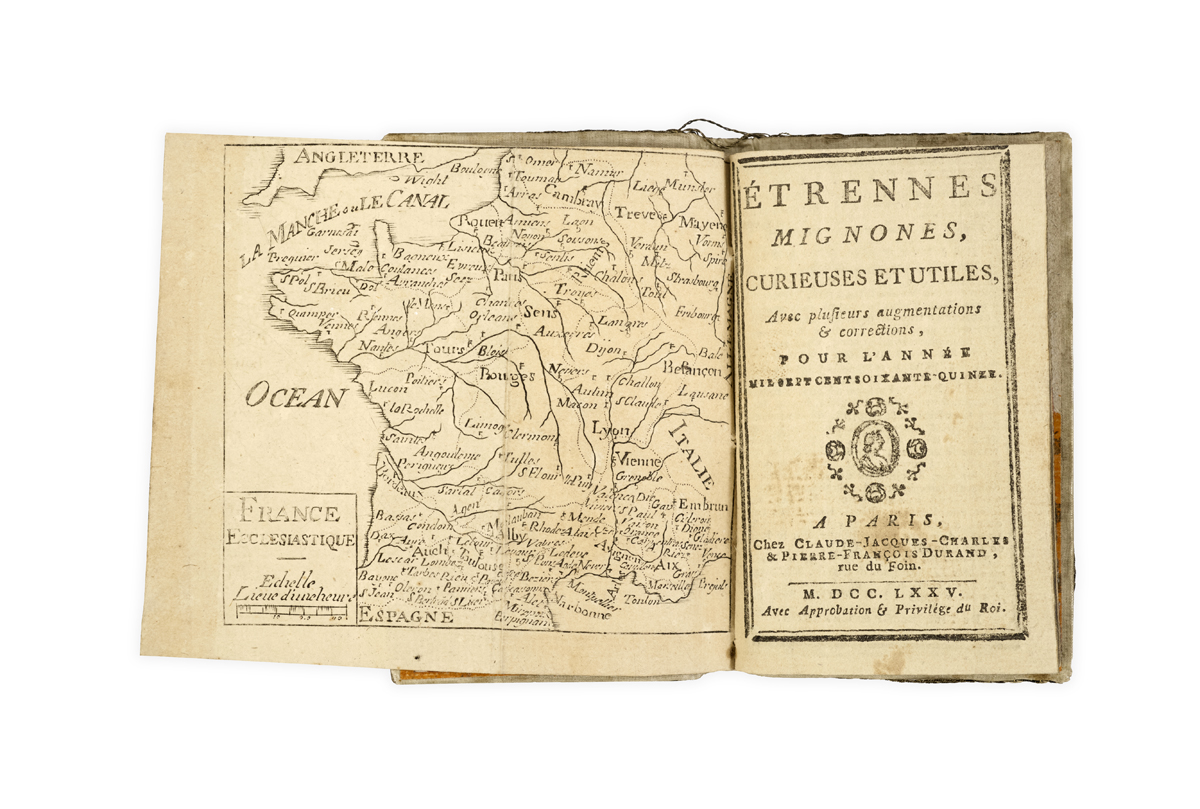
Étrennes mignones [sic], curieuses et utiles, avec plusieurs augmentations & corrections, pour l’année mil sept cent soixante-quinze. Paris, Claude-Jacques-Charles [Durand] and Pierre-François Durand, 1775.
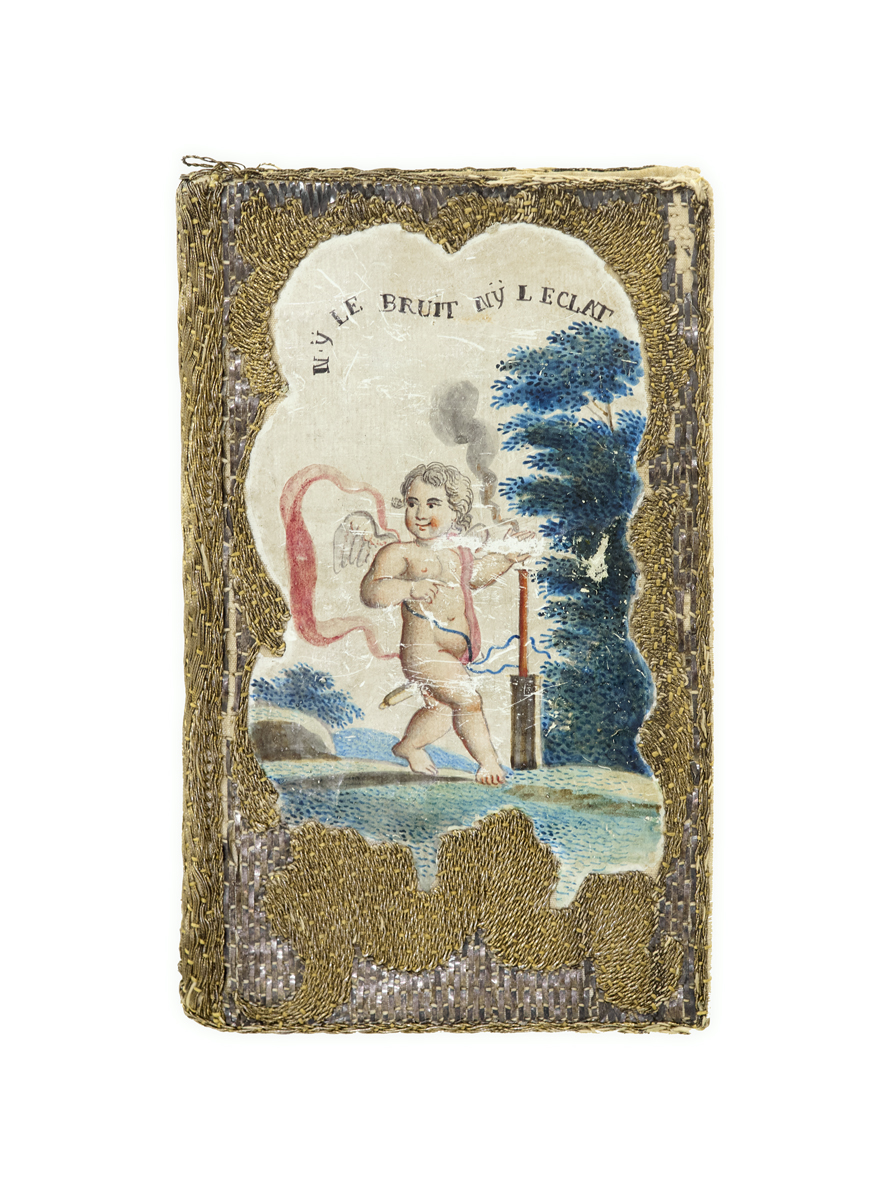
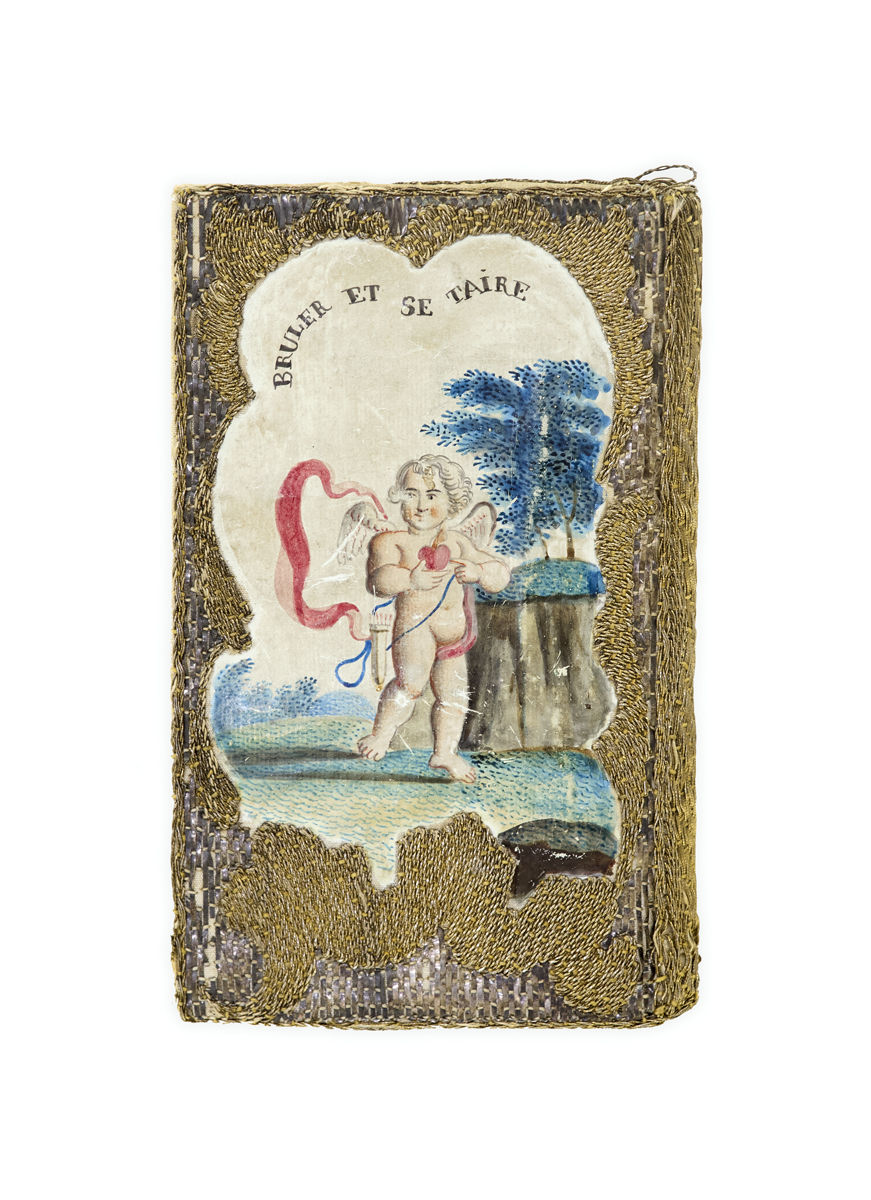
24mo, pp. [96], with folding engraved maps of France and Paris bound in; small woodcut of a woman in profile surrounded by typographic ornaments, text within woodcut frame; trimmed close at foot (sometimes shaving frames but not touching text), small marginal wormhole to quire F; in a contemporary silk binding with painted panels depicting putti with the mottoes ‘Nÿ le bruit nÿ l’eclat’ to front board and ‘Bruler et se taire’ to rear board, within a richly embroidered border of gold and silver threads, printed patterned paper pastedowns over earlier brocade endpapers, silver edges; edges tarnished, slightly rubbed with a few loose threads.
Added to your basket:
Étrennes mignones [sic], curieuses et utiles, avec plusieurs augmentations & corrections, pour l’année mil sept cent soixante-quinze.
A very rare Parisian almanack for 1775, our copy in a handsome binding embroidered in gold and silver threads and with emblematic mottoes and charming illustrations depicting putti fanning smoke from a burning candle and holding a flaming heart.
As well as a list of public libraries and their opening hours, the present almanack features a list of deceased and newly elected members of the Academie Française, natural disasters, home remedies for gout and warts, and a list of curious events from the previous year, e.g. a woman returning to work six days after giving birth to triplets, quadruplets born in the fourth month of pregnancy, a monstrous fish caught off the Adriatic, and the discovery of an ancient walled city at the foothills of the Alps.
Both the emblematic visual representation and mottoes used in the binding appear, for example, in Daniel de la Feuille’s 1691 Devises et emblemes anciennes et modernes, the motto ‘Ni le bruit, ni l’éclat’ (‘Neque lux, neque rumor’, or ‘nor light nor noise’) symbolised by a putto with a flaming torch (in this case a smoking candle), and ‘Bruler et se taire’ (‘Silens ardere’, or ‘to burn and be silent’), a symbol of secret, burning desire illustrated by a putto holding aloft a flaming heart.
The Parisian almanacks Étrennes mignonnes, published with an engraved title until 1750, appeared from 1725 to 1848, first published by Jouënne and later Lambert or Durand (as here); Guillot from 1787, and finally by Demoraine in the nineteenth century.
OCLC finds copies of the Étrennes mignonnes for 1775 at the National Library of Wales and Cornell only.
See Grand-Carteret 107; Saffroy 257.