Annotated Epigrams From Boutourlin’s Library
[ANTHOLOGIA GRAECA PLANUDEA.]
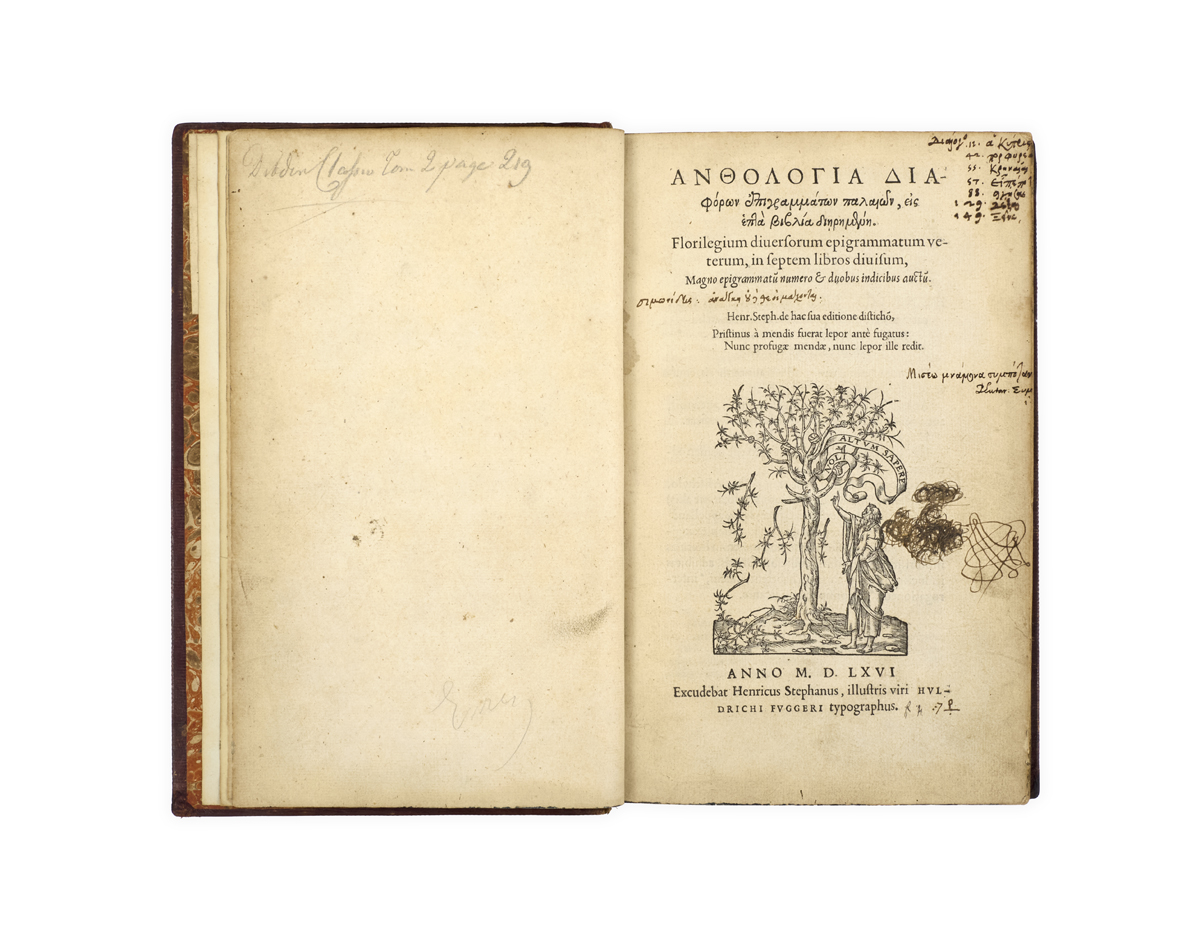
Ανθολογια διαφορων επιγραμματων παλαιων, εις επτα βιβλια διῃρημενη. Florilegium diversorum epigrammatum veterum, in septem libros divisum, magno epigrammatum numero & duobus indicibus auctum … [Geneva], Henri Estienne, 1566.
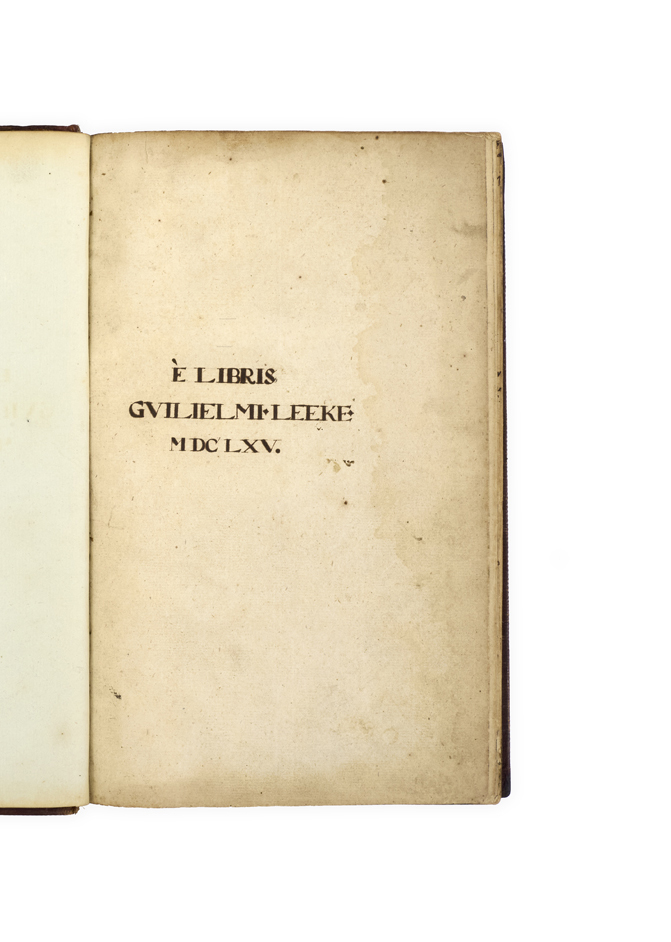
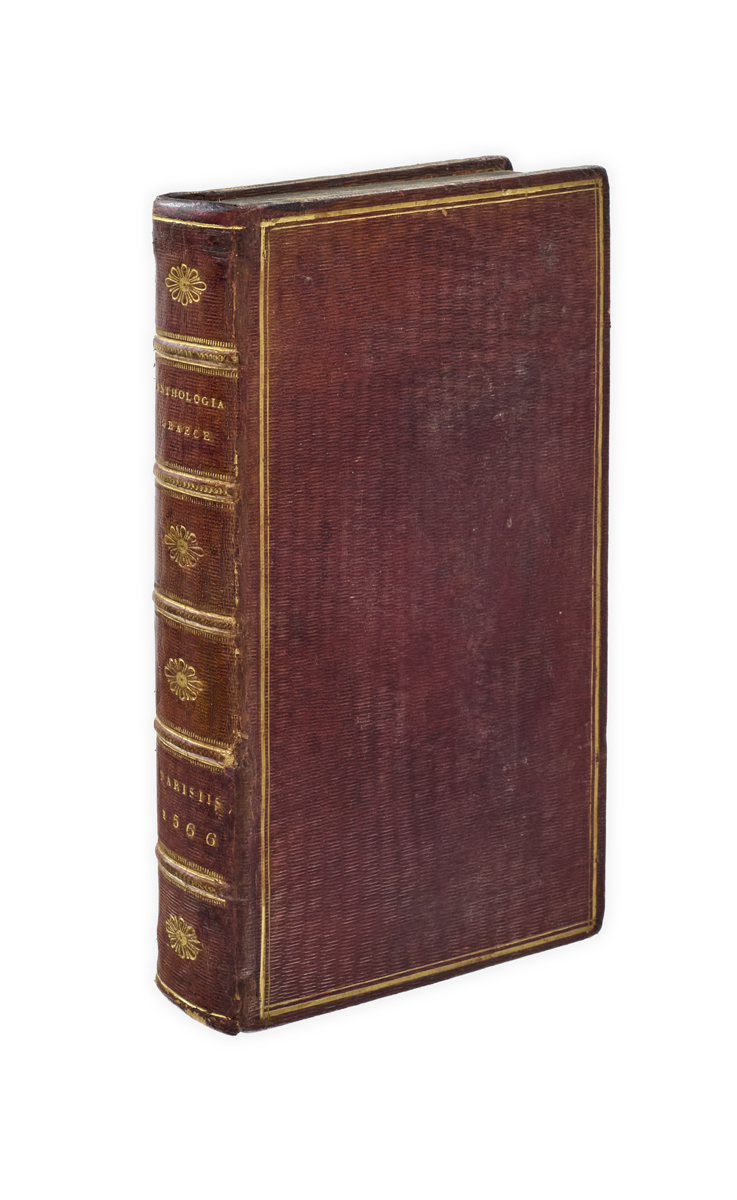
4to, pp. [iv], 288, 283–539, [35]; large woodcut printer’s device to title-page [Schreiber 10]; marginal dampstaining to lower outer corner of final leaves, small ink stains on x2–4 obscuring only a few characters, otherwise a very good copy; bound in early nineteenth-century straight-grained maroon morocco, spine gilt in compartments and lettered directly in gilt, edges stained blue (in the sixteenth century), marbled endpapers, retaining older flyleaves; extremities and joints rubbed and neatly repaired; early annotations to c. 158 pp. (a few trimmed) mostly in Greek in a mid-seventeenth-century English hand, ownership inscription ‘E libris | Guilielmi Leeke | MDCLXV’ to old flyleaf, nineteenth-century engraved armorial bookplate of Count Dmitry Boutourlin to front pastedown (see below).
Added to your basket:
Ανθολογια διαφορων επιγραμματων παλαιων, εις επτα βιβλια διῃρημενη. Florilegium diversorum epigrammatum veterum, in septem libros divisum, magno epigrammatum numero & duobus indicibus auctum …
First Estienne edition of the Planudean Anthology, a substantial collection of classical Greek poems and epigrams which proved a fertile source for scholars, poets, and artists, with extensive seventeenth-century annotations in Greek by an English scholar.
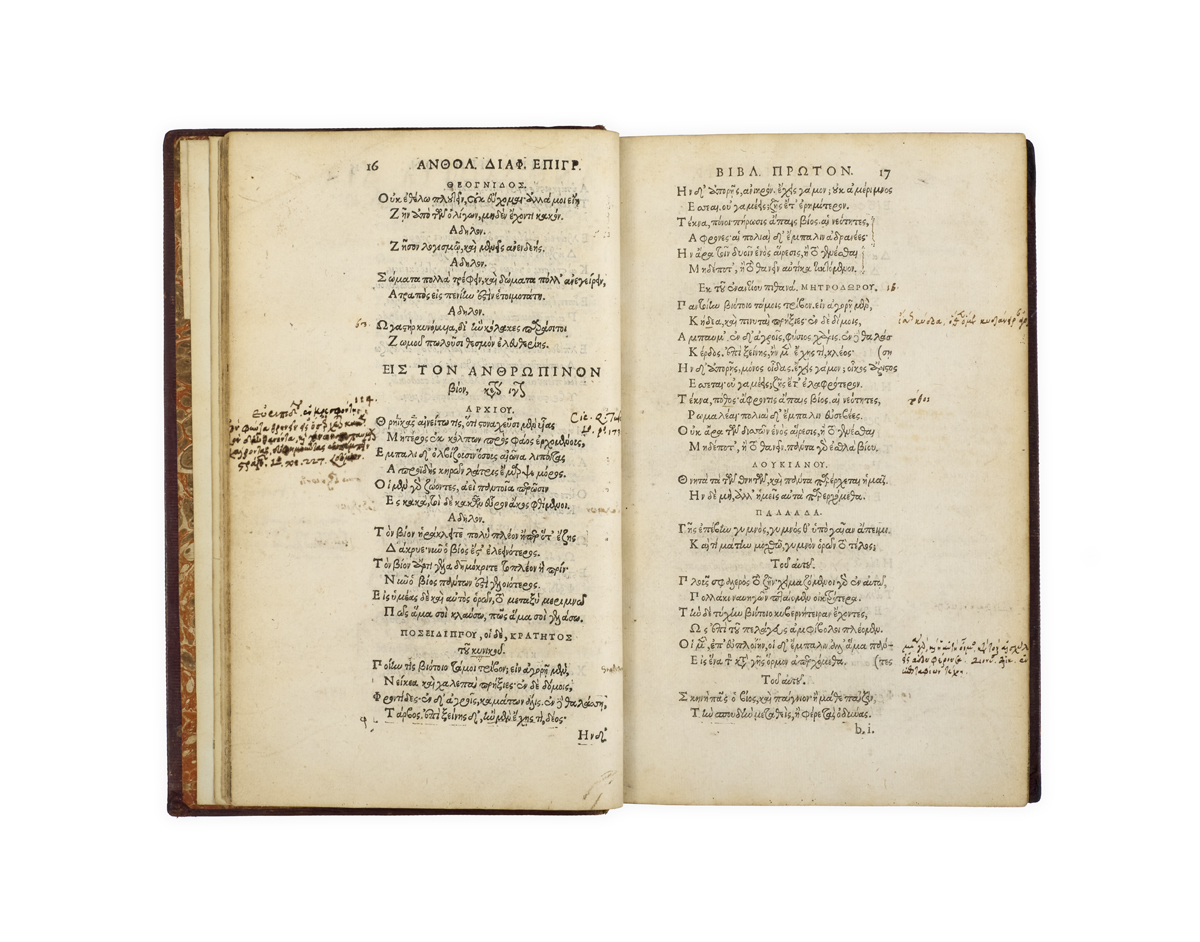
‘The Greek Anthology is one of the great books of European literature, a garden containing the flowers and weeds of fifteen hundred years of Greek poetry, from the most humdrum doggerel to the purest poetry’ (OCD). Assembled (and partially bowdlerized) by the scribe, scholar, monk, and poet Maximus Planudes (c. 1255–1305) around 1300 from the tenth-century manuscript now known as the Palatine Anthology, the Planudean Anthology was first printed in Florence in 1496, expanded twice by the Aldine press (1503 and 1521), and simply reprinted in Paris by Josse Bade in 1531. They are here subjected to a careful revision of the text and expanded with extensive scholarly notes by Henri Estienne; ‘For this edition Henri devised a system of diacritical marks “peculiar to himself” (“notae sibi peculiares”) to denote various classes of proper nouns: e.g. persons and famous animals, nations and cities, mountains, and bodies of water’ (Schreiber, p. 143).
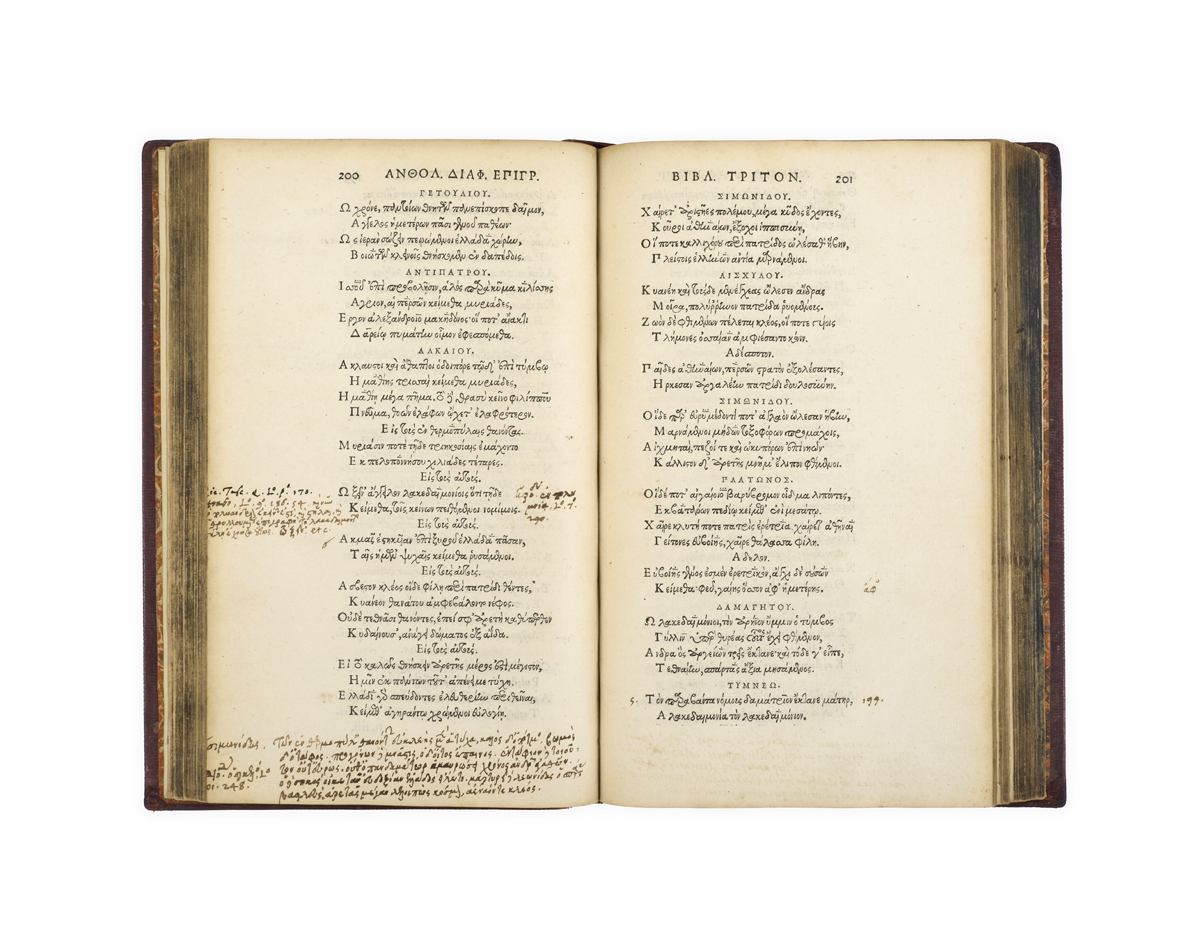
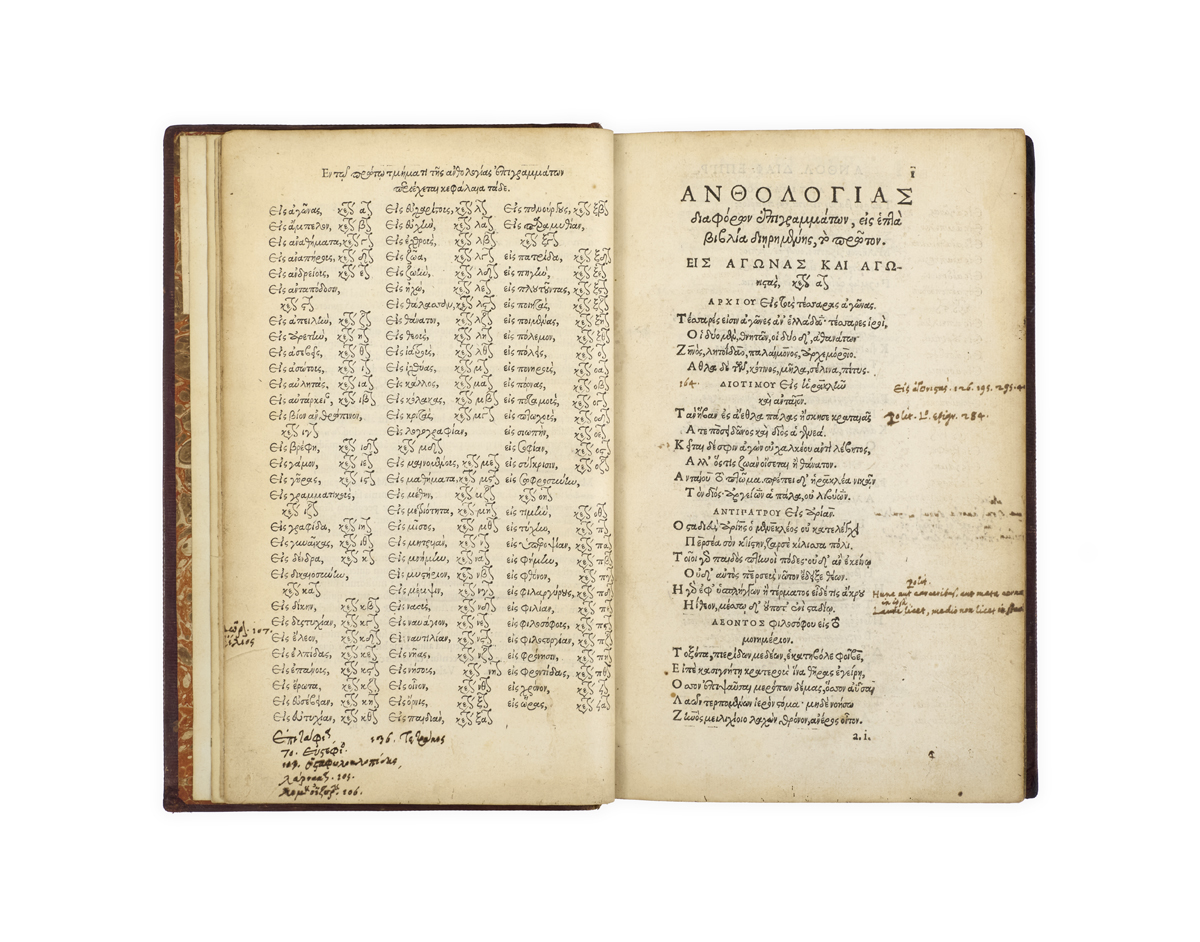
This copy contains numerous annotations in Greek, with a few in Latin, in a seventeenth-century English hand, indicating its use by an expert scholar of Greek. Short quotations from Plutarch and from Simonides have been written on the title-page, and the list of contents, on the final page of preliminaries, has some additional manuscript entries. Many of the verses have been numbered by hand, and often the source or a reference to another writer has been noted, including Poliziano, Ovid, Strabo, Plautus, Diogenes Laertius, Virgil, and Cicero. A few annotations copy out the relevant words or phrases, but most notes provide variant readings, add a line or more of text from a different source, and correct errors or fill gaps in the transcription; on p. 143, mention is made of a manuscript source for some scholia, and on p. 204, a word omitted from the printed text (the gap marked with an asterisk) is provided in manuscript.
Provenance:
1. The William Leeke who inscribed his name on the title page in 1665 is plausibly the William Leeke who matriculated at Trinity College, Cambridge in 1664–1665.
2. Count Dmitry Petrovich Boutourlin (or Buturlin, 1790–1849), Russian general, historian, and book collector, appointed librarian of the Imperial Russian Library in 1843. He assembled two large libraries during his lifetime; one which was lost during the burning of Moscow in 1812, and a second, far superior one, including 244 medieval manuscripts, around 1,000 incunables, and an almost complete collection of Aldine editions, assembled during his fifteen years’ residence in Tuscany. This volume was item 53 in the Belles lettres section of the catalogue of his library published by Audin de Rians in Florence in 1831, and lot 941 in the sale held by Silvestre in Paris, 25 November 1839 onwards.
USTC 450543; Adams A 1187; GLN 15–16 2294; Schreiber, The Estiennes 159.