Comforting the Condemned
[ARCHCONFRATERNITY OF SAN GIOVANNI DECOLLATO.]
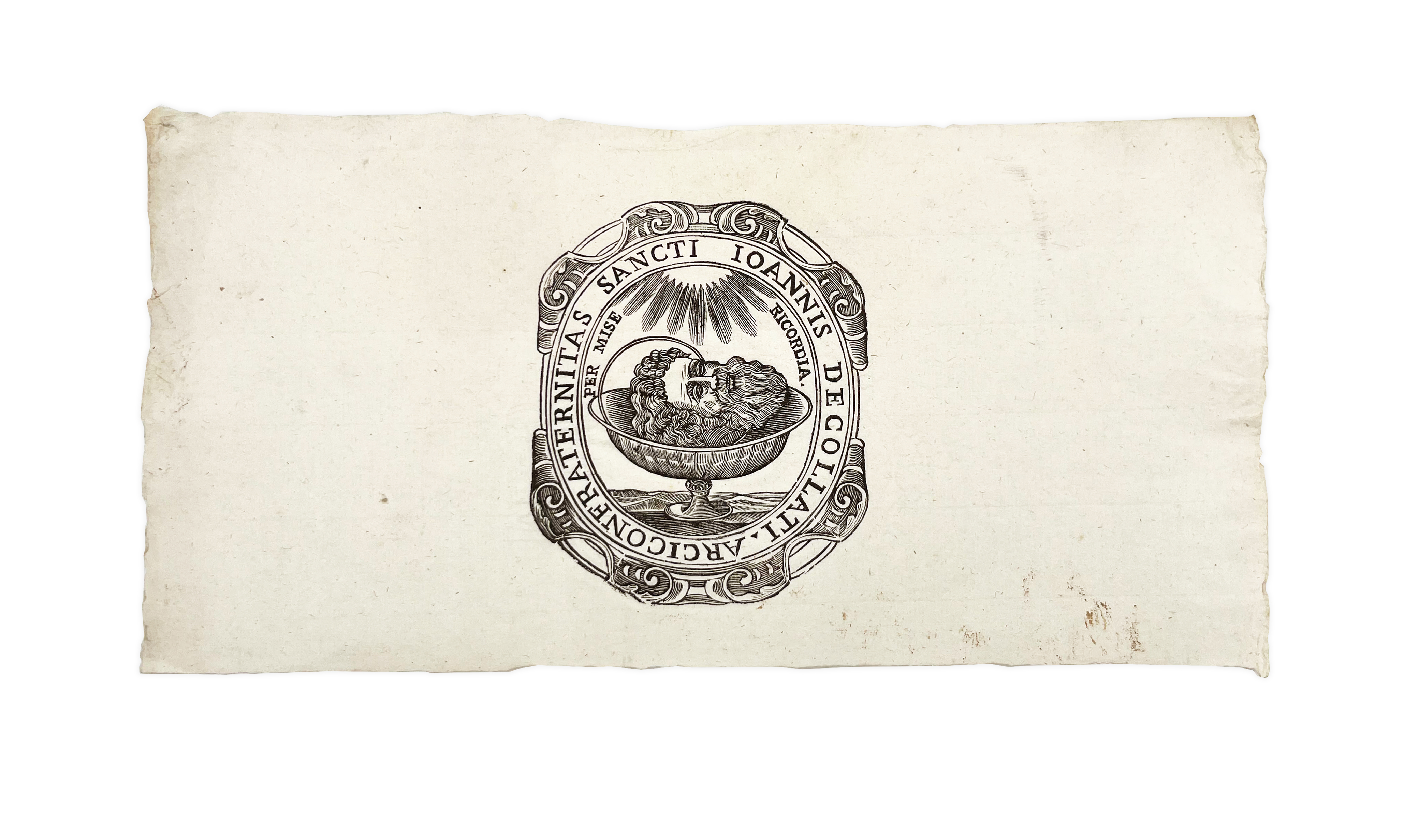
‘Arciconfraternitas Sancti Ioannis decollati’. Rome, second half of eighteenth century.
Woodcut on paper (160 x 320 mm); paper watermarked ‘GM’ (i.e. Giorgio Magnani) beneath banded shield surmounted by crown, woodcut depicting head of St John the Baptist with motto ‘Misericordia’ within roundel lettered ‘Arciconfraternitas Sancti Ioannis decollati’, three deckle edges; very well preserved.
An unusual woodcut – likely intended for use as a badge – bearing the insignia of the Arciconfraternita di San Giovanni decollato, a Roman archconfraternity which provided comfort and company to those condemned to death, most notably Giordano Bruno in 1600.
The archconfraternity of San Giovanni decollato (the beheaded St John the Baptist) – also known as the Misericordia – was established by Florentines living in Rome in 1488, in keeping with the mission of the Florentine company of the Battuti Neri, which likewise comforted the condemned from the moment the death sentence was announced to the moment of death; St John the Baptist, namesake of the present archconfraternity, is also the patron saint of Florence. Members of the archconfraternity, known as ‘comforters’, could be identified by their black habits tied with rope to which they would pin a badge such as this one, bearing the company’s insignia. Often these badges would be elaborately coloured or illuminated.
In 1540, Pope Paul III granted the archconfraternity the right to release one condemned man each year; this privilege was not extended to their most famous ‘patient’, Giordano Bruno, who was burnt at the stake on 17 February 1600. Members of San Giovanni decollato accompanied him, however, from the Tor di Nona prison to the Campo de’ Fiori, and they remained at his side during his execution, singing litanies throughout. Prior to his execution they had attempted to convince him to repent (with the aid of two Jesuits, two Dominicans, and a Carthusian) – but to no avail. The archconfraternity exists to this day and now provides support to the incarcerated; the present woodcut, produced later in the eighteenth century, likely reusing an earlier woodblock, reflects the endurance of the archconfraternity’s practices.
We are unable to trace any other examples.