Ancient Love-Adventures
Volpi’s Copy
ARISTAENETUS.
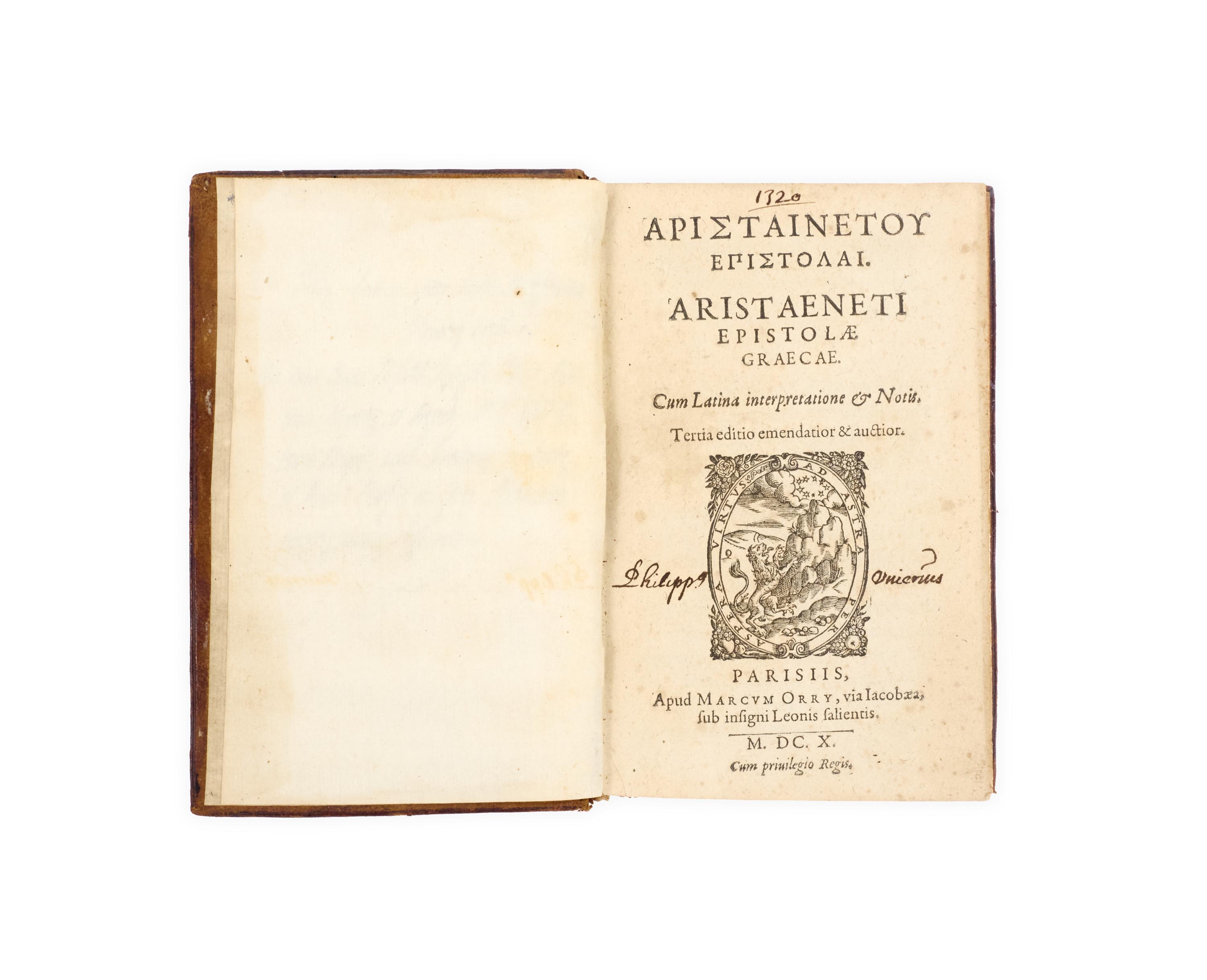
Επιστολαι … Epistolae graecae. Cum Latina interpretatione & notis. Tertia editio emendatior & auctior. Paris, Marc Orry, 1610.
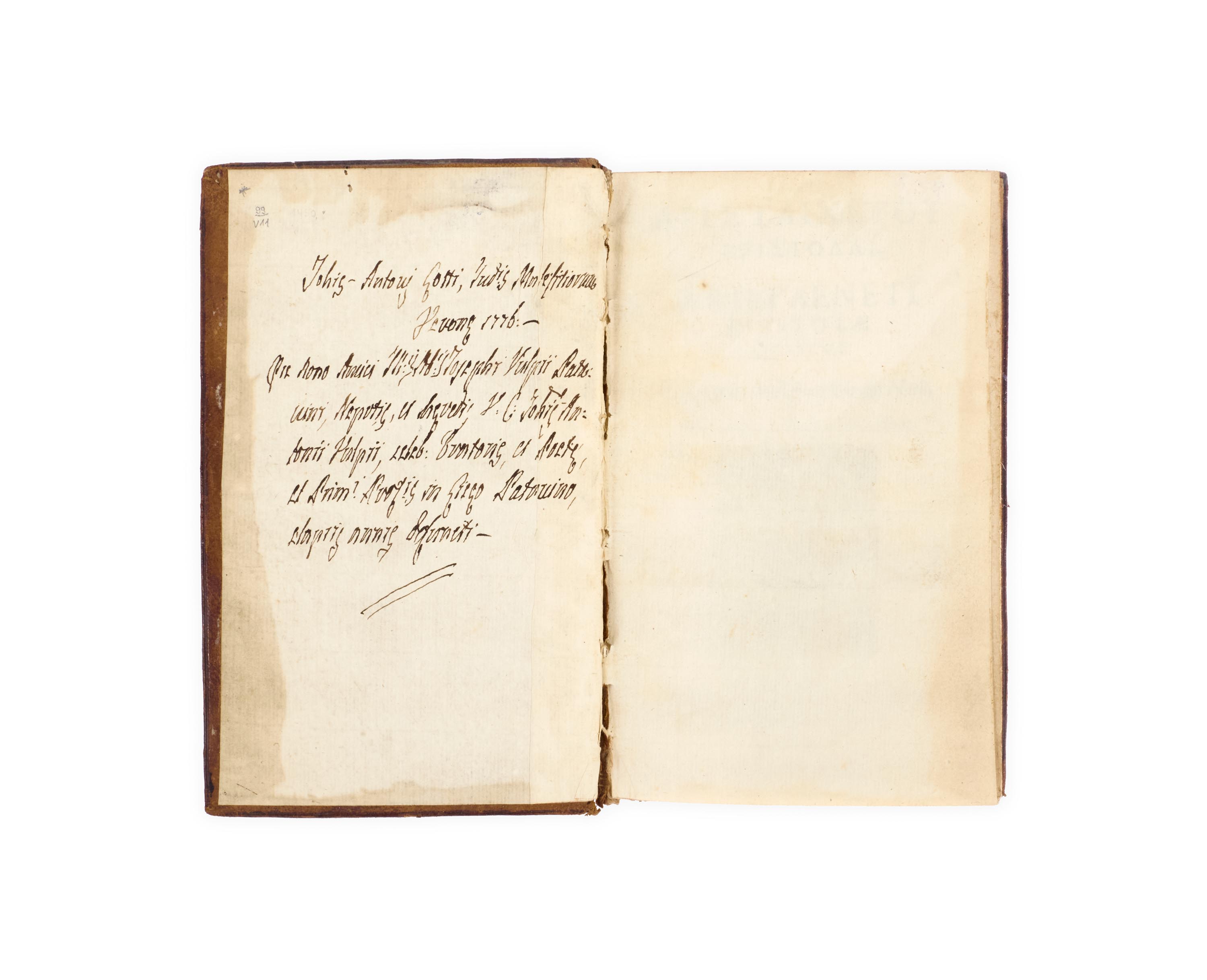
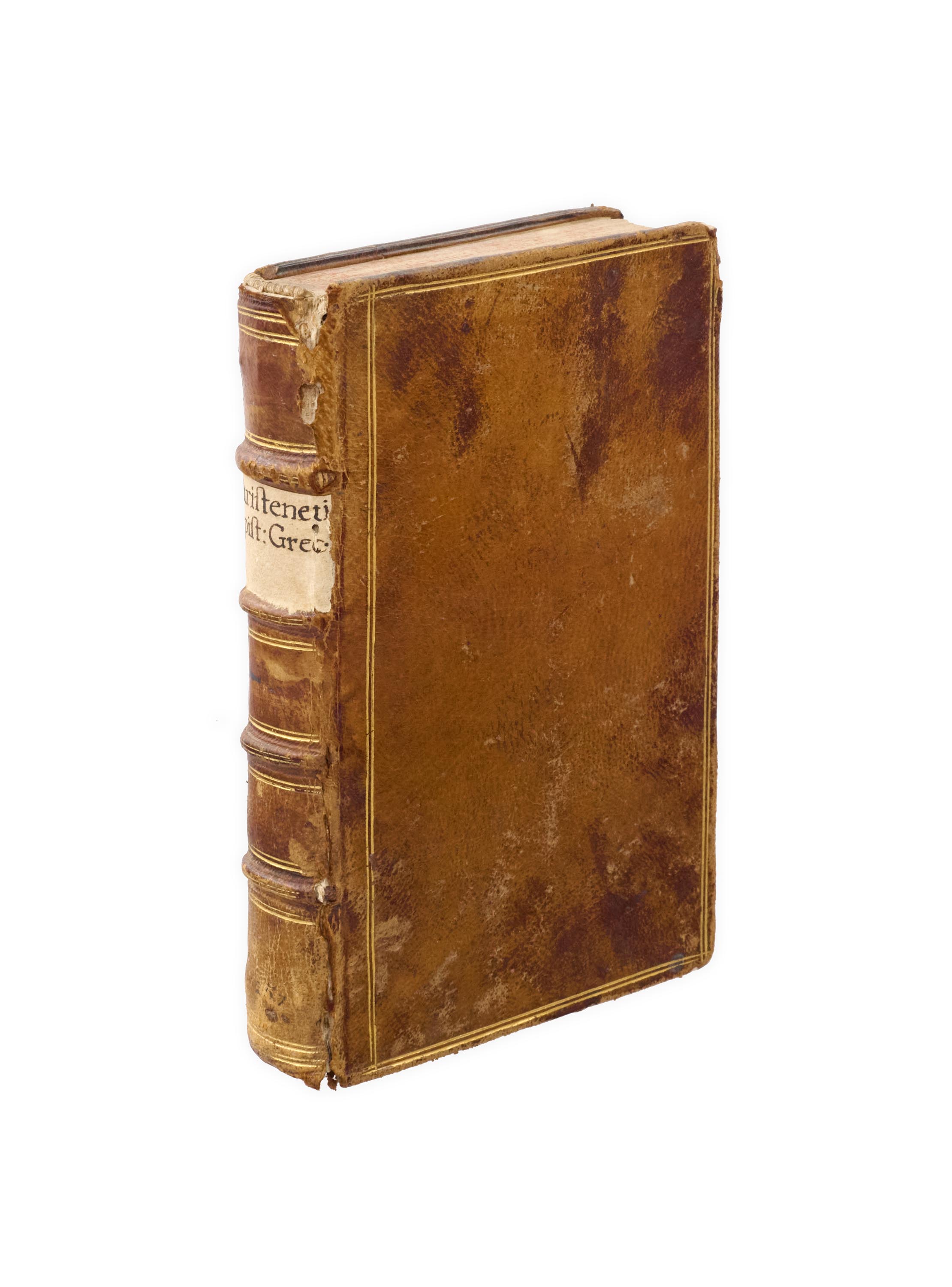
8vo, pp. [viii], 295, [1, errata]; text printed in parallel Latin and Greek on facing pages, woodcut printer’s device to title-page, woodcut initials and headpieces; occasional very light foxing, a few leaves lightly toned; a very good copy bound in contemporary sheep with double gilt fillet border, spine with double gilt fillets along spine bands and manuscript title on paper lettering-piece, edges speckled red; a little worn, short split to upper joint, endcaps chipped and minor worming to spine, corners bumped; early ownership inscription ‘Philippus Unierius[?]’ to title, inscription of Joannes Antonius Gottus dated Verona 1776 to front pastedown, recording the gift of the book from Giuseppe Volpi of Padua (see below), inscription ‘1320’ to head of title (?inventory number from the Volpi library).
Added to your basket:
Επιστολαι … Epistolae graecae. Cum Latina interpretatione & notis. Tertia editio emendatior & auctior.
A volume of fictional Greek love stories, presented in the form of letters, printed in parallel Greek and Latin, from the library of the Padua professor and printer Giovanni Antonio Volpi.
Aristaenetus, known from a single manuscript found by Joannes Sambucus, is of unknown origin but plausibly an epistolographer belonging to the literary circle at Justinian I’s court in Constantinople around 500 AD. His epistles have ‘a dominant thematic nucleus: the description, conquest, and defence of love. This thematic nucleus gathers around itself conventional amatory topics: the flame of love; love at first sight; servitium amoris (“love slavery”); love-sickness; the erōtodidaskalos (teacher of love); the paraclausithyron (lover's lament by a locked door)’ (Oxford Classical Dictionary).
It was first printed by Plantin in 1566 (his original preface is reprinted here), and Orry’s edition first appeared in the 1590s; this is his third.
Provenance:
The inscription on the inside front cover dated 1776, written by Joannes Antonius Gottus (Gozzi?), a judge from Verona, states that the book was a gift from his friend Giuseppe Volpi of Padua, who was the heir of the famous poet and Greek professor Giovanni Antonio Volpi. Giovanni Antonio Volpi (1686–1766) and his brother Gaetano set up a press in their home in Padua, producing works of high quality; the first two books issued by them in 1717 were scientific and medical works, by Poleni and Morgagni. Giovanni Antonio later became professor of philosophy at Padua and then, in 1736, of Greek and Latin. The brothers inherited the renowned library of their father, Giovanni Domenico Volpi (1660–1745); this volume is listed in the 1766 catalogue of the Volpi library, La libreria de’ Volpi, e la stamperia Cominiana (p. 9), in the section of books inherited from Giovanni Domenico.
USTC 6011546.