Courtly Ethics
[ARISTOTLE.] NIFO, Agostino; Galeazzo FLORIMONTE, editor.
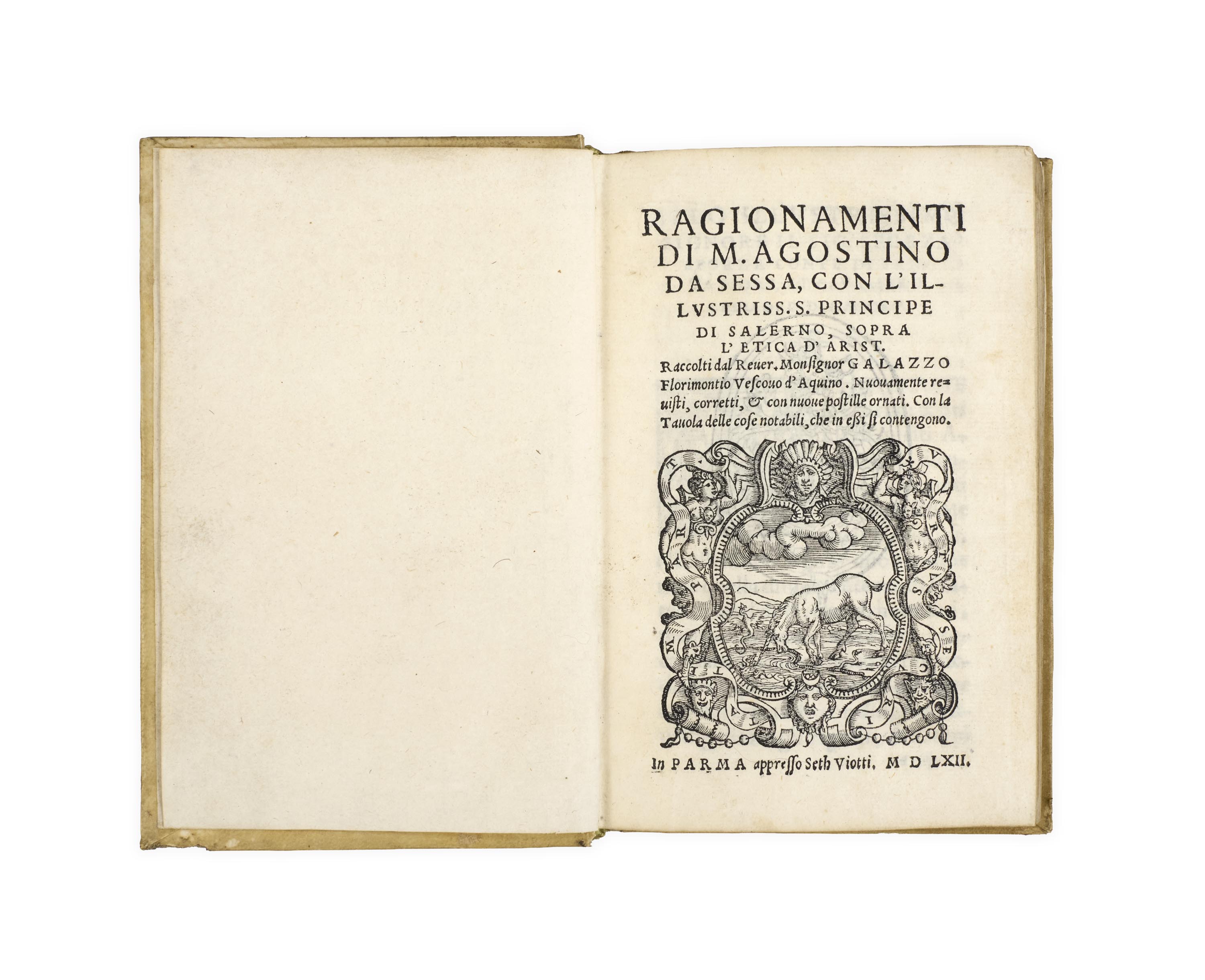
Ragionamenti di M. Agostino da Sessa, con l’illustriss. S. Principe di Salerno, sopra l’Etica di Arist. … Parma, Seth Viotti, 1562.
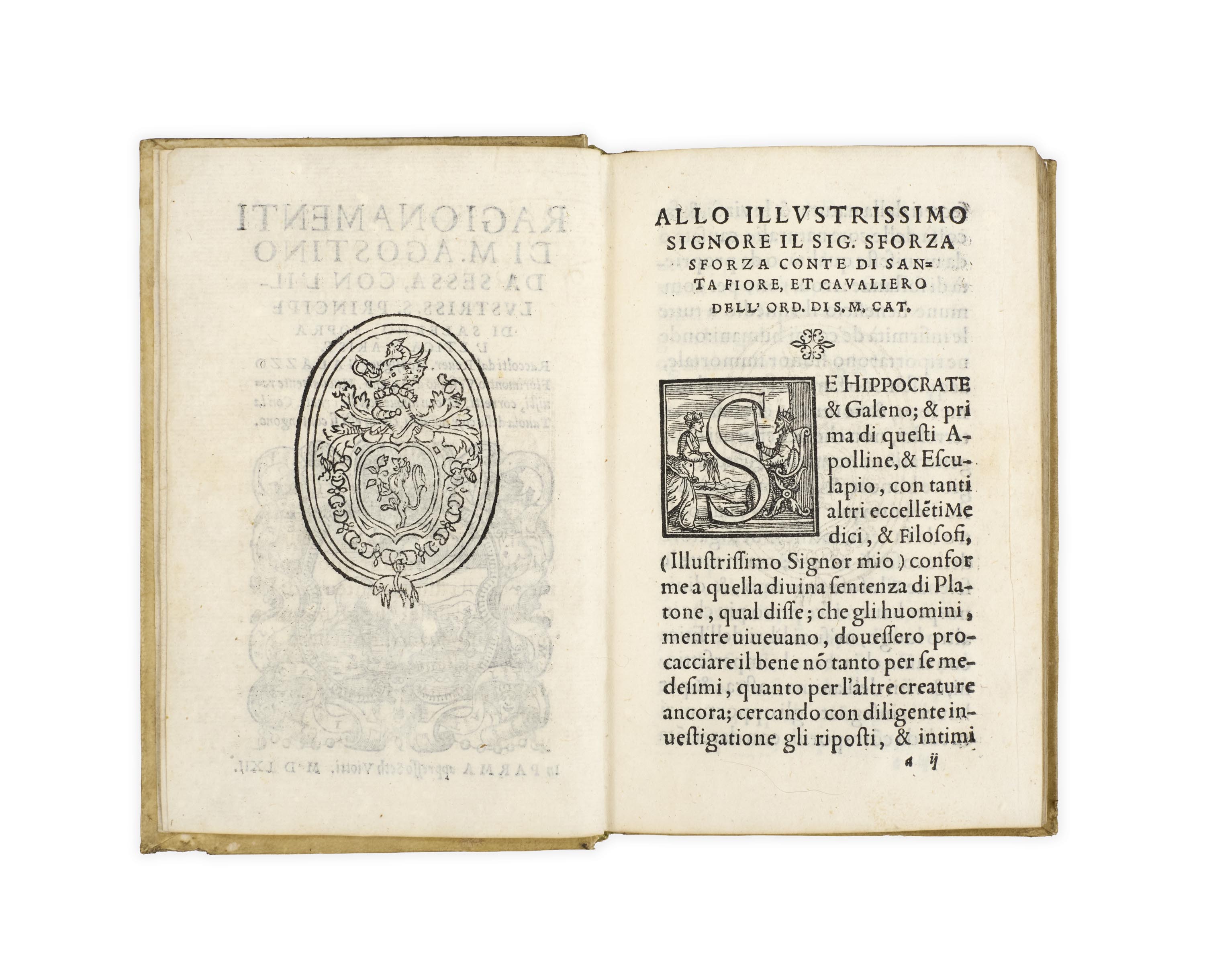
8vo, ff. [viii], 107, [1, errata]; woodcut printer’s device to title, armorial device of the dedicatee to verso of title, large woodcut initials; a very good copy in later vellum over boards.
Added to your basket:
Ragionamenti di M. Agostino da Sessa, con l’illustriss. S. Principe di Salerno, sopra l’Etica di Arist. …
Second edition of this important commentary on Aristotle’s Ethics produced by Galeazzo Florimonte, the figure who inspired Giovanni Della Casa’s Galateo.
The vernacular rendition by Florimonte (1484–1565), which first appeared without the author’s permission in 1554, distances itself from contemporary paraphrases for scholars, consciously shifting away from the academic sphere and explicitly addressing the text to princes, rulers, and courts as a practical and practicable instrument of governance.
‘The profile of Florimonte suggested by the Galateo is consistent with his biography and, in particular, with his philosophical training under the philosopher Agostino Nifo. Evidence of Florimonte’s acquaintance with Nifo comes from the Ragionamenti sopra l’Ethica, not accidentally a dialogue which casts the philosopher as the leading character. The presence of Nifo, one of the most important Aristotelian scholars of the time, gives a deeper hue of intellectual authority to the work, as confirmed by the 1554 and 1561 editions of the Ragionamenti, both of which were published – most likely for marketing purposes – as actually based on Agostino Nifo’s teaching’ (Refini, p. 102).
Florimonte’s political and practical intention informed his choice of genre: the dialogue form allows the main character, Nifo, both to instruct his unscholarly, busily courtly students in elements of philosophy in the vernacular, and to mentor them in the art of ruling through deliberately selected and summarized, concise material. This intention is made explicit in the preface to the 1567 edition, addressed to Alfonso Cambi, where the author frees his audience from the traditionally required mastery of Latin, grammar and logic, and asserts the value of clear, accessible communication of useful precepts to be put to use for the common good.
This edition follows the arrangement of the first edition of 1554, with only two books; the completed work was not published until 1567, after the author’s death, expanded with new second and third books and with the original second book completely revised as book four.
EDIT16 CNCE 39081; USTC 844783. See Refini, ‘Aristotelian commentaries and the dialogue form in Cinquecento Italy’, in Vernacular Aristotelianism in Italy from the Fourteenth to the Seventeenth Century (2016).