Learning Aristotle in a Jesuit College
[ARISTOTLE.]
‘P[hiloso]phia na[tur]alis seu Phisica; In duos Ar[istote]lis libros de generatione et corruptione; Commentarius in 4 libros Ar[istote]lis de coelo; In tres libros Aristotelis de anima’. [Douai, c. 1702].
[bound after:]
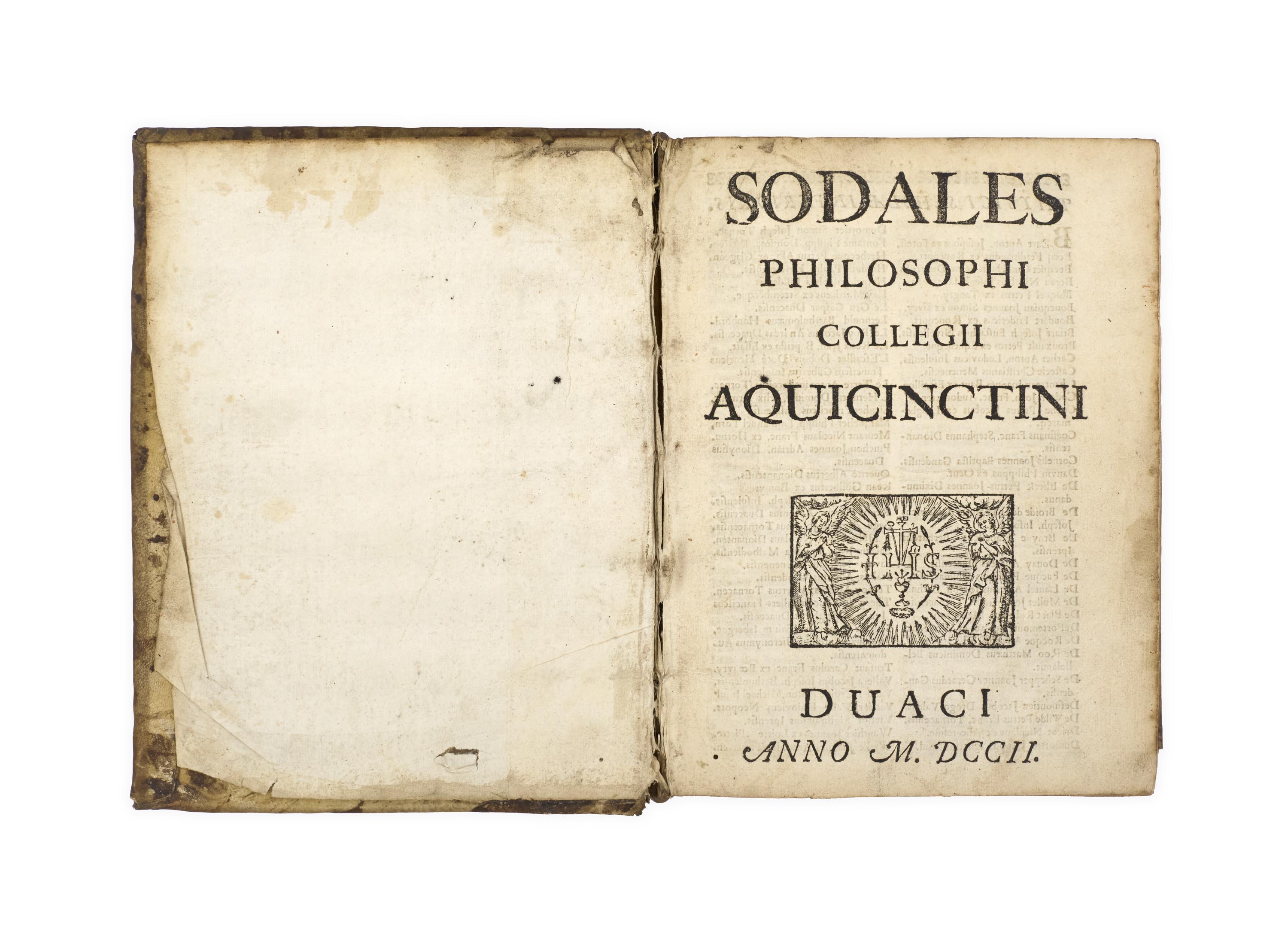
[COLLÈGE D’ANCHIN.] Sodales philosophi collegii Aquicinctini. Douai, [s.n.], 1702.[and interleaved with:]
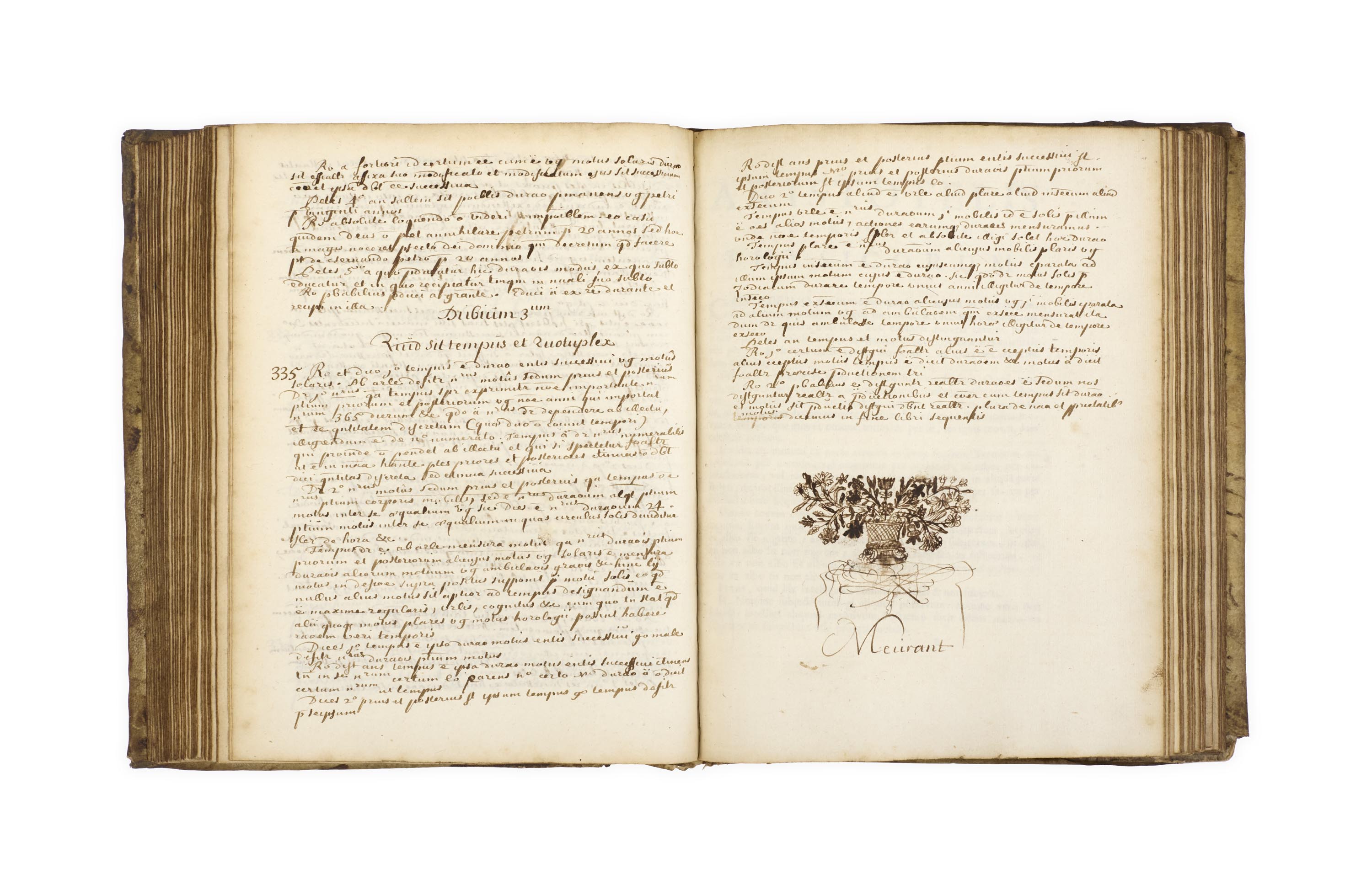
Aristotelis liber primus [–octavus] Physicorum; Aristotelis libri duo de ortu et interitu seu de generatione et corruptione. [Douai?, s.n., s.d.].Three works in one vol., 4to (c. 220 x 180 mm); Philosophia: manuscript on paper, in Latin, ff. [379] (a few leaves evidently excised); neatly written in brown ink in a single hand, up to 45 lines per page, the name ‘Meurant’ appearing below a tailpiece at the end of Physics book IV, 21 small cut-out engraved diagrams pasted in-text or loose in parts of De Coelo; interleaved with individual leaves of the printed Aristotle (pp. [16]) bound in at the relevant section; bound after Sodales: pp. 7, [1, blank], woodcut Jesuit device to title; some worming to lower margins of first quarter of volume, a few light marks; very good in contemporary vellum over boards, spine in compartments, very faint blind lettering to one (Physica?); short split to head of front joint, some wear to tailcap, corners and edges, small abrasions and marks to covers, rear endpaper torn.
Added to your basket:
‘P[hiloso]phia na[tur]alis seu Phisica; In duos Ar[istote]lis libros de generatione et corruptione; Commentarius in 4 libros Ar[istote]lis de coelo; In tres libros Aristotelis de anima’.
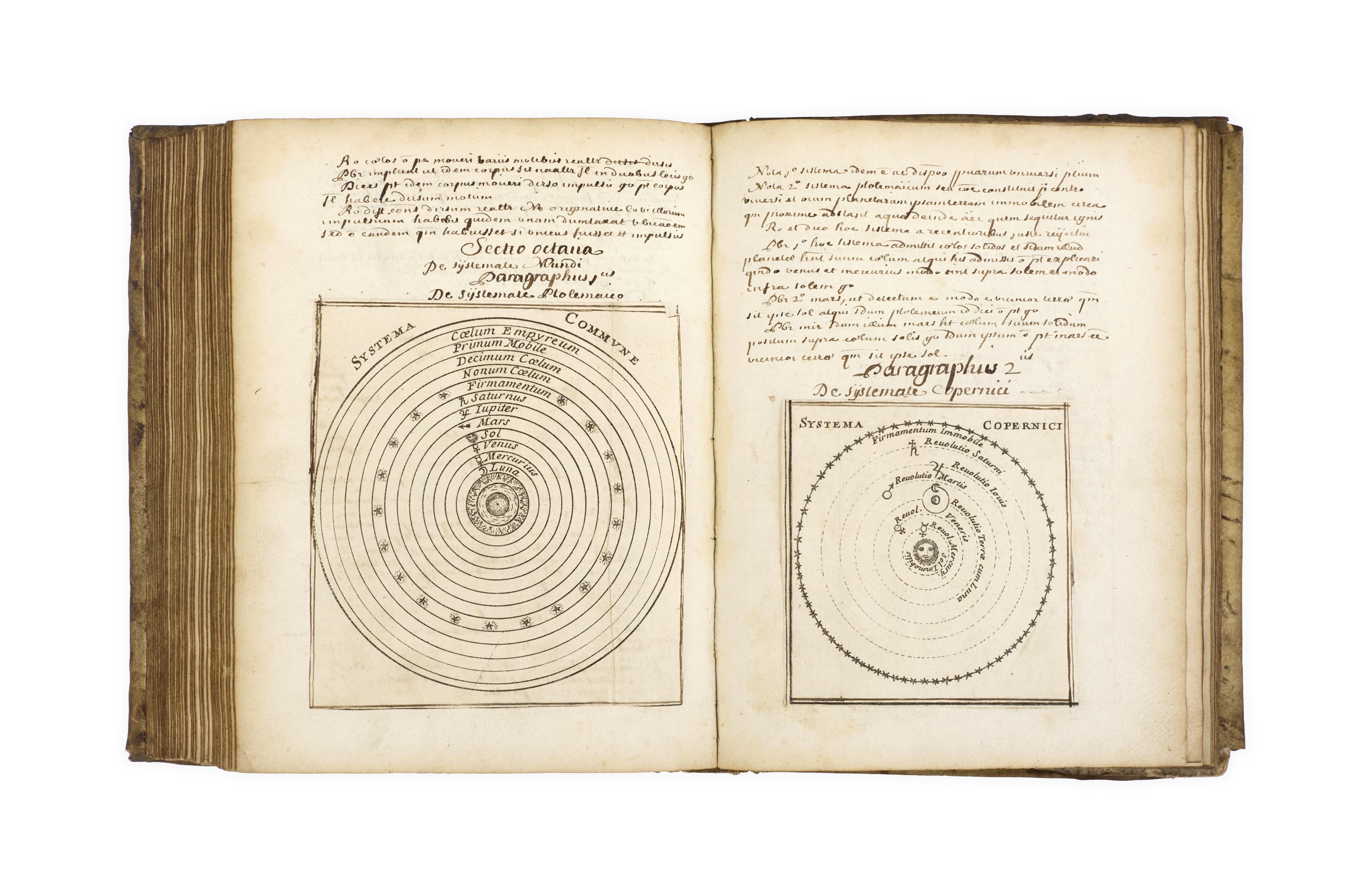
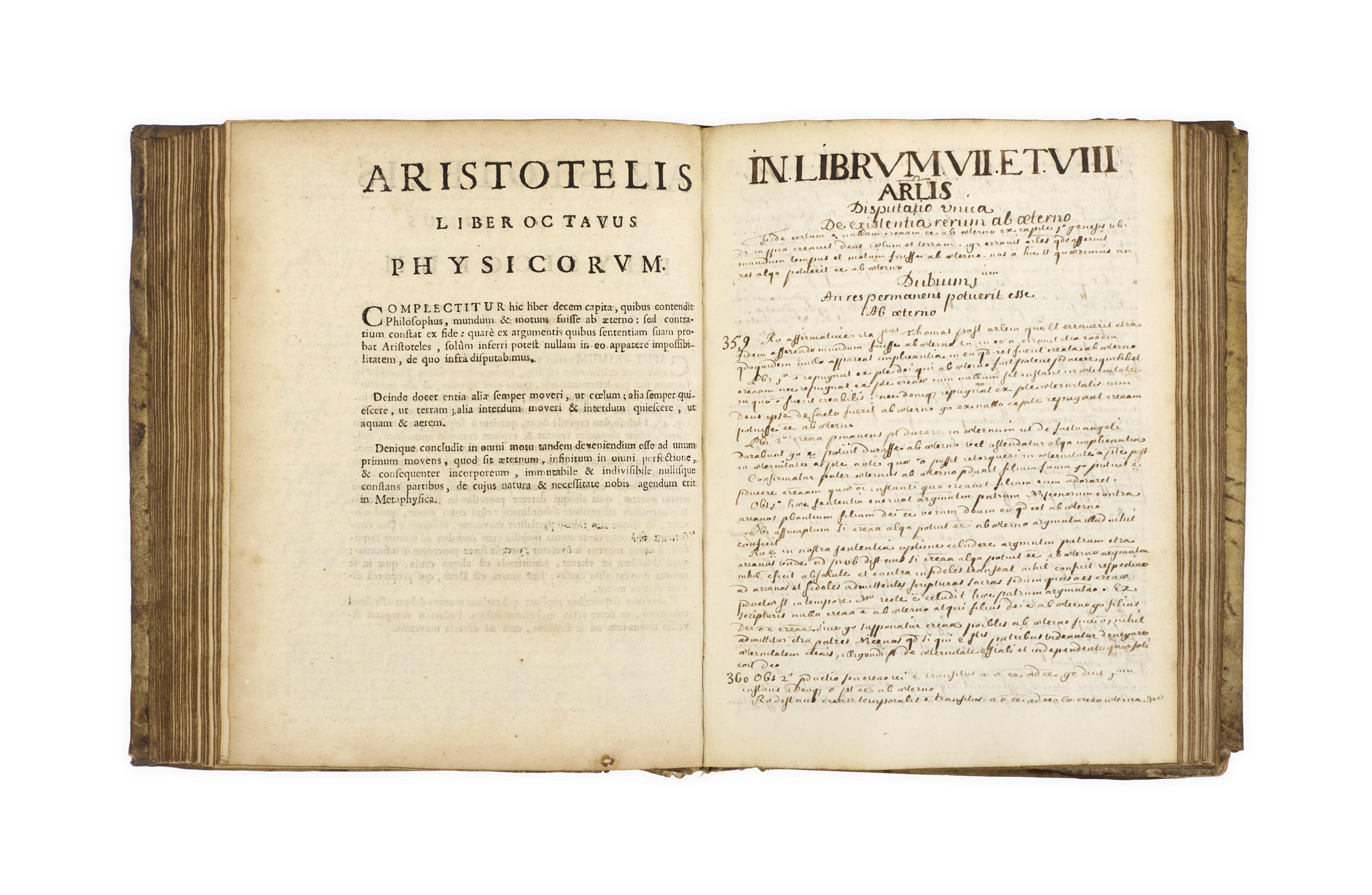
An interesting hybrid volume, combining manuscript notes of lectures on Aristotle given at the Jesuit Collège d’Anchin in Douai, northern France, at the opening of the eighteenth century, with a printed list of the College’s students in 1702, interleaved with printed summaries of each book of the Physics and of On Generation and Corruption, with several engraved diagrams pasted in.
The list of the College’s students gives the names of all those in the lower and upper classes in physics and logic; from this, the compiler of our manuscript, who gives his name as ‘Meurant’, can be identified as Nicolas François Meurant of Hornu in Belgium, who in 1702 was in the lower physics class.
The volume is an appealing example of the interaction of print and manuscript in a student’s notebook. Meurant acquired a sixteen-page summary of the contents of the Physics and On Generation and Corruption, clearly printed for the student market, had it disbound, and each leaf then inserted at the appropriate place within his manuscript. His notes to On the Heavens incorporate engraved diagrams pasted within the text, including illustrations of the cosmological systems of Ptolemy, Copernicus, and Tycho Brahe, and of eclipses.