Mystical Soliloquies
AUGUSTINE, Pseudo-; [Agostino da SCARPERIA, attributed translator].
Soliloquia in Italian. Italy (Tuscany?), early fifteenth century.
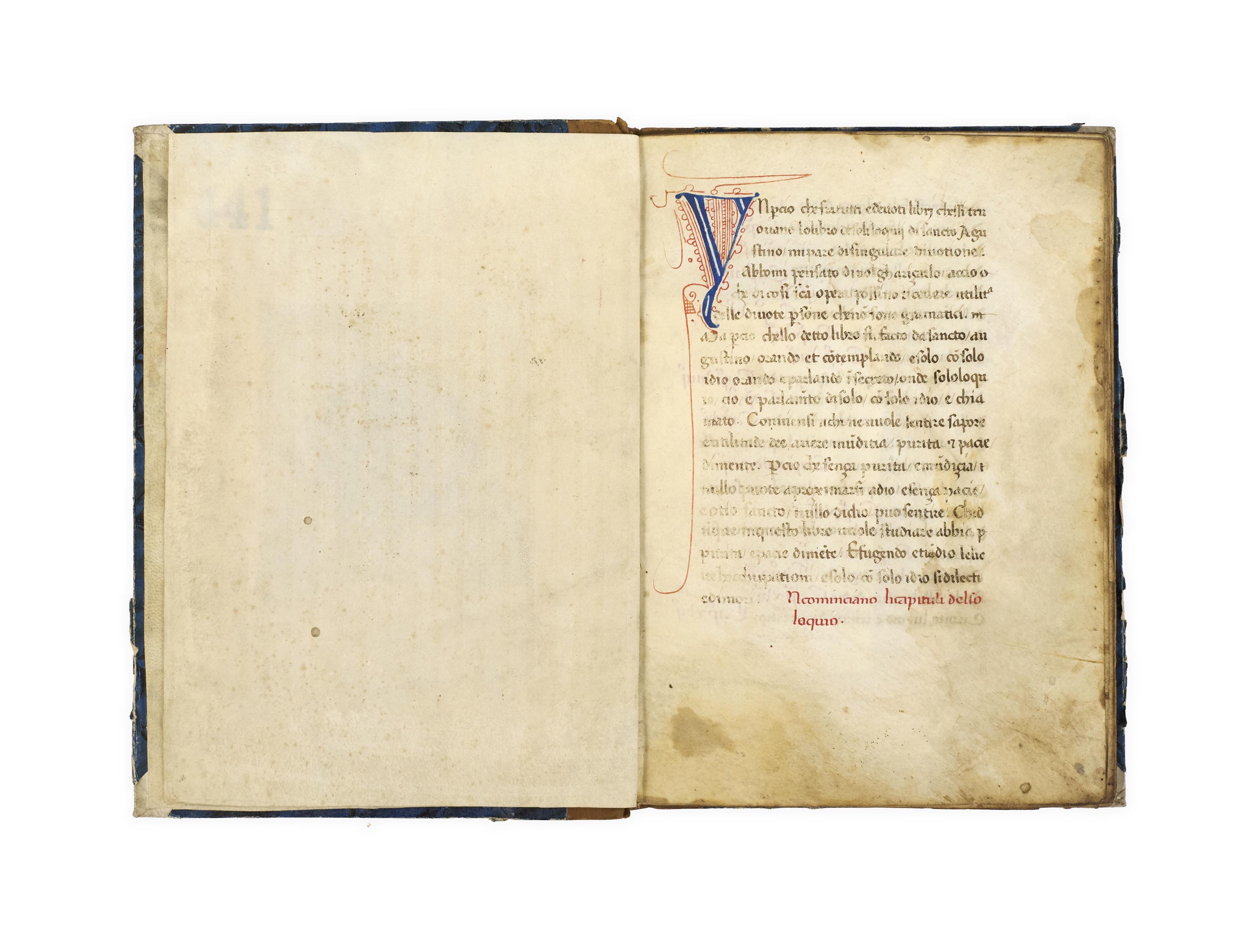
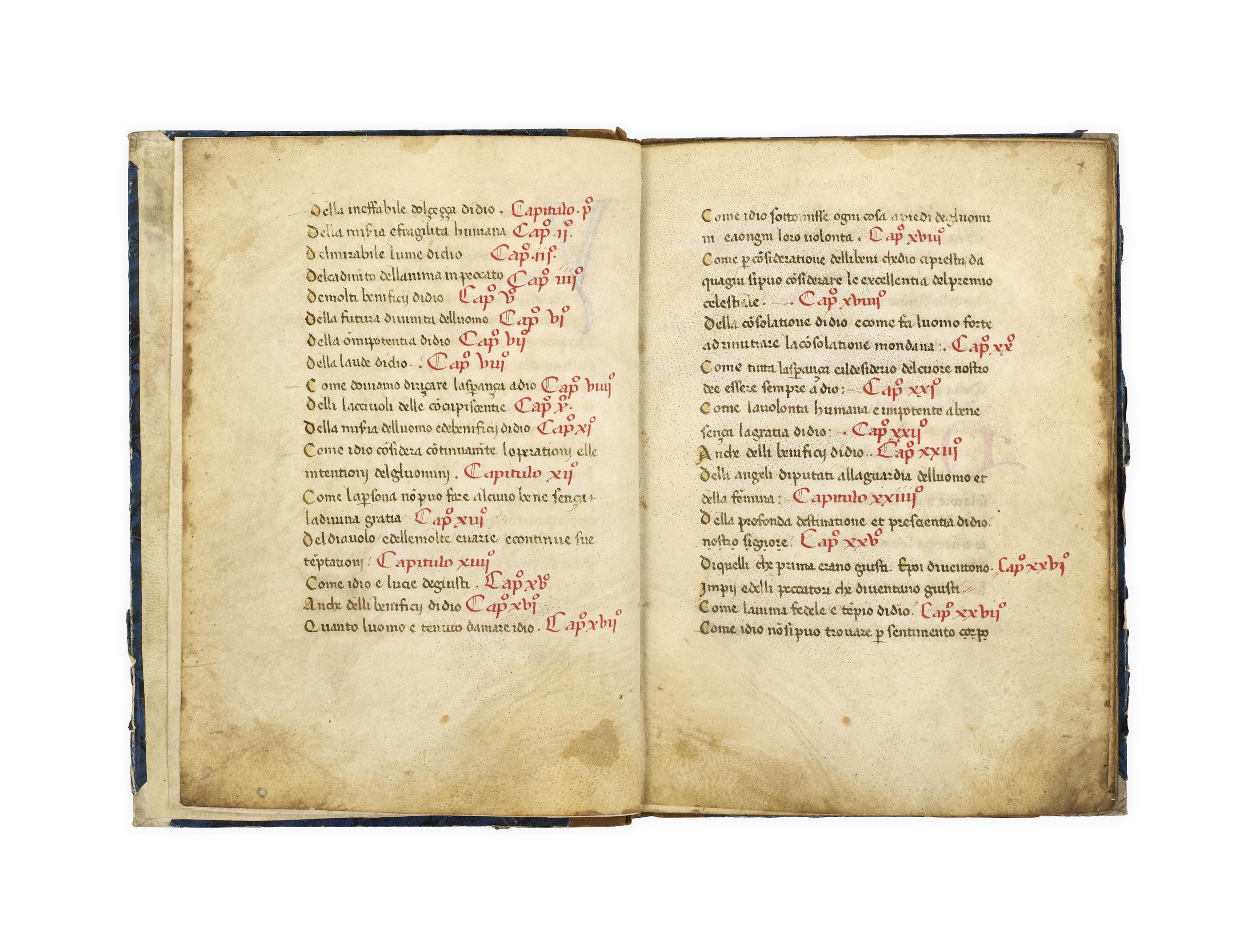
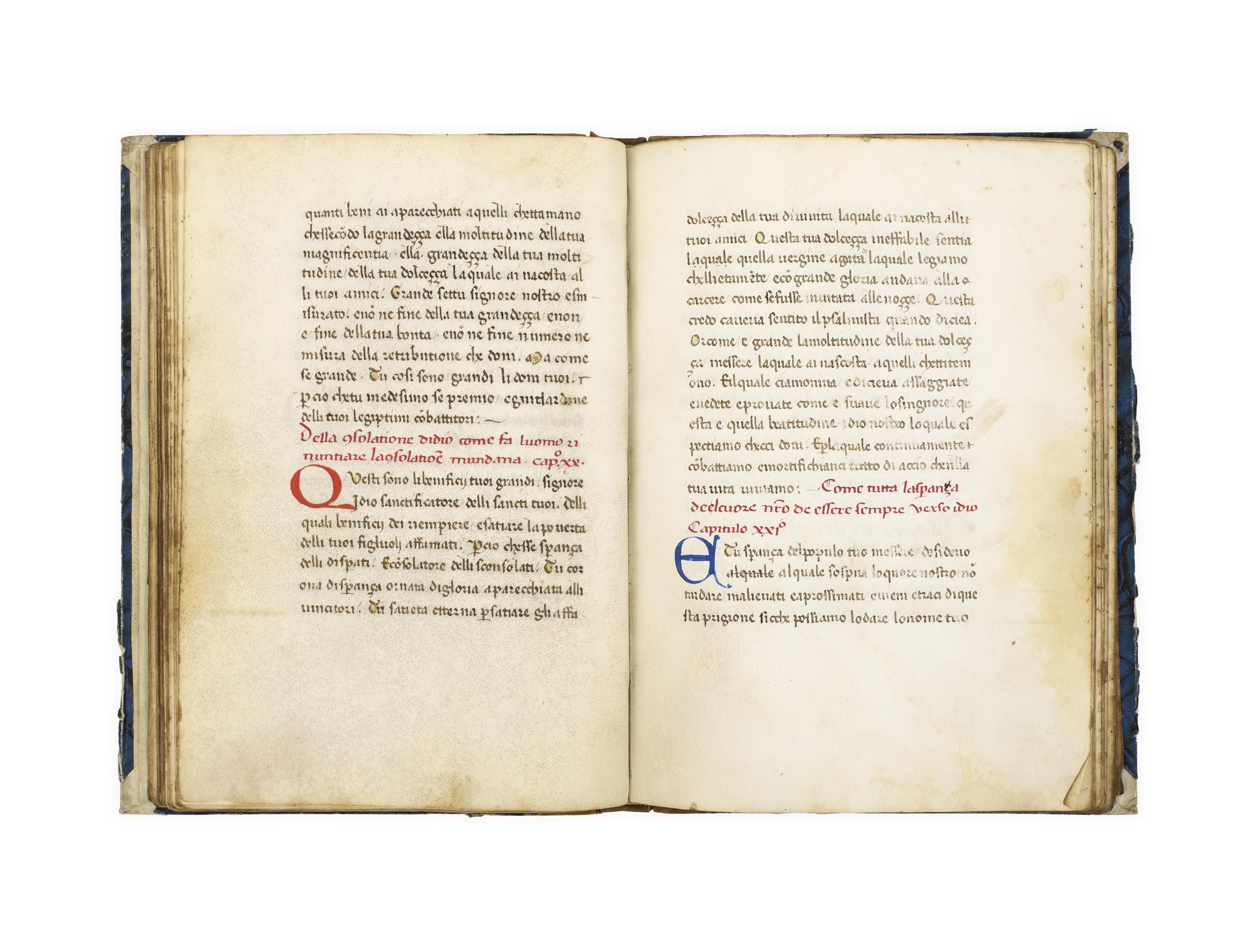
Manuscript on vellum, in Italian, 8vo (c. 205 x 150 mm), ff. [61], [i]–[vi]¹⁰ [vii]¹; very neatly written in brown ink in a semi-humanist hand, 20 lines per page, six-line opening initial ‘Y’ (Ynpercio) in blue with red pen flourishing extending into margins, two-line chapter initials alternately in red and blue, smaller capitals touched in yellow, chapter headings in red, faintly ruled with a hard point, pricking to outer margins, rubric and text to lower half of last page thoroughly erased; some staining to edges and slight cockling, small marginal holes to first and last leaves; very good in nineteenth-century quarter sheep with blue marbled sides, vellum corners, spine in compartments lettered in gilt (‘Soliloqui di S. Agostino volgariz.’, ‘M.S membran.’), original vellum endpapers; rubbed, corners and edges worn with small loss to outer edge of upper board, some worming and staining to rear endpapers; armorial bookplate (‘Ex libris M. A. Principis Burghesii’) and sticker (‘441’) to front pastedown (see below).
An attractive manuscript of the Italian translation of the Pseudo-Augustinian Soliloquia attributed to the Augustinian friar Agostino da Scarperia (b. c. 1320).
St Augustine’s genuine Soliloquies take the form of an inner dialogue and are an intimate witness to his state of mind between his conversion and baptism. By the later Middle Ages, however, the original text was virtually forgotten, superseded by a Pseudo-Augustinian and deeply mystical Soliloquia, of thirteenth-century composition, which enjoyed great popularity in Italy and France. Composed in Latin, it was influenced by Hugh of St Victor’s Soliloquium de arrha animae and by Augustine’s own Confessions. It was very early on attributed to Augustine because of the highly personal first-person discourse.
Three Italian translations emerged in the fourteenth and fifteenth centuries, that present here being the most successful: Esnos (who designates it ‘traduction A’) lists fifty-two extant manuscripts, mostly in Italy. The translation no doubt originated in Florence in an Augustinian milieu, and it is traditionally ascribed to Agostino da Scarperia, who was educated in the Tuscan capital and translated the Pseudo-Augustinian Sermones ad heremitas. The first printed edition appeared in Milan in 1480.
The text proper in our manuscript begins ‘Damiti a cognoscere signore che mi cognosci. Damiti a cognosce[re] uirtu dellanima mia’, and ends ‘Questa e la porta di dio e solo gli iusti entrono p[er] essa’. The thirty-five chapters encompass God’s gentleness; human fragility; falling into sin; hope; the temptations of the devil; divine grace and light; human will; angels; the just; Christ and the Holy Spirit; and eternal life.
Provenance:
1. Marcantonio Borghese (1814–1886), prince of Sulmona and Rossano, and perhaps in his family’s library for some generations before his ownership. His ancestral library was sold by Vincenzo Menozzi in Rome in two auctions in 1892 and 1893 (see Bibliotheca Burghesiana, catalogue des livres composant la bibliothèque de S. E. Don Paolo Borghese, prince de Sulmona, première partie (Rome, 1892) where the present volume is lot 4561).
2. From the collection of Adolf Lagerfelt (1897–1967), vice-consul to the Middle East; from his library at Säbylund, Sweden, no. ‘441’.
See Esnos, ‘Les traductions médiévales françaises et italiennes des Soliloques attribués à Saint Augustin’, in Mélanges d’archéologie et d’histoire 79:1 (1967), pp. 299–370.