Imperial Iconography
AURELIUS VICTOR, Sextus.
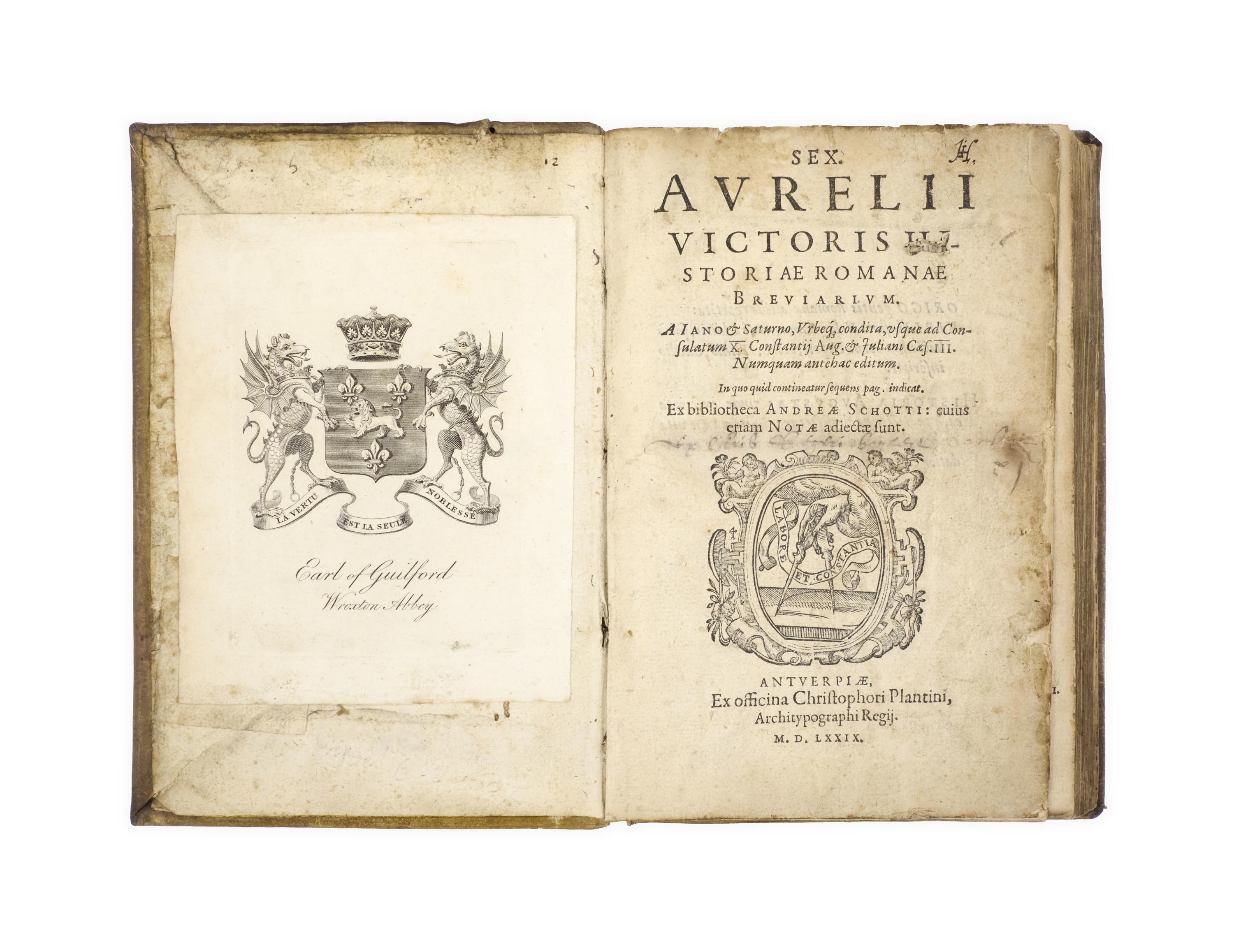
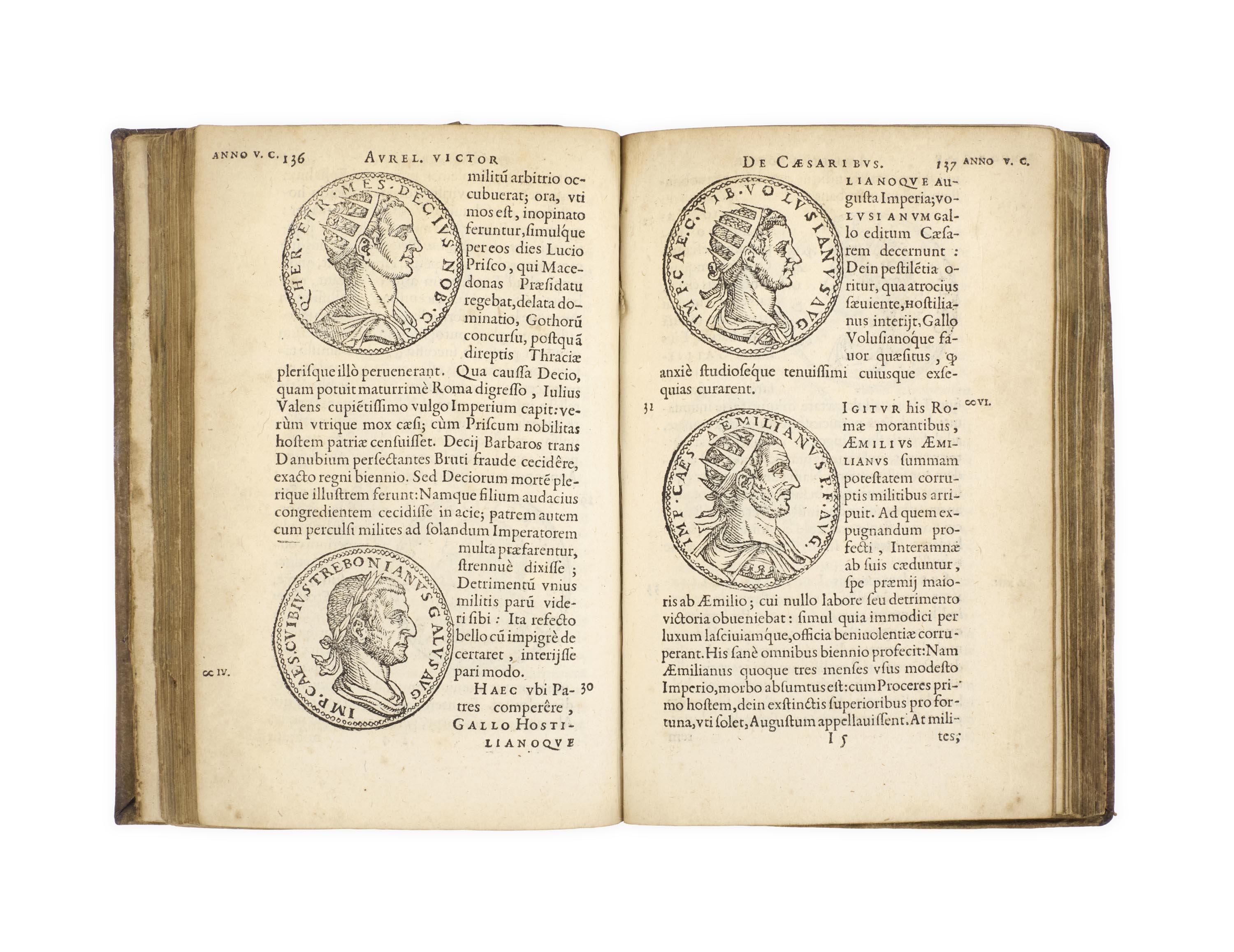
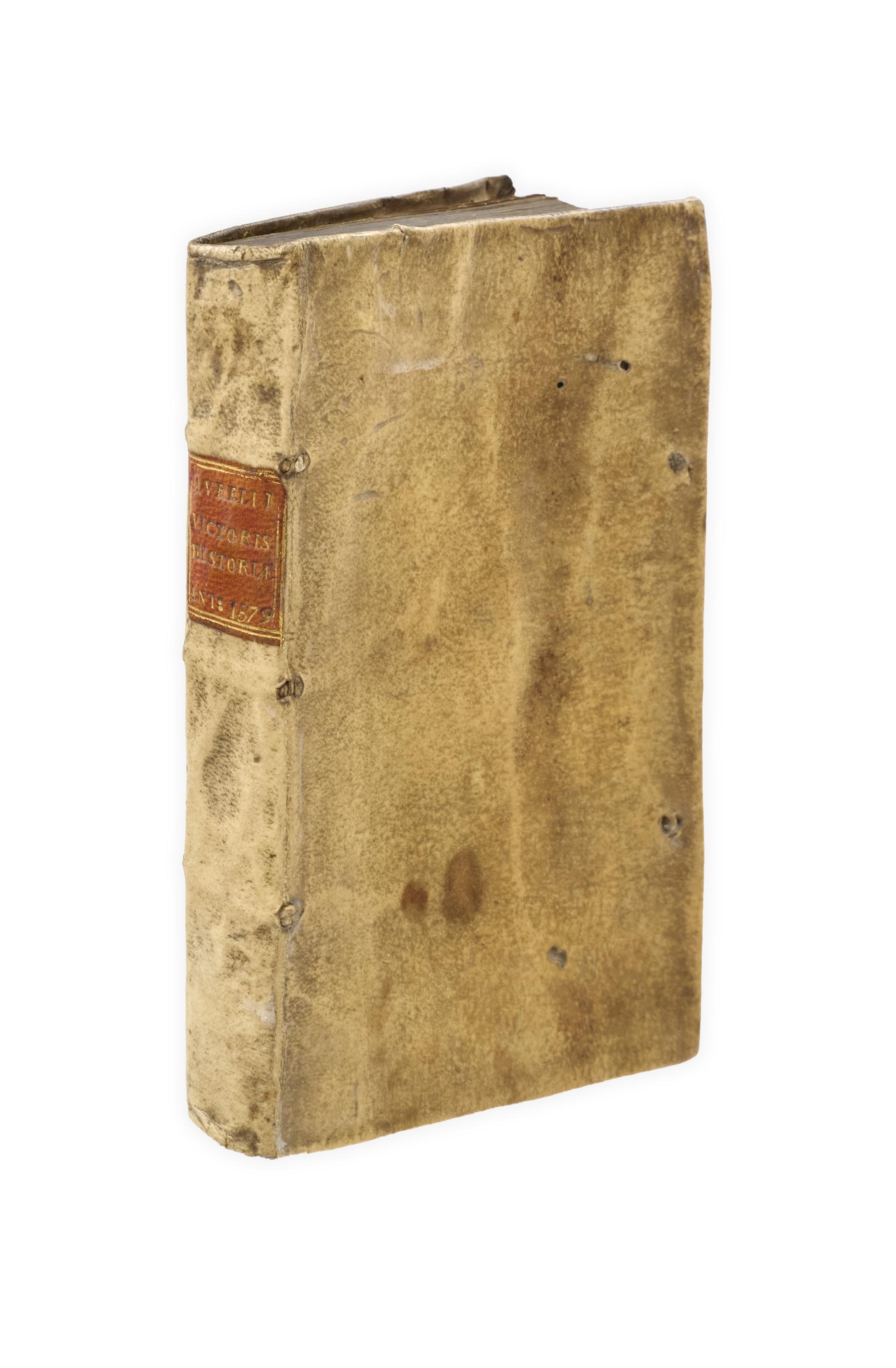
Historiae romanae breviarium. A Jano & Saturno, Urbeque condita, usque ad Consulatum X Constantii Aug. & Juliani Caes. III. Numquam antehac editum … Ex bibliotheca Andreae Schotti cuius etiam Notae adiectae sunt. [bound with:] —. De vita et moribus imperatorum Romanorum: excerpta ex libris Sexti Aurelii Victoris, a Caesare Augusto usque ad Theodosium Imperatorem. Editio vulgata. Andreas Schottus compositis tribus M.SS. cum Vett. vulgaris emendabat; Scholiis & veris Iconibus ex antiquis numismatis delineatis illustrabat. Quibus accesserunt & Eliae Vineti notae. Antwerp, Christophe Plantin, 1579.
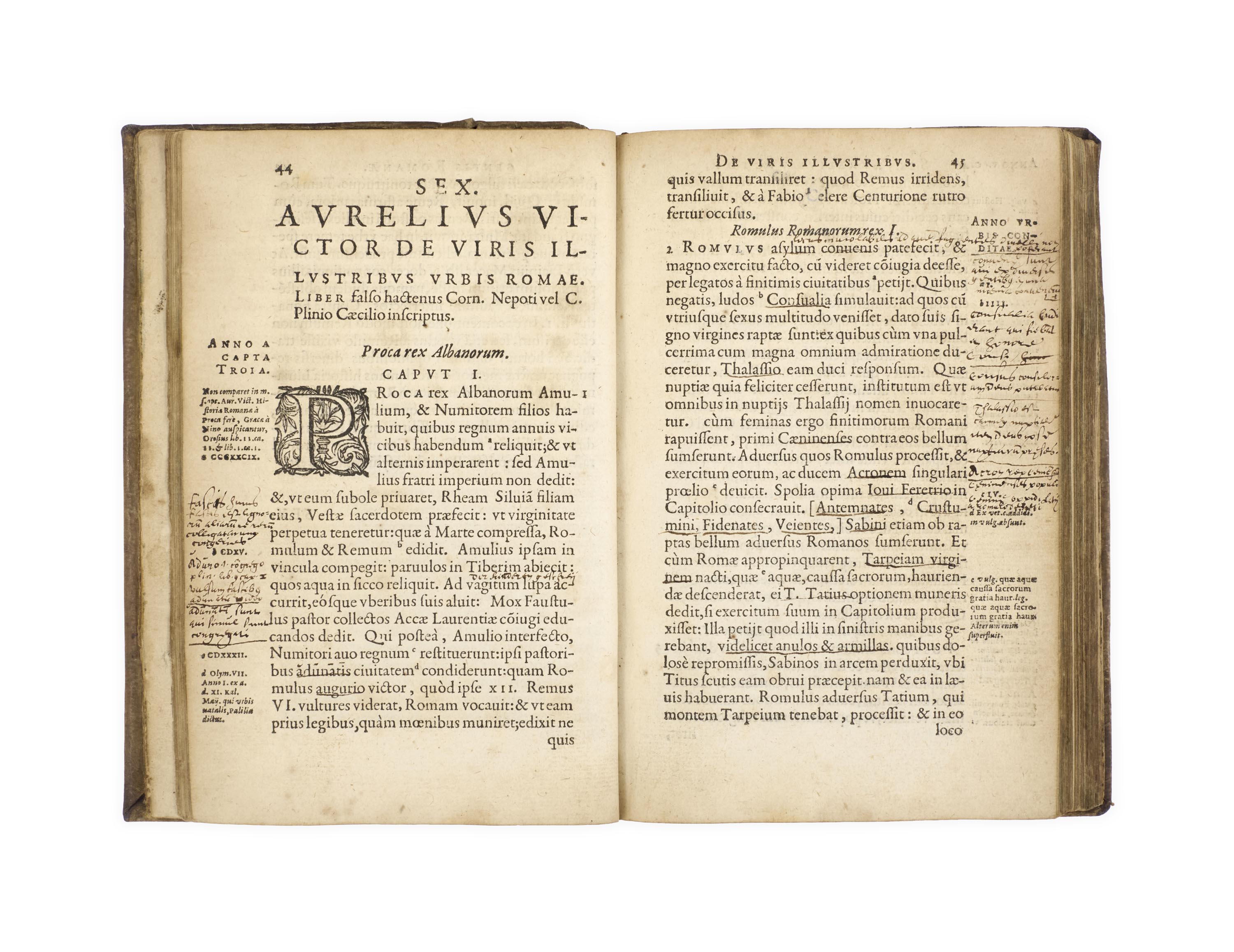
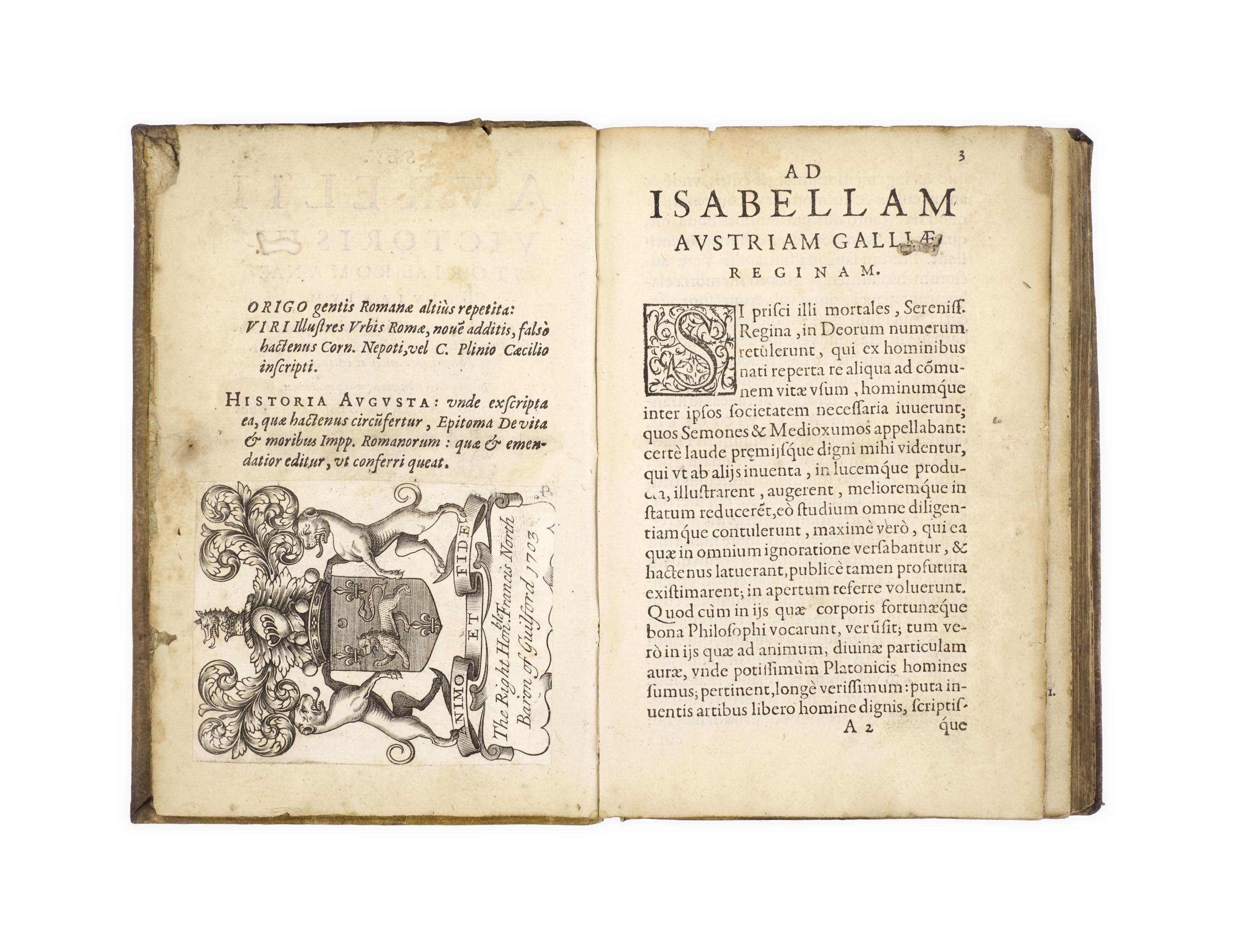
Two works in one vol., 8vo, pp. 221, [2, index], [1, blank]; 123, [11, index], [2, blank]; woodcut printer’s device to titles, woodcut initials, 64 and 76 woodcut medallion portraits of Roman Emperors (some used in both works); first title slightly frayed and soiled, short wormtrack in text of first four leaves, occasional light staining, but good copies; bound in seventeenth-century vellum, eighteenth-century red morocco lettering-piece, remnants of ties, endguards of manuscript waste on vellum; binding somewhat soiled with a few small wormholes, rear flyleaves stained; sixteenth-century manuscript notes in red ink in Latin to rear flyleaf (partly about the etymology of the word Capitaneus), a few manuscript annotations in a seventeenth-century English hand on pp. 25, 39, 44–45 and rear flyleaf (the latter perhaps a list of texts, now obscured), occasional underlinings, first title with early ownership inscription (partly washed), HI monogram to head, early eighteenth-century bookplate of Francis North, earl of Guilford to verso, and nineteenth-century bookplate of the Earl of Guilford at Wroxton Abbey to front pastedown.
Added to your basket:
Historiae romanae breviarium. A Jano & Saturno, Urbeque condita, usque ad Consulatum X Constantii Aug. & Juliani Caes. III. Numquam antehac editum … Ex bibliotheca Andreae Schotti cuius etiam Notae adiectae sunt. [bound with:] —. De vita et moribus imperatorum Romanorum: excerpta ex libris Sexti Aurelii Victoris, a Caesare Augusto usque ad Theodosium Imperatorem. Editio vulgata. Andreas Schottus compositis tribus M.SS. cum Vett. vulgaris emendabat; Scholiis & veris Iconibus ex antiquis numismatis delineatis illustrabat. Quibus accesserunt & Eliae Vineti notae.
A pair of abbreviated histories based on the lost work of Sextus Aurelius Victor, from the distant origins of Rome up to the death of the Emperor Theodosius in 395 AD, illustrated with coins and portraits of the emperors, with early English provenance, later in the library of the Earls of Guilford.
Sextus Aurelius Victor (c. 320–390 AD), an Imperial governor and prefect of the city of Rome, was the author of a substantial history of imperial Rome, which has only survived in fragments and abbreviations. He was an author of considerable political and literary reputation, admired by Ammianus Marcellinus and the Emperor Theodosius.
The two short histories in this volume are usually called Liber de Caesaribus and Epitome de Caesaribus, whose contents overlap considerably. The first work contains three short texts: on the foundation of Rome, on the kings and the Republic, and on the emperors; the preface to one of Schott’s source manuscripts states that the text was based on Livy and Aurelius Victor, though the third part can only be from Aurelius Victor. The second work, shorter in both length and chronology, from Augustus to Constantius II and Julian in the year 360, is much less moralistic in tone. The first work was likely compiled in the 360s, before the abbreviated history of Eutropius was composed in around 370. Although usually attributed to the late fourth or early fifth century, a date in the later sixth century or even the seventh century has recently been proposed for the composition of the Epitome, though using a fourth-century source. It is also plausible that the two versions are based on different antique recensions of Aurelius Victor’s text.
The long and complicated history of these abbreviated works has recently been the subject of a thorough investigation; see Stover and Woudhuysen, The lost history of Sextus Aurelius Victor (2023). The once-postulated Kaisergeschichte, supposedly the lost source for the late antique abbreviated histories of Aurelius Victor, Eutropius, the Historia Augusta and others, is none other than the original work of Aurelius Victor himself, considered by St Jerome to be the equal of Livy.
Although issued separately, these two works were offered for sale jointly at 7 stuivers, and are usually found bound together, as here.
‘In the letter to the reader in the Breviarium-edition Schottus mentions in passing that he used three manuscripts (page 19); they are enumerated in the ‘Scholia’ in the De vita et moribus-edition (page 63): a manuscript lent by Petrus Pithoeus (Pithou), a manuscript indicated as ‘codex Floriacensis’ lent by Petrus Daniel, and a manuscript put at his disposal by Jacobus Cuiacius (Cujas)’ (Plantin Press Online).
Provenance:
1. ‘Ex libris Rutgeri [-]’, seventeenth-century English inscription to title-page.
2. HI monogram, probably seventeenth century.
3. Francis North (1673–1729), 2nd Baron Guilford, armorial bookplate dated 1703. He was the great-grandfather of the notable book collector Frederick North, 5th Earl of Guilford. This evidently remained in the family into the nineteenth century, with their Wroxton Abbey bookplate.
USTC 402815 & 401809; Voet 606 & 607; STCV 12912209 & 12912210; Dekesel A75 & A74.