Mercantile Arithmetic and Mathematical Games
BAKER, Humfrey.
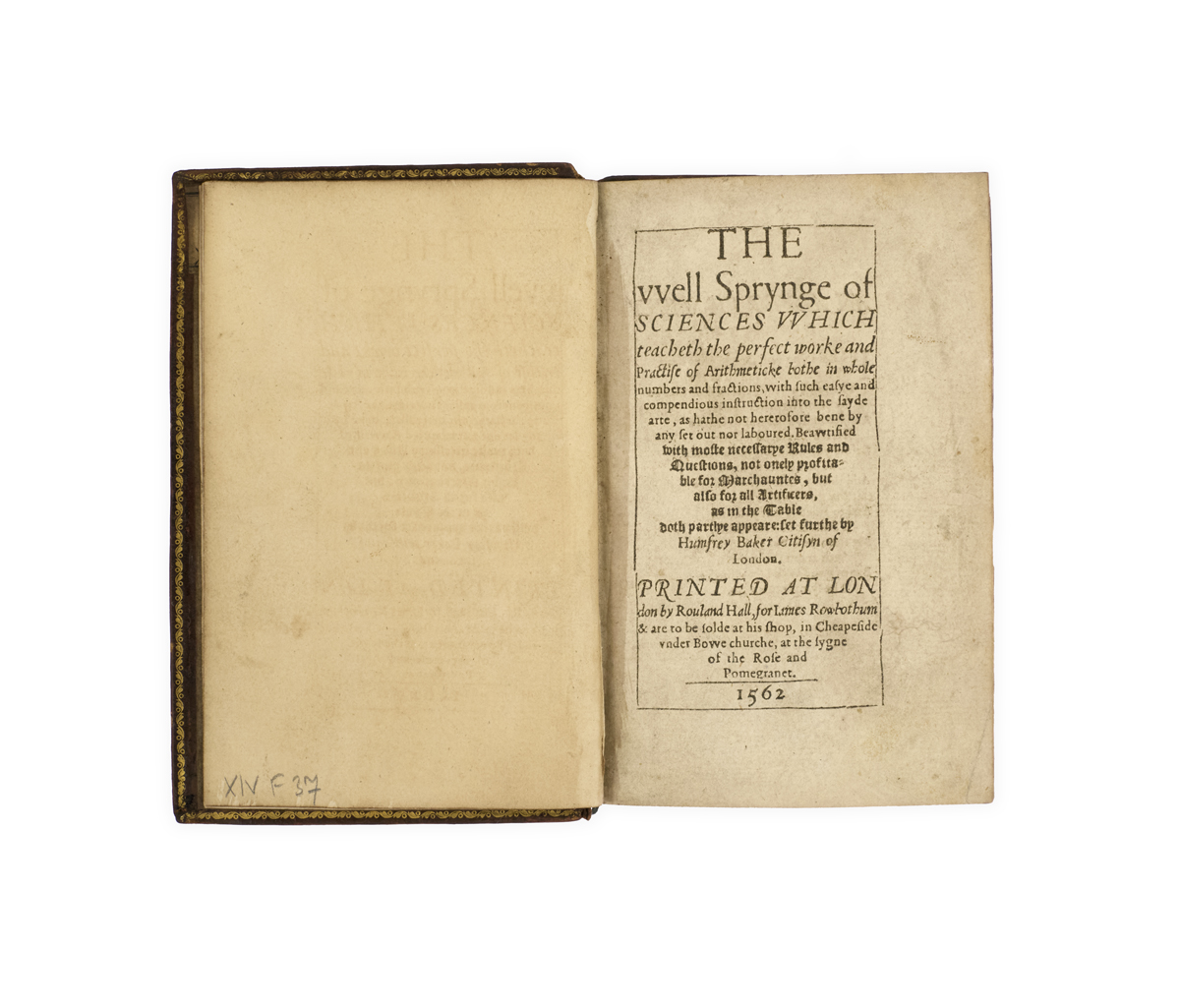
The Well Sprynge of Sciences which teacheth the perfect Worke and Practise of Arithmeticke bothe in whole Numbers and Fractions, with such easye and compendious Instruction into the sayde Arte, as hathe not heretofore been by any set out nor laboured. Beawtified with most necessarye Rules and Questions, not onely profitable for Marchaunts, but also for all Artificers, as in the Table doth partlye appeare … London, Roland Hall for James Rowbotham, 1562.
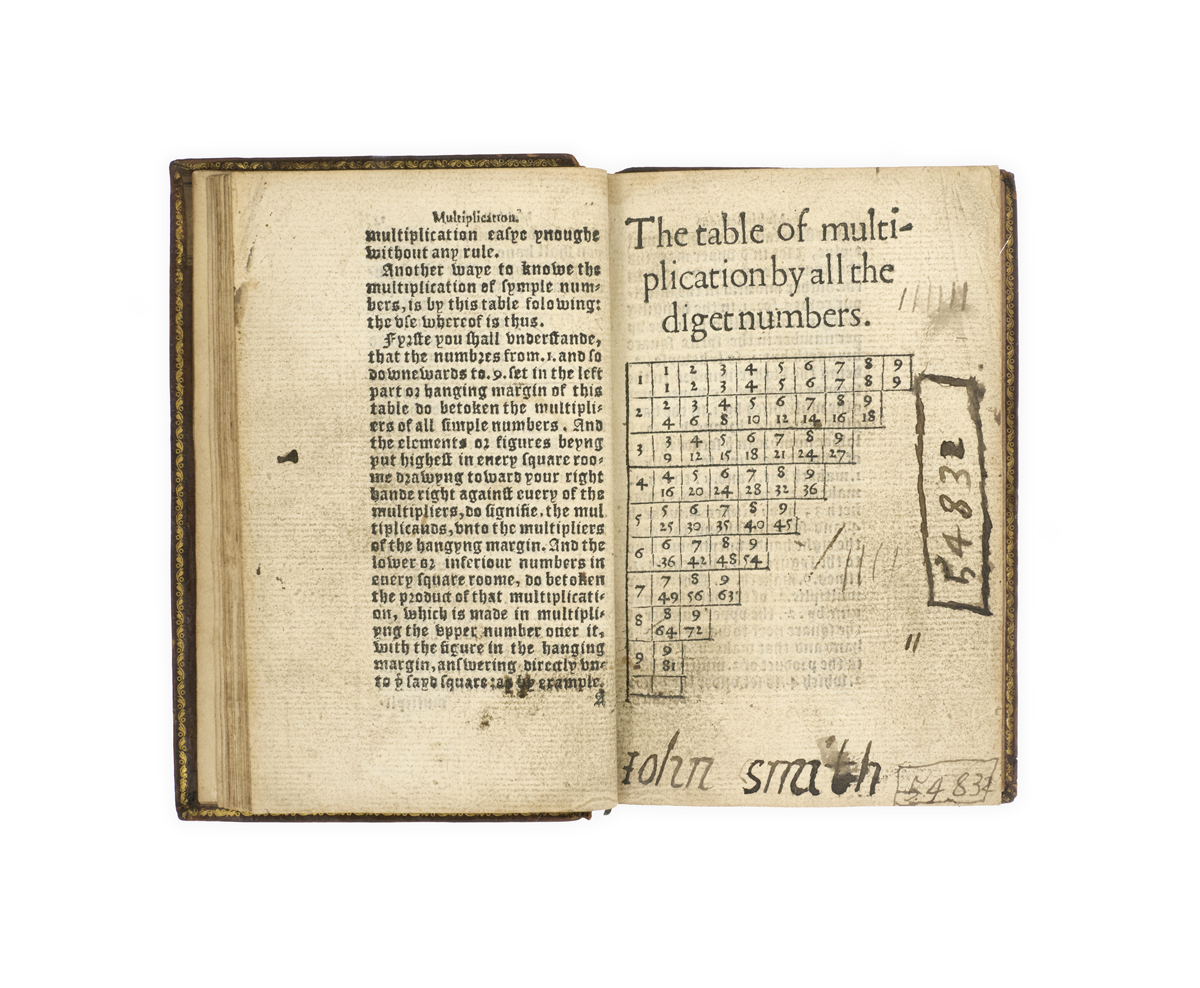
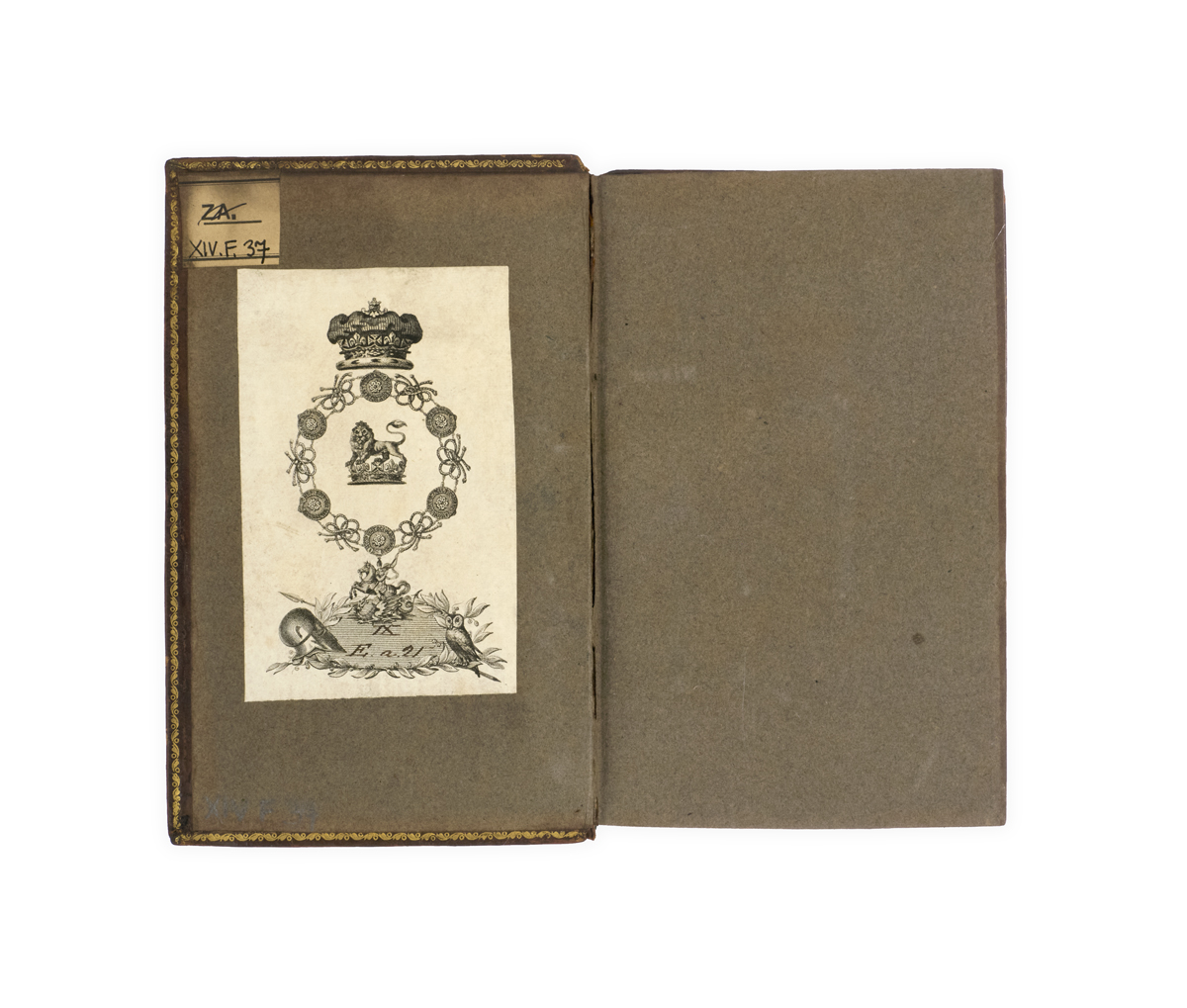
Small 8vo, ff. [4], 160; somewhat dusty throughout, a few stains, withal a very good copy, bound in early nineteenth-century panelled calf; joints rubbed, spine chipped at head, light wear to corners; faded annotation to f. a3r, sums in an early hand to c. 5 pp., early inscription ‘John Smith’ on f. 15; armorial bookplate of the Duke of Sussex, inscription to front endpaper ‘Presented by E. Ryley Esqr'.
Added to your basket:
The Well Sprynge of Sciences which teacheth the perfect Worke and Practise of Arithmeticke bothe in whole Numbers and Fractions, with such easye and compendious Instruction into the sayde Arte, as hathe not heretofore been by any set out nor laboured. Beawtified with most necessarye Rules and Questions, not onely profitable for Marchaunts, but also for all Artificers, as in the Table doth partlye appeare …
The extremely rare first edition (one of two copies in ESTC) of a very popular guide to arithmetic by the London schoolteacher and almanack-maker Humfrey Baker (fl. 1557–87).
The work went through at least nine further editions in the sixteenth century (some revised), and remained in print throughout the seventeenth, the later editions known simply as Baker’s Arithmetic. ‘For a long time Baker’s arithmetic was the only English rival to Recorde’s Ground of Artes, and it was in many respects better than that popular work’ (Smith). Its success was largely due to its practical appeal to merchants.
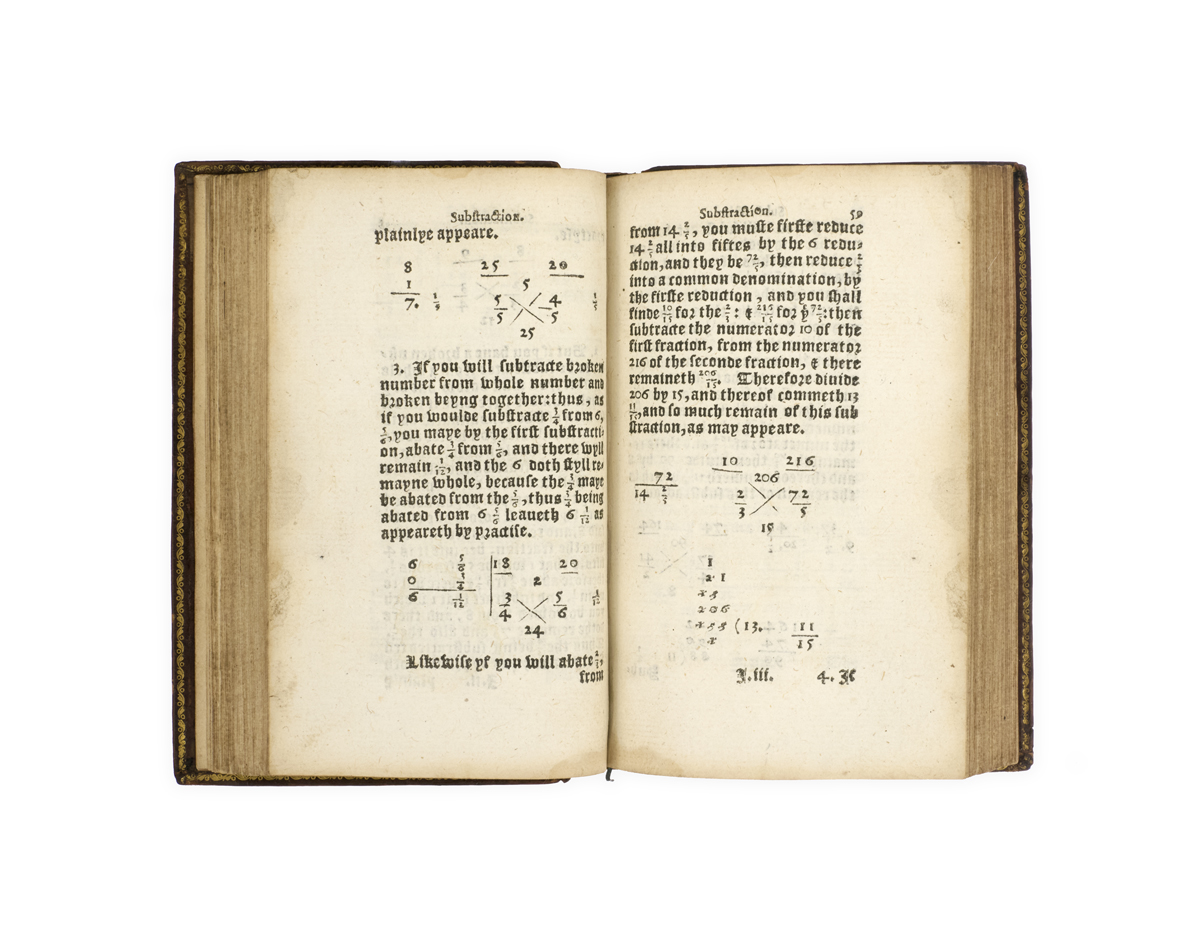
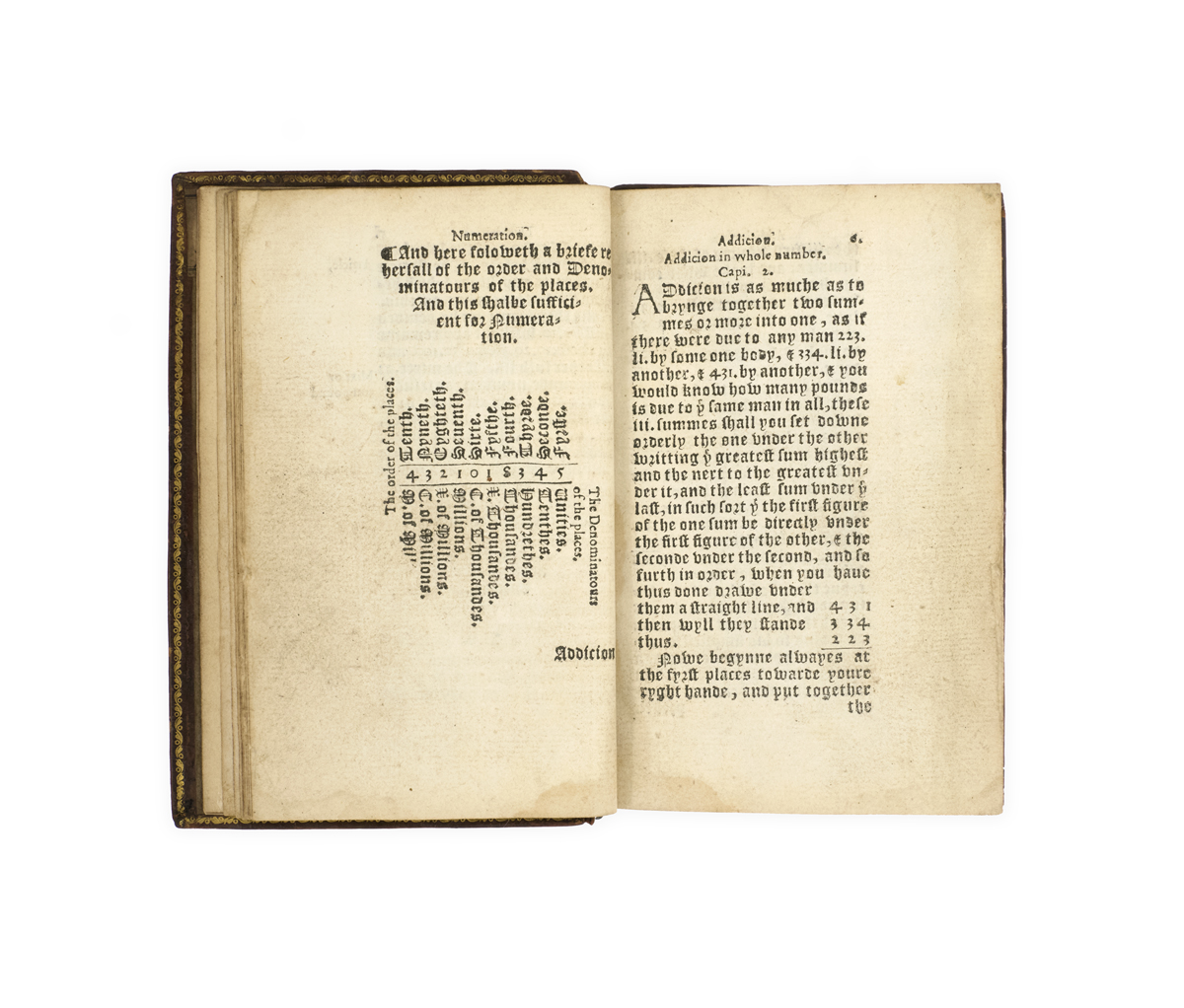
In his dedication to the Merchant Adventurers, Baker refers to his subject – in an obvious nod to Robert Recorde’s 1557 Whetstone of Witte – as ‘the best whetstone, or sharpening of the wit of every man that was ever invented, and … most necessarye to bee taught to unto children’. After dealing with basic arithmetic of integers and fractions, and providing lists of questions, Baker turns in Part Three to ‘rules of practise … profitable for Marchaunts’, with problems devoted in particular to ‘lengths and breadthes of tapistrie’, barter, fellowship, alligation, and ‘false position’.
Chapter 15 in the Third Part ‘treateth of sportes, and pastime, done by number’, with ‘some of the first pieces of recreational mathematics to be printed in England’ (Wardhaugh, A Wealth of Numbers (2012), p. 2). They include games that allow you to correctly identify a number that ‘any man may thinke of or imagine in his minde, as though you coulde devine’, and the numbers rolled on three hidden dice.
All early editions of Baker’s arithmetic are very rare: none of the first eight editions are known in more than three copies, and the edition of 1591 is the only one to appear in auctions records; of this first edition there is only one other recorded copy, at UCL.
Provenance:
1. Augustus Frederick, Duke of Sussex (1773–1843), son of George III, whose celebrated library of fifty thousand books and manuscripts was sold by Messrs Evans in six parts in 1844–5 (this sold as part of Part VI, lot 28).
2. Presentation inscription of Edward Ryley (d. 1896), ‘one of the ablest and most zealous of Cardinal Wiseman’s lay coadjutors in obtaining equal rights for Catholics’ (obituary in The Tablet).
ESTC S90366; STC 1209.5; Smith, Rara Arithmetica, p. 327.