

Creating a Christian Socialist Utopian Community
BALLOU, Adin.
Practical Christian Socialism: a conversational Exposition of the true System of human Society; in three Parts, viz: I. Fundamental Principles. II. Constitutional Polity. III. Superiority to other Systems. Hopedale and New York, by the author and Fowlers and Wells, 1854.
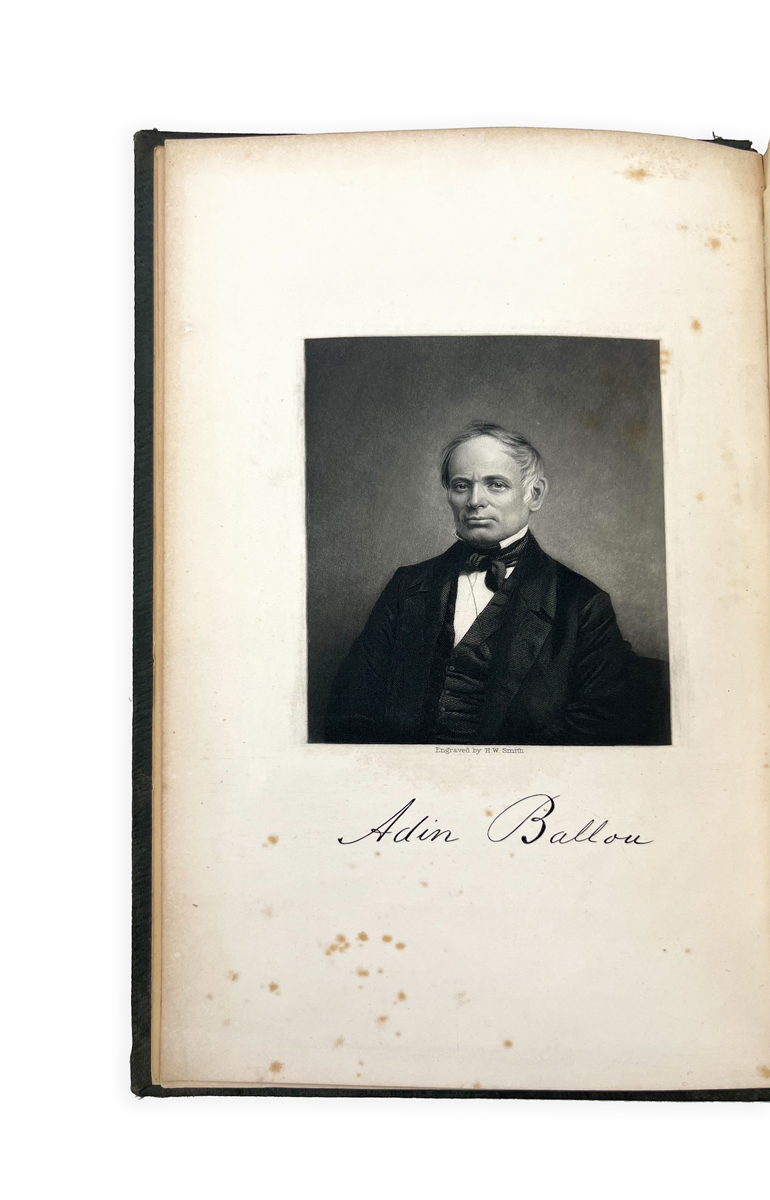
8vo, pp. xxi, [22]–655, [1 (blank)], with a stipple-engraved portrait frontispiece of Ballou; some foxing to endpapers and frontispiece, a few small stains to fore-edge; else a very good copy in contemporary green pebble-grained cloth, spine and covers blocked in blind, spine lettered directly in gilt; slight wear to extremities, endcaps chipped, scrape to lower cover.
Added to your basket:
Practical Christian Socialism: a conversational Exposition of the true System of human Society; in three Parts, viz: I. Fundamental Principles. II. Constitutional Polity. III. Superiority to other Systems.
First exposition of Ballou’s most important work, an explication of the principles behind his utopian Hopedale Community, established in Milford, Massachusetts in 1841.
The socialist, abolitionist, leading American Christian social reformer, and Universalist clergyman Adin Ballou (1803–1890) founded the Hopedale Community (1841–1856) during the heyday of such communal experiments. He surrendered his presidency of Hopedale in 1852 in order to devote himself to expanding his movement and elucidating its principles. Two years after the publication of the present work, the Hopedale Community would go bankrupt, and its assets would be purchased by the (aptly named) loom manufacturers Ebenezer and George Draper.
Here, Ballou sets out – in the form of a catechistic discourse between an inquirer and an expositor – inter alia, a definition of socialism, the theological principles informing Hopedale, property and mutual banking, physical exercise, sex education (‘This should be done long before puberty. It should be done by parents and educators whom the young reverence and love’), and the importance of the natural sciences, arts, and modern languages (Greek and Latin are dismissed as ‘worse than useless in nineteen out of every twenty cases. Possibly five students in a hundred might be encouraged to master the dead languages, and plod through the so called classics … Let living knowledge be accumulated and perfected, not the learning of dead pagans’), and proposes the adoption of libraries and reading rooms in utopian communities.
His early use of the phrase ‘Christian socialism’ in the work is highly significant, since no definite movement under that banner existed in the United States until, in the 1870s and 1880s, firm links were forged between progressive clergymen and leaders of the fast-growing ranks of organised labour. Ballou’s ideas had a significant influence on socialist and libertarian thought in the United States and Europe. He particularly influenced Tolstoy, and their correspondence was published in Arena in the year of Ballou’s death.
Library Hub records a single copy in the UK, at the British Library.
Not in Goldsmiths’. See Netlau, Bibliographie de l’anarchie, p. 229.