Menorahs and Gauffered Edges
[BIBLE – OLD TESTAMENT.]
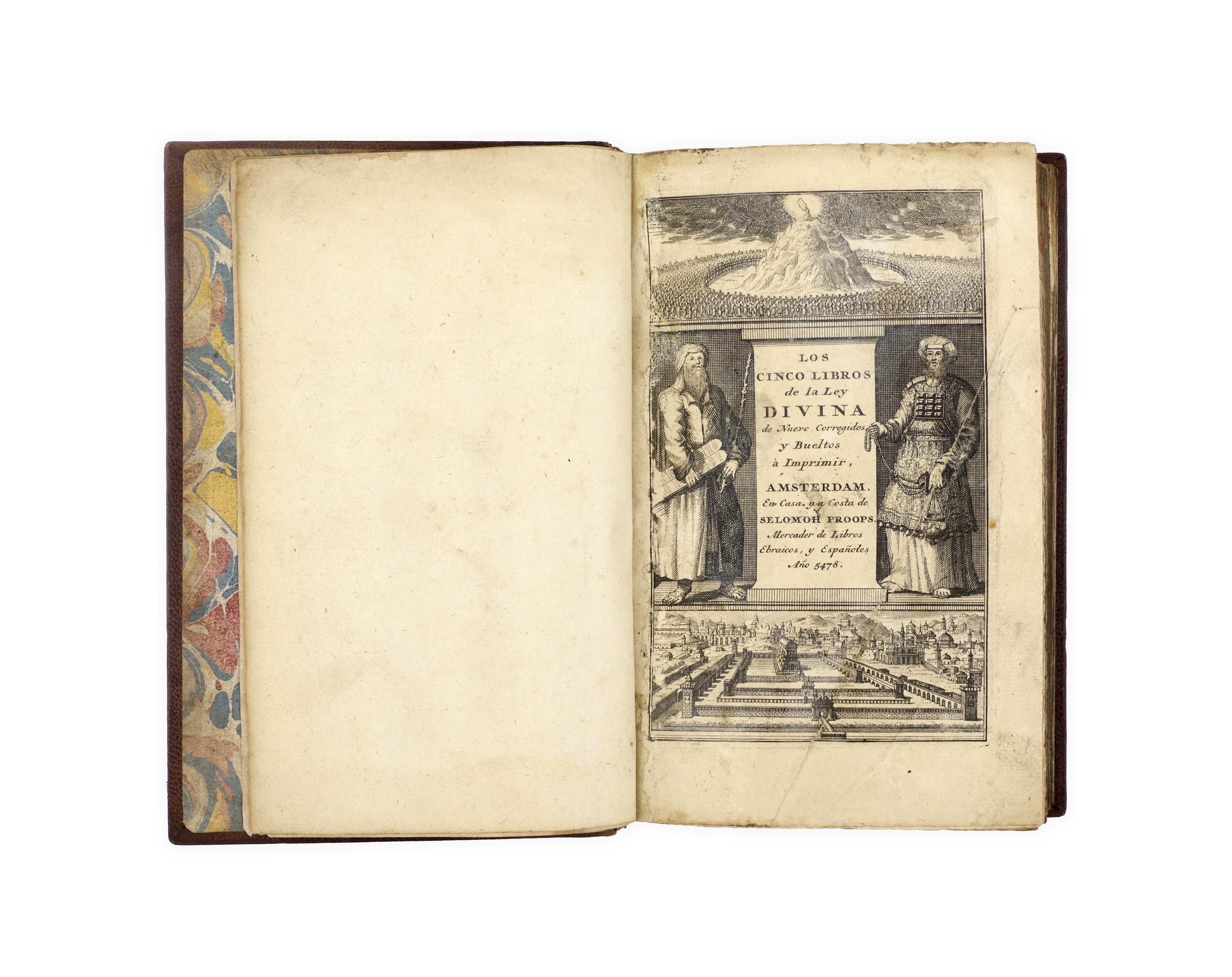
Los cinco libros de la ley divina. De nuevo corregidos y bueltos à imprimir [– Aphtaroth de todo el año Sabatoth, Ros-hodes, fiestas, solemnidades, y ayumos, que celebra el pueblo de Ysrael, segun. el uzo de nuestro K[ahal] K[adosh] en Amsterdam]. Amsterdam, ‘en casa, y a costa de Selomoh Proops’, ‘año 5478’ [i.e. 1717/1718].
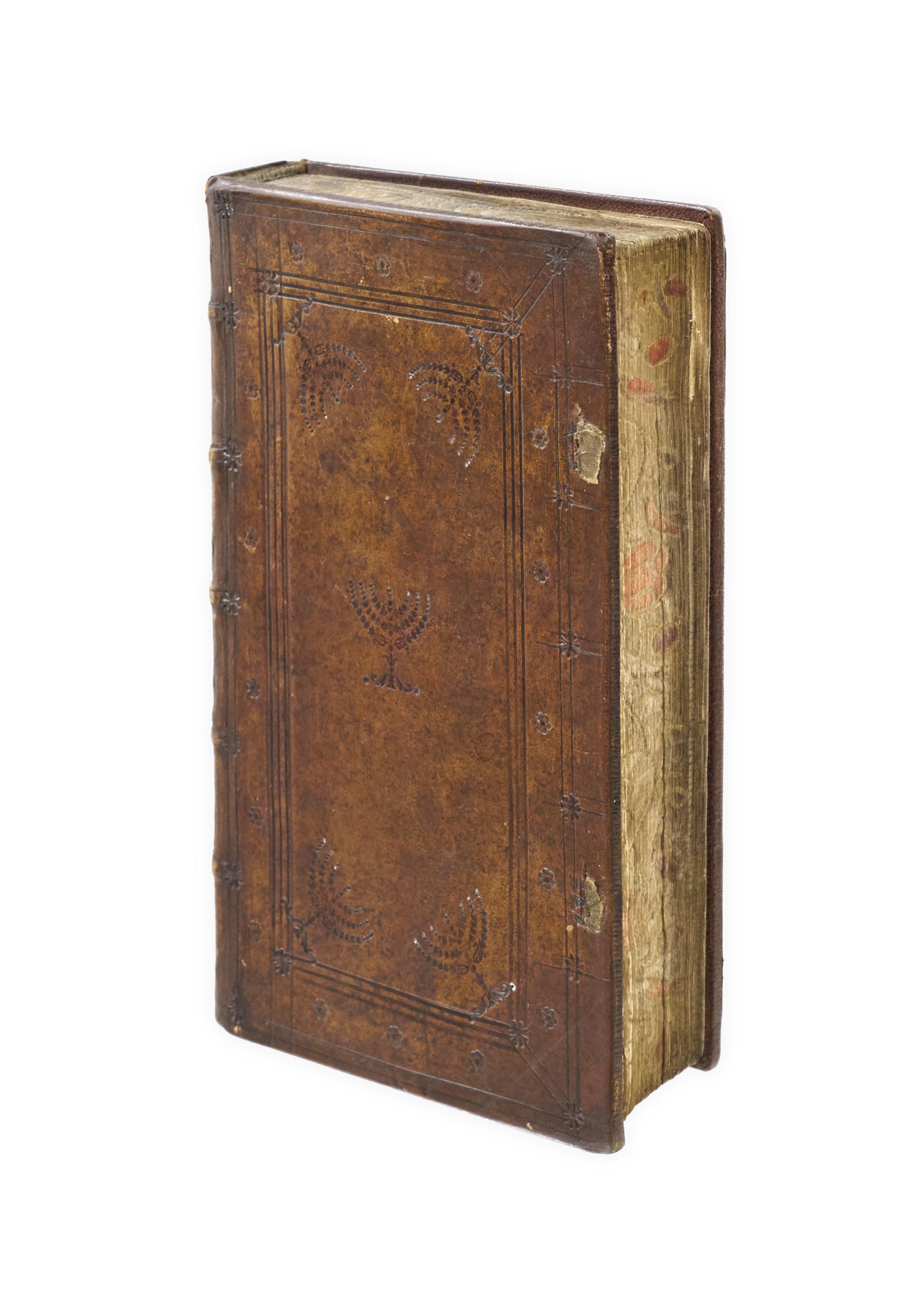
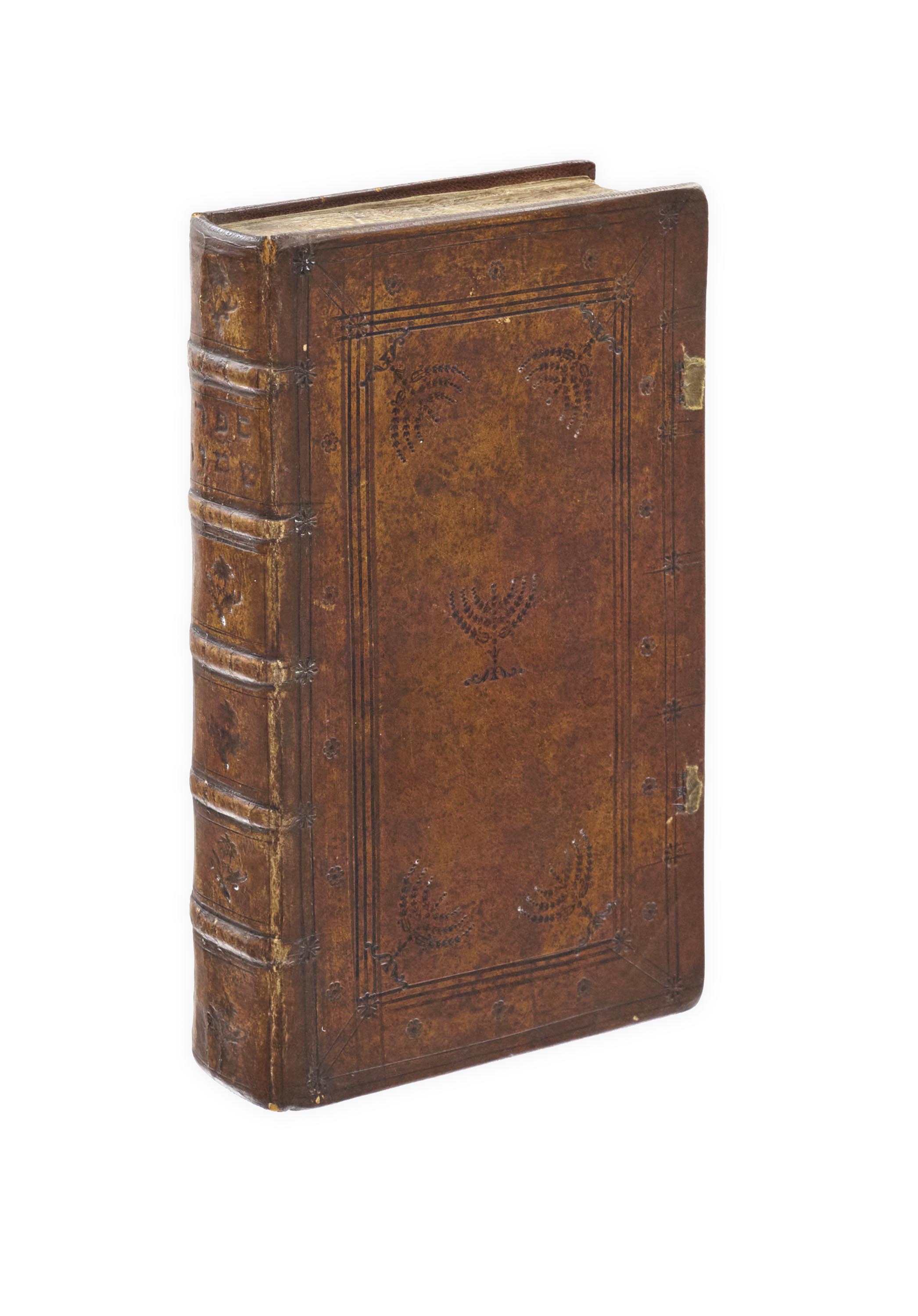
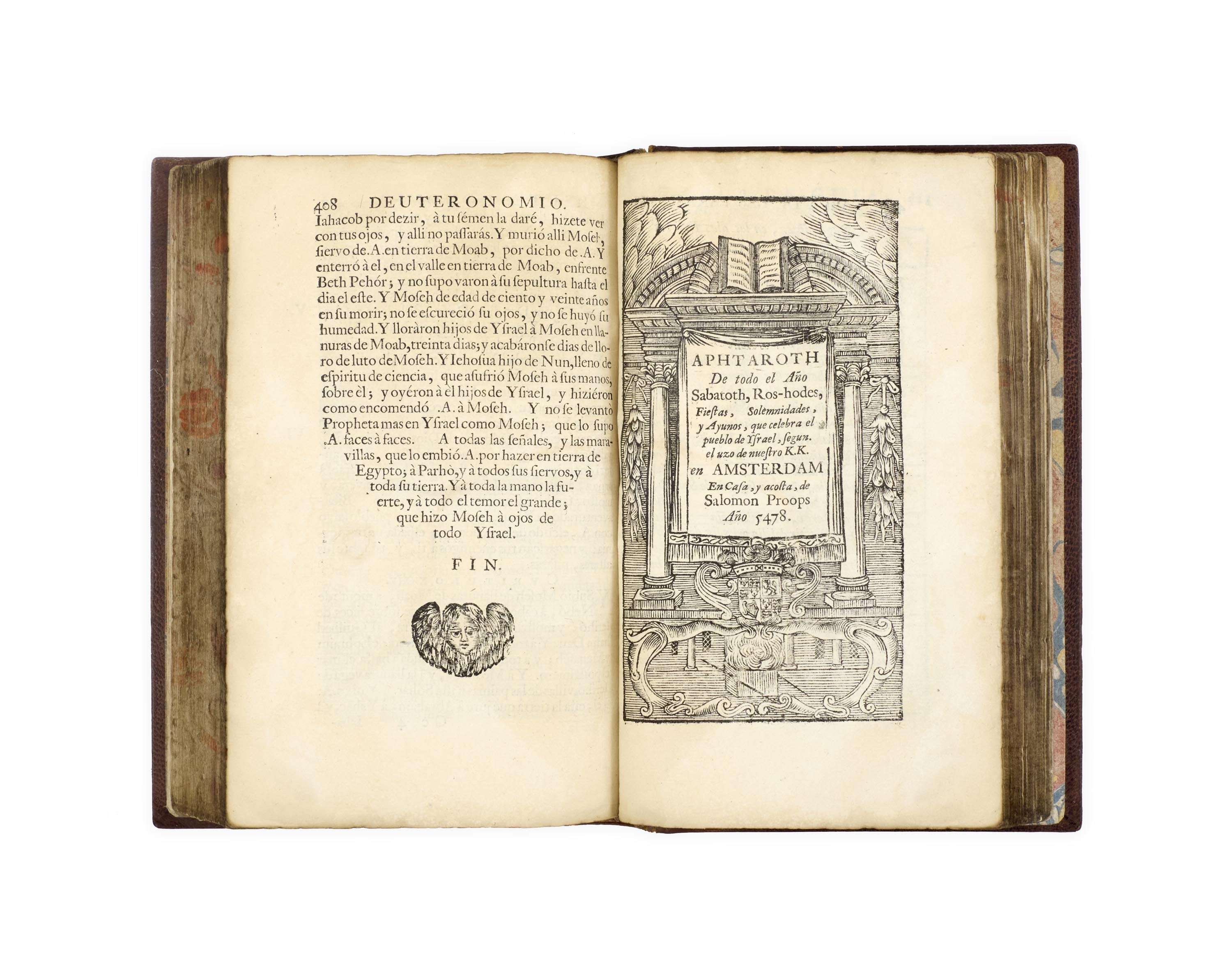
Two parts in one vol., 8vo, pp. [2], ‘528’ (recte 530); title copper-engraved, Haftarot (‘Aphtaroth’) with part-title within architectural woodcut border; sporadic light dampstaining and spotting, repair to lower corner of A2 affecting several words, but a good copy; bound in old calf, boards unusually tooled in blind to a panel design with menorah centre- and cornerpieces, spine blind-tooled in compartments and lettered directly in blind (‘ספר שמו[ת]’), edges gilt, gauffered, and coloured with a design of flowers and birds (see below); endpapers renewed, very skilful restorations to binding, ties perished.
Added to your basket:
Los cinco libros de la ley divina. De nuevo corregidos y bueltos à imprimir [– Aphtaroth de todo el año Sabatoth, Ros-hodes, fiestas, solemnidades, y ayumos, que celebra el pueblo de Ysrael, segun. el uzo de nuestro K[ahal] K[adosh] en Amsterdam].
An uncommon and handsomely produced Pentateuch with haftarot, printed for the use of the Spanish-speaking Sephardic Jewish community of Amsterdam, our copy in an attractive binding incorporating menorahs and with richly gauffered edges featuring birds and floral motifs.
Amsterdam was home to a large community of Sephardic Jews and conversos following the Spanish Inquisition, and by 1639 had unified its three Sephardic congregations, and the city’s Esnoga, also known as the Portuguese synagogue, was completed in 1675.
Solomon ben Joseph Proops (elsewhere Salomon or Selomoh, d. 1734) was active as a bookseller in Amsterdam from 1697, and in 1704 ‘set up his own Hebrew press, which produced mainly liturgical books but also a wider range of works in halakah, Aggadah, Kabbalah, ethics, and history … In 1730 he issued a sales catalog (Appiryon Shelomo), the first such Hebrew publication’ (Jewish Virtual Library). The Proops publishing house was continued by his sons Joseph, Jacob, and Abraham, and later by Jacob’s widow, sons, and nephew. The handsomely engraved title-page shows Moses on Mount Sinai and with the Tabernacle, a High Priest, and the Temple. The second section of the work, containing the haftarot, features a guide on which parshas should be doubled up according to leap years from 5479 to 5538 (pp. 409–11); its woodcut architectural border, with the royal arms of England below, is likely reused from Bibles printed in Amsterdam for the English market in the previous century.
Our copy appears to have been bound originally, as often, with Proops’s Orden de las oraciones cotidianas and the Calendario de Ros-hodes, both issued in the same year: we know of a volume containing the two other works, with corresponding edge decoration but now in a modern binding, currently in the American trade.
OCLC finds six copies in the US (Emory, Harvard, Hebrew Union, Newberry, Ohio State, and UCLA), and two in the UK (CUL, UCL), to which Library Hub adds another, at the Leopold Muller Memorial Library.
STCN 317296965 (recording only two copies, at the Universiteitsbibliotheek Amsterdam and Ets Haim).