Sacred Scripture, Greek Guerrillas, a Moscow Mix-Up, and a Forger Foiled
[BIBLE.]
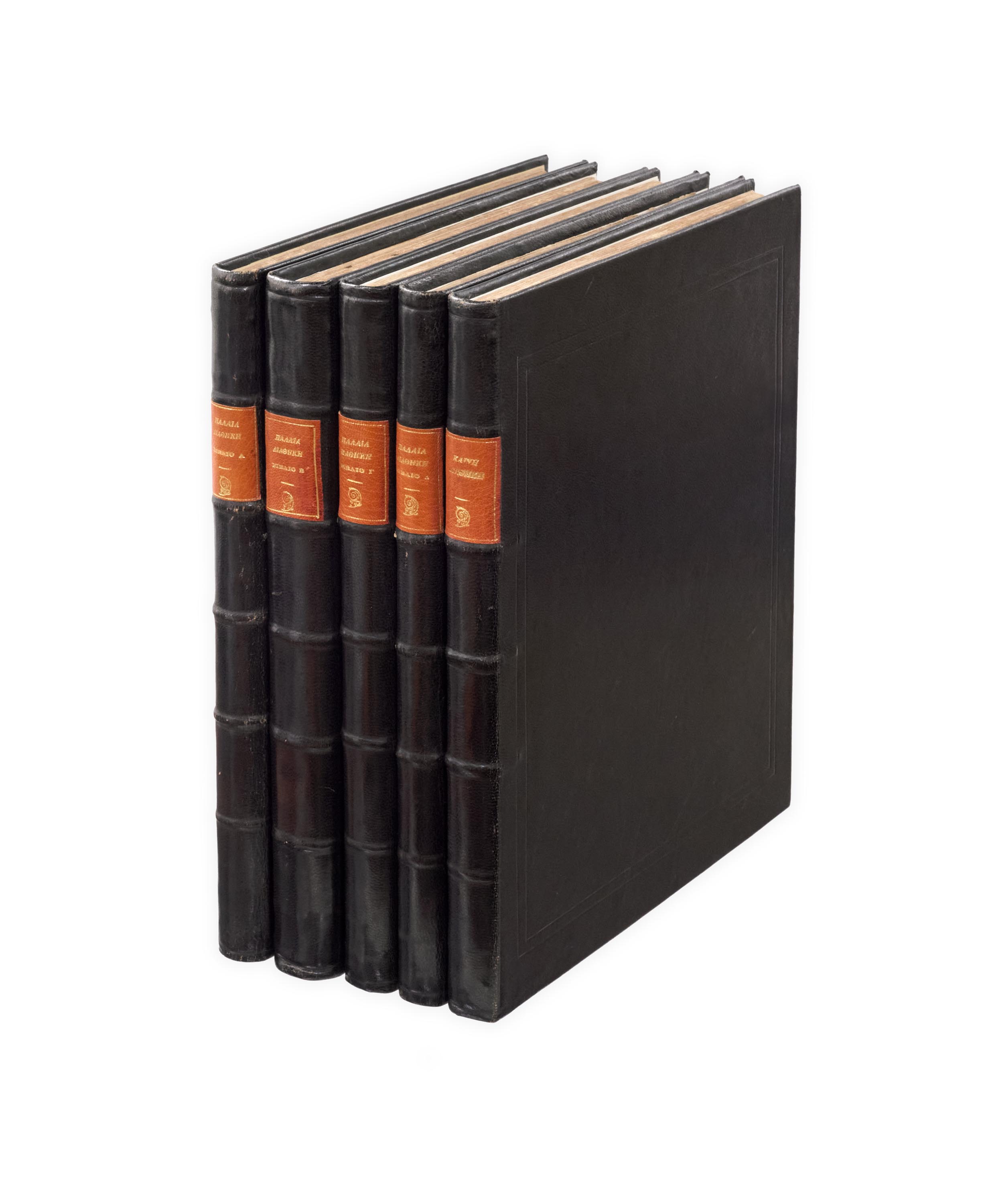
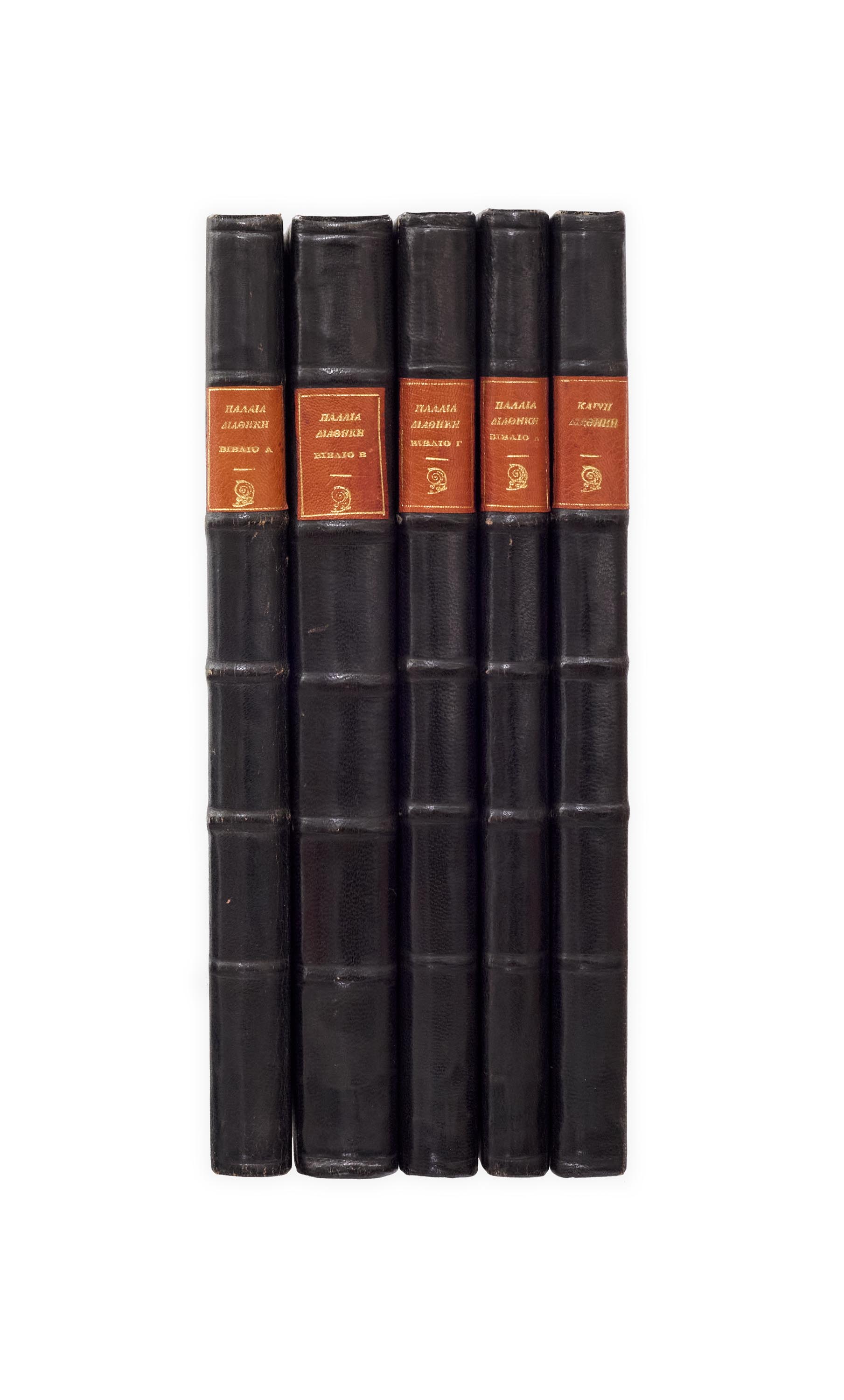
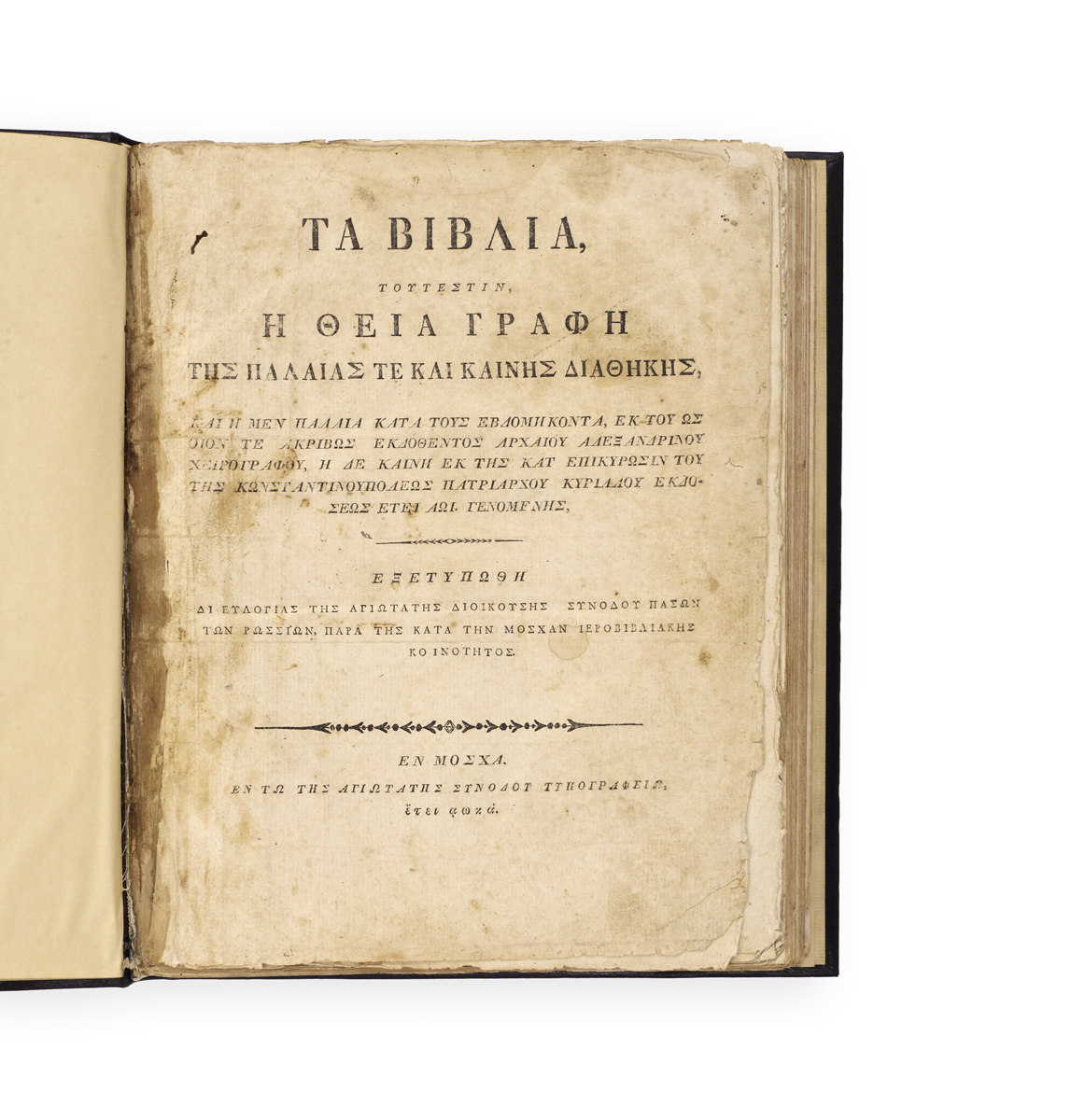
Τα Βιβλια, τουτεστιν, η Θεια Γραφη της Παλαιας τε και Καινης Διαθηκης … Moscow, the Holy Synod Press for the Russian Bible Society, 1821.
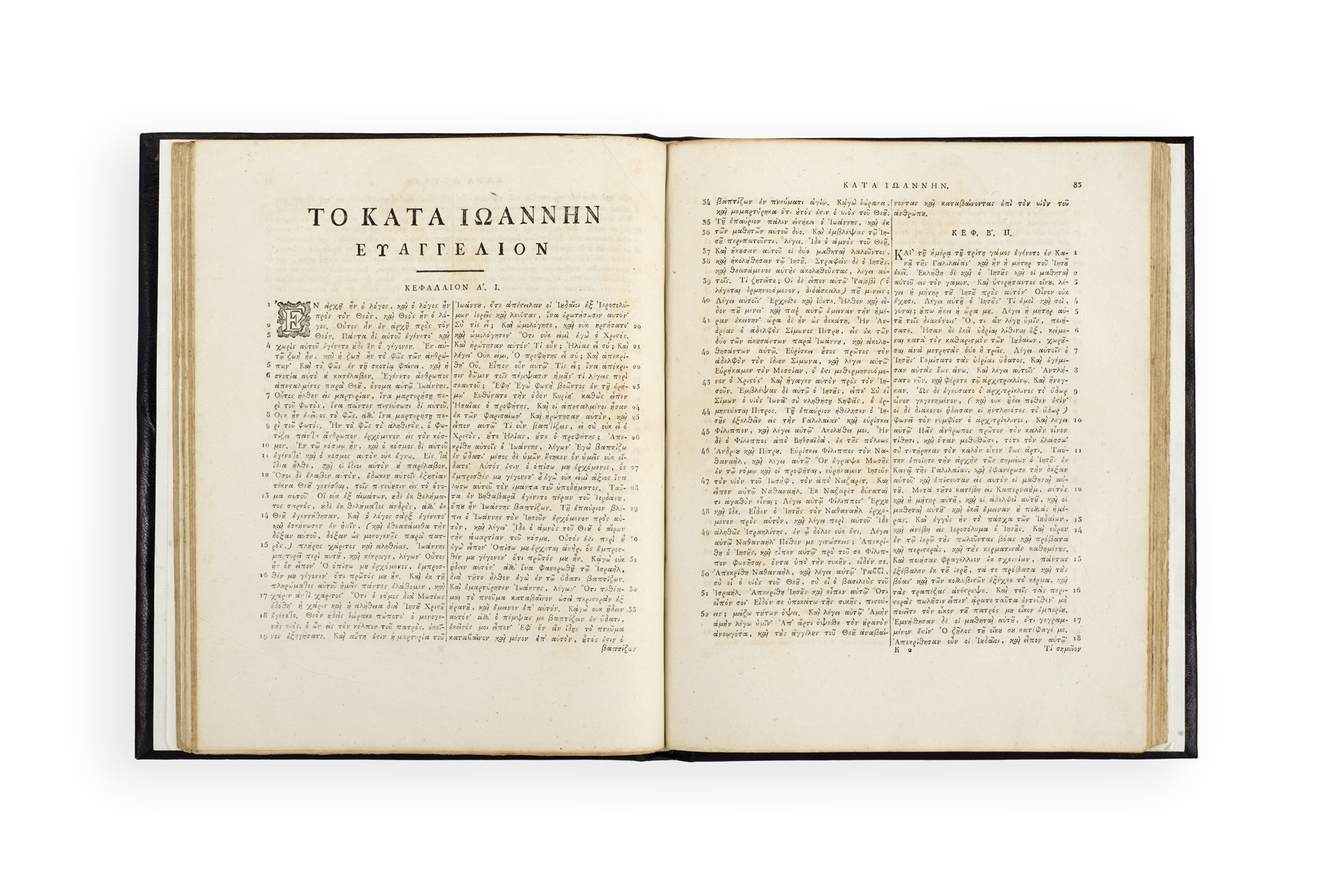
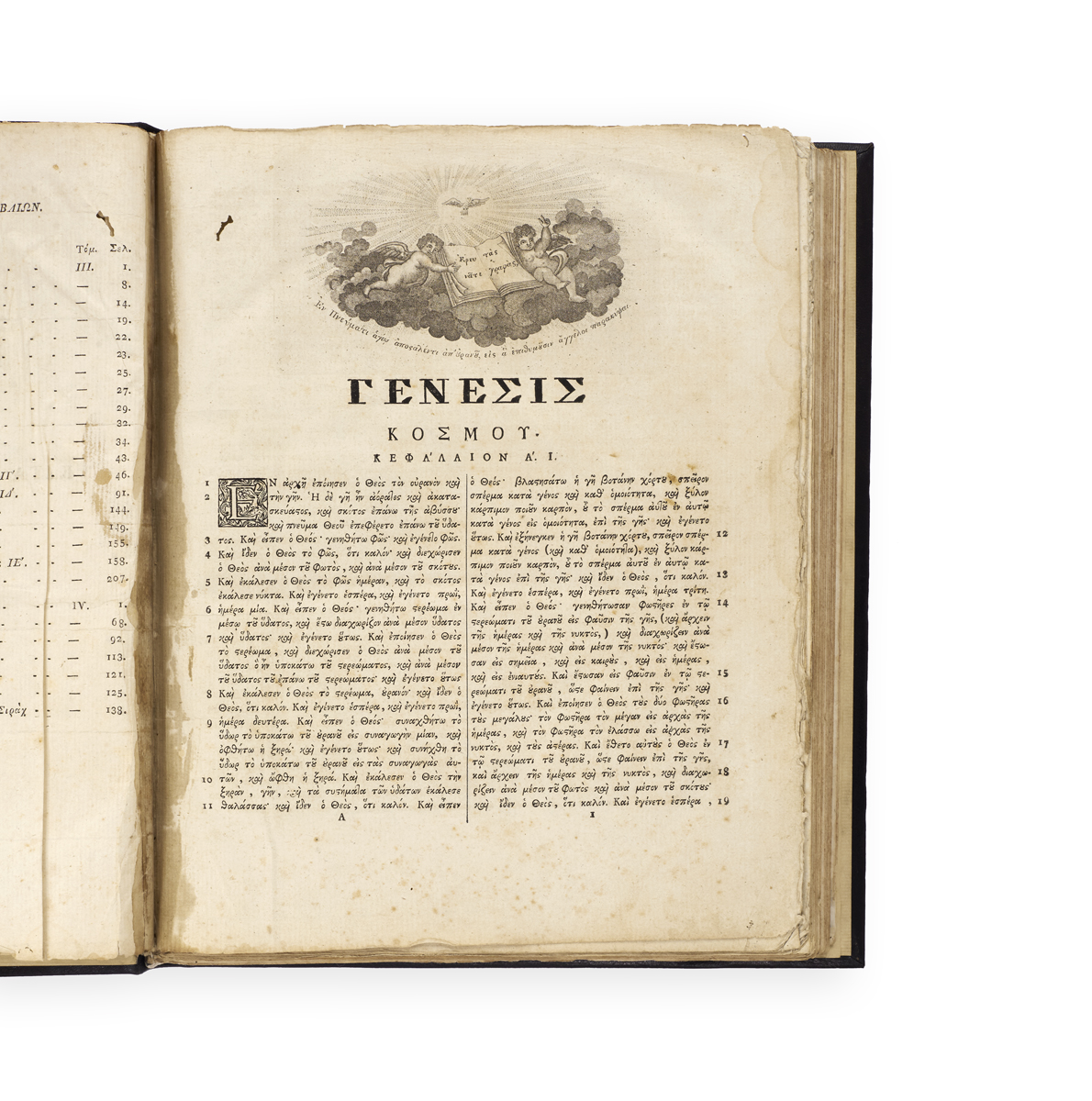
Five vols, large 4to, with pp. [iv] and [ii] of preliminaries in vols I and V not recorded in Darlow & Moule, wanting final leaf of variant readings in vol. IV; bifolium I X1.4 misbound within X2.3; text in Greek, ornamental initials at start of each volume, stipple-engraved vignette head-piece to I A1r (Genesis); minor worming throughout (affecting a handful of words per page in some sections, occasionally repaired with paper or tape), occasional dampstains, foxing, and other blemishes, crude repair with some staining to gutter of π1–(1)1 of vol. I, small holes to (16)1 of vol. II and ъ2 of vol. V, paper-flaw to fore-edge of (2)2 of vol. II; bound in modern black morocco, gilt red morocco lettering-pieces to spines; very slightly scuffed; occasional pencil annotations.
Added to your basket:
Τα Βιβλια, τουτεστιν, η Θεια Γραφη της Παλαιας τε και Καινης Διαθηκης …
First edition printed in Russia of the Septuagint and Greek New Testament, published likely with political motives in the year of the Greek Revolution.
Despite the official status of the Greek Bible in the Orthodox Church, no edition was printed in Russia prior to this 1821 set. This version also stands as only the second Orthodox-sponsored edition, the first having been printed at Venice in 1687 – Ottoman restrictions and a reluctant Orthodox priesthood having served to slow the advent.
Several factors seem to have been behind this Moscow edition. Tsar Alexander I had taken an intensely religious turn since Napoleon’s invasion, reading the Bible daily and establishing in 1813 the ecumenical Russian Bible Society, inspired and supported by the British and Foreign Bible Society founded the decade before. Like its London counterpart, the Russian Bible Society aimed to publish the scriptures in large numbers and in a broad array of languages both ancient and modern. Its productions included the first Bibles printed in Russian as well as editions in Slavonic, Armenian, Georgian, Mongolian, Chuvash, and many other minority languages of the Russian Empire.
Though published under the Society’s aegis, this Greek edition was funded by the brothers Zosimas (also known as the Zosimades), merchants born in Ottoman-controlled Epirus who operated across the Mediterranean and Russia. With their wealth they became great patrons of the Greek Enlightenment and the cause of independence, donating to schools and libraries, aiding the publication of Korais’s Greek Library, and funding the Philike Hetaireia, the secret society that after several years of plotting launched the Greek War of Independence in 1821.
Given the date of our edition and the Zosimades’ revolutionary activities, it is likely that the present set was printed with the nascent independence movement in mind. Copies may have been intended for distribution in Greece itself. Equally the edition may have had geopolitical aims: one open question at the rebellion’s outset was whether Russia would come to its coreligionists’ aid or prefer the stability of the Congress System. (Prince Alexander Nikolayevich Golitsyn, one of the Russian Bible Society’s founders, was also among the most vocal supporters of the Greek revolt in Russia.) If such was the case, the Society failed in both its present and its broader aims: Tsar Alexander refused to support the Greeks, removing the Greek nationalist leader Yspilantis from his post in the Russian Army, and the Society itself was suspended under conservative pressure in 1826 (to be revived only in 1990).
Textually the Septuagint found here is peculiar, perhaps the result of hasty preparation in response to events in Greece. The text is based on Grabe’s 1707–20 edition of Codex Alexandrinus. The Moscow editors, however, ‘ignored Grabe’s critical remarks with the result that some of his corrections of and additions to the text … which had been printed in smaller type, were included in the Moscow edition as if they had formed part of that codex’s text, while its actual readings are to be found in the four lists of variants printed at the end of the edition’ (Thomson, pp. 618–9). These misreadings went on to cause considerable confusion in Russian biblical criticism.
This edition also played a role in the fabrications of Constantine Simonides, ‘perhaps the most ambitious modern forger of classical texts’ (Freeman, p. 80). Born in the Dodecanese at the time of the revolution, he claimed to have lived with the monks at Athos, whence his forged manuscripts supposedly came. Sir Thomas Phillipps and others were fooled, but Simonides was soon found out. In revenge he alleged that a manuscript of genuine antiquity – Codex Sinaiticus, one of the oldest witnesses of the Greek Bible, at the time recently discovered at St Catherine’s Monastery in Sinai, removed to St Petersburg, and in the process of being published at the Russian government’s expense – had in fact been written out by him.
Writing to the British press in 1862, Simonides asserted that the codex had in fact originated during his time at Athos. In this false account, the young Simonides was asked to copy out the Greek Bible ‘according to the ancient form, in capital letters’, in a volume of blank parchment, as a gift for Tsar Nicholas. The manuscript was subsequently ‘much altered, having an older appearance than it ought to have’, with the dedication to the Tsar removed, and found its way to St Catherine’s, where it was discovered and mistaken by the German scholar Constantin von Tischendorf. ‘When, about two years ago, I saw the first fac-similes of Tischendorf … I at once recognised my own work’ (The Guardian, 3 September 1862).
The text Simonides claimed to have transcribed was none other than ‘the Moscow edition of both Testaments (published and presented to the Greeks by the illustrious brothers Zosimas)’ (ibid.). Was this Simonides’ punch line: that a Greek Bible, taken from a Greek Orthodox monastery by the Russians, was in fact a modern copy based on a Russian edition funded by Greeks?
Darlow & Moule 4796. See Freeman, Bibliotheca fictiva: a Collection of Books and Manuscripts relating to literary Forgery, 400 BC–AD 2000 (2024); Thomson, ‘The Slavonic translation of the Old Testament’, in Jože Krašovec, ed., The Interpretation of the Bible (1998).