Real Boethius and Fake Boethius
BOETHIUS; [Pseudo-] Thomas AQUINAS, commentator.
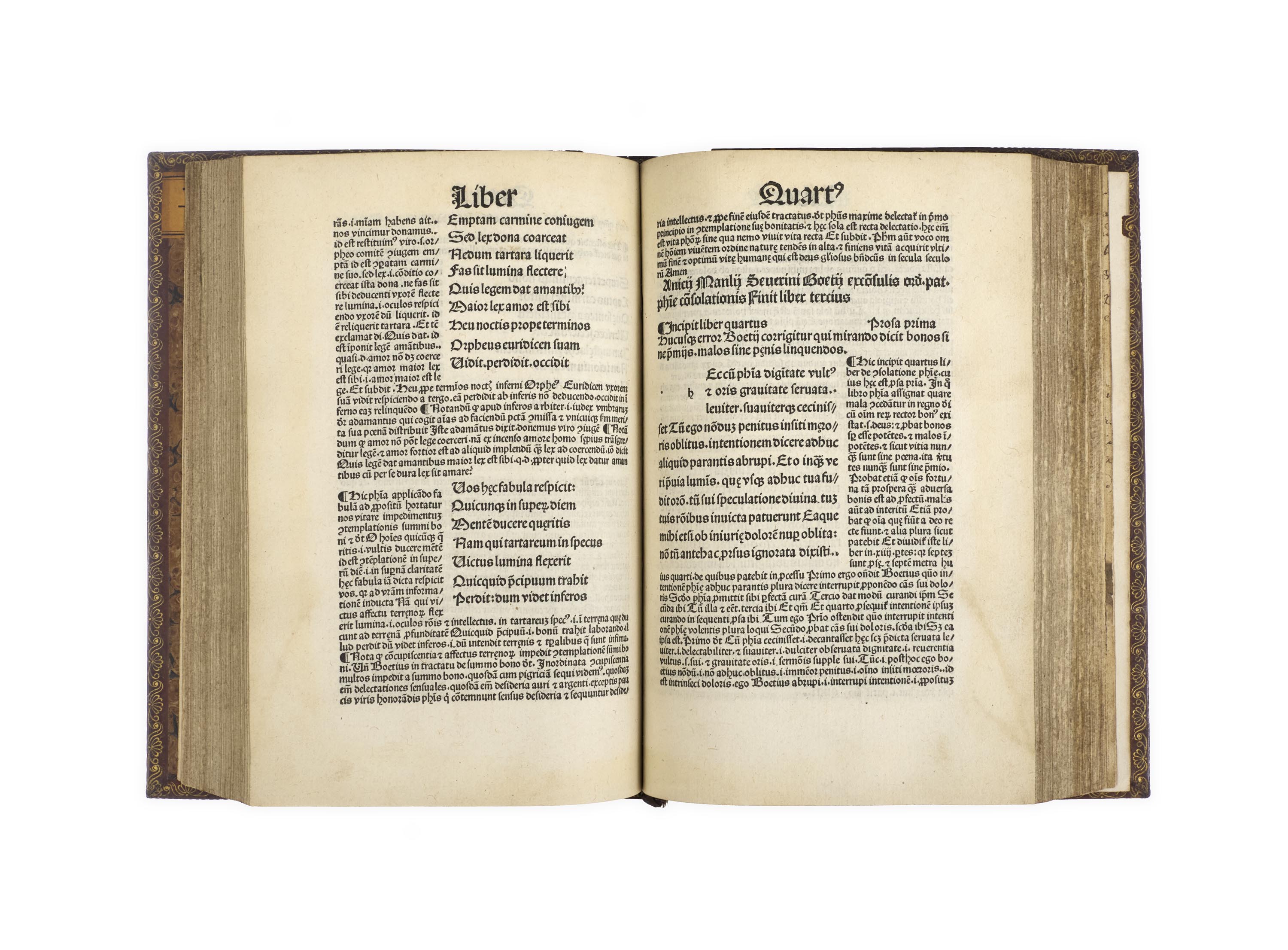
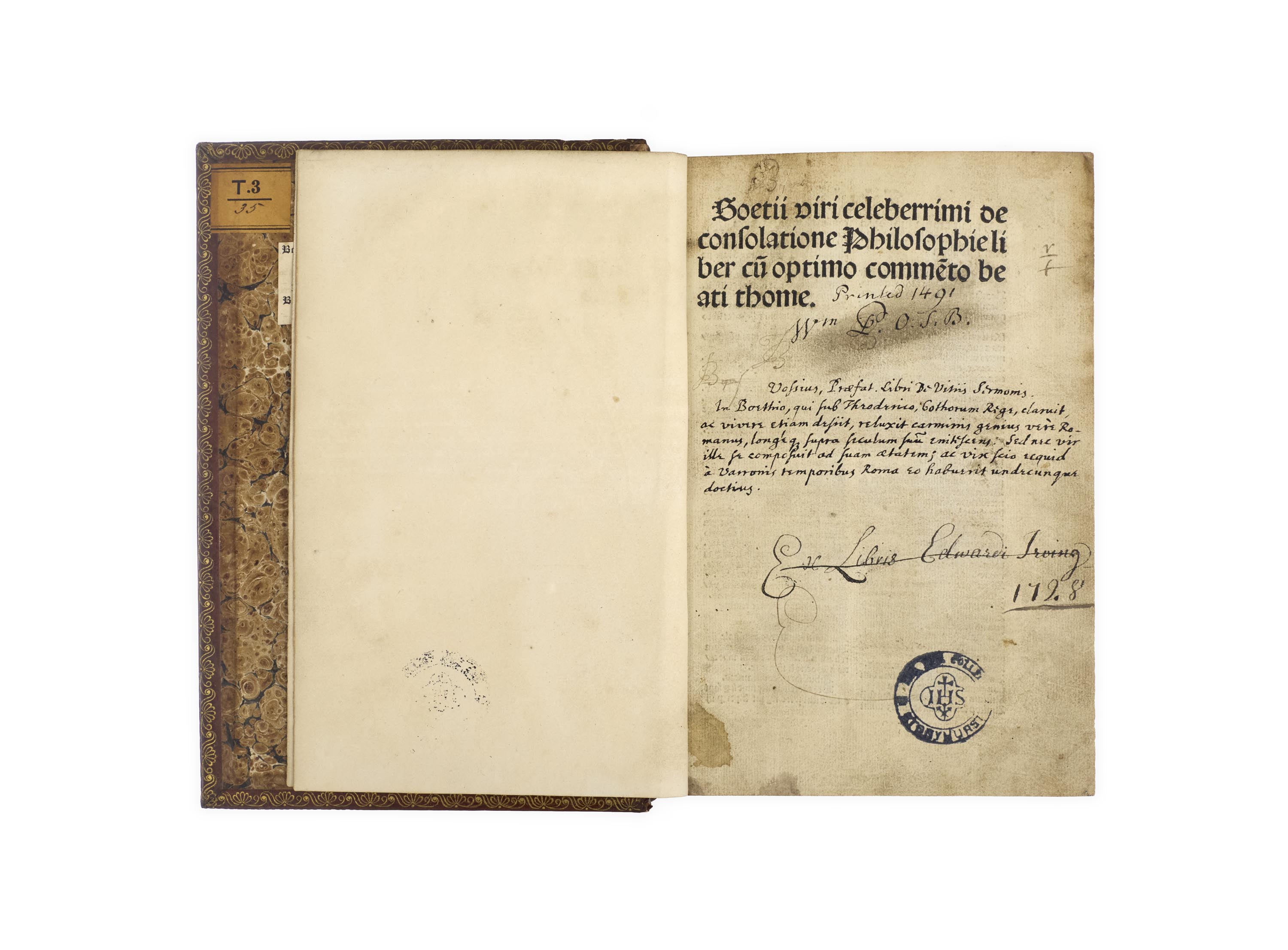
De consolatione philosophie liber cum optimo commento beati Thome. [(Colophon:) Deventer, Jacobus de Breda, 19 March 1491.]
[bound with:]
BOETHIUS [Pseudo-]. De disciplina scholarium cum notabili commento. [(Colophon:) Deventer, Jacobus de Breda, 3 February 1492.]
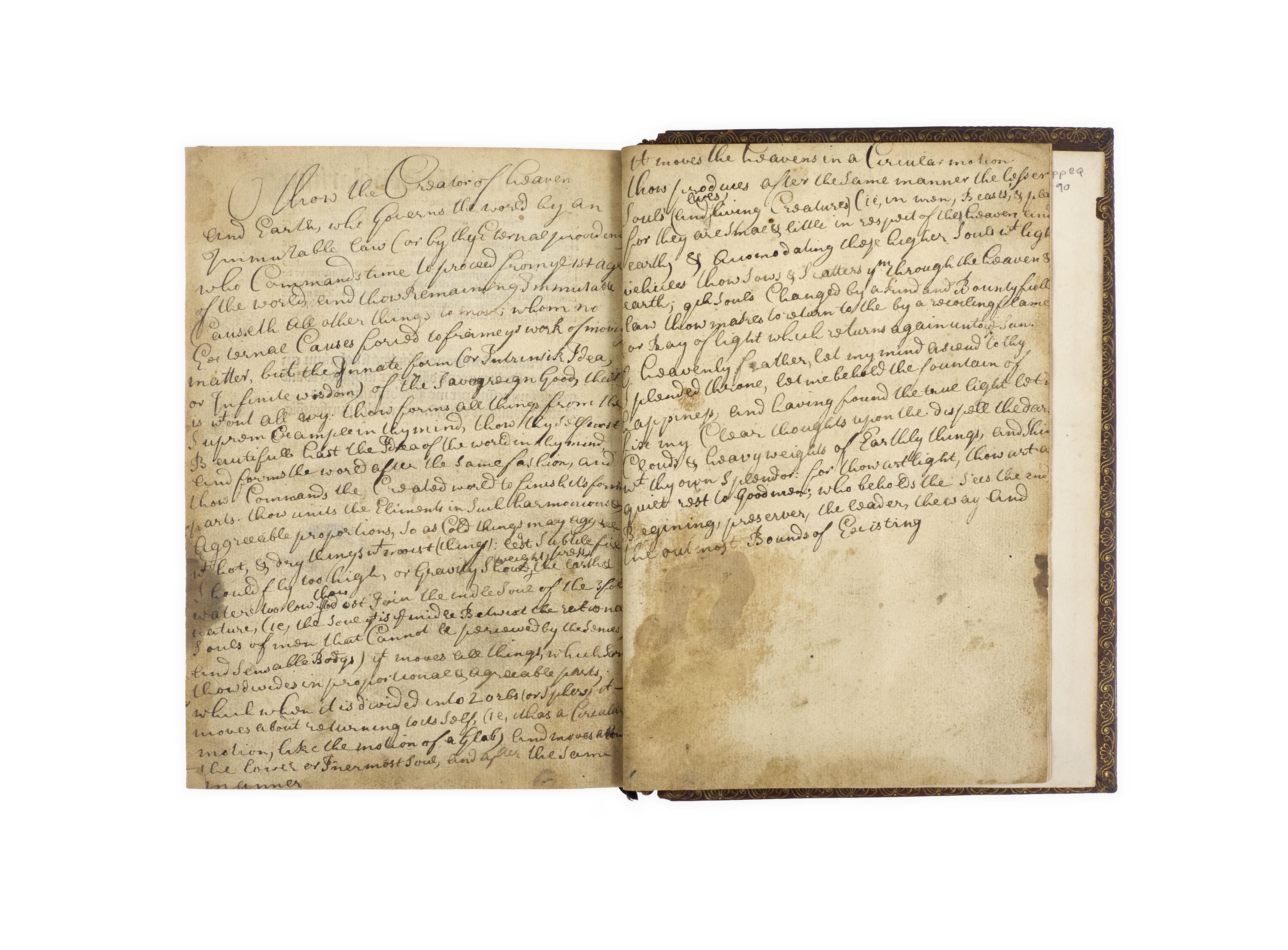
Two works in one vol., 4to, De consolatione: ff. [174]; [*]6 a8 b–r6 s4 t–z6 A–D6; De disciplina: ff. [60]; a–k6, with final blank k6; gothic letter, capital spaces with guide letters, first initial supplied later in ink incorporating a sketch of a head; first title a little duststained, some light marginal dampstaining, quire a with some staining to text, but good copies; bound in early nineteenth-century russia, boards roll-tooled in gilt and blind to a panel design, spine tooled in gilt and blind and lettered in gilt, edges speckled blue, marbled endpapers; neatly rejointed; ink inscriptions and monogram of J. Byers to title (partly obscured), ink inscription ‘Ex Libris Edwardi Irving | 1728’ to title (deleted in ink) and to k5r, with extensive notes in English to k5v–k6r, ink inscription ‘Wm. P. O.S.B’ with notes in English and Latin to first title-page, later ink stamps of Stonyhurst College to first and last leaves with shelflabel to front board.
Added to your basket:
De consolatione philosophie liber cum optimo commento beati Thome.
Uncommon Deventer edition of Boethius’s famous Consolation of Philosophy, along with the spuriously attributed treatise of advice for scholars.
The second work was supposed to have been composed by Boethius after the Consolation but was actually a medieval invention first recorded in the 1230s. It advises what to study, obedience to one’s teacher, and how to handle servants and money, but this is interspersed with episodes of stupidity, violence, and mischief, ridiculing both teachers and students. Both works claim to contain a commentary by Thomas Aquinas, but the attribution is now disputed in both cases.
‘Situating De disciplina among other serio-comic grammar school teaching texts that make use of puerile fantasies, explicit sexuality, and ambiguous exempla to teach otherwise upright lessons, clarifies the pedagogical purpose of its supposedly odd Boethian humor and the acceptance that it met … For much of the Middle Ages, humor, and often transgressive humor, was considered a natural pedagogical tool to stimulate interest and memory in the youngest scholars’ (Hunter, p.163).
Both works were printed by Jacobus de Breda, active as a printer in Deventer between 1480 and 1518. The widespread interest in Boethius through the Middle Ages and beyond meant that his works were constantly in demand; Jacobus produced at least five editions of the Consolation and four of the Disciplina by the end of the fifteenth century.
Provenance:
The notes by one Edward Irving at the end of the volume contain text in English, beginning ‘O how the Creator of Heaven and Earth, who governs the world by an immutable law…’, perhaps responding to Boethius’s meditations on the tension between divine Providence and man’s free will.
ISTC lists three copies of the first work in the US (Newberry, Yale and the Huntington) and only one of the second work (Johns Hopkins).
De Consolatione: C 1111; BMC IX 67; GW 4552; Goff B794; ILC 418; Bod-inc B-399; ISTC ib00794000; De Disciplina: HC 3414; BMC IX 67; GW 4599; Goff B823; ILC 424; BSB-Ink B-625; ISTC ib00823000. See Hunter, ‘Boethian humor and the Pseudo-Boethian De disciplina scolarium’, in Viator 46 (2015), pp. 161–179.