Austrian Economics
BÖHM-BAWERK, Eugen von.
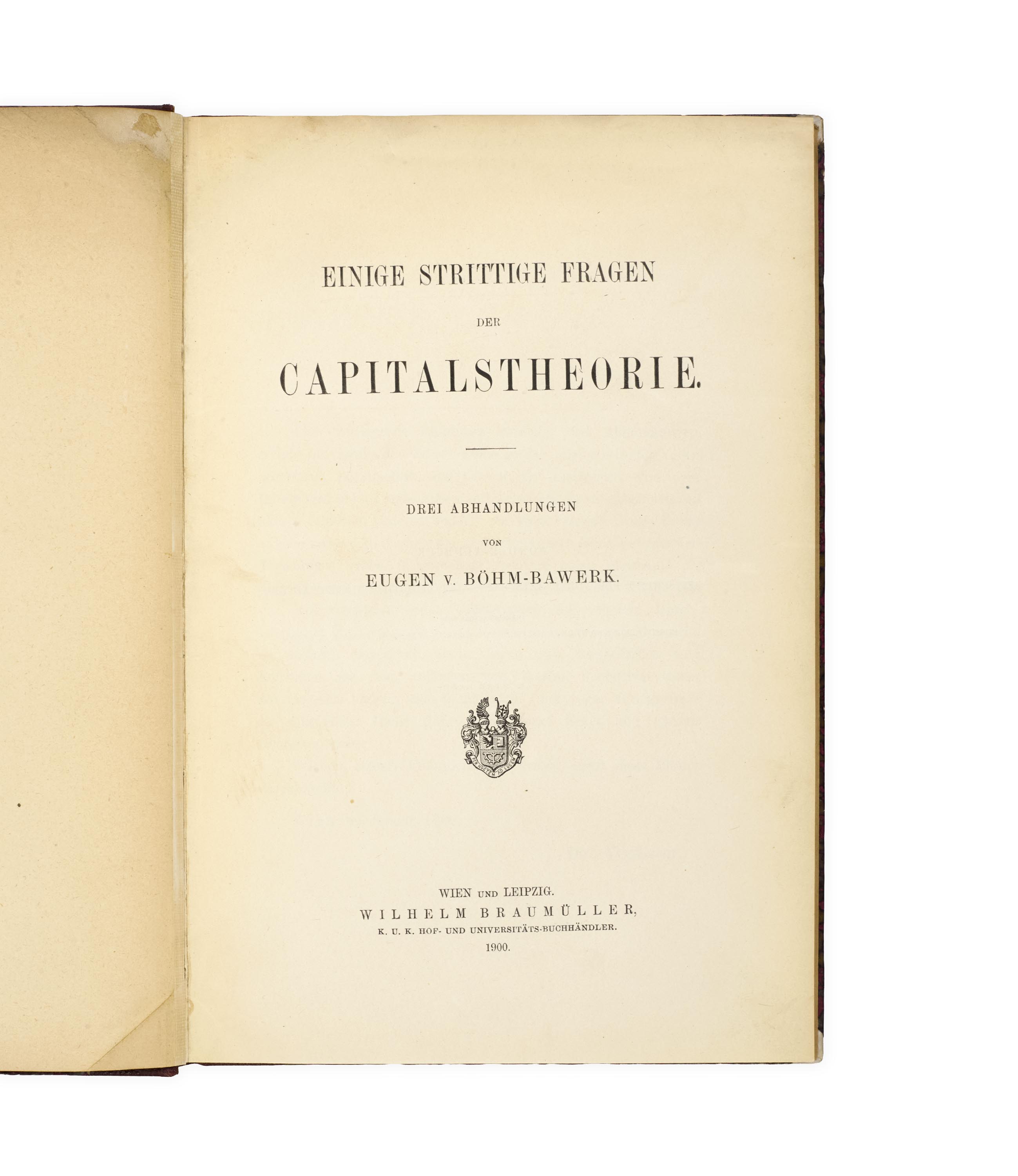
Einige strittige Fragen der Capitalstheorie. Drei Abhandlungen … Vienna & Leipzig, Wilhelm Braumüller, 1900.
Large 8vo, pp. [iv], 127, [1, blank]; very slight marginal browning, but a very good copy; bound in old maroon hard-grained morocco-backed boards with marbled sides and vellum tips, spine ruled in gilt and lettered directly in gilt, marbled endpapers, publisher’s printed front wrapper bound in; a little rubbed at extremities, spine lightly sunned; embossed paper bookplate of Stockholms Stads Sparbank to front pastedown, a few pencil annotations in shorthand.
First separate edition of three treatises, offprinted from the Zeitschrift für Volkswirtschaft, Socialpolitik, und Verwaltung in which they had first appeared the previous year, of this rare contribution on problems of capital theory by one of the most important leaders of the Austrian school of economics.
‘As civil servant and economic theorist, Böhm-Bawerk was one of the most influential economists of his generation. A leading member of the Austrian School, he was one of the main propagators of neoclassical economic theory and did much to help it attain its dominance over classical economic theory. His name is primarily associated with the Austrian theory of capital and a particular theory of interest’ (Hennings, p. 254). His work, however, was subsequently taken up by American economists and exerted great influence, particularly on Irving Fisher (ibid., p. 257).
The present essays – ‘Die Regel von der grösseren Ergiebigkeit der längeren Productionsumwege und die Rolle der Erfindungen in der Capitalstheorie’, ‘Ganzes und Theile des arbeitsheiligen Productionsprocesses; das Theoretisieren mit ungekannten Grössen’, and ‘Woran eine richtige Zinstheorie sich auf die Probe stellen lassen muss, und woran nicht; ein moderner vulgär-ökonomischer Ableger der socialistischen Ausbeutungstheorie’ – are a reply to critics, especially to the assaults made by Lexis, in which Böhm-Bawerk develops several important themes raised in his masterpiece, Kapital und Kapitalzins (1884–1889), one of the outstanding achievements of modern economic theory, both a constructive theory of interest on capital and a criticism of Marxist thought.
Einaudi 571; Menger, col. 128; Stammhammer, p. 40. See Hennings in The New Palgrave I, pp. 254–258.