Oppression of Women as Perversion of Nature
[BOUDIER DE VILLEMERT, Pierre-Joseph.]
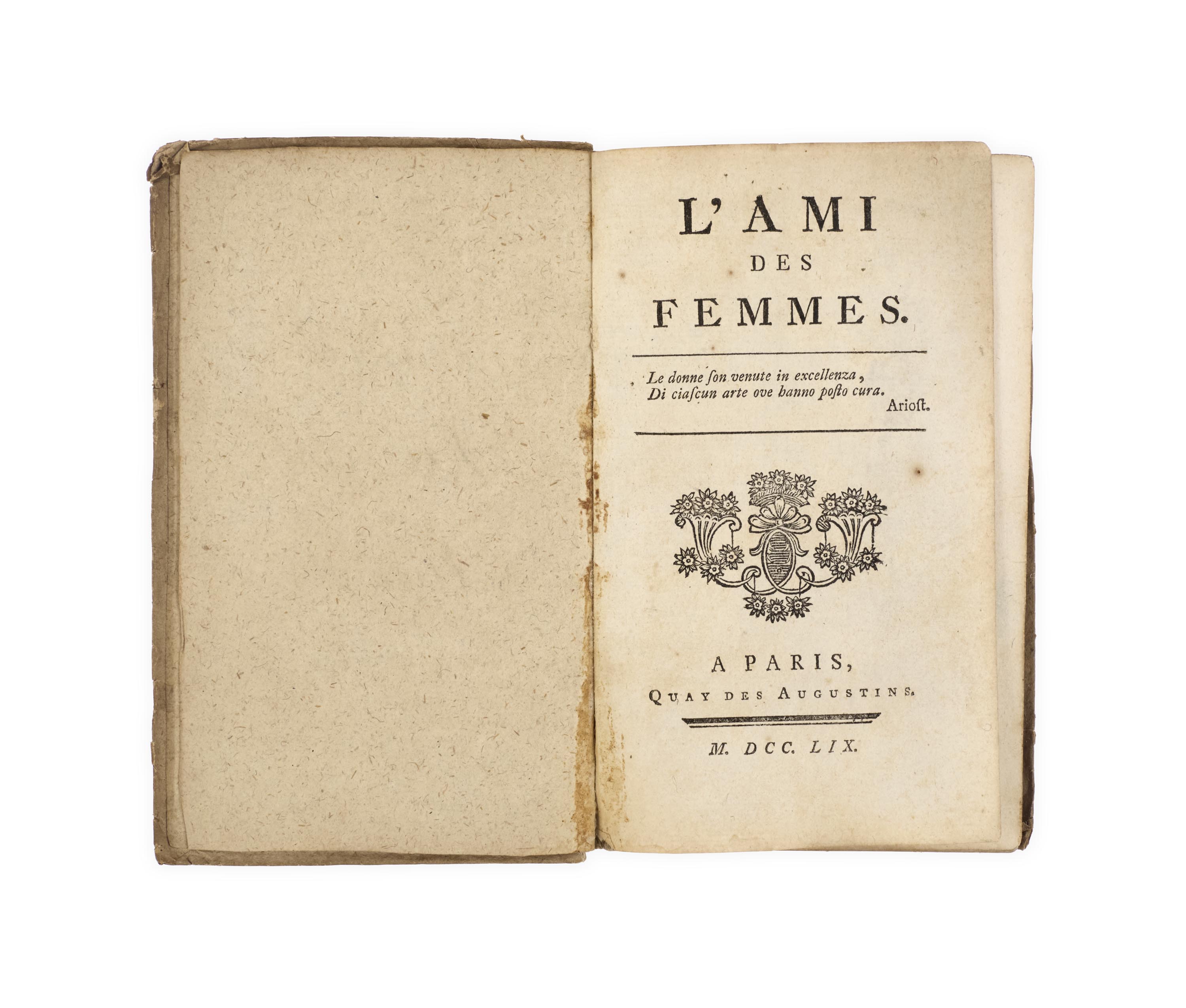
L’ami des femmes. Paris, ‘Quay des Augustins’, 1759.
8vo, pp. 182, [2, contents, blank]; woodcut ornament to title, woodcut initials and head- and tailpieces; first and last leaves coming loose, worming to hinges affecting inner margin of final leaf, otherwise a very good copy; in near-contemporary drab boards, spine lettered in manuscript, sums and doodles to boards; corners worn, a few chips to spine; nineteenth-century ownership inscription of François Marie Humpel to front free endpaper.
Uncommon early edition, printed a year after the first, of Boudier de Villemert’s most famous work, a courtesy book for women discussing education and the place of woman within society.
Published anonymously in 1758, L’ami des femmes was an immediate success, with later editions published under the author’s name; it was swiftly translated into German in 1759 as Der Freund des Frauenzimmers, and into English in 1766 as The Ladies Friend. Boudier (b. 1716), a jurisconsult about whom little is known, here promotes a natural harmony between men and women, arguing that the oppression of women is a perversion of Nature’s law, despite the idea that, according to the same natural laws, women and men might have different roles and different destinies within marriage.
He discusses, inter alia, the state of women in society; studies suitable for women; women’s occupation and dress; love and gallantry; marriage; and the education of children. Boudier de Villemert frequently vacillates between liberalism and traditional paternalism: while he argues that ‘“the mind has no sex”, he nonetheless denies women “abstract sciences and strenuous research whose details might weigh down their minds”. These hesitations show the difficulties experienced by minds in developing a liberal thesis from a misogynistic foundation’ (Albistur and Armogathe, Histoire du féminisme français I (1977), p. 269, trans.).
In the Avertissement, Boudier warns that his book is not a parody of Mirabeau’s L’Ami des hommes, but was nonetheless inspired by it.
Gay I, p. 112. This edition not in Quérard (see vol. I, p. 443), Barbier (see vol. I, col. 132), or Weller (see vol. II, p. 152). See Williams, ‘The Fate of French Feminism’ in Eighteenth-Century Studies 14.1 (1980), pp. 37–55.