Condemned Materialism, Global Annihilation, and Fake Female Authorship
[BOUREAU-DESLANDES, André-François.]
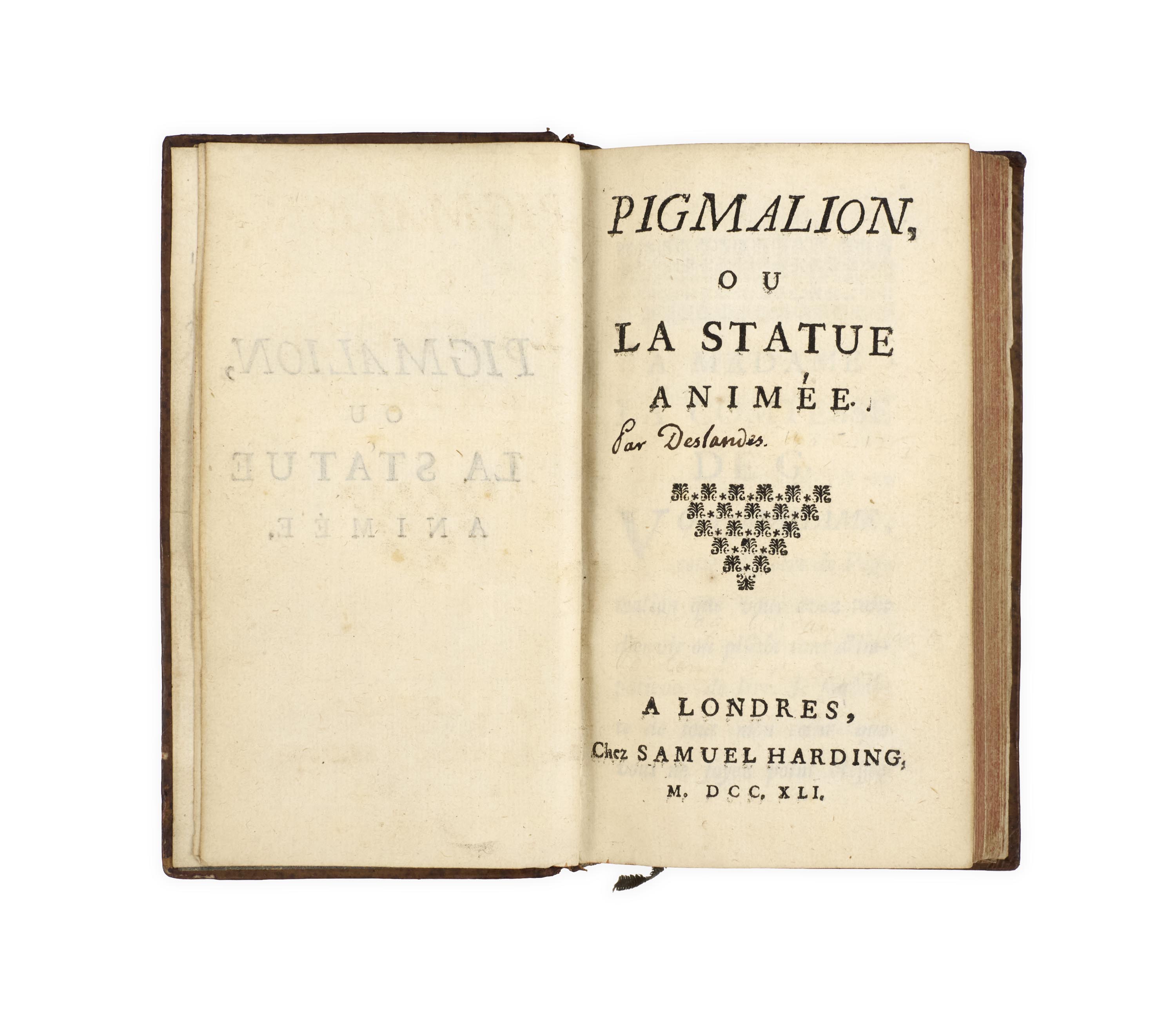
Pigmalion, ou la statue animée. ‘A Londres, chez Samuel Harding’, 1741.
[bound with:]
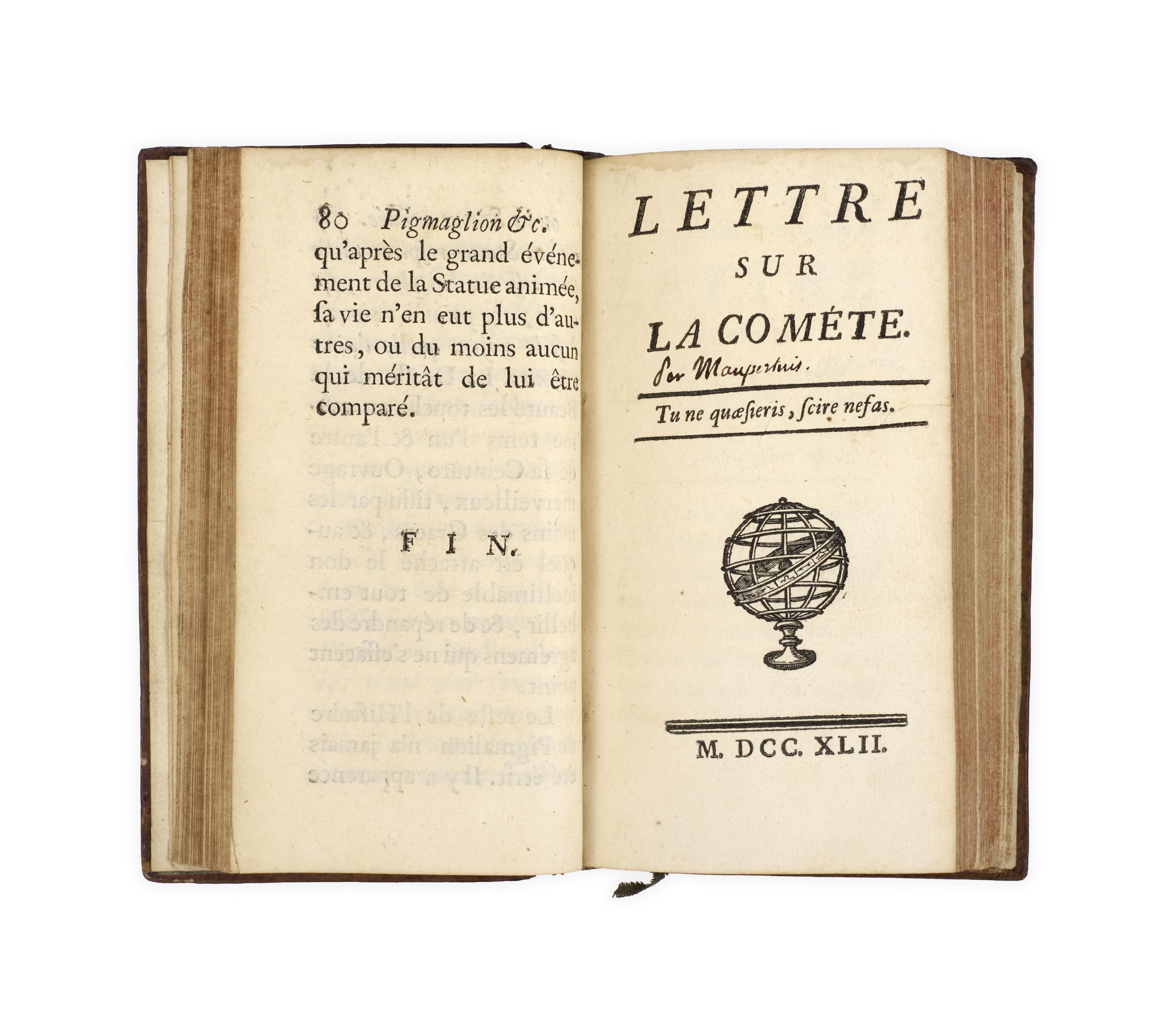
[MAUPERTUIS, Pierre-Louis Moreau de.] Lettre sur la comète. [S.l., s.n.,] 1742.[and:]
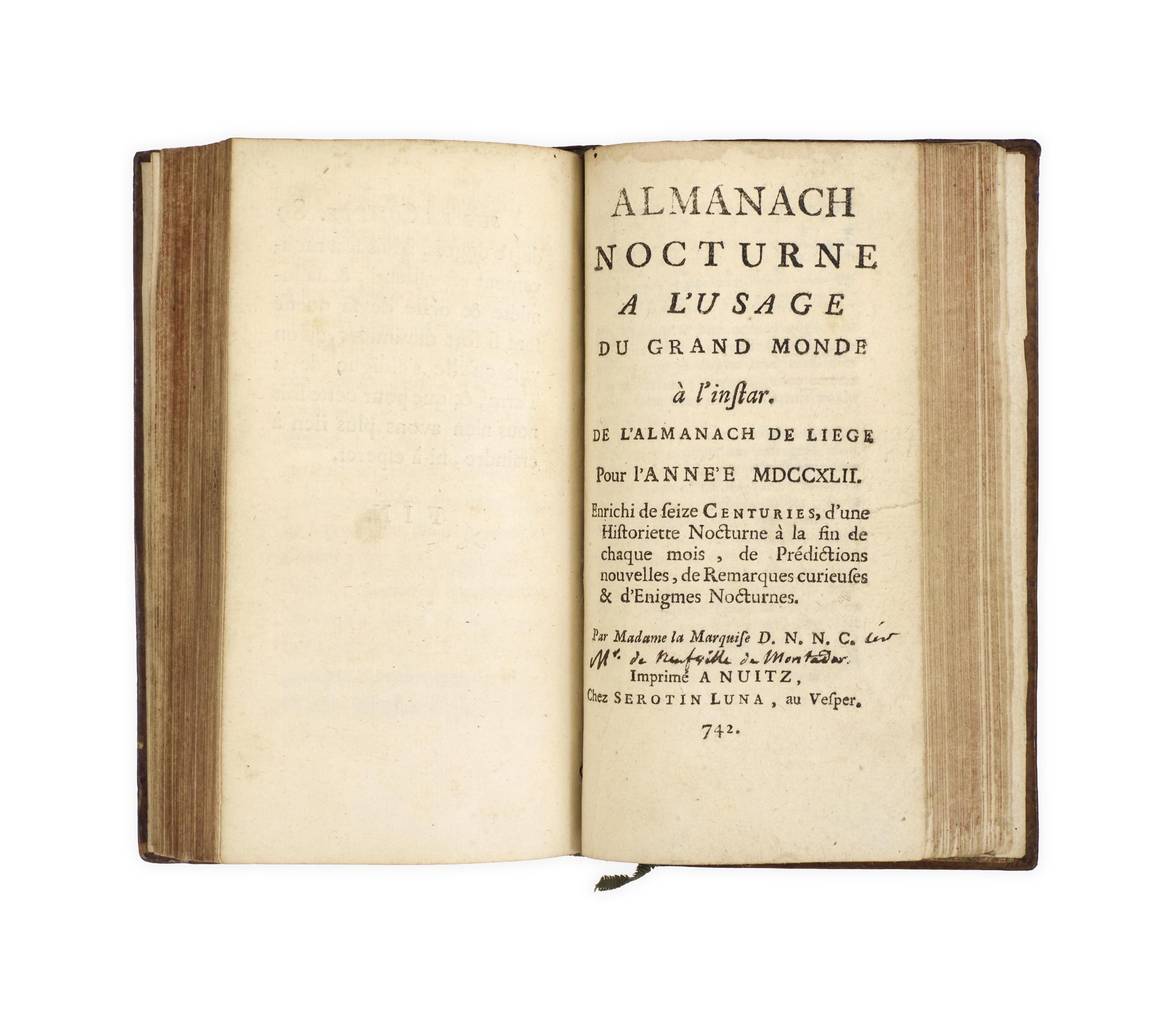
[Neufville de Brunaubois-Montador, Jean-Florent-Joseph de.] Almanach nocturne à l’usage du grand monde à l’instar de l’almanach de Liege pour l’année MDCCXLII. Enrichi de seize centuries, d’une historiette nocturne à la fin de chaque mois, de prédictions nouvelles, de remarques curieuses et d’enigmes nocturnes. Par Madame la Marquise D. N. N. C. ‘Imprimé à Nuitz, chez Serotin Luna, au Vesper, 742’.Three works in one vol., 12mo, Pigmalion: pp. [4], viii, 80; Lettre: pp. [2], 89, [1, blank], woodcut celestial globe to title; Almanach: pp. [2], 6, 9–124, bound without pp. 7–8 (calendar for January); very good copies; bound in contemporary calf, spine in compartments lettered and decorated in gilt, edges red, marbled endpapers, blue silk placemarker; slight wear to extremities, neat repairs to endcaps and corners; authors’ names written in a contemporary hand to each title.
A very interesting sammelband of scarce works encompassing materialism clothed as myth, astronomy, and Parisian polite society.
The volume opens with the uncommon first edition of Pigmalion by André-François Boureau-Deslandes (1690–1757), a short, materialist treatise, disguised as fiction, that was condemned to be burnt by the Dijon parlement but which went through numerous editions and was translated into German. The false imprint employs the fictional London printer ‘Samuel Harding’, whose name was used in various books produced on the Continent between the 1730s and 50s.
Pigmalion is followed by the first edition of Lettre sur la comète by the Enlightenment polymath Maupertuis (1698–1759), written following the appearance of a comet in spring 1742. The letter ‘presents the annihilation of the earth by comet as a remote but nonetheless real future threat’, cycling ‘rapidly between inciting and discouraging readers’ fear, revealing a profoundly ambivalent attitude towards global disaster’ (Barnet).
The last work is the final issue of the short-lived and scarce Almanach nocturne (which ran from 1739 to 1742), a collection of stories, Parisian gossip, and riddles compiled by Neufville de Brunaubois-Montador (1707–c.1770) and presented under the guise of female authorship. Émilie du Châtelet was at one time suspected of being the author, a claim she rebuffed in her correspondence. One of the stories, Le Poisson d’Avril (April Fools’ Day), for example, sees a young lady take revenge on her unfaithful lover by having him arrested by the local constable while scrambling up a rope to her bedroom: ‘to be fair to our sex,’ the author writes, ‘while we have our faults, we are less faithless than men ... It is true that thereafter we willingly resort to vengeance, but is that not natural?’.
Pigmalion: ESTC N37578; no copies traced in the UK; four located in the US (Huntington, universities of Minnesota, Pennsylvania, and Seattle). Lettre: only one copy located in the UK (CUL), and four in the US (Burndy, Huntington, Princeton, Smithsonian). Almanach: Grand-Carteret, Les Almanachs Français no. 144; no copies traced in the UK or US.
See Barnett, ‘Between pleasure and terror: Enlightenment science and Maupertuis’ Letter on the Comet’, Architectural Theory Review, 20(1) (2015), pp. 30–45.