A Prologue to the Sceptical Chymist
BOYLE, Robert.
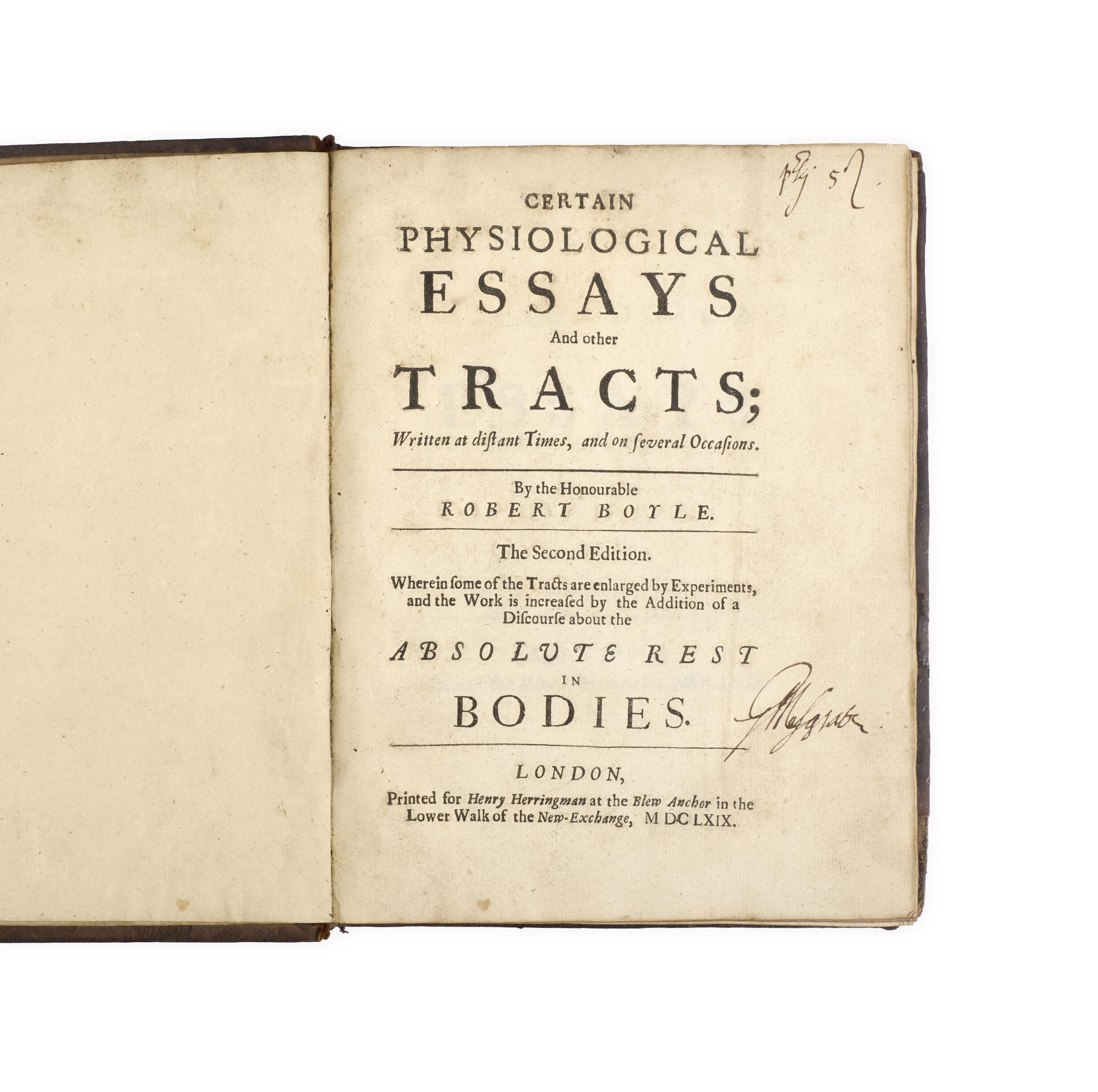
Certain physiological Essays and other Tracts; written at distant Times, and on several Occasions. The second Edition. Wherein some of the Tracts are enlarged by Experiments, and the Work is increased by the Addition of a Discourse about the absolute Rest in Bodies. London, Henry Herringman, 1669.
4to, [viii], 292, [4], 30, [2, blank]; title-page and a few upper margins dust-soiled, otherwise a very good copy; in contemporary mottled, panelled sheep, corners bumped, small patches of insect damage to covers; ownership inscription and purchase note to title ‘G Musgrave’ (see below).
Added to your basket:
Certain physiological Essays and other Tracts; written at distant Times, and on several Occasions. The second Edition. Wherein some of the Tracts are enlarged by Experiments, and the Work is increased by the Addition of a Discourse about the absolute Rest in Bodies.
Second edition in English, enlarged. ‘The importance of the Essays [first 1661] lies in the fact that in a very real sense it was a “prologue” to the more widely known Sceptical Chymist since it continued the attack on the alchemists begun in New Experiments, and actually it was as much of a landmark in the history of chemistry. In the Essays Boyle gives the first clear outline of his corpuscular hypothesis concerning the nature of matter’ (Fulton). The new additions to this edition were to have been indicated by parenthesis, but these being ‘by an oversight of the Press, omitted’, Boyle provides a list of the main changes in a new Advertisement.
Provenance:
George Musgrave (1648–1721), of Nettlecombe, Somerset, who may have known Boyle through his brother, the physician and antiquary William Musgrave (1655–1721, Fellow of the Royal Society, for which he acted as secretary and editor of the Philosophical Transactions in 1685). George Musgrave, who studied at Exeter College, Oxford, and then qualified as a barrister, was a friend of Edward and Mary Clarke, the friends and correspondents of John Locke – his son later married their daughter. Like his brother William (who had a large collection of works by Boyle in his library, sold in Exeter in 1725), he seems to have combined legal and medical training.
ESTC R17579; Wing B3930; Fulton 26.