State Over Church
BURNET, Gilbert.
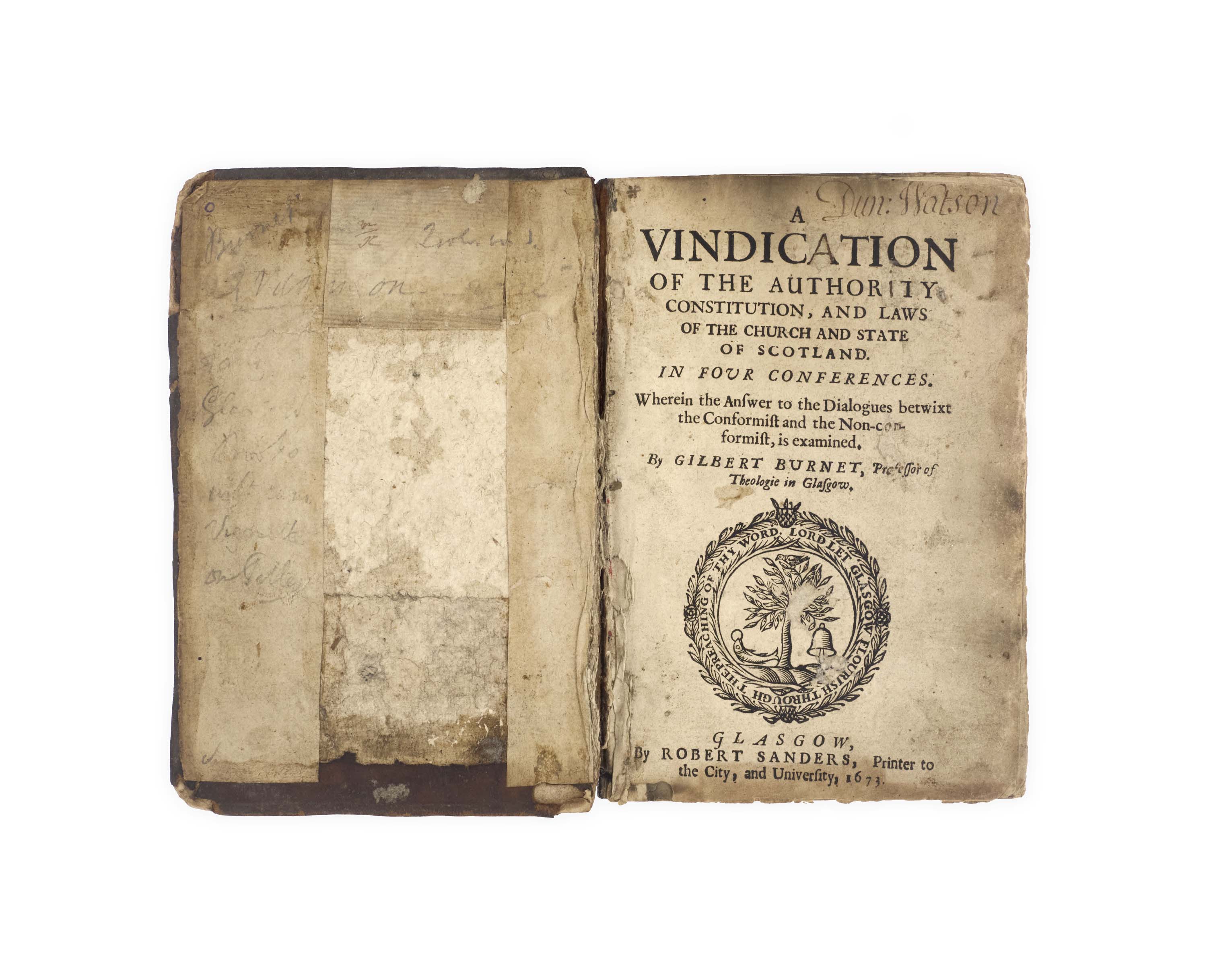
A Vindication of the Authority, Constitution, and Laws of the Church and State of Scotland. In four Conferences. Wherein the Answer to the Dialogues betwixt the Conformist and the Non-conformist, is examined. Glasgow, Robert Sanders, 1673.
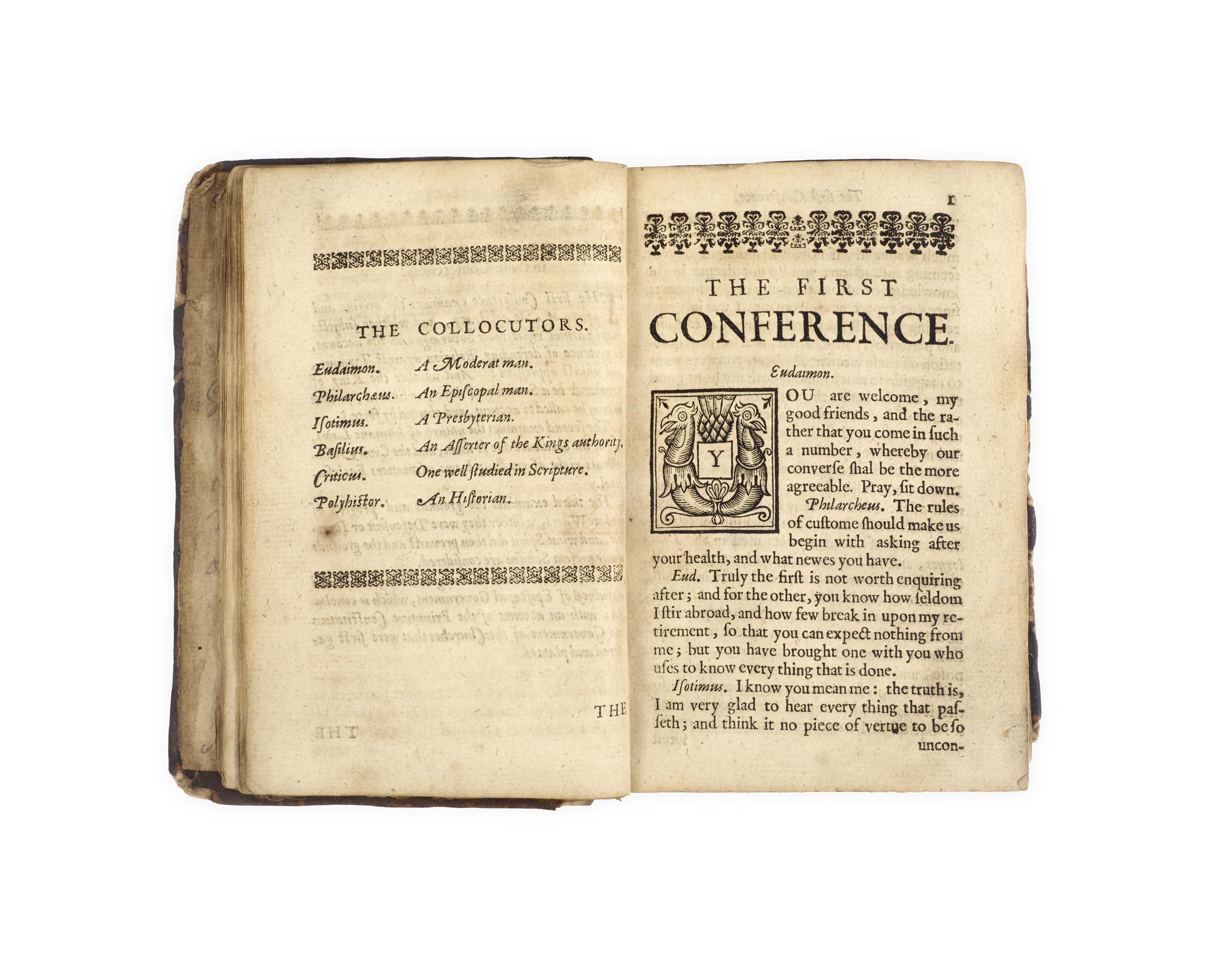
Two parts in one vol., 8vo, pp. I: [26], 102, ‘133–362’ [i.e. 103–332], II: [2], 125, [1]; woodcut device with seal of Glasgow to titles of both parts, typographic headpieces, woodcut and factotum initials; light browning and foxing throughout, title dusty and worn with a few letters lost (filled in old manuscript), bottom corner of G4 neatly excised with a few characters shaved, wormhole to last two quires affecting a few characters per page, but a good copy; bound in contemporary sheep; somewhat scuffed, extremities worn, short splits to joints, endcaps lost; early ownership inscription of ‘Dun: [Duncan?] Watson’ to title.
Added to your basket:
A Vindication of the Authority, Constitution, and Laws of the Church and State of Scotland. In four Conferences. Wherein the Answer to the Dialogues betwixt the Conformist and the Non-conformist, is examined.
One of three editions, all of the same year, of a ‘decidedly aggressive’ (Stewart, p. 40) tract in dialogue on the powers of the state in church affairs and on the subject’s right to resist.
The work was written by Gilbert Burnet (1643–1715), later Bishop of Salisbury and remembered for his controversial History of his own Time, in the febrile religious climate of Restoration Scotland. Bishops had been restored and nonconformists cast out of the Church of Scotland. To neutralize the threat from the Dissenters, Lauderdale (Burnet’s patron at the time) put forward a policy of divide and rule: moderate nonconformists would be indulged and brought back into the fold, while intransigents would be punished. Faced with strong opposition from both Episcopalians and nonconformists, the scheme failed, prompting the present defence.
Burnet’s dialogue, pitting five speakers against a lone and out-argued Presbyterian, poses and answers four questions: 1. can subjects resist their rulers ‘on pretence of defending religion against tyranny’? (no); 2. can the magistrate alter the external government of the church? (yes); 3. were the Covenanters in the right during the recent wars? (no); and 4. is episcopacy lawful and advantageous? (yes). The discussion of resistance is of particular note: ‘Burnet’s theory differed considerably from that held most commonly in the 17th century. He did not believe that the Divine Right was inherited by birth, but that it arose from a contract between king and people, in which certain rights and authority had been conferred on the king with the people’s consent. This contract could not be broken except both parties agreed. As long as the king did not exceed the authority originally assigned to him all resistance was unlawful’ (Clarke and Foxcroft, p. 110).
The tract, with its effusive epistle dedicatory to Lauderdale, would prove embarrassing, for the statesman soon broke with Burnet and turned to a policy of wholesale repression.
ESTC R206010; Wing B 5938A. See Clarke and Foxcroft, A Life of Gilbert Burnet, Bishop of Salisbury (1907); Ralph Stewart, ‘Gilbert Burnet’s Politics’, International Review of Scottish Studies 33 (2008).