Byron’s Armenian Grammar
[BYRON, George Gordon Noel, Lord.] AUCHER, Paschal.
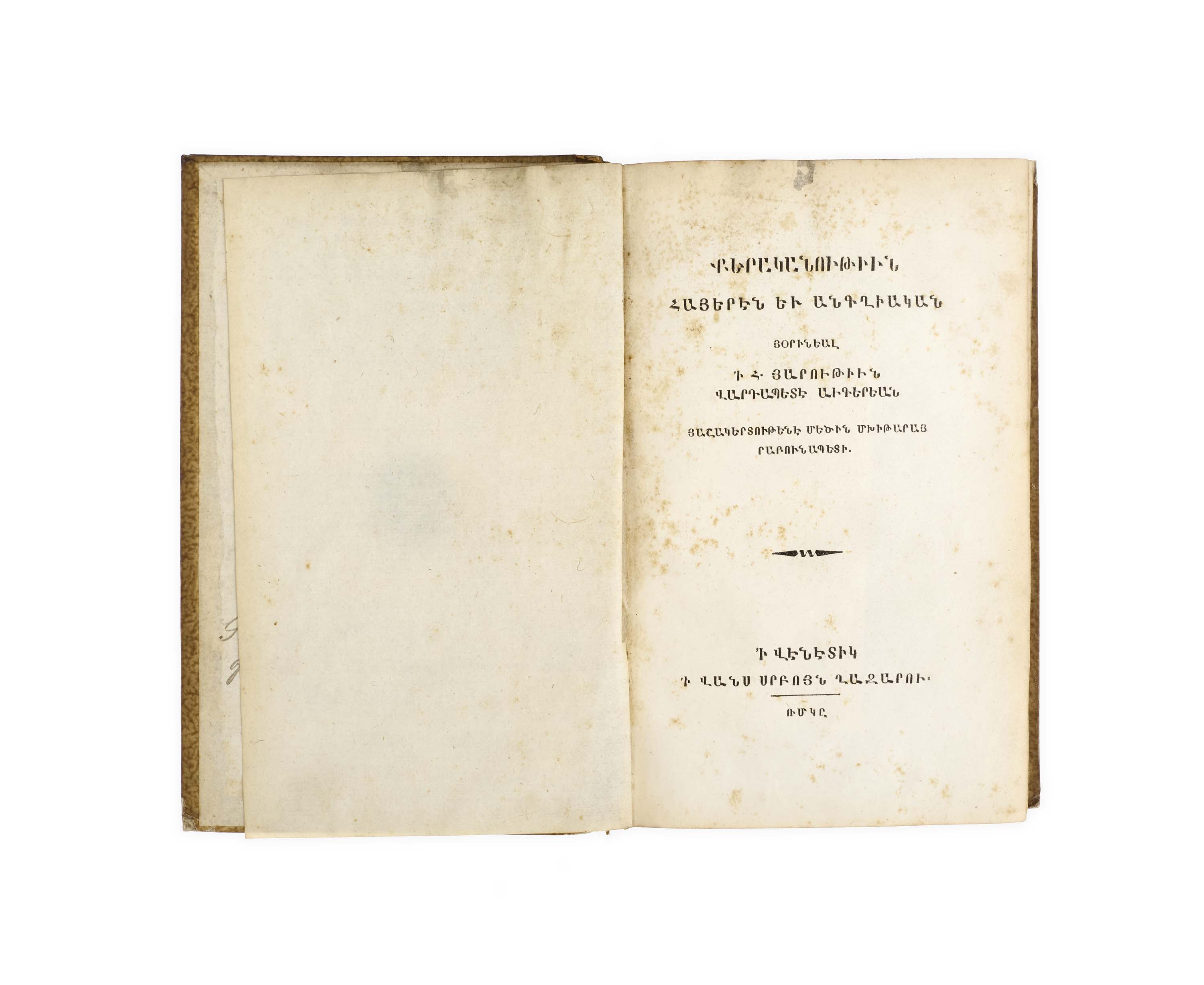
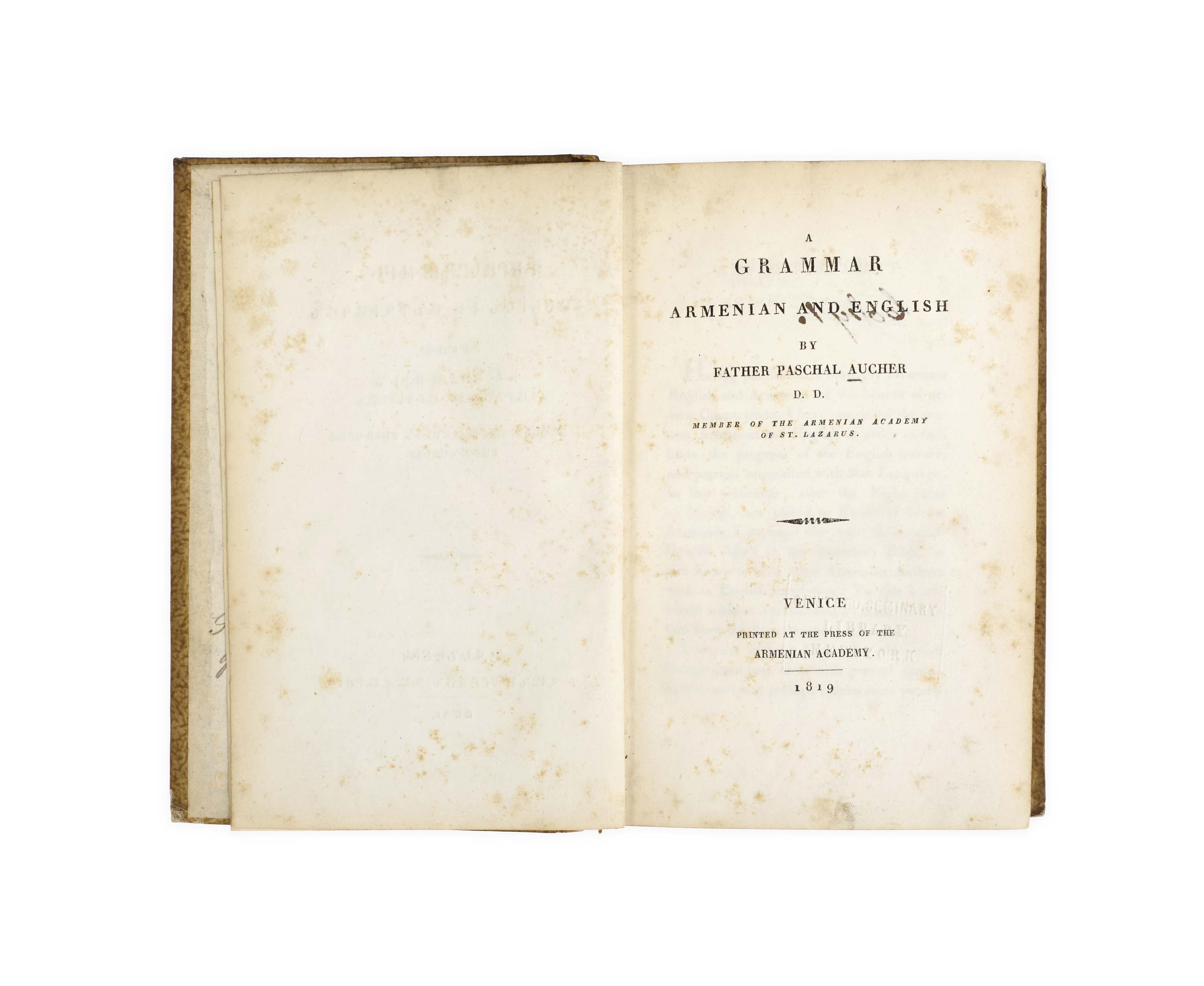
A Grammar Armenian and English … Venice, at the Press of the Armenian Academy, 1819.
8vo, pp. [viii], 334, [2 (index, errata)], with an Armenian title-page preceding the English; some scattered foxing but a good copy in contemporary paste paper boards, later buckram spine, corners bumped; small engraved portrait in an oval pasted to front endpaper (not obviously Byron or Aucher); from the library of the General Theological Seminary in New York, with manuscript accession note dated May 1834, bookplate, and blindstamps.
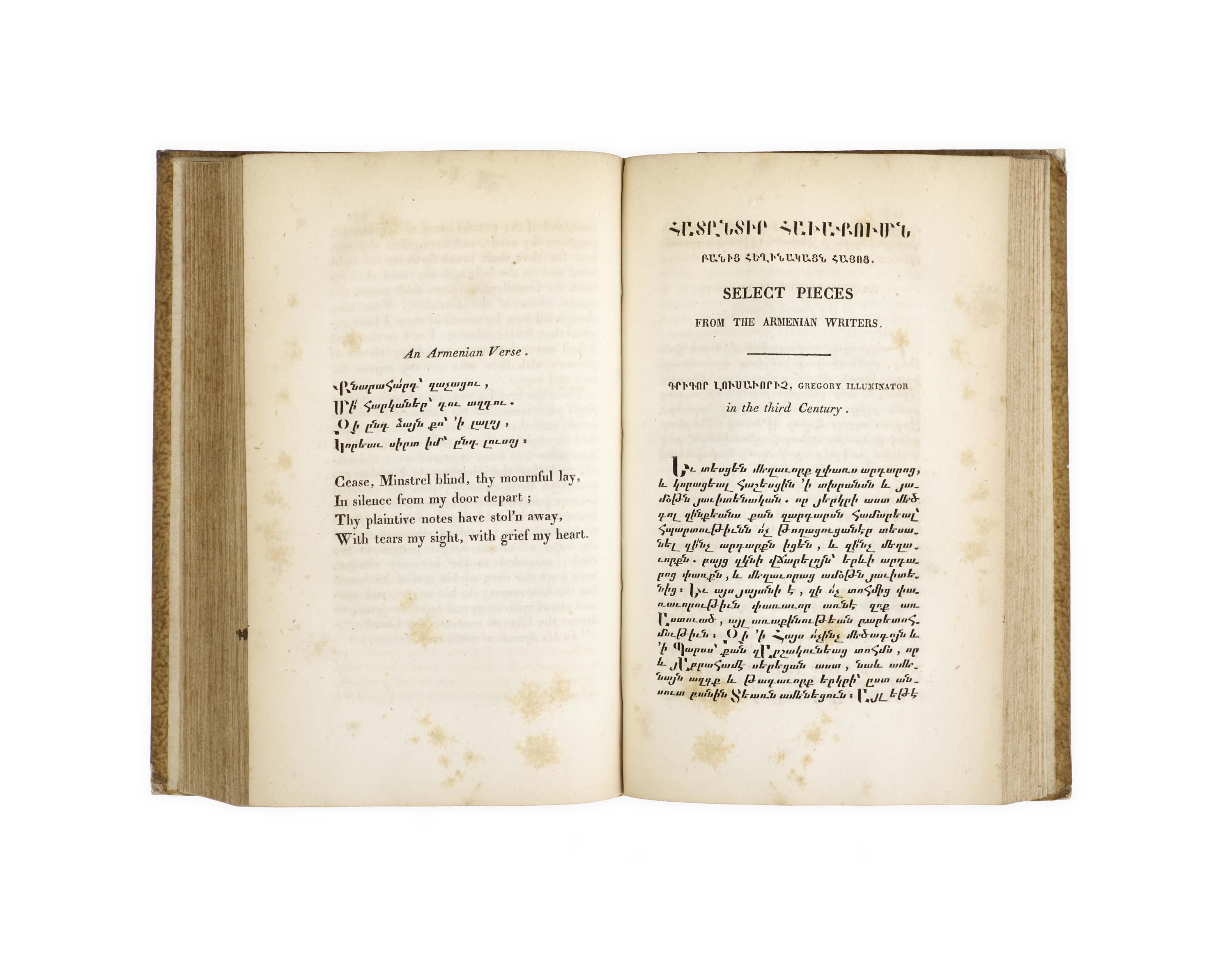
First edition, scarce, of Byron’s Armenian Grammar, ‘the first English-language attempt to explain the structures of classical Armenian’, also containing ‘Byron’s only surviving verse translation of Armenian poetry’ (Rizzoli), but probably published without his knowledge.
In November 1816, Byron arrived in Venice and made a beeline for the Mekhitarite monastery on the island of San Lazzaro, inspired by the recent work of Angelo Mai on Armenian manuscripts. He began lessons with the learned Father Paschal Aucher (Harut’iwn Awgerean, 1774–1854), and by early 1817 had paid for the printing and corrected the proofs of Aucher’s Grammar English and Armenian (1817). A second book, A Grammar Armenian and English (1819), ‘was Byron’s project: a grammar of classical Armenian for the use of English speakers, complete with model English translations … A few years later, Byron proudly claimed that he had “compiled the major part of two Armenian & English Grammars” for Aucher’ (Rizzoli).
Byron’s involvement with the Grammar had long been known but the extent had been much underestimated and the work never subject to critical study until recently. Rizzoli assigns to Byron ‘most of the English text’ of 1819, i.e. the majority of the Grammar section (pp. 1–148) as well as the ‘Exercises in the Armenian Language’ (pp. 175–212), which comprise translations from the apocryphal Pauline epistles of the Armenian Bible, and some shorter extracts from other writers; and ‘An Armenian Verse’ (p. 212), a quatrain with echoes of Byron’s ‘My Soul is Dark’ (1814).
As Rizzoli demonstrates, Byron visited the monastery regularly to translate the Armenian works printed in the Exercises, and rendered Aucher’s grammar from Italian into English, in which Aucher was not then proficient. By June 1818 Aucher was already using Byron’s manuscript grammar to teach another pupil, but Byron was unable to pay for printing at that time, and the Mekhitarite press was focussed on a monumental edition of Eusebius’s Chronicon. But relations between Byron and Aucher were also beginning to deteriorate, and in early 1819 they fell out permanently over Byron’s intended preface to the Grammar, in which he decried Ottoman rule in Armenian-speaking territories. Byron never returned to San Lazzaro, but he left behind the manuscripts of the Grammar, and later that year Aucher published them under his name alone (though he was evidently sometimes incapable of deciphering them, and his English was insufficient to spot the resulting errors). It is not clear whether Byron ever knew about the publication, because in 1821 he asked Murray to publish his translations of the Armenian Epistles, presumably unaware they were already in print – Murray could not comply because it would open him up to accusations of blasphemy.
Aucher later came to acknowledge Byron’s involvement more openly, naming him in the preface to his revised edition of 1832 but under-reporting Byron’s contributions. That edition omitted the supporting theological extracts printed on pp. 195–199, as well as the poem.
Rizzoli, ‘Byron’s unacknowledged Armenian Grammar and a new Poem’, Keats-Shelley Journal 64 (2015).