Camden’s Britannia
CAMDEN, William.
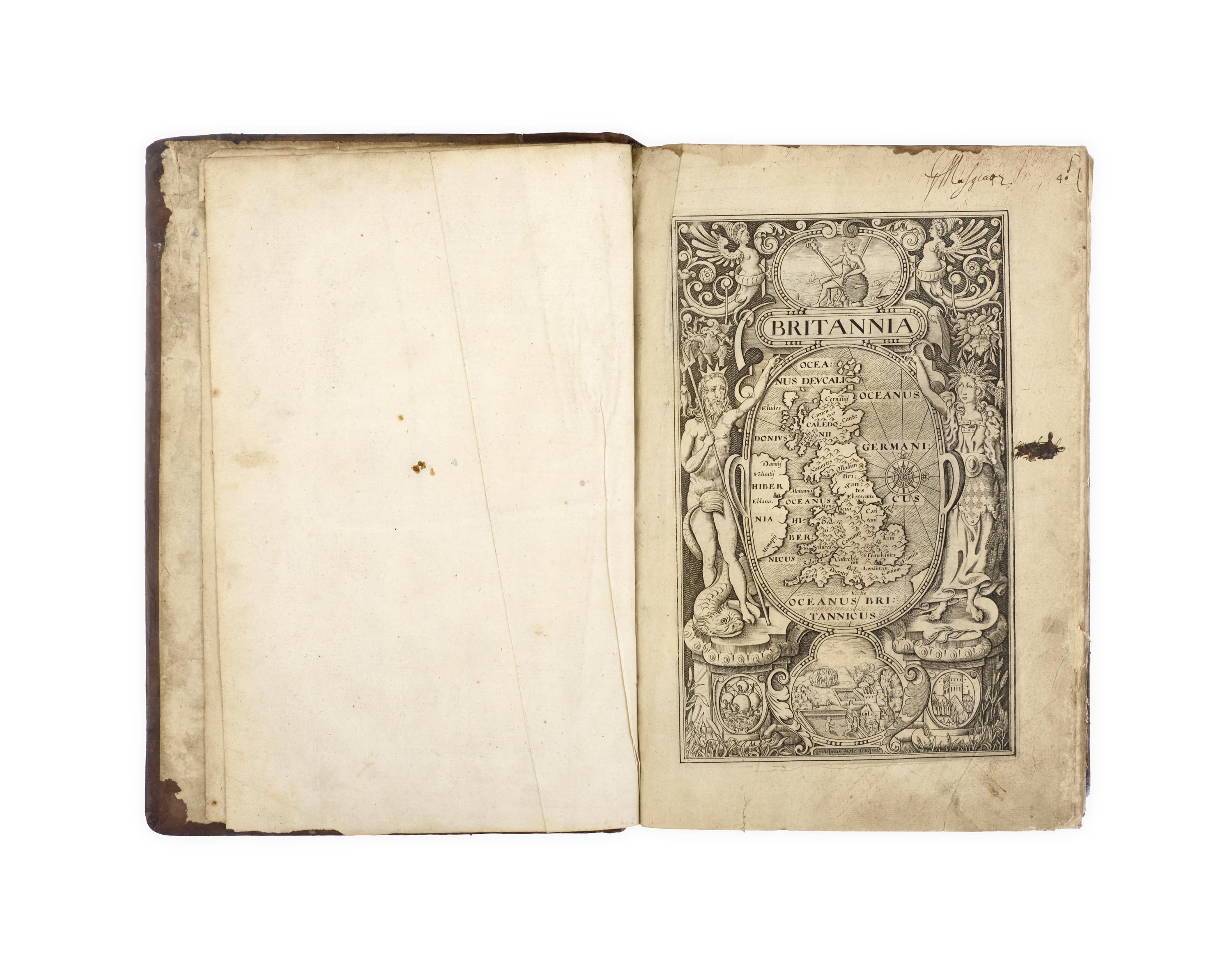
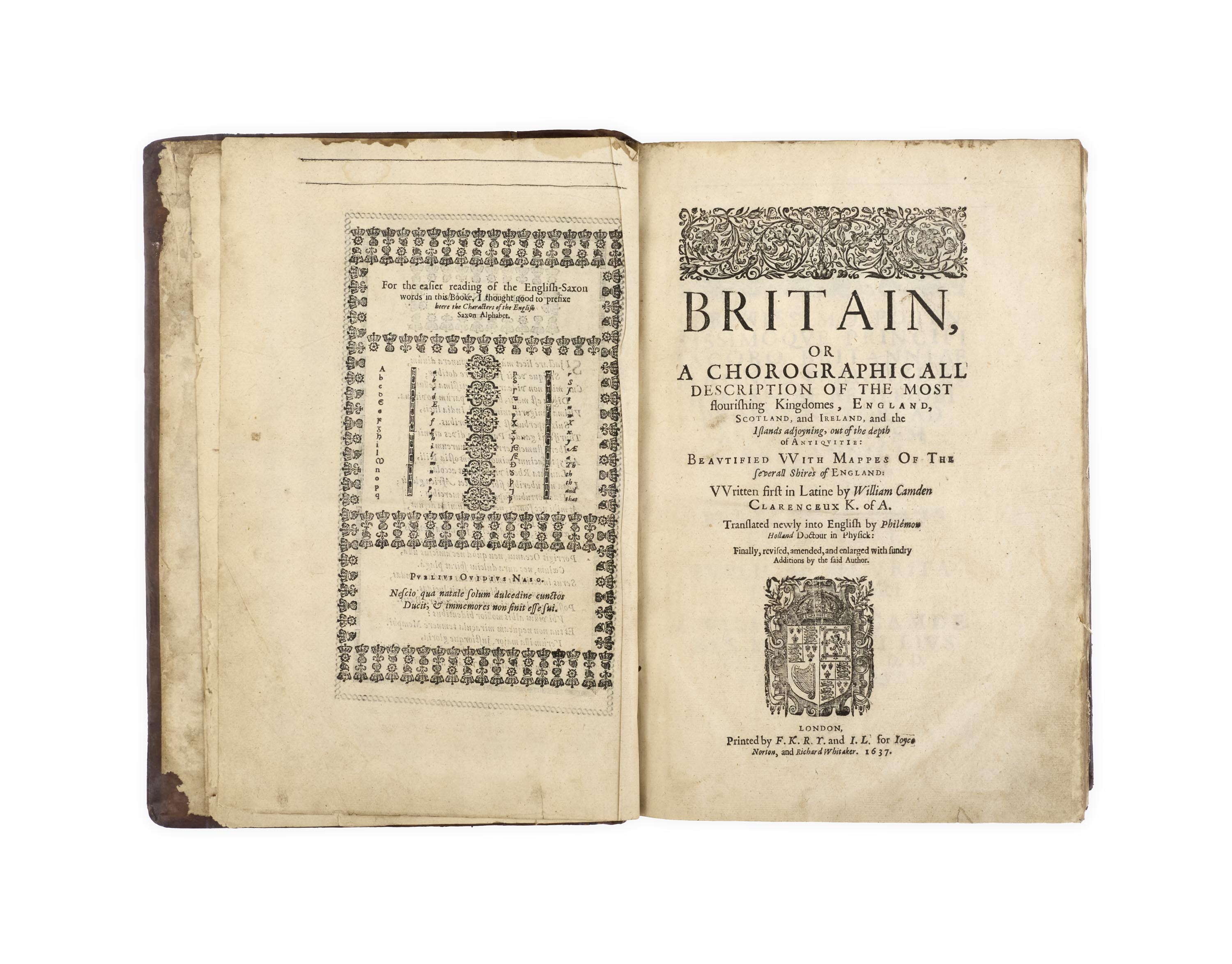
Britain, or a chorographicall Description of the most flourishing Kingdomes, England, Scotland, and Ireland, and the Islands adjoining, out of the Depth of Antiquitie: beautified with Mappes of the several Shires of England … Translated newly into English by Philemon Holland Doctor in Physick: finally, revised, amended, and enlarged with sundry Additions by the said Author. London, Francis Kingston, Robert Young, and John Legat, for Joyce Norton, and Richard Whitaker, 1637.
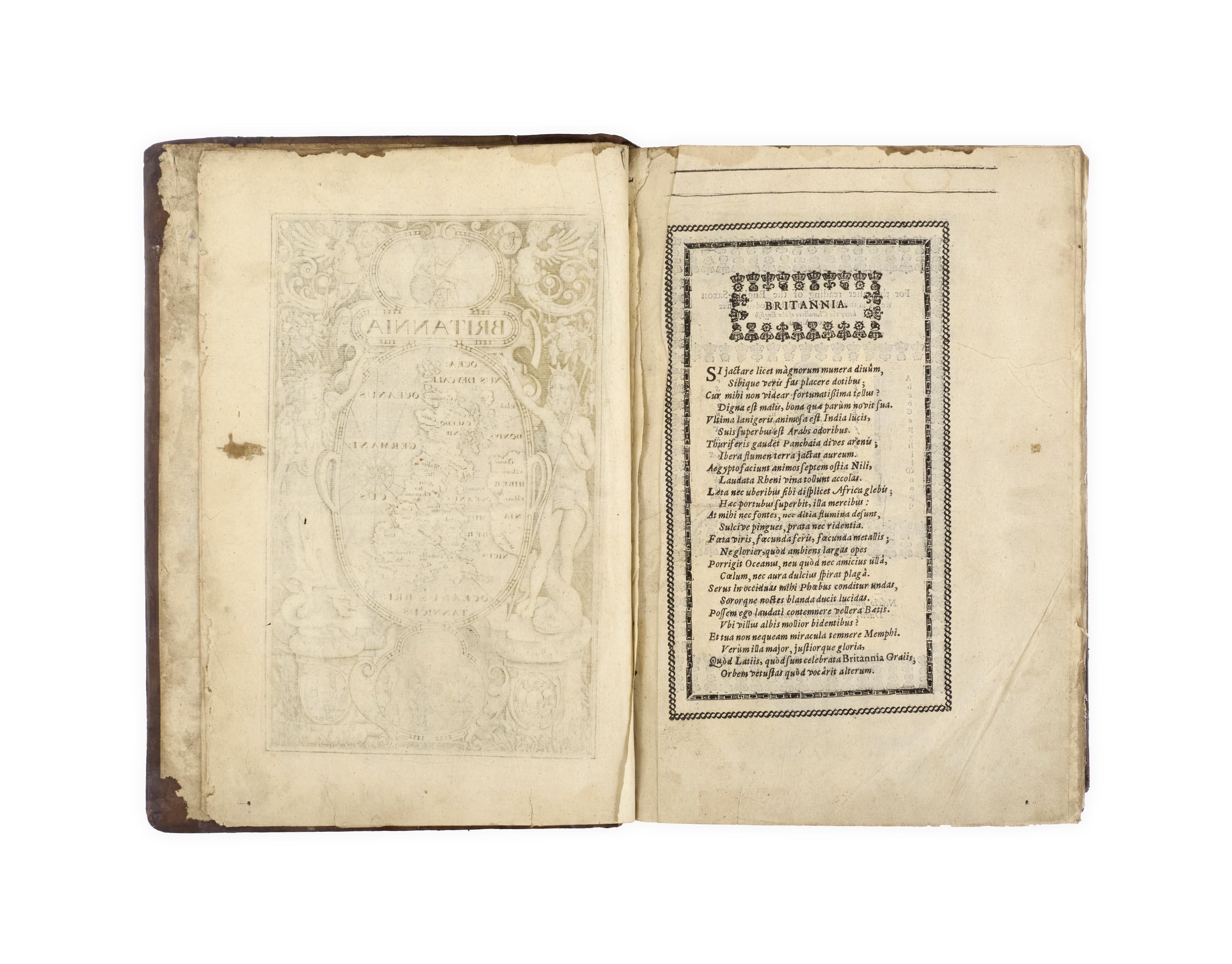
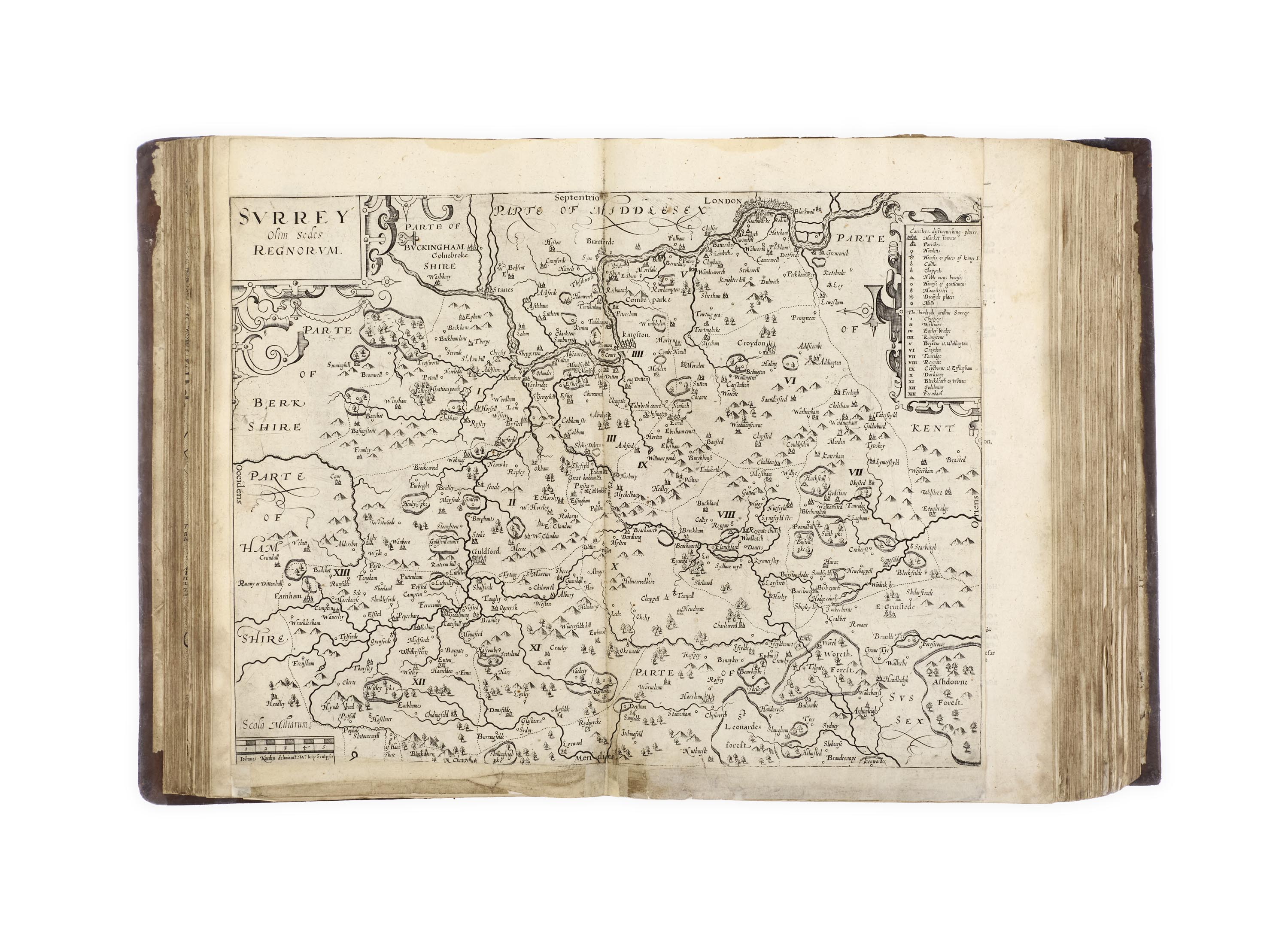
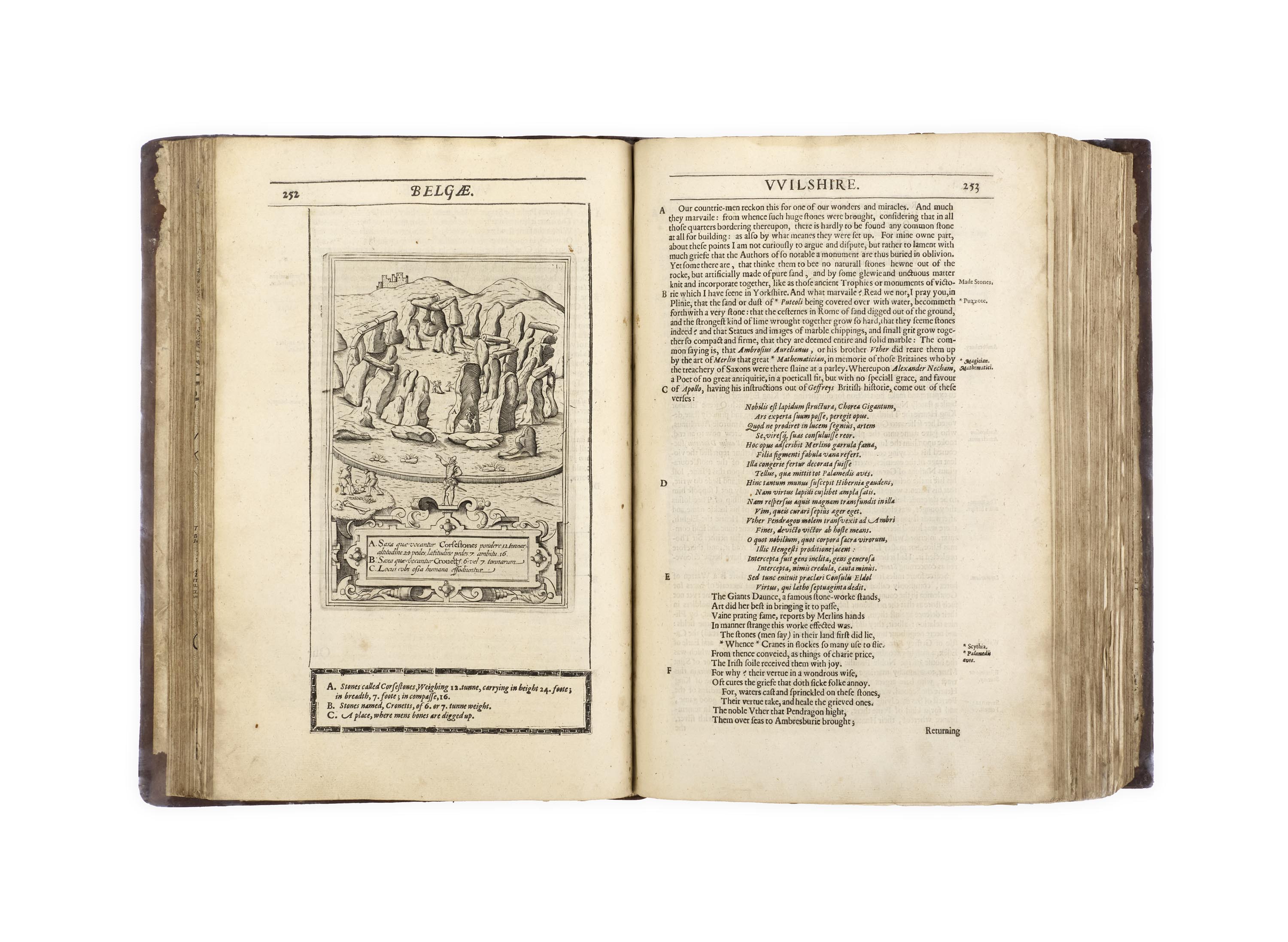
Folio, pp. [18], 297, ‘290’, ‘287’, ‘299’, 303–822, 122, 111-120, 133–233, [57]; with an additional engraved title-page by William Hole, 56 (of 57) double-page or folding maps mounted on stubs (wanting the map of Leicestershire), nine engraved illustrations (of coins and Stonehenge) and numerous woodcut illustrations; the preliminaries bound in the wrong order, index to counties at the end of the prelims; a few maps worn at the edges or slightly shaved, some occasional old stains, worm track to last few leaves; withal a very good copy in contemporary panelled calf; rebacked, some repairs to boards; seventeenth-/eighteenth-century ownership inscriptions of George Musgrave and George Musgrave junior (see below).
Added to your basket:
Britain, or a chorographicall Description of the most flourishing Kingdomes, England, Scotland, and Ireland, and the Islands adjoining, out of the Depth of Antiquitie: beautified with Mappes of the several Shires of England … Translated newly into English by Philemon Holland Doctor in Physick: finally, revised, amended, and enlarged with sundry Additions by the said Author.
Second edition in English (first 1610) of Camden’s monumental Britannia (1586), printed for Joyce Norton.
‘The Britannia had an enormous and lasting impact on multidisciplinary historical writing, and was also of the highest importance as a cultural icon affecting the national self-image ... Not a history, the Britannia attempts … “to restore Britain to Antiquity, and Antiquity to Britain” … It does so by attempting to document the ancient pre-Roman British past using every kind of primary historical evidence imaginable, whether written records, inscriptions, literary remains, material both historical and mythological, or testimony drawn from the physical landscape’ (ODNB).
The enlarged Latin edition of 1607 was the first to include the county maps, engraved by William Hole (21) or William Kip (34), after the maps of Christopher Saxton (41) or John Norden (6). George Owen contributed Pembrokeshire. The other county maps are unsigned, and the general maps of England, Scotland, and Ireland are derived from Mercator.
There were three variants of this edition, the present bearing the name of Joyce Norton (d. 1643), who had been assigned her husband John Norton’s share in 1632. John (1556/7–1612) had served as King’s Printer of Latin, Greek, and Hebrew, and Joyce retained links with the King’s Printing House after his death, though these were not always felicitous. Chancery documents show that Joyce was ordered to pay money to Robert Barker (printer of the 1611 King James Bible) as reparation for books embezzled from the King’s Printing House. While she laid the blame on Bonham Norton, her husband’s cousin and executor, claiming he had sold the books and ‘pursed the money’, she was ordered to hand over profits from her shop together with damages and costs. Joyce worked in association, as here, with Richard Whitaker, of St Paul’s Churchyard.
Provenance:
George Musgrave (1648–1721) of Nettlecombe, Somerset, brother of the physician and antiquary William Musgrave (1655–1721, Fellow of the Royal Society, for which he acted as secretary, and editor of the Philosophical Transactions in 1685). George, who studied at Exeter College, Oxford, and then qualified as a barrister, was a friend of Edward and Mary Clarke, the friends and correspondents of John Locke. His son, also George (1682–1724), married the Clarkes’ daughter Mary. This volume appears to have been repaired for George junior since it bears his note ‘Repar. p[ro] Geo: Musgrave Junr’.
ESTC S1529; STC 4510.2.