Polemic on Poverty, with a False Imprint
CAMUS, Jean-Pierre.
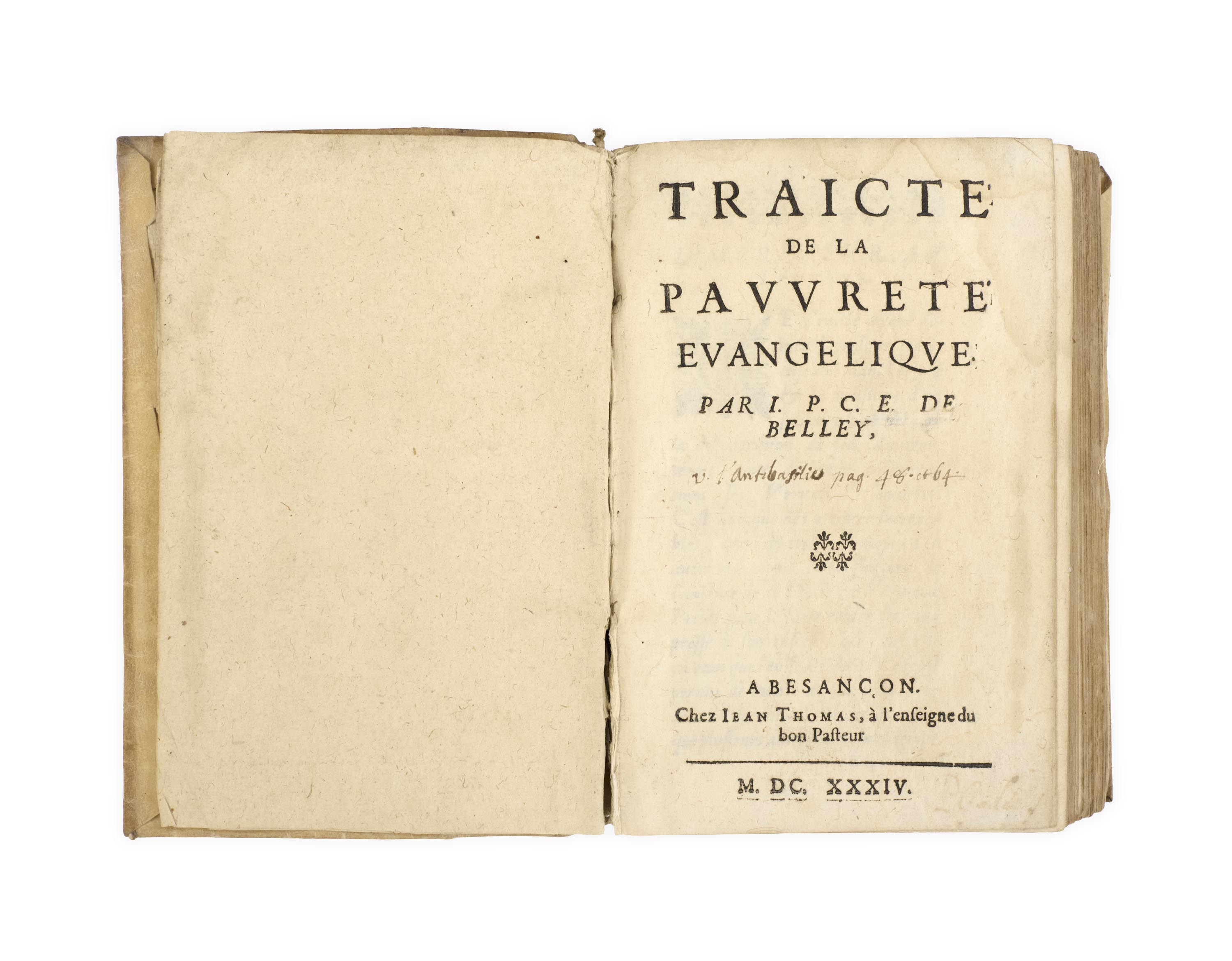
Traicté de la pauvreté evangelique. Par I. P. C. E. de Belley. ‘Besançon, chez Jean Thomas, à l’enseigne du bon pasteur’ [Paris, Gervais Alliot and Robert Bertault], 1634.
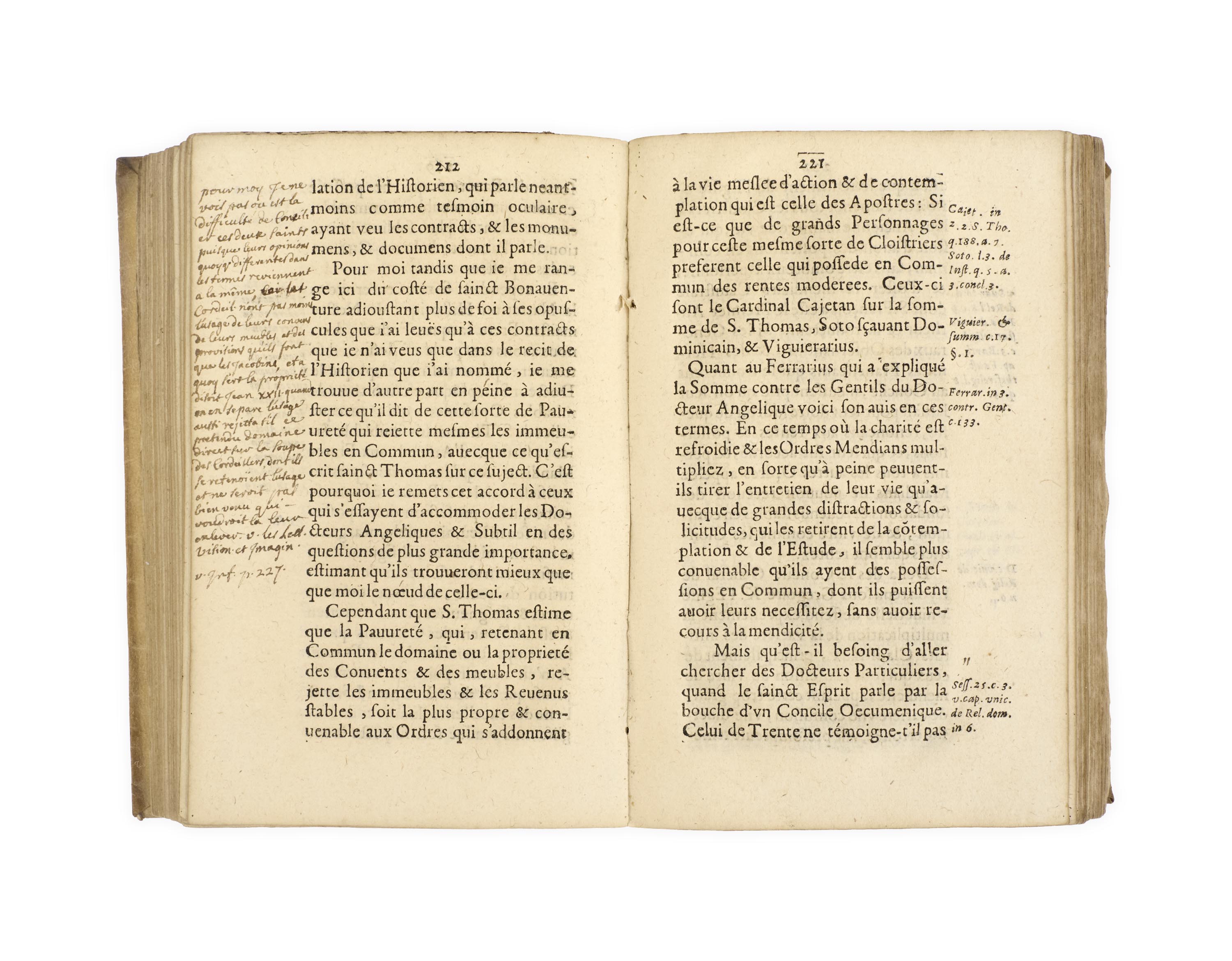
8vo, pp. [9], [3, blank], ‘390’ (i.e. 386), [2, errata]; numerous errors in pagination and catchwords, woodcut initials, headpieces; small abrasion to title-page, light marginal damp-staining at beginning, some marginal worming to pp. 81–100 and 151–160, some creasing towards the end; a good copy in contemporary vellum, title in manuscript to spine and top edge, printer’s waste to hinges; upper hinge split, lower cover cockled and stained; later seventeenth-century ownership inscription to front endpaper ‘Dumoulinet Des Tuilleries’, occasional later seventeenth-century marginal annotations in French, with note to title and notes in Latin to last page and rear endpapers in the same hand.
Uncommon first edition of this polemical work by Jean-Pierre Camus (1584–1652), bishop of Belley, renowned preacher, and prolific novel writer, published with a false Besançon imprint, and with a foreword by the fictitious printer ‘Jean Thomas’.
From the 1620s onwards Camus did not shy from penning works critical of the regular clergy, whom he accused of considering themselves above secular clerics, of evading the authority of bishops (such as himself), of refusing to get their hands dirty, and of accumulating the Church’s wealth; he even had a run-in with Cardinal Richelieu on the subject.
During a stay in Besançon in 1632, Camus was accused by a Capuchin monk of falling into the same error as the thirteenth-century theologian William of Saint-Amour, who had so strenuously opposed the rise of the mendicant friars. Piqued by the comparison, Camus penned two tracts: the Traicté de la pauvreté évangélique and Traité de la désappropriation claustrale. In the former he argued that nothing prevented secular clergy and lay persons from practising ‘evangelical poverty’ with greater perfection than monks and mendicants, despite not taking vows to this effect, while in the latter he claimed that renouncing private property was not enough to render regulars ‘poor’ in an evangelical sense.
Correctly anticipating the regular clergy’s resultant wrath and recourse to the king, Camus employed a fake Besançon imprint for both works – a knowing nod to the city in which they were composed. They were in fact printed in Paris by Gervais Alliot and Robert Bertault, as the authorities (not so easily fooled) soon discovered.
The occasional marginalia (one dated 1697) include a note on reconciling the opinions of Aquinas and Bonaventure, while the Latin annotations at the end refer to Geoffroy bishop of Châlons and Gerald of Wales.
Five copies traced in the UK (BL, NLS, Advocates Library, Durham University, Middle Temple) and two in the US (Cornell, Syracuse). USTC 6809540. See Bernard de Vregille, ‘Un imprimeur fantôme à Besançon: Jean Thomas, 1634’, Revue française d’histoire du livre, 1997, vol. 96–97, pp. 315–328.