Preserving Proverbs
CARO Y CEJUDO, Gerónimo Martín.
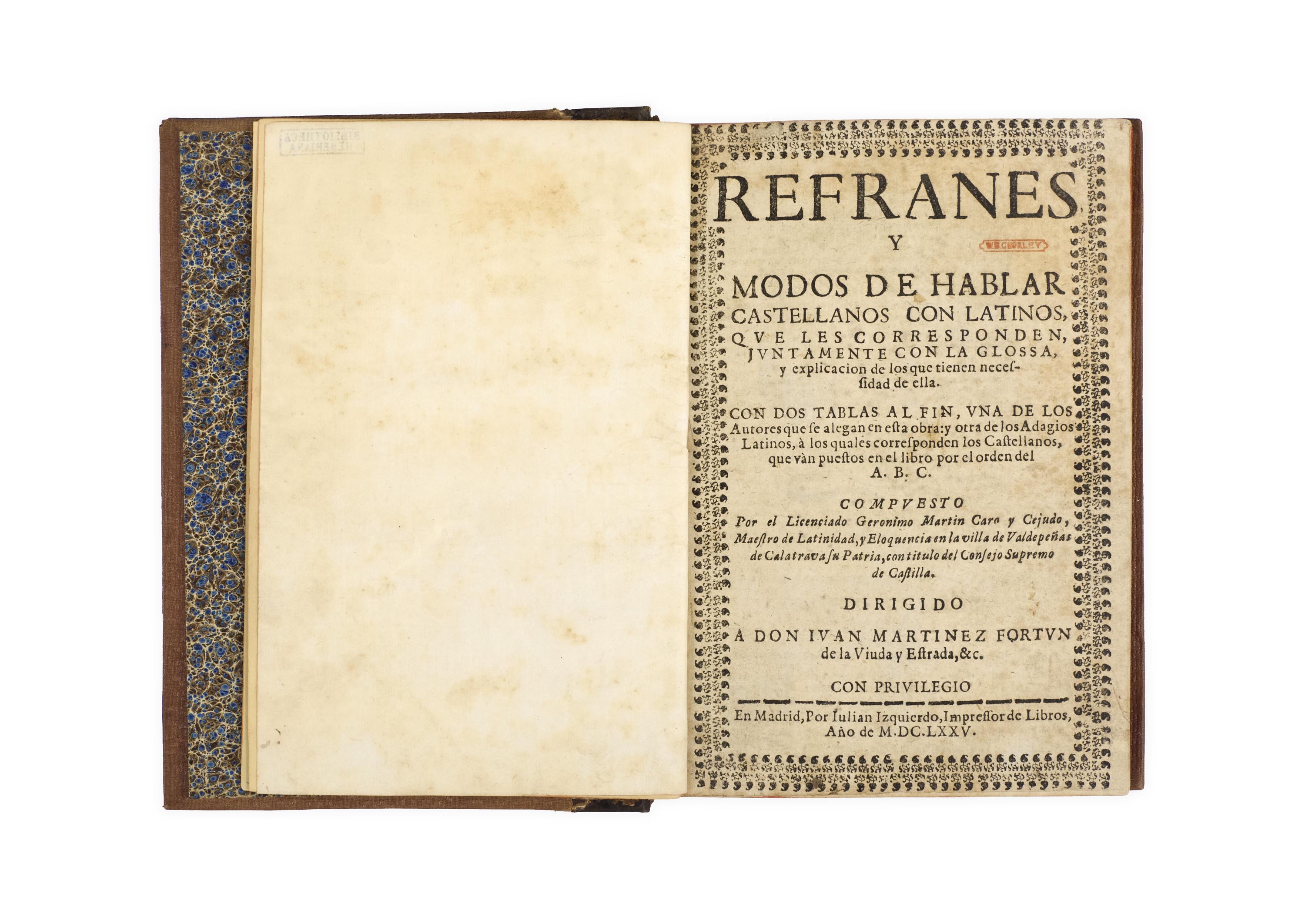
Refranes y modos de hablar, castellanos con latinos, que les corresponden, juntamente con la glossa, y explicacion de los que tienen necessidad de ella … Madrid, Julián Izquierdo, 1675.
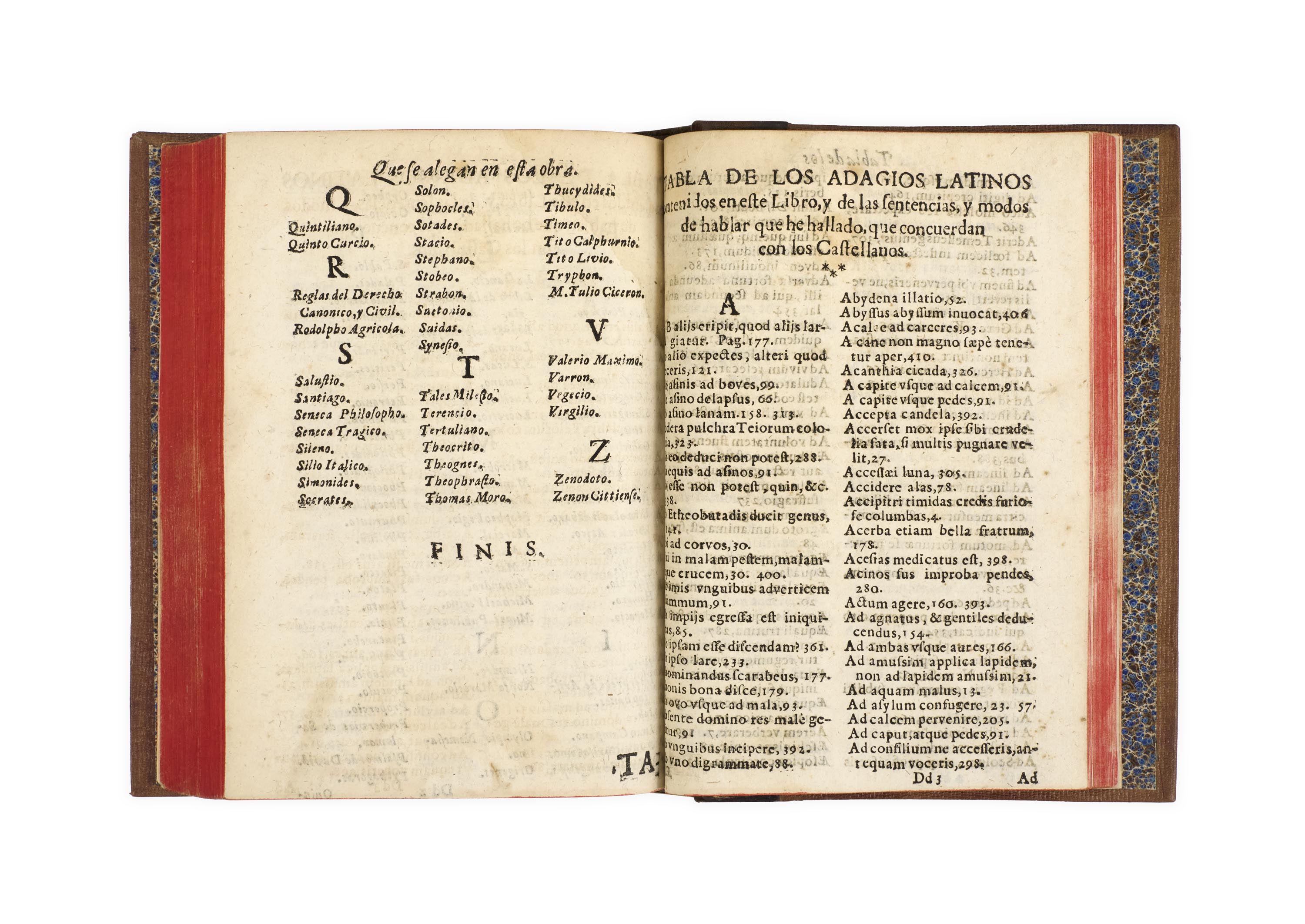
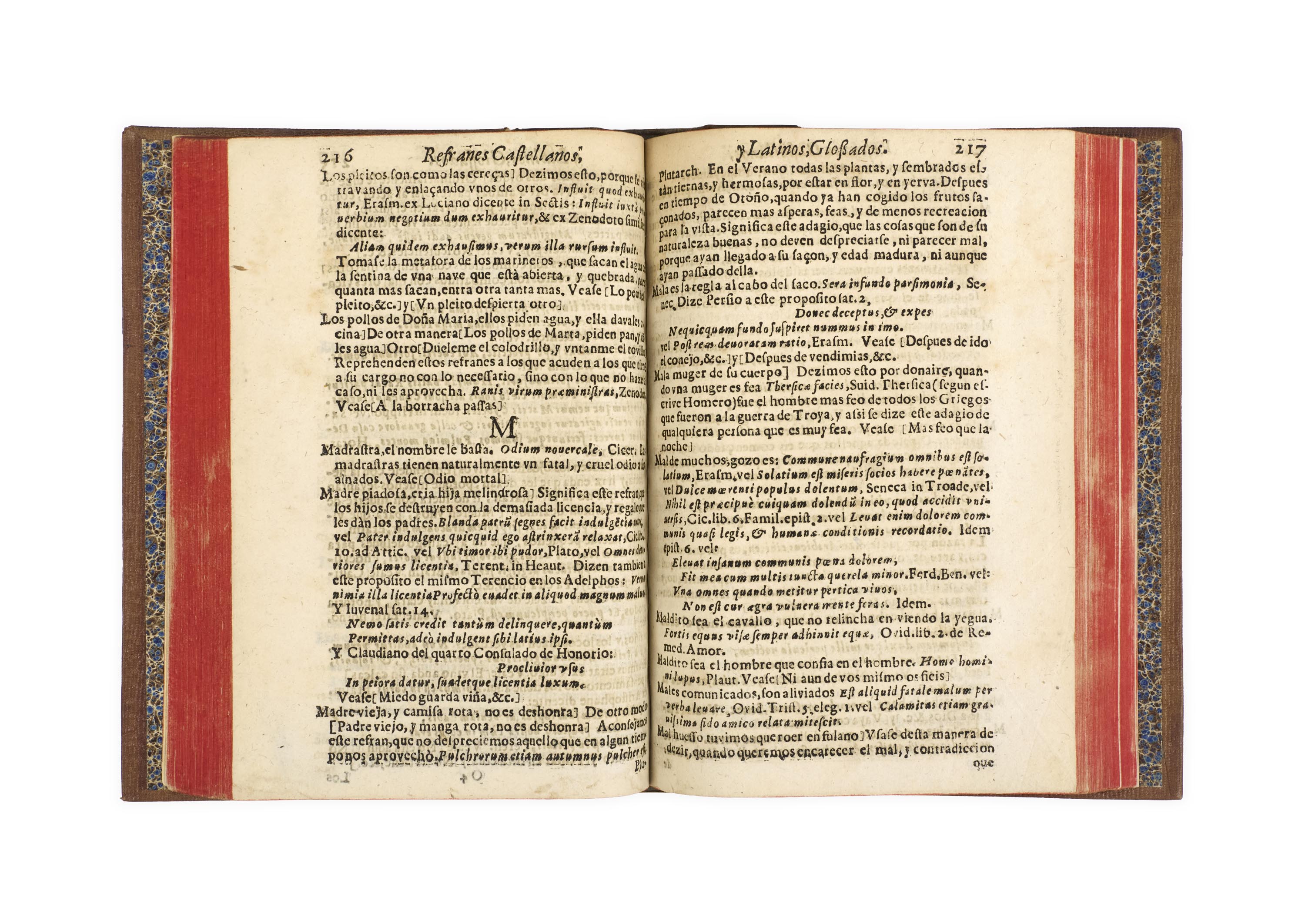
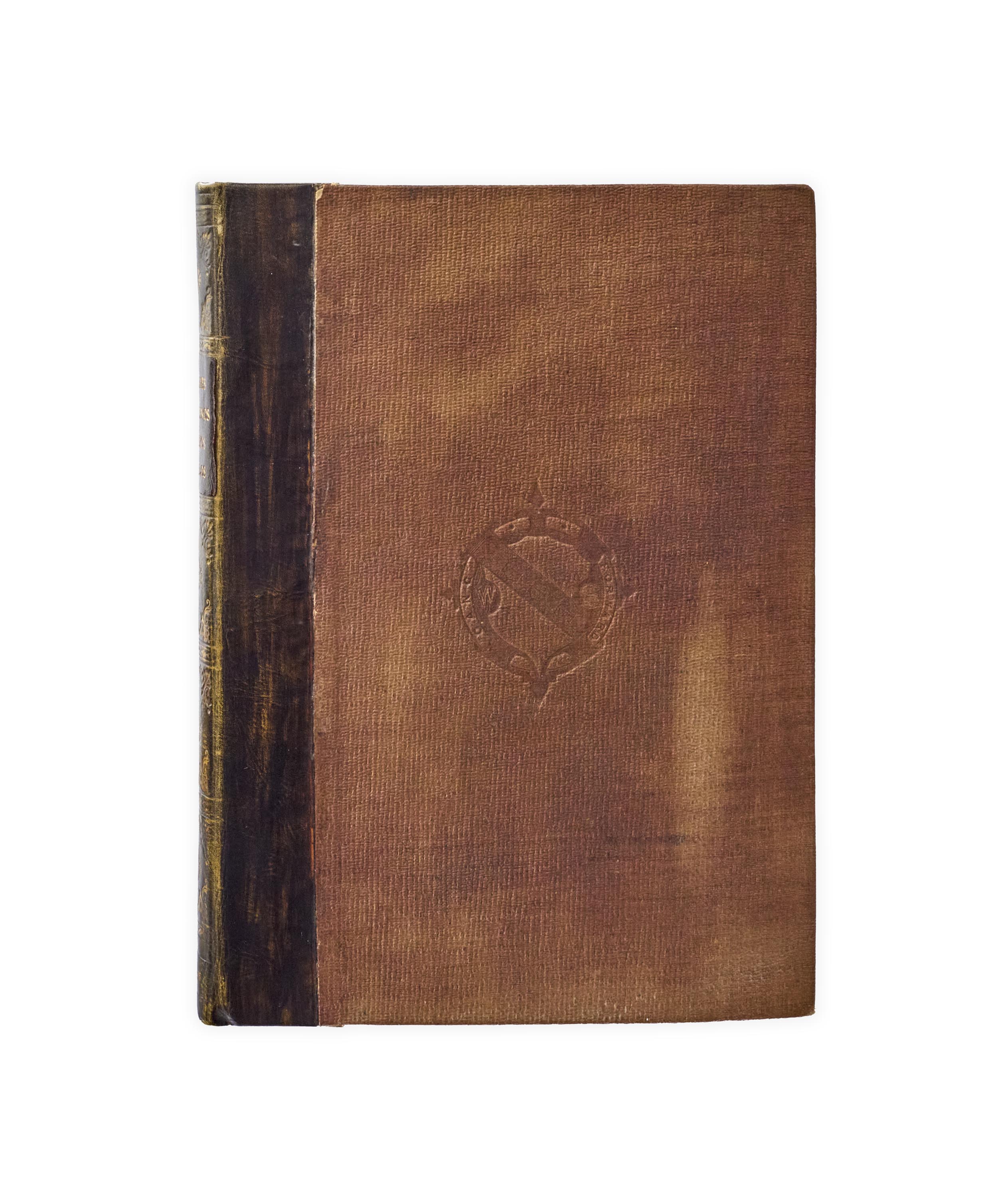
4to, pp. [xxiv], 417, [79]; title printed within typographic border, large woodcut armorial to dedication (p. [iii]), woodcut initial, typographic headpiece; cut somewhat close (shaving a few catchwords), occasional light foxing, slight damp-stain to upper inner corner, paper-flaw to lower outer corner of M3 neatly repaired, but a good copy; bound in twentieth-century pebble-grained brown cloth, arms of Stirling Maxwell blocked to front board in blind (BAB stamp 11), rebacked in calf with gilt lettering-piece to spine, edges stained red, endpaper renewed; ink stamp ‘Bibliotheca Heberiana’ to front flyleaf, red ink stamp ‘W.B. Chorley’ to title, bookplate of William Stirling Maxwell to front pastedown, bookplate of Lt. Col. V.S.M. de Guinzbourg to front free endpaper.
Added to your basket:
Refranes y modos de hablar, castellanos con latinos, que les corresponden, juntamente con la glossa, y explicacion de los que tienen necessidad de ella …
First edition, the Heber–Chorley–Stirling Maxwell–de Guinzbourg copy, of this extensive series of over 3500 Latin proverbs and idioms with their Spanish equivalents, taken from classical sources as well as Alciati, Augustine, Hadrianus Junius, and Thomas More.
Gerónimo Martín Caro y Cejudo (1630–1715) was a teacher of Latin grammar and rhetoric in Valdepeñas in Castille–La Mancha, and the work is dedicated to the city’s mayor. In his preface, he maintains that documenting proverbs and adages is a noble endeavour (despite remarks from ‘many’ dismissing the endeavour as ‘vulgar, useless, and unworthy’, p. [xv], trans.). ‘I believe that this work will not displease all those curious readers who wish to know which Latin adages correspond to our Castilian ones, particularly since (if I am not mistaken) no other book has been published until now in which so many Latin adages are glossed in our language, almost all of those included by Erasmus in his Adagia’ (p. [xvi], trans.). Here, Caro y Cejudo draws upon some two hundred sources, including the Psalms of David, Deuteronomy, canon and civil law, Pythagoras, Apuleius, Jerome, the Suda, and Erasmus.
Provenance:
1. Richard Heber (1773–1833); his first sale, Sotheby’s, 10 April–9 May 1834, lot 1443.
2. William Brownsword Chorley (1804–1879), collector of Spanish books and manuscripts and brother of the Hispanist and collector John Rutter Chorley (1807–1867); his sale, Sotheby’s, 21 October 1846, lot 212 (to White).
3. Sir William Stirling Maxwell (1818–1878). His library was sufficiently rich in books of this nature for a catalogue of ‘proverbs, emblems, apophthegms, epitaphs and ana’ to be produced in 1860; his sale, Christie’s, 20 May 1958, lot 781 (in ‘old calf’).
4. Victor de Guinzbourg (1906–1976), a former governor of the National Counter Intelligence Corps Association and a long-serving attaché to the United Nations. A passionate proverb-enthusiast, Guinzbourg was a founder and Permanent Secretary of the Paremiological Society and his only published work, Wit and Wisdom of the United Nations (1961), is a collection of ‘proverbs and apothegms on diplomacy’.
USTC 5093605; Palau 44854.