With Bilingual Christmas Carols
[CAROLS.]
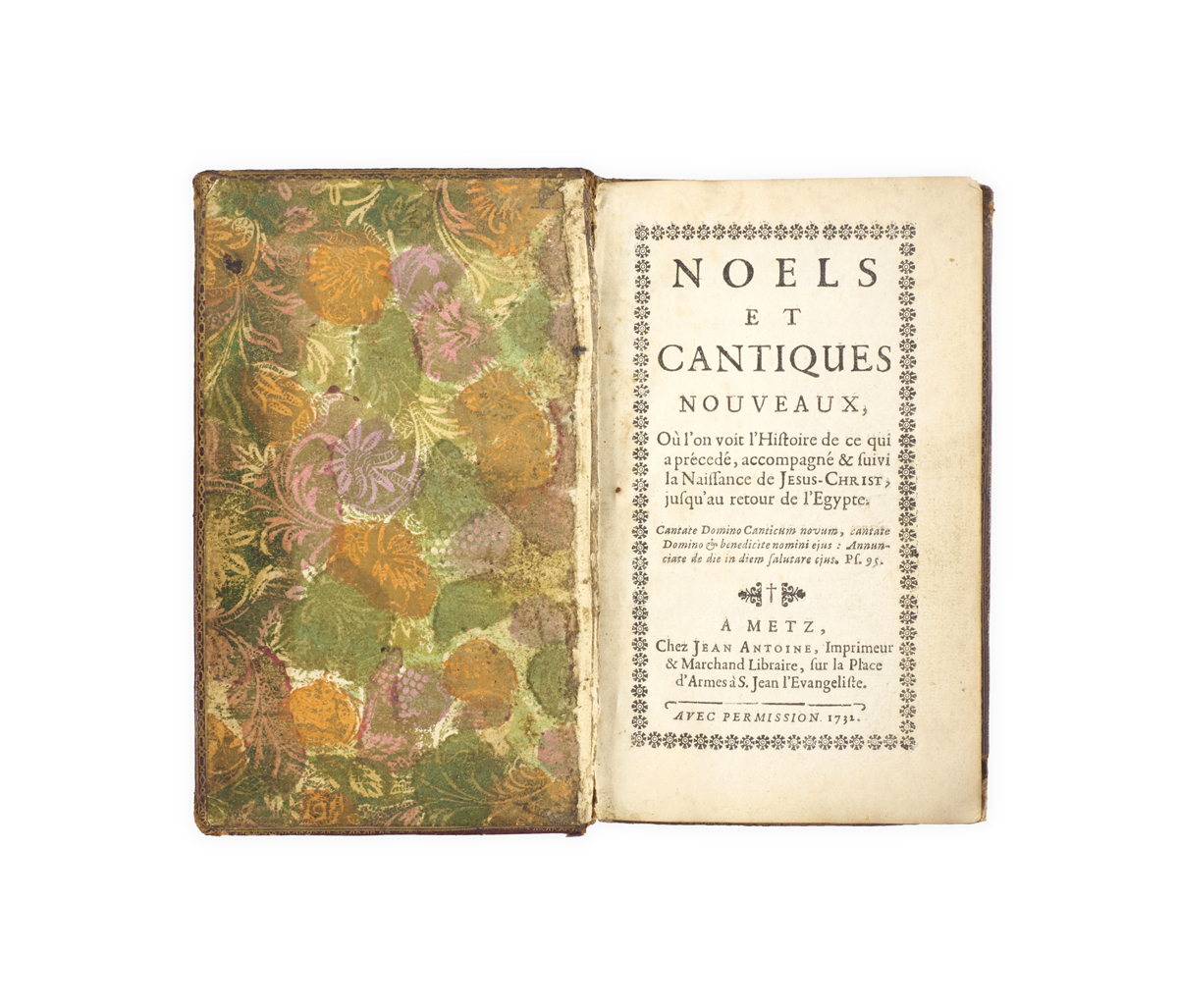
Noels et cantiques nouveaux, où l’on voit l’histoire de ce qui a précedé, accompagné et suivi la naissance de Jesus-Christ, jusqu’au retour de l’Egypte … Metz, Jean Antoine, 1732.
8vo, pp. 119, [1 (blank)]; title within typographic border, typographic headpieces, woodcut tailpiece; occasional light marks, somewhat toned; else a good copy in contemporary French red morocco, gilt border and fleurs-de-lys cornerpieces to covers, spine gilt in compartments, lettered directly in gilt, gilt edges, coloured gilt brocade endpapers; some wear to spine, joints, and corners, small abrasions to covers, wanting front free endpaper.
Added to your basket:
Noels et cantiques nouveaux, où l’on voit l’histoire de ce qui a précedé, accompagné et suivi la naissance de Jesus-Christ, jusqu’au retour de l’Egypte …
Very rare collection of carols and canticles celebrating Christ’s nativity, printed at Metz in northeast France.
The collection includes songs on the marriage of the Virgin Mary, the Annunciation, the Visitation, the birth of John the Baptist, the birth of Jesus, the adoration of the shepherds and Magi, the Circumcision and Purification, the massacre of the innocents, and the flight from and return to Egypt. There are numerous carols for Christmas Day itself, including one in imitation of the medieval carol ‘Chantons par mélodie, relicto taedio’ with lines alternating in French and Latin; some are specific to Metz, such as ‘Hommages des Messeins à la crèche du sauveur’.
The dedication takes the form of a letter of thanks from the poor of Metz to Henri Charles du Cambout, third Duke of Coislin (1665–1732), in his capacity as the city’s bishop. Cambout was a member of the Académie française and inherited the outstanding library of his great-grandfather Pierre Séguier. Numerous acts of charity originating from him are referred to here: the establishment of refuges for girls, seminaries, and hospitals; the repair of churches and monasteries; the construction of homes for soldiers; and the release of prisoners. His ill health is also referred to, and he died a matter of weeks after this volume was published.
No copies traced in the UK, and only one in the US (Yale).