
From Montevideo to Paris
CASTRO, Manuel de.
Lámpara (Vigilias de la cruz y la flauta) Poemas. [Montevideo], Fernandez y Gonzales, 1938.
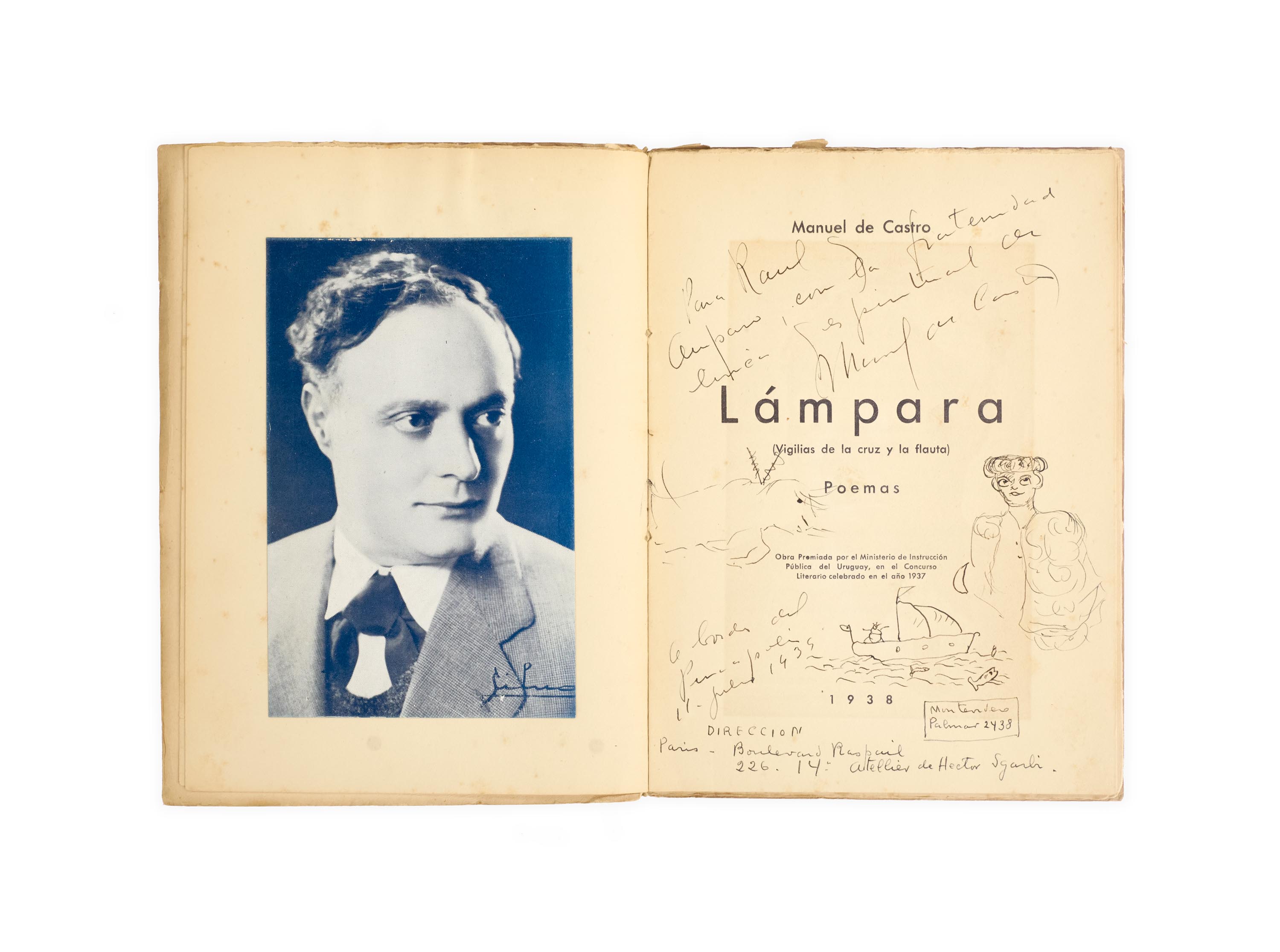
8vo, pp. 59, [3, blank, colophon, blank]; half-title, tipped-in photographic frontispiece portrait of the author, printed music on pp. 37–46, partly uncut and unopened; some light foxing throughout, tears to head of pp. 13–16 and 37–40 where pages crudely opened, a good copy; bound in publisher’s pictorial wrappers; edges slightly dusty; presentation inscription and ink sketches by the author to title-page (see below).
First edition, a presentation copy with an inscription and sketches by the Uruguayan journalist, novelist and poet Manuel de Castro (1896–1970).
The presentation inscription reads: ‘Raul | Amparo, con la fraternidad | lirica y espiritual de | Manuel de Castro’ followed by several sketches; a bull in a bullfight with two banderillas in its back and the note ‘[la corda?] del | Persepoli | 11 Julio 1935’, the bust of a person with a hat, and a boat on the sea. At the foot of the title-page is the address ‘Montevideo Palmar 2438’ written in a small box (Castro’s address?), and an address in Paris, ‘Boulevard Raspail, 226. 14: Atellier de Hector Sgarbi’.
Manuel de Castro began his literary career in the 1910s, joining several literary groups and later becoming a journalist for El Pueblo. He was fascinated by bullfighting, hence the sketch of a bull: in 1949 he would write the poem Pregon lirico diciendo de la muerte de Manolete on the death of a famous matador, and in 1964 published his essay Goya y la fiesta de toros. Here, he connects his sketch of a bullfight to the excavations taking place at Persepolis in the 1930s, where bulls featured prominently in the decoration of the ancient buildings. In 1937 Héctor Sgarbi, a contemporary Uruguayan artist also from Montevideo, moved to Paris, and it seems that Castro visited him there soon afterwards; perhaps the boat represents him crossing the Atlantic. Raul Amparo, the dedicatee, has not been identified, but it is likely that he was a fellow writer, perhaps in one of the same literary societies as Castro.
Three of Castro’s poems, Las tres rondas, were set to music by Vicente Ascone and Apolo Ronchi, and designated to be sung in primary schools. The title-page also states that this work won a literary contest held by the Ministry of Public Instruction in 1937, the year in which Castro published his celebrated autobiographical novel El padre Samuel, reviews of which conclude this publication.