Enlightened Education in Catherine’s Russia
[CATHERINE the Great of Russia.] BETSKOY, [Ivan]; [Nicolas-Gabriel LE] CLERC, translator; [Denis DIDEROT, contributor].
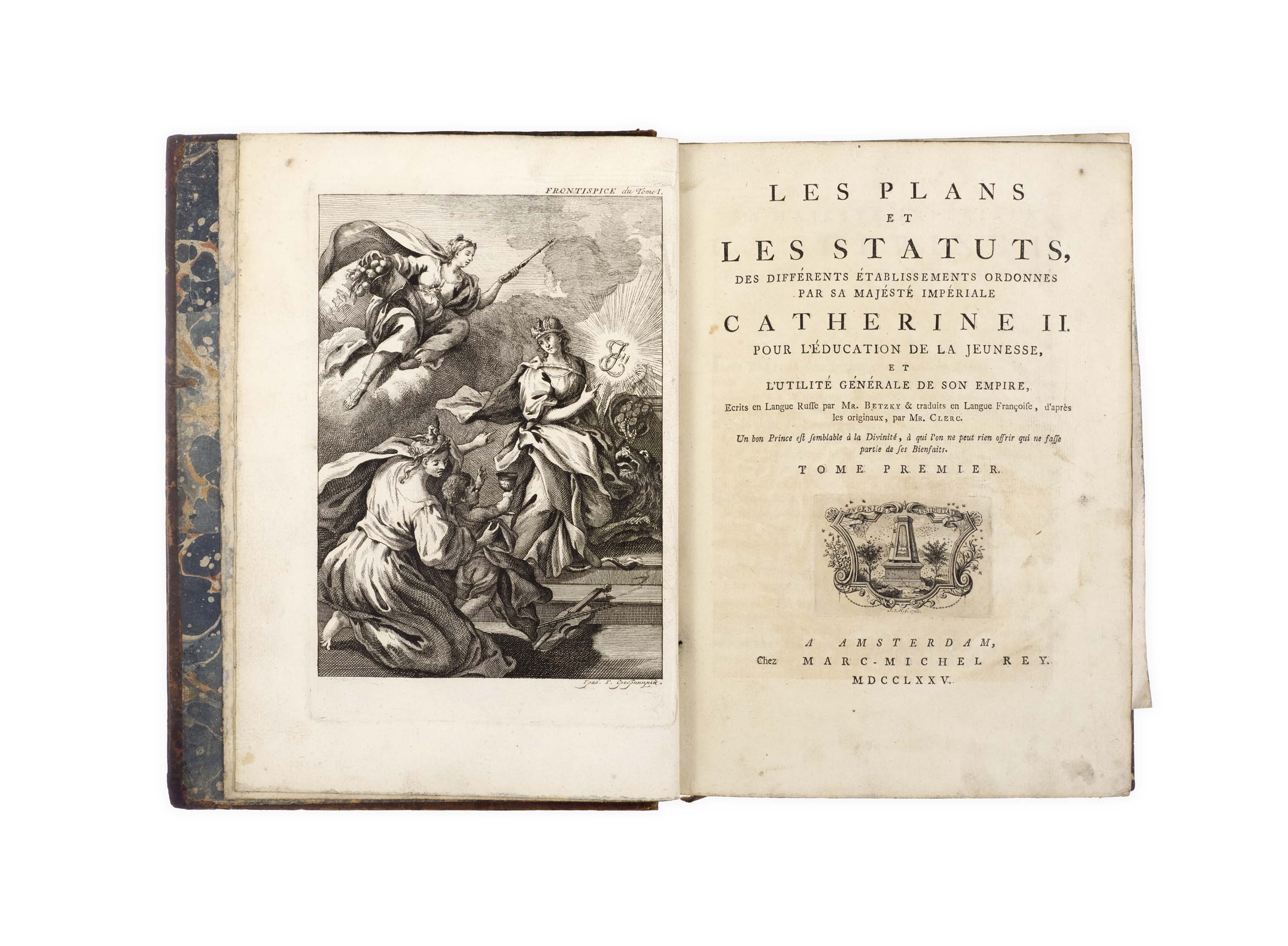
Les plans et les statuts, des différents établissements ordonnés par sa majesté impériale Catherine II. pour l’éducation de la jeunesse, et l’utilité générale de son empire. Amsterdam, Marc-Michel Rey, 1775.
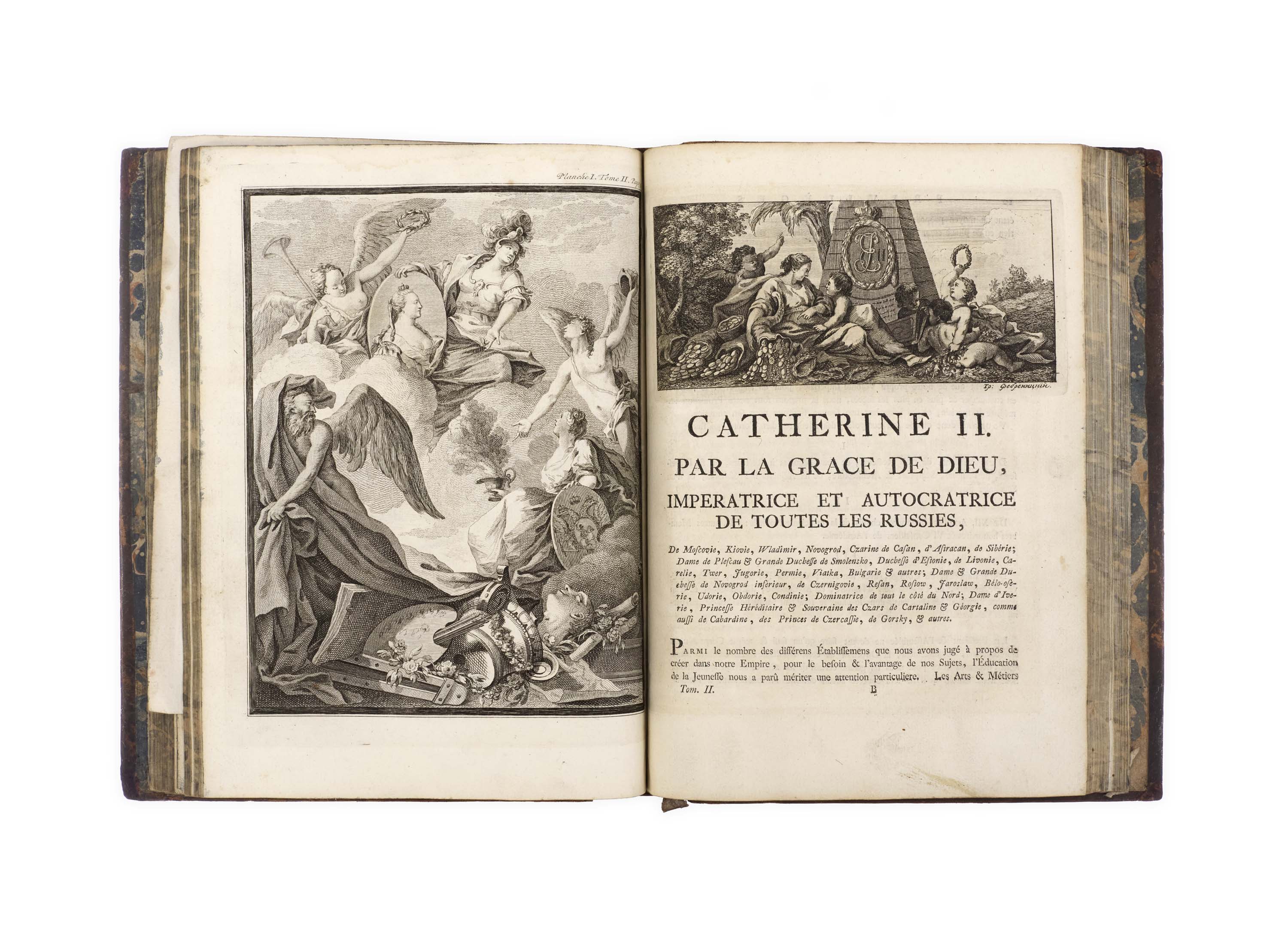
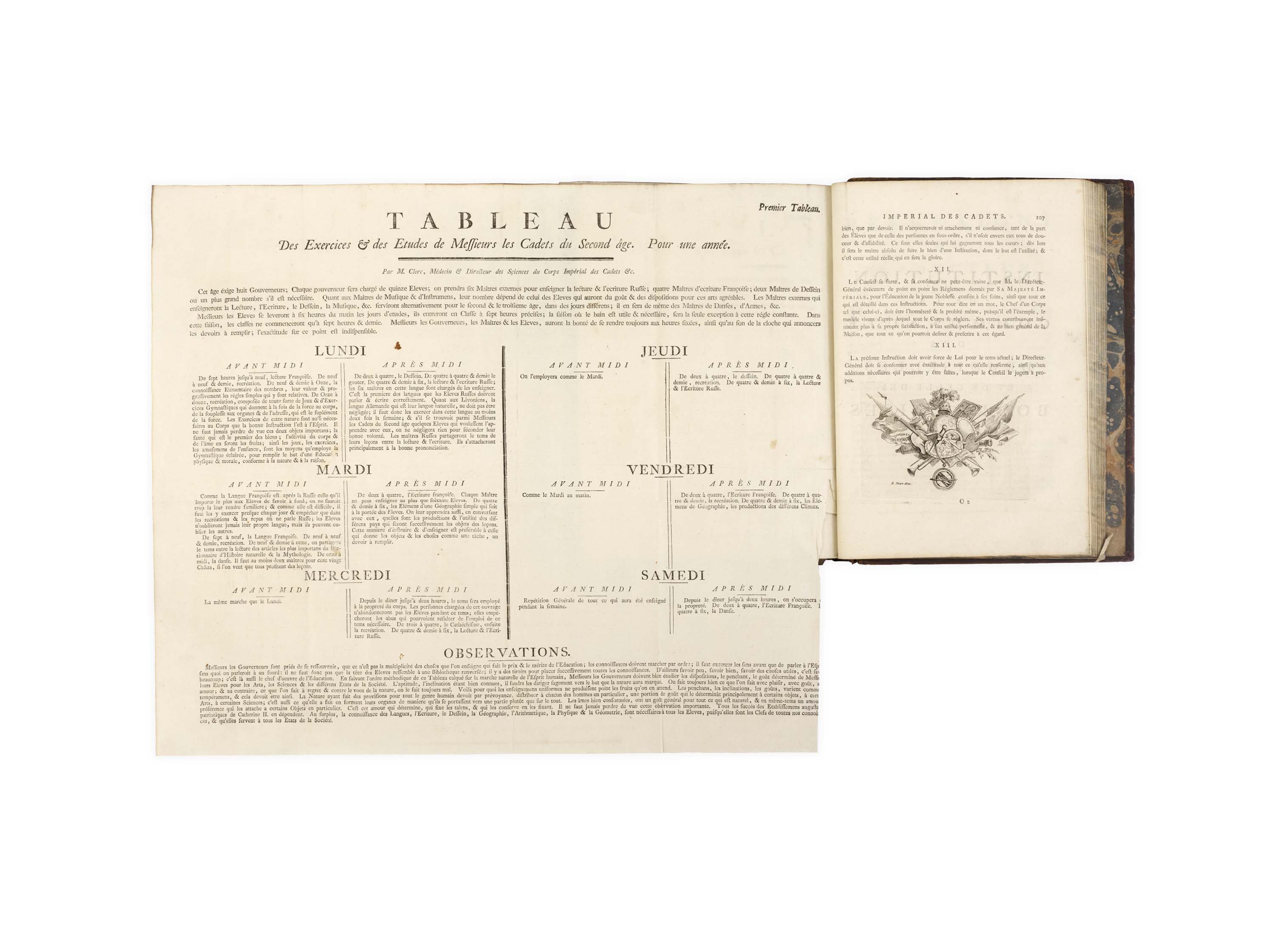
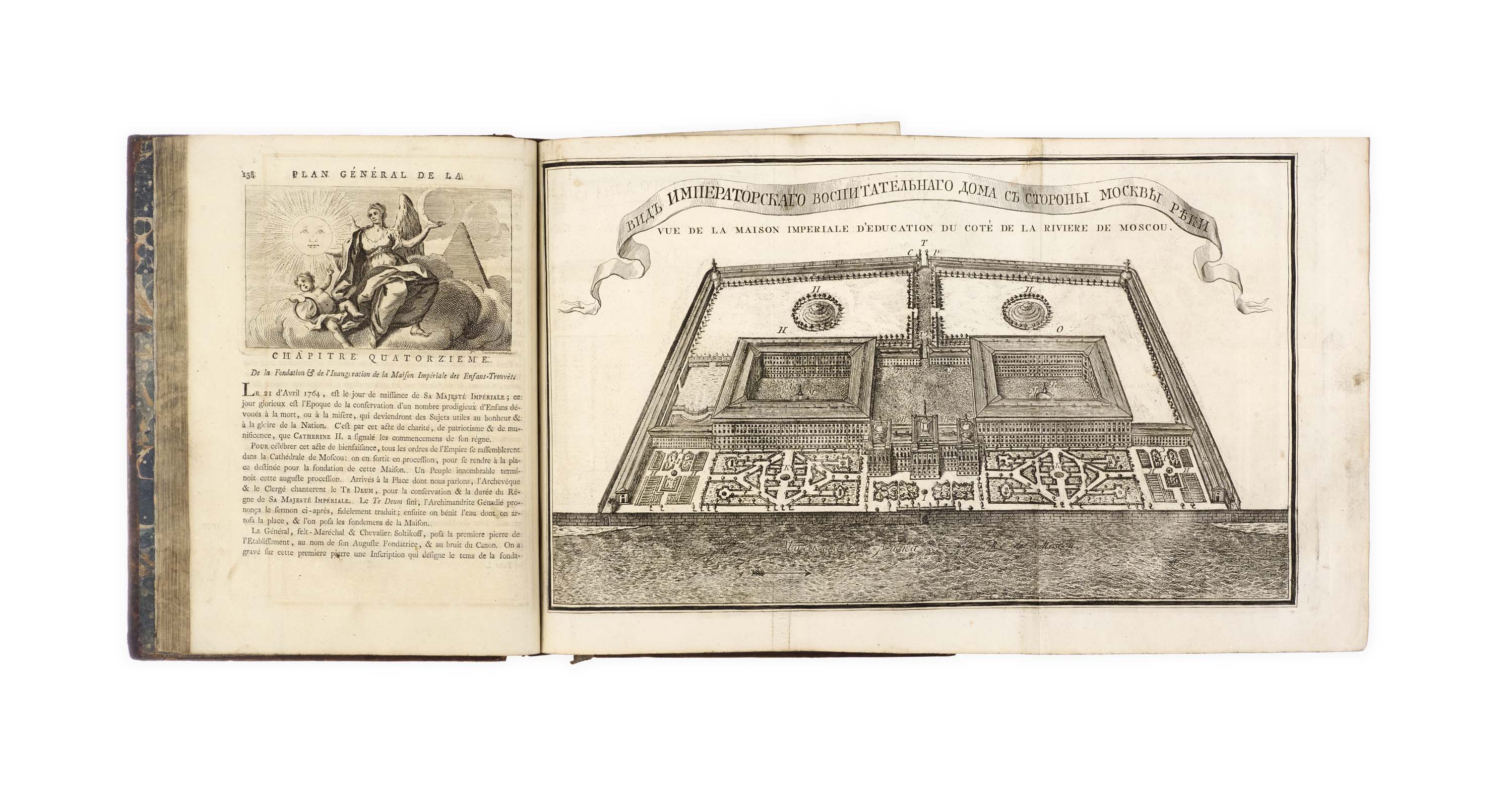
Two vols in one, 4to, pp. I: [vi], [2], 160, 42, [2], II: [iv], 160, with an engraved frontispiece to each vol., 5 plates (of which 3 folding, the plate for vol. II, p. 109 bound after vol. II, p. 9), and 5 folding tables; engraved device to each title, engraved vignettes and head- and tailpieces throughout, one woodcut tailpiece; a few minor stains; else a very good copy in contemporary mottled sheep, spine gilt in six compartments with gilt lettering-piece, pink silk placemarker, edges marbled; neatly recornered, a little rubbed, hinges broken but joints sound.
Added to your basket:
Les plans et les statuts, des différents établissements ordonnés par sa majesté impériale Catherine II. pour l’éducation de la jeunesse, et l’utilité générale de son empire.
First edition in French, translated from the Russian of 1764–7, of Catherine the Great’s plans for the Enlightened reform of education in her empire, with large engraved plans, tables, and allegorical vignettes proposing a striking and compelling vision for the new Russia.
Influenced by Locke, Fénélon, and the Encyclopédie, Catherine had been interested in reforming Russian education since seizing power in 1762. The following year she appointed as her chief advisor on education Ivan Ivanovich Betskoy, natural son of a Russian prince, who had toured schools, universities, and hospitals on his travels abroad and mixed with the encyclopédistes while exiled in Paris. From 1764 he published a series of works on Catherine’s planned reforms, collected and first translated into French in the present edition.
‘The emphasis was on the creation of a “new kind of person”, a new generation, which could only be achieved by isolating the child completely from the age of five to twenty-one from the harmful influences of parents and an illiterate, brutal and corrupt society. Schools were to stress not professional or vocational training but the creation of good citizens and accomplished human beings. Education was to be by precept and moral persuasion. Two years later Betskoy produced a continuation of the general plan dealing with the physical aspect of the education of children from birth to youth. These instructions, “selected from the best authors”, are extremely modern in conception, with the emphasis on hygiene, simplicity, fresh air, loose clothing, well fitting and low heeled shoes etc.’ (de Madariaga, p. 376).
Among the more pioneering aspects was a refutation of Locke’s support for corporal punishment: ‘All forms of beating, apart from the pain, are, in accordance with all knowledge of all physical principles, harmful to health’ (quoted in ibid., trans.).
Betskoy’s works were translated into French (for pan-European consumption) and published under the supervision of Diderot, who appended a note of his own praising Betskoy and Catherine’s reforms. Seemingly not by Diderot, however, is the ‘biting indictment of serfdom’ inserted here as well: ‘it may have been added by M. Clerc [the translator], or even by Betskoy. It must certainly have been known to Catherine; it provides an example of the difference between the image of Russia presented to Russians and that presented to the West’ (ibid., p. 378 n.).
Library Hub shows copies at the BL, TCD, Rylands, and UCL only.
Cioranescu 38333; STCN 306114666. See de Madariaga, ‘The Foundation of the Russian educational System by Catherine II’ in Slavonic and East European Review 57, no. 3 (1979).