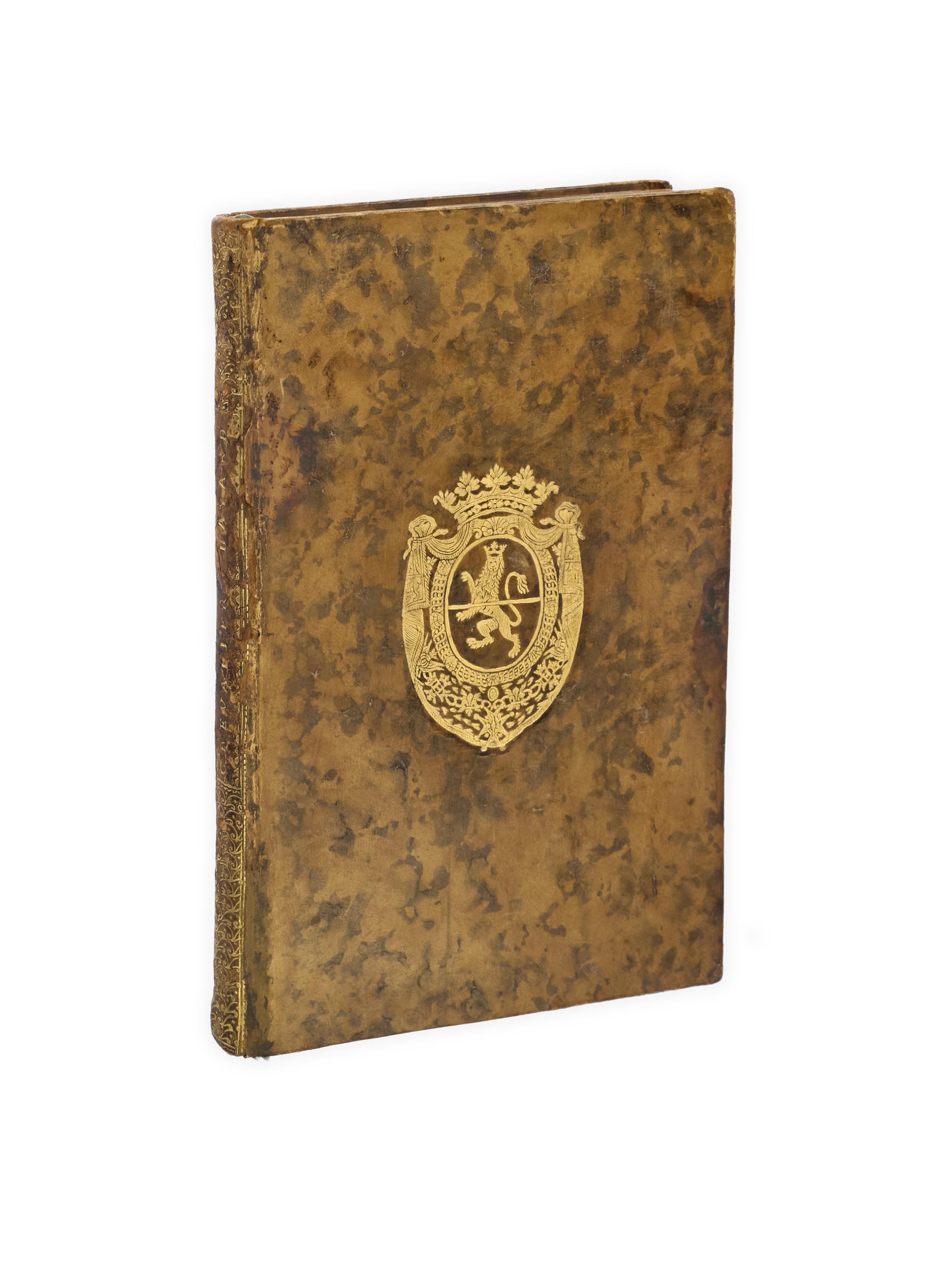
The Duc De La Vallière Copy
[CHAMPIER, Symphorien.]
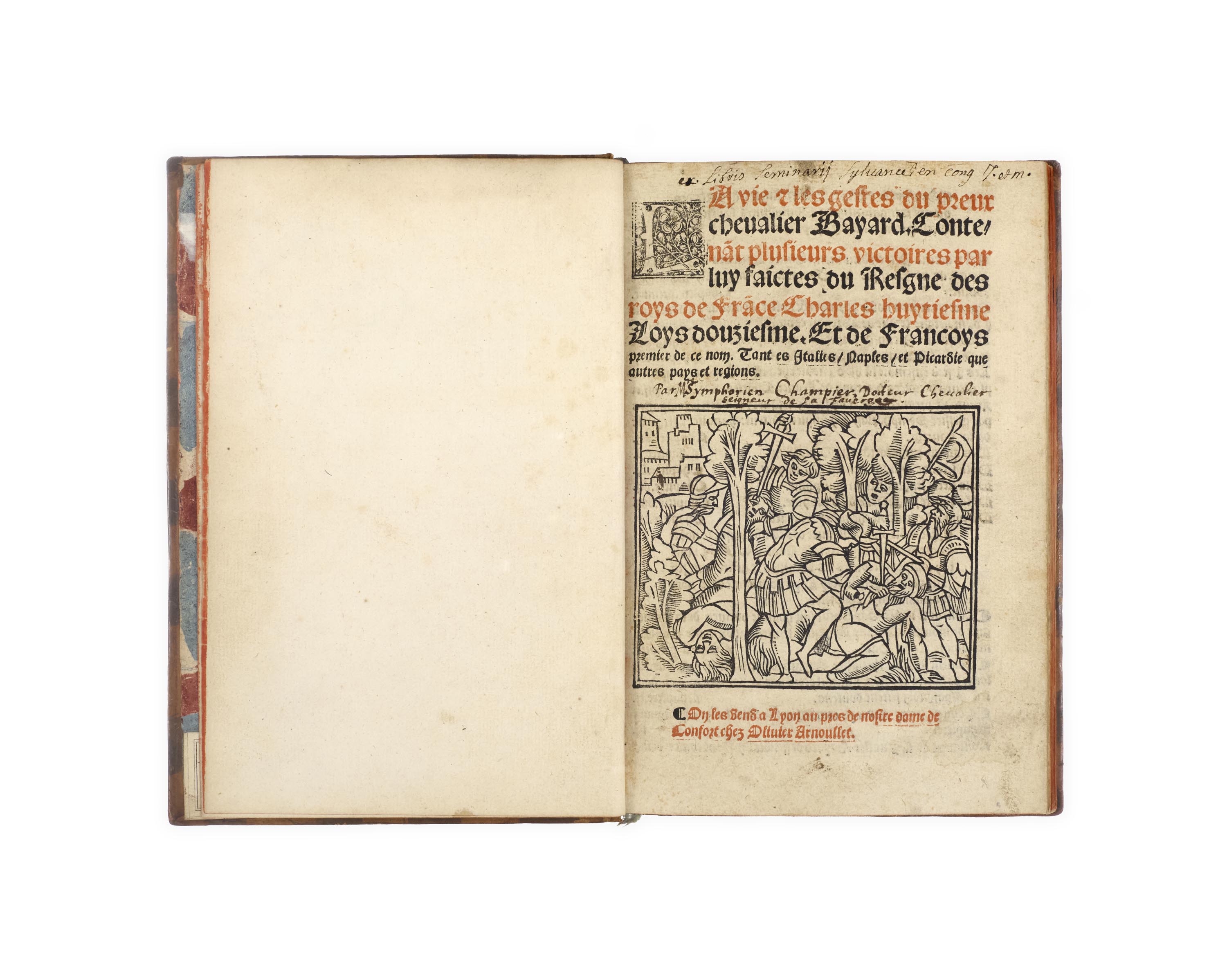
La vie & les gestes du preux chevalier Bayard. Contenant plusieurs victoires par luy faictes du Resgne des roys de France Charles huytiesme Loys douzieme. Et de Francoys premier de ce nom. Tant es Italies, Naples, et Picardie que autres pays et regions. Lyons, Olivier Arnoullet, [(colophon:) 8 April 1558].
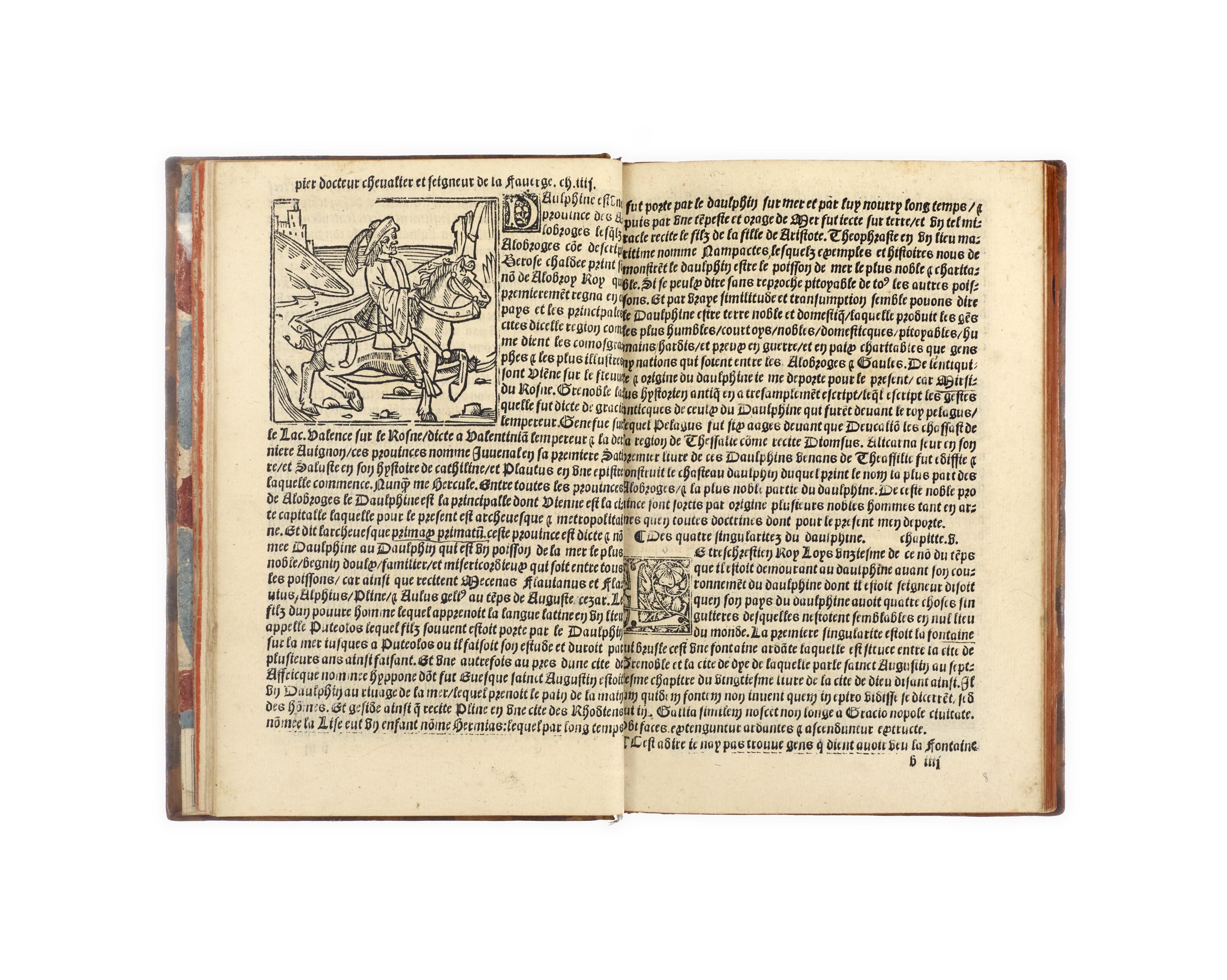
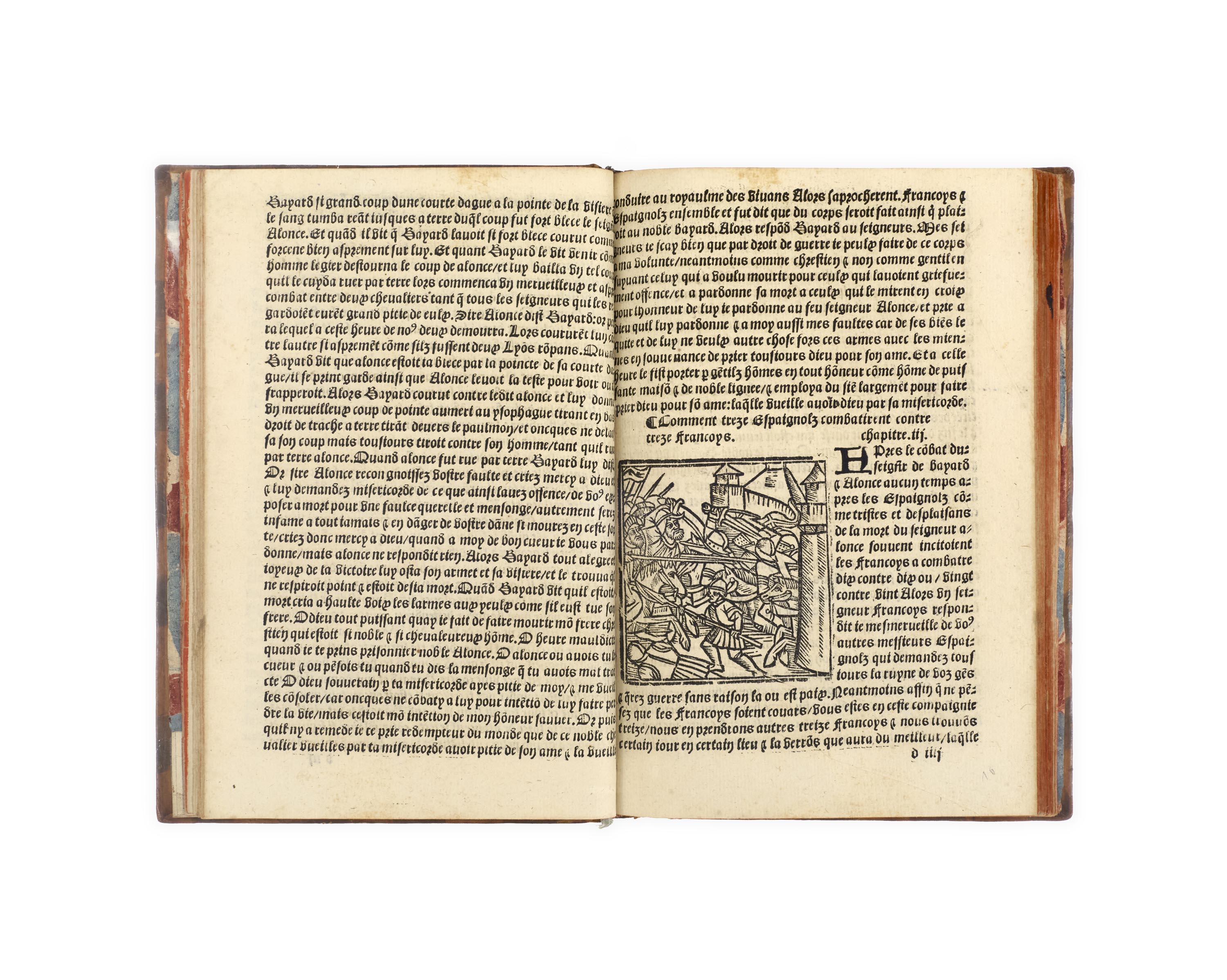
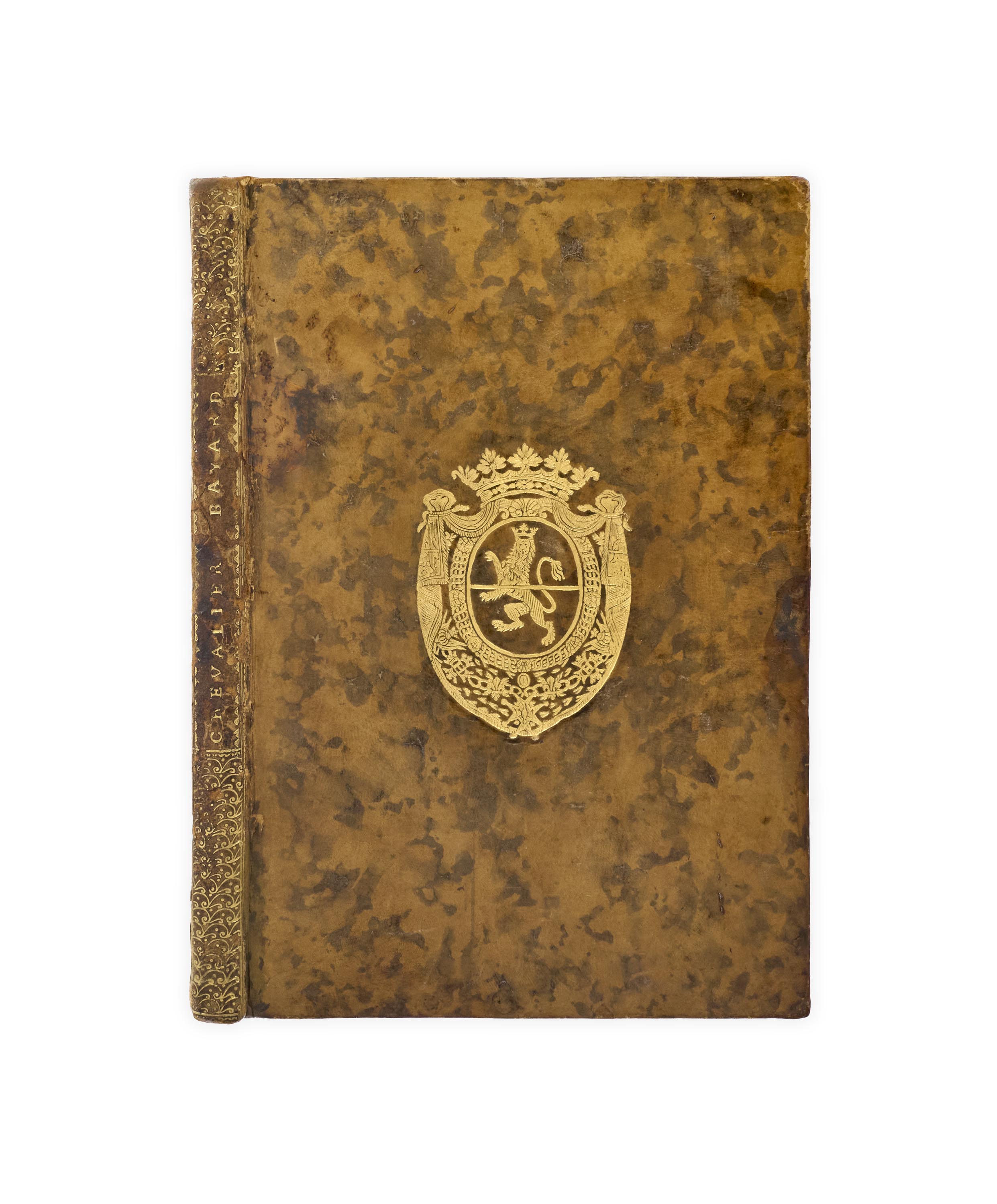
4to, ff. [56]; lettres bâtardes, title printed in red and black with woodcut initial and large woodcut illustration, woodcut initials throughout, 12 woodcut illustrations; marginal paper-flaws to lower corners of G1 and H1, very occasional light foxing, but a very good copy; bound in eighteenth-century French mottled calf with the arms of the duc de La Vallière (Olivier 1719, fer 1) blocked in gilt to each board, spine gilt à travers and lettered directly in gilt, edges stained red, blue silk place-marker, marbled endpapers, flyleaves watermarked with a bunch of grapes and the date 1742; a little rubbed, skilful repairs to corners; author’s name added in manuscript to title-page, inscription ‘ex libris Seminarii Sylvanecten. cong. J. et M.’ to head of title-page, two paper shelf labels to front pastedown.
Added to your basket:
La vie & les gestes du preux chevalier Bayard. Contenant plusieurs victoires par luy faictes du Resgne des roys de France Charles huytiesme Loys douzieme. Et de Francoys premier de ce nom. Tant es Italies, Naples, et Picardie que autres pays et regions.
A rare edition of Champier’s account of the preux chevalier Bayard’s life and achievements, from the renowned library of the duc de La Vallière.
Pierre Terrail (c. 1473–1524), seigneur de Bayard, fought in the Italian Wars of Charles VIII, Louis XII, and François I, starting with the Battle of Fornovo in 1495, Agnadello in 1509, the sieges of Padua and Brescia, Ravenna, and Marignano in 1515 (where Champier claims he knighted François I on the battlefield). François appointed him deputy governor of the Dauphiné in 1515, and he subsequently took part in military action against Charles V at Mezières in 1521. Finally, in 1524, he was shot and killed in Piedmont as the French army retreated over the Alps.
‘Given the title “le chevalier sans peur et sans reproche,” Bayard was seen as embodying the best of the traditional chivalric virtues of the gentle knight: courage, purity, devotion to duty, loyalty to one’s prince, respect for one’s enemy, and mercy towards the vanquished and the weak. These virtues represented the highest ideals of noble behaviour, ideals which appeared to many commentators to be dying out in the sixteenth century via the introduction of gunpowder (Bayard was killed by an arquebus projectile), the use of mercenaries and peasant infantry, and the spread of religious tensions that were beginning to tear France apart’ (Kalas, review of Les gestes ensemble la vie du preulx Chevalier Bayard, edited by D. Crouzet, 1992, in The Sixteenth Century Journal XXV (1994), p. 1014).
Symphorien Champier (1471–1539), a doctor from Lyons, was married to Marguerite Terrail, a cousin of the Chevalier. Champier attended the French army during the Italian Wars in a medical capacity, as physician to Antoine duke of Lorraine, tending to Bayard’s battlefield wounds in 1512, and was therefore able to report events first-hand. Champier’s account of Bayard’s life and achievements begins with prefaces addressed to Laurent II Alleman, Bishop of Grenoble, and to Merlin de Saint-Gelais. Then comes a description of the Dauphiné (in the south-east of France) and the life of Terrail, which takes up around half the text. This is followed by a comparison of the four ‘preux chevaliers’ from the Dauphiné: Monteson de Clermont, Claude de Vaudrey, François Champier (surely a relation), and finally Bayard. Champier compares Bayard with historical, biblical, and mythical figures, such as Hannibal, Scipio Africanus, Theseus, King David, Samson, and Roland, ending with lamentations on the death of Bayard.
First printed in Lyons in 1525, this is perhaps the ninth printing. It was a very popular work, but despite the numerous editions printed in both Lyons and Paris very few copies have survived.
Olivier Arnoullet (1486–1567) continued his father Jacques’s printing business in Lyons, producing numerous novels and illustrated texts in French throughout his long career.
Provenance:
1. The Eudist seminary in Senlis, Oise (the Congregation of Jesus and Mary was founded in Caen in 1643).
2. Louis César de La Baume Le Blanc, duc de La Vallière (1708–1780), whose two libraries were sold at auction in Paris in 1783 and 1788; his sale, Guillaume de Bure, December 1783, part 3, lot 5090.
We have located only one copy in the US, at the Newberry (incomplete), two copies in France (Tours and Grenoble, both incomplete), and one in Milan (Trivulziana).
USTC 65185; Bechtel C-147; von Gültlingen III, Arnoullet 101.