
Le Chevalier Sans Peur Et Sans Reproche
CHAMPIER, [Symphorien].
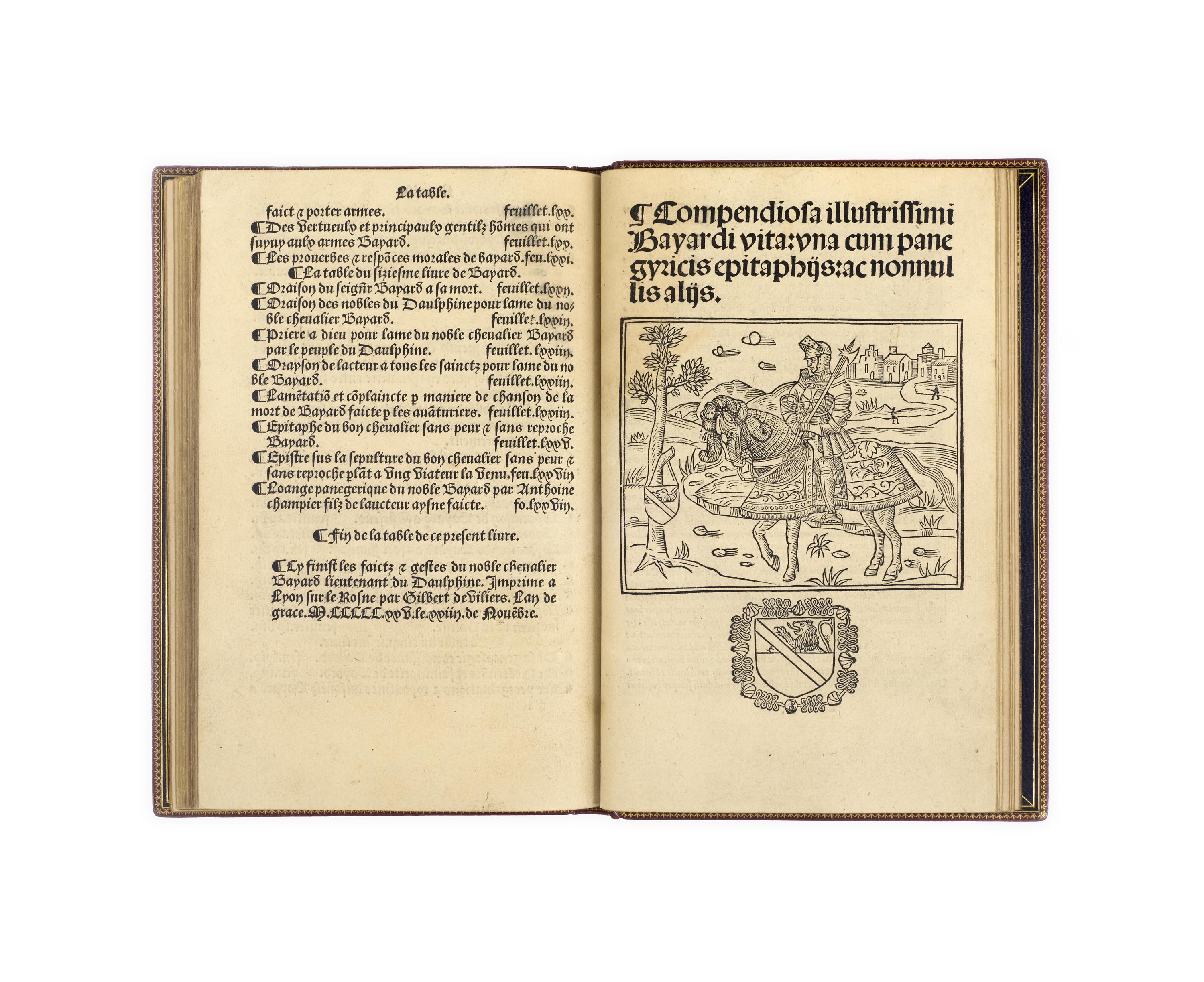
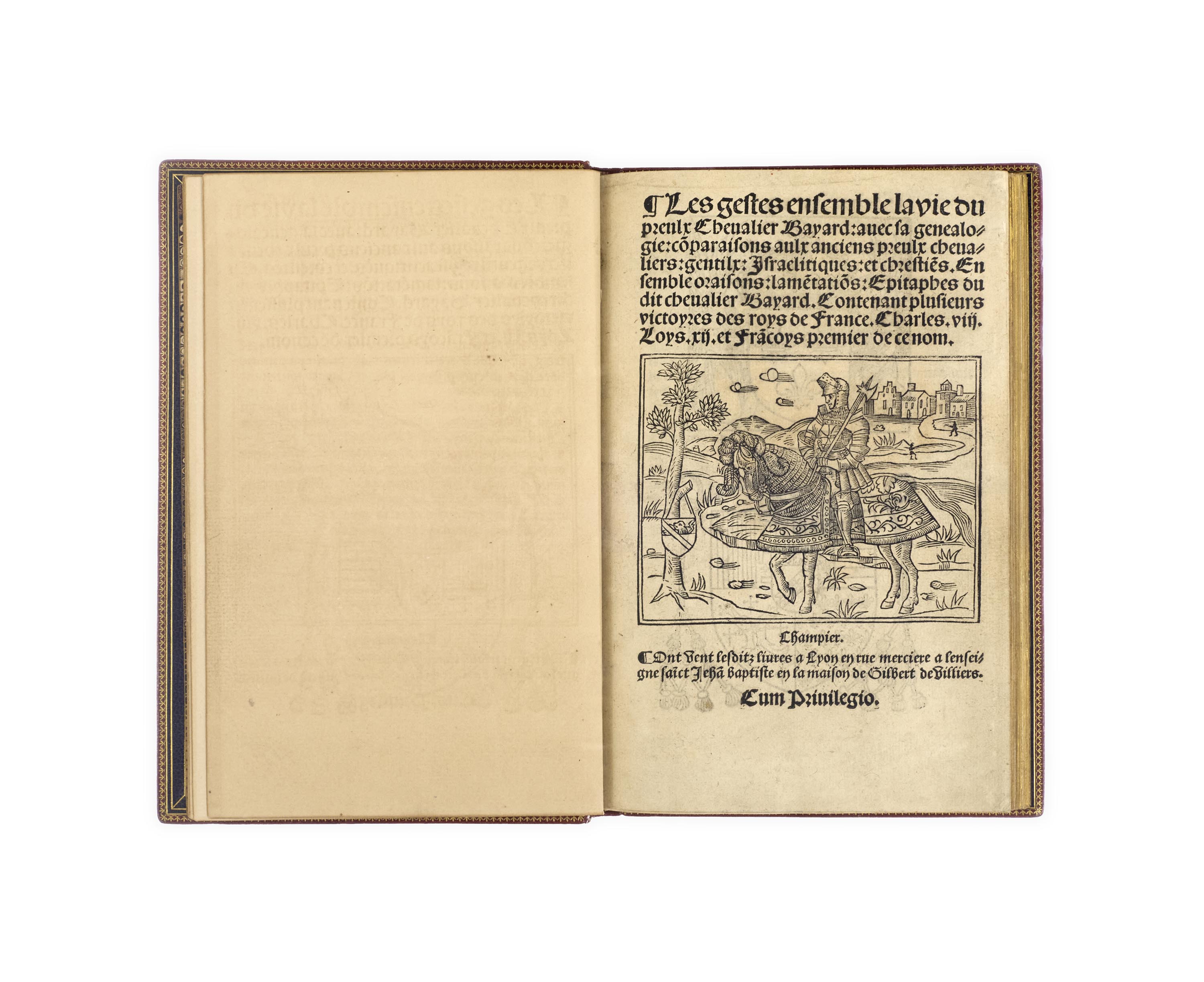
Les gestes ensembles la vie du preulx chevalier Bayard [– Compendiosa illustrissimi Bayardi vita, una cum panegyricis epitaphiis, ac nonnullis aliis]. Lyons, Gilbert Devilliers, [(colophon:) 24 November 1525].
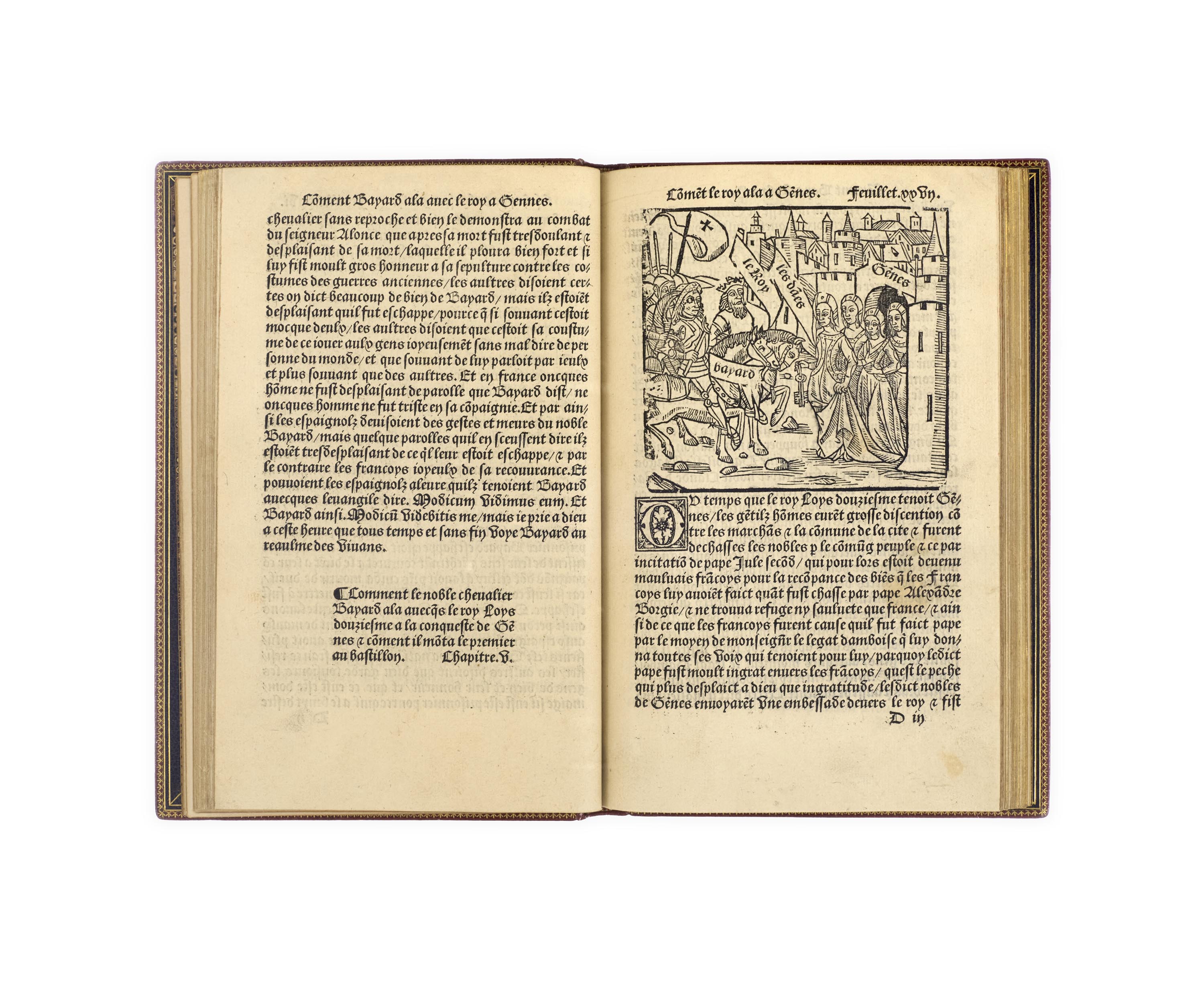
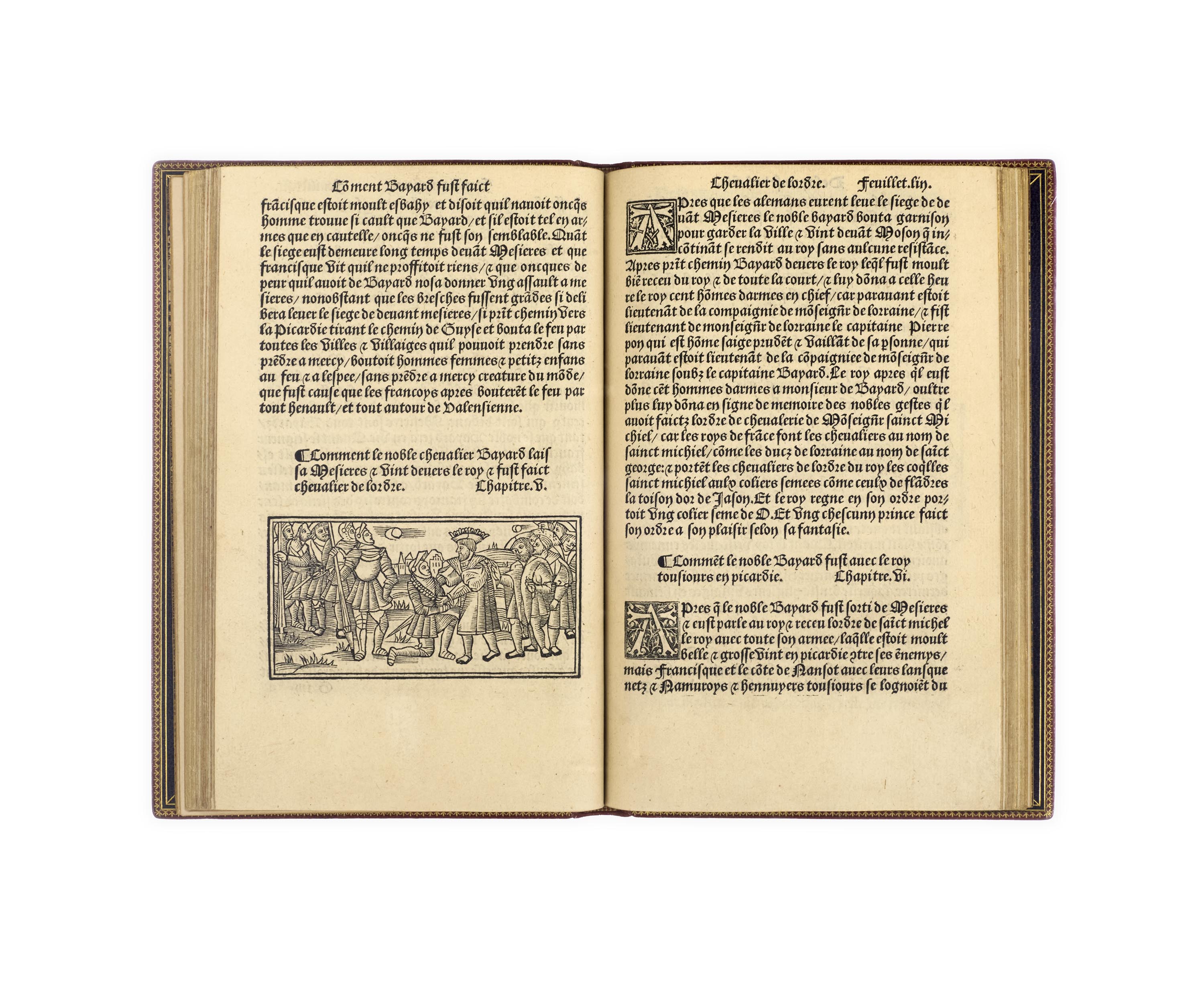
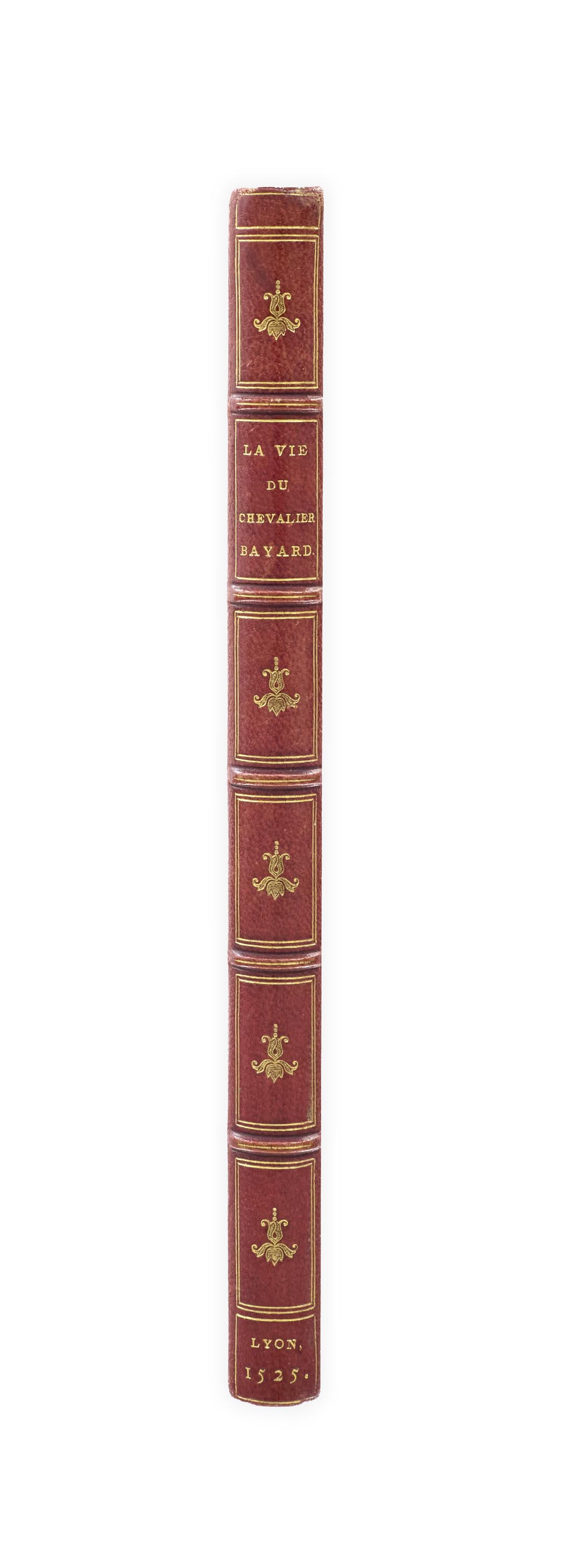
Two parts in one vol., 4to, ff. lxxviii, [2], [4]; first part in lettres bâtardes, second part in italics, woodcut portrait of a mounted Chevalier to each title-page, large white-on-black woodcut initials, numerous woodcut illustrations, woodcut armorials of France and of Laurent II Alleman to title verso; light stain to B1, but a very good copy; late nineteenth-century crushed red morocco gilt by Allô and Wampflug (turn-ins signed in gilt, front flyleaf signed in black), spine gilt in compartments and lettered directly in gilt, edges gilt, crushed navy morocco gilt doublures, marbled endleaves and flyleaves; gilt blue paper booklabel of the Bibliothèque Genard and engraved booklabel of Eugène Chaper of Grenoble to front free endpaper, signature of Chaper to front flyleaf verso.
Added to your basket:
Les gestes ensembles la vie du preulx chevalier Bayard [– Compendiosa illustrissimi Bayardi vita, una cum panegyricis epitaphiis, ac nonnullis aliis].
Rare first edition of this richly illustrated chivalric history of the Chevalier de Bayard, one of France’s most celebrated warriors, written in the year of his death.
Pierre Terrail (c. 1473–1524), seigneur de Bayard, fought in the Italian Wars of Charles VIII, Louis XII, and François I, starting with the Battle of Fornovo in 1495, Agnadello in 1509, the sieges of Padua and Brescia, Ravenna, and Marignano in 1515 (where Champier claims he knighted François I on the battlefield). François appointed him deputy governor of the Dauphiné in 1515, and he subsequently took part in military action against Charles V at Mezières in 1521. Finally, in 1524, he was shot and killed in Piedmont as the French army retreated over the Alps.
‘Given the title “le chevalier sans peur et sans reproche,” Bayard was seen as embodying the best of the traditional chivalric virtues of the gentle knight: courage, purity, devotion to duty, loyalty to one’s prince, respect for one’s enemy, and mercy towards the vanquished and the weak. These virtues represented the highest ideals of noble behaviour, ideals which appeared to many commentators to be dying out in the sixteenth century via the introduction of gunpowder (Bayard was killed by an arquebus projectile), the use of mercenaries and peasant infantry, and the spread of religious tensions that were beginning to tear France apart’ (Kalas, review of Les gestes ensemble la vie du preulx Chevalier Bayard, edited by D. Crouzet, 1992, in The Sixteenth Century Journal XXV (1994), p. 1014).
Symphorien Champier (1471–1539), a doctor from Lyons, was married to Marguerite Terrail, a cousin of the Chevalier. Champier attended the French army during the Italian Wars in a medical capacity, as physician to Antoine duke of Lorraine, tending to Bayard’s battlefield wounds in 1512, and was therefore able to report events first-hand. Champier’s account of Bayard’s life and achievements begins with prefaces addressed to Laurent II Alleman, Bishop of Grenoble, and to Merlin de Saint-Gelais. Then comes a description of the Dauphiné (in the south-east of France) and the life of Terrail, which takes up around half the text. This is followed by a comparison of the four ‘preux chevaliers’ from the Dauphiné: Monteson de Clermont, Claude de Vaudrey, François Champier (surely a relation), and finally Bayard. Champier compares Bayard with historical, biblical, and mythical figures, such as Hannibal, Scipio Africanus, Theseus, King David, Samson, and Roland, ending with lamentations on the death of Bayard.
Although Bechtel lists an edition with the date 14 November 1524 in the colophon (C-138), the BnF shelfmark for the only recorded copy is assigned, in the BnF online catalogue, to the 1525 edition; similarly, von Gültlingen records only the 1525 edition. The text was also issued in 1525 by Jean Trepperel, Philippe le Noir, Jacques Nyverd, and Denis Janot of Paris.
Provenance:
1. Claude-Auguste Genard (1819–1908), of Grenoble, with his booklabel incorporating the Dauphiné device; his sale, Paris, 4 December 1882 onwards, lot 839 (‘RARISSIME ÉDITION ORIGINALE’), 1605 fr.
2. Eugène Chaper (1827–1890), also of Grenoble, who formed a notable library on the Dauphiné and whose booklabel similarly includes the Dauphiné device.
3. Silvain S. Brunschwig; his sale, Nicolas Rauch, Geneva, 29 March 1955, lot 356.
We have traced no copies in the US and just one copy in the UK, at the Rylands.
USTC 34088; Bechtel C-139; von Gültlingen III, Devilliers 26 (listing two copies, both in Paris); French Vernacular Books 9730. Not in Fairfax Murray, French or Mortimer, Harvard French.