Cheke Speaks Greek
CHEKE, John, Sir, and Stephen [GARDINER], Bishop of Winchester.
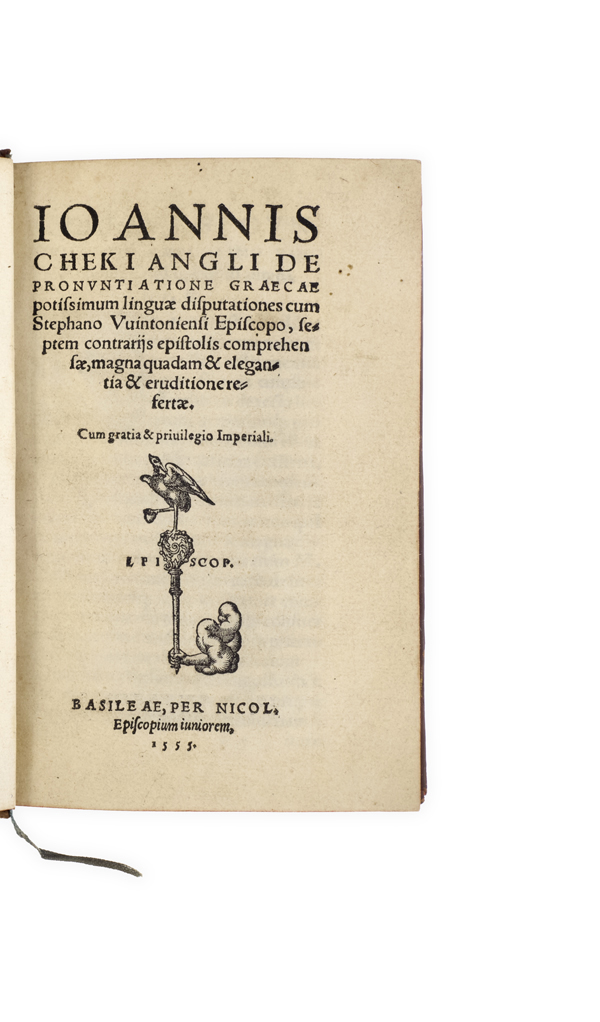
De pronuntiatione graecae potissimum linguae disputationes … septem contrariis epistolis comprehensae, magna quadam & elegantia & eruditione refertae. Basel, Nikolaus Episcopius the younger, 1555.
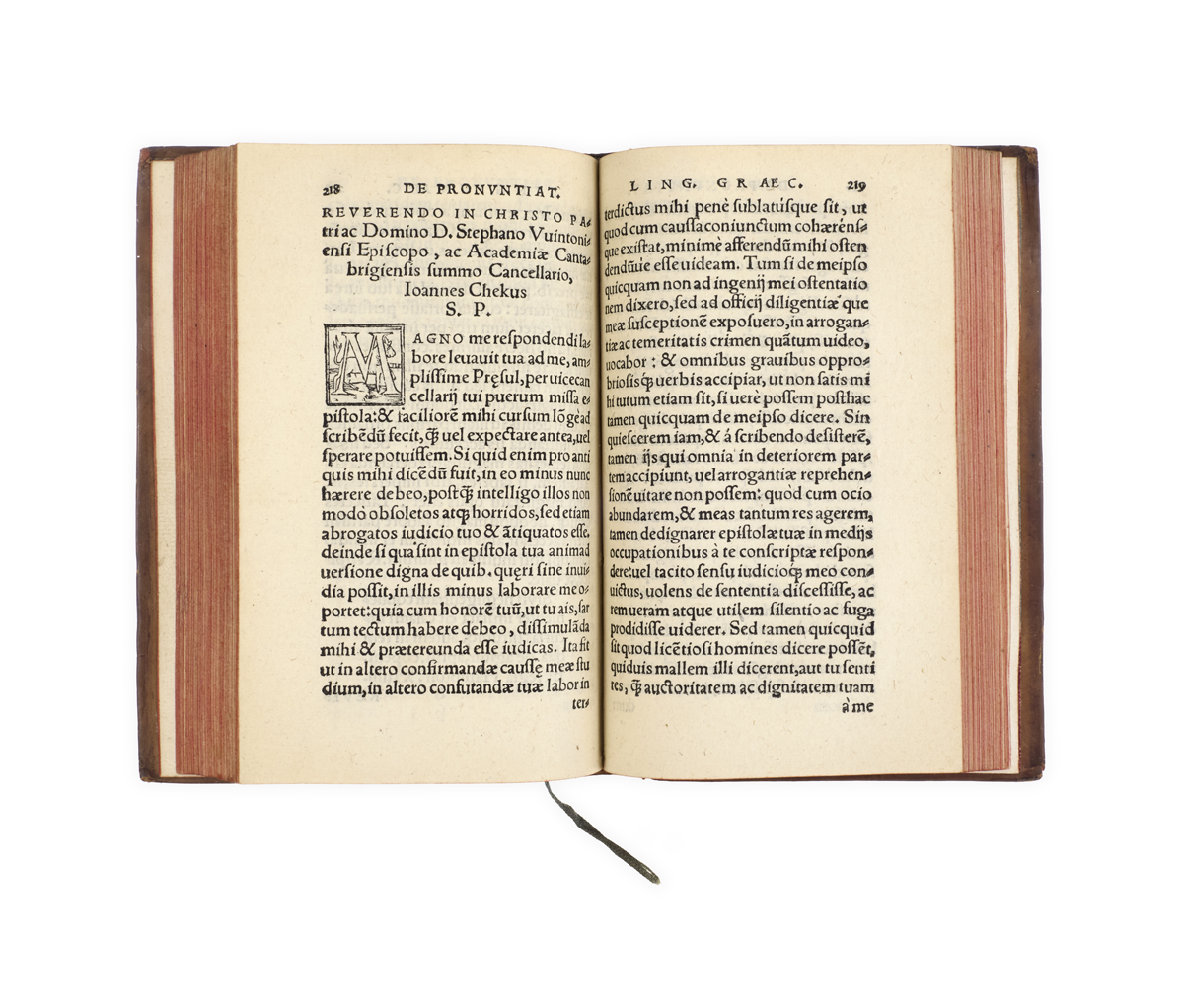
8vo, pp. [xii], [4, blank], ‘349’ (recte 351), [1, blank]; woodcut printer’s device to title, woodcut initials, a very good copy; bound in late eighteenth-century English polished calf, spine gilt in compartments with gilt red morocco lettering-piece, edges stained red, marbled endpapers, blue ribbon place-marker; extremities very slightly rubbed, corners a little worn; inscription dated 1830 erased from front flyleaf.
Added to your basket:
De pronuntiatione graecae potissimum linguae disputationes … septem contrariis epistolis comprehensae, magna quadam & elegantia & eruditione refertae.
First edition of this collection of letters between John Cheke and Stephen Gardiner debating the correct pronunciation of classical Greek, printed in Basel, where Cheke was in exile during the reign of Queen Mary.
Sir John Cheke (1514–1557) was appointed the first Regius professor of Greek at Cambridge in 1540, later becoming tutor to Edward VI. He was one of the most significant promoters of humanist learning in England, teaching all manner of notable men of the Tudor age, from Roger Ascham to William Cecil. As a committed Protestant connected to the Lords Protector Somerset and Northumberland, he was also heavily involved with religious reform. His involvement with Lady Jane Grey led to his imprisonment in the Tower and his exile to the Continent, where, shortly after this publication, he was apprehended in Antwerp and returned to the Tower. He was forced to recant his Protestantism to avoid being burnt at the stake, but died shortly after being freed.
The pronunciation of Greek was a matter of great interest to humanist scholars of the late fifteenth century, and in 1528 Erasmus composed a treatise to explain that it should not be spoken in the manner of modern (Byzantine) Greek, but closer to the patterns of speaking recorded in classical texts. In the 1530s John Cheke and his colleague Thomas Smith also investigated problems of pronunciation, but following Cheke’s lectures on this, the new Chancellor of the University of Cambridge, Stephen Gardiner, Bishop of Winchester and later Lord Chancellor under Queen Mary, issued a decree in 1542 to prevent this teaching. Gardiner, while acknowledging the justification for the change, considered that it would cause problems with those used to the established pronunciation. The outcome of the dispute reflected the idea that English and Greek did not need the intermediary presence of Latin, with its association with the Roman Church, and Gardiner’s reaction has also been attributed to a desire to prevent the challenge to authority made by the change in pronunciation.
The printing of this work in Basel was arranged by the Italian scholar Celio Secundo Curione, apparently without Cheke’s knowledge. The laudatory preface is addressed to Sir Anthony Cooke, another tutor of the late Edward VI, also in exile on the Continent.
USTC 667485; VD16 C 2144; Adams C 1432.