’You Will Rejoice in the Creation of This Index’
CHRYSOSTOM, John.
Opera … [(Colophon:) Venice, Bernardino Stagnino and Gregorio de’ Gregori, 9 February 1503.]
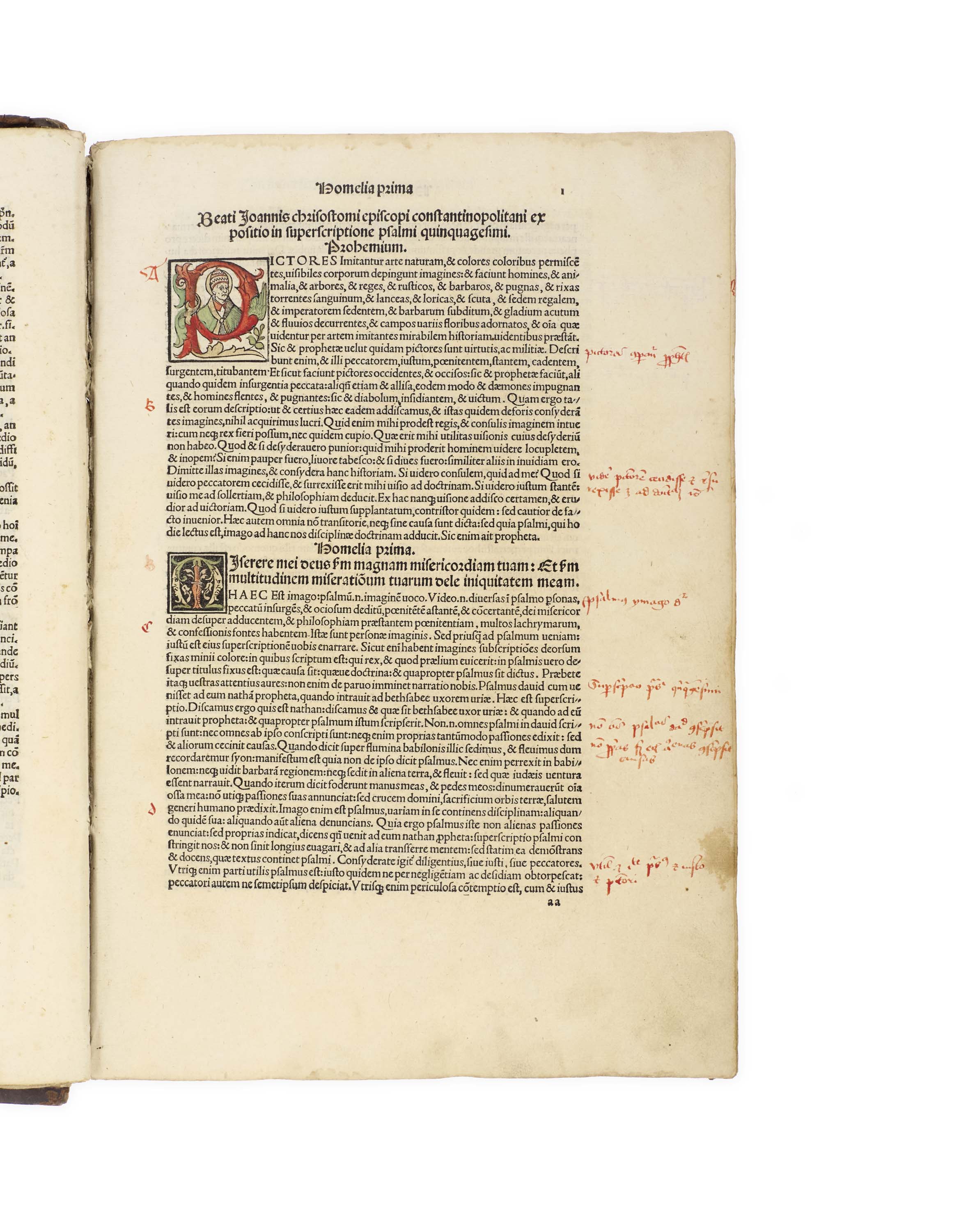
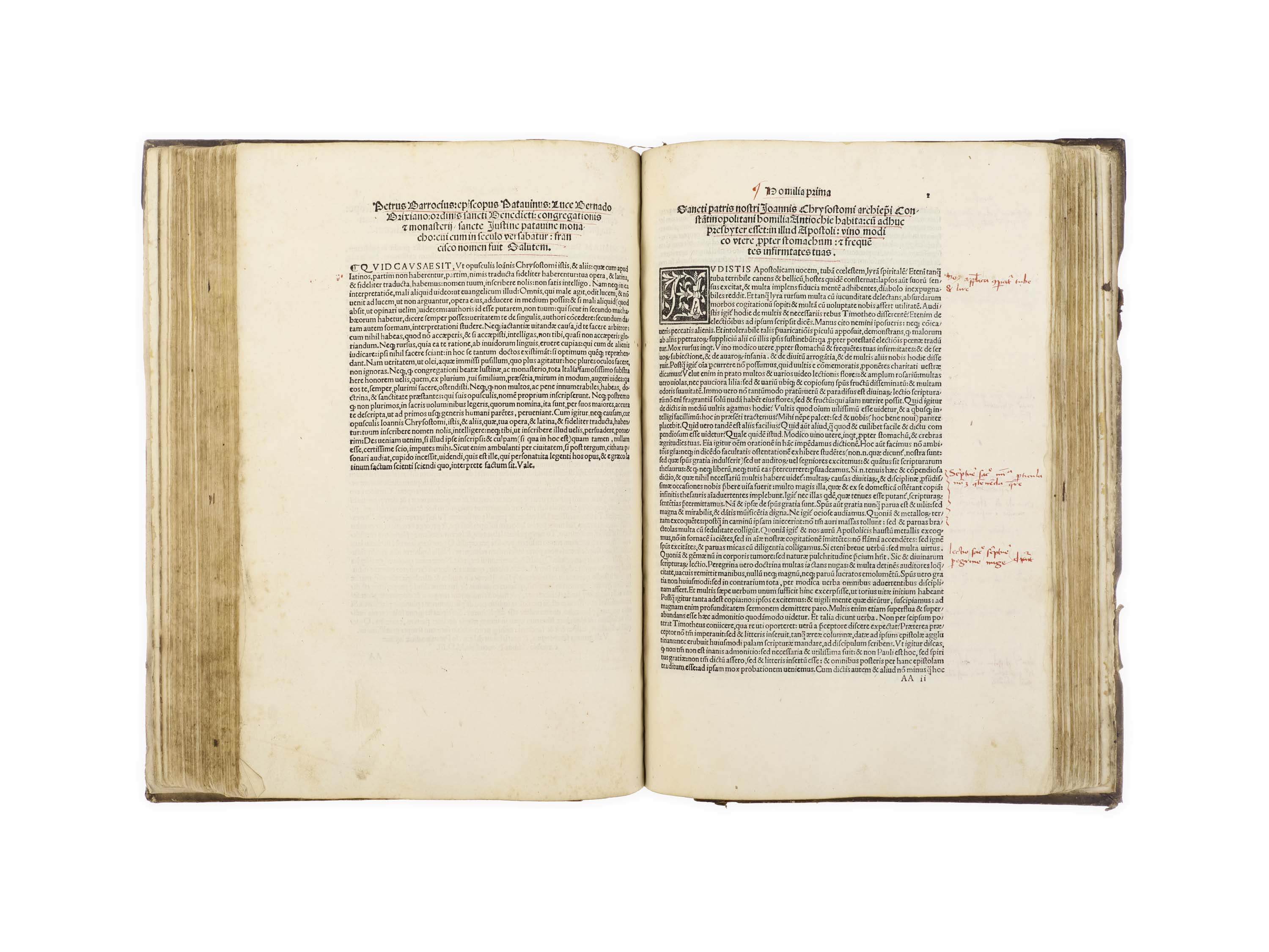
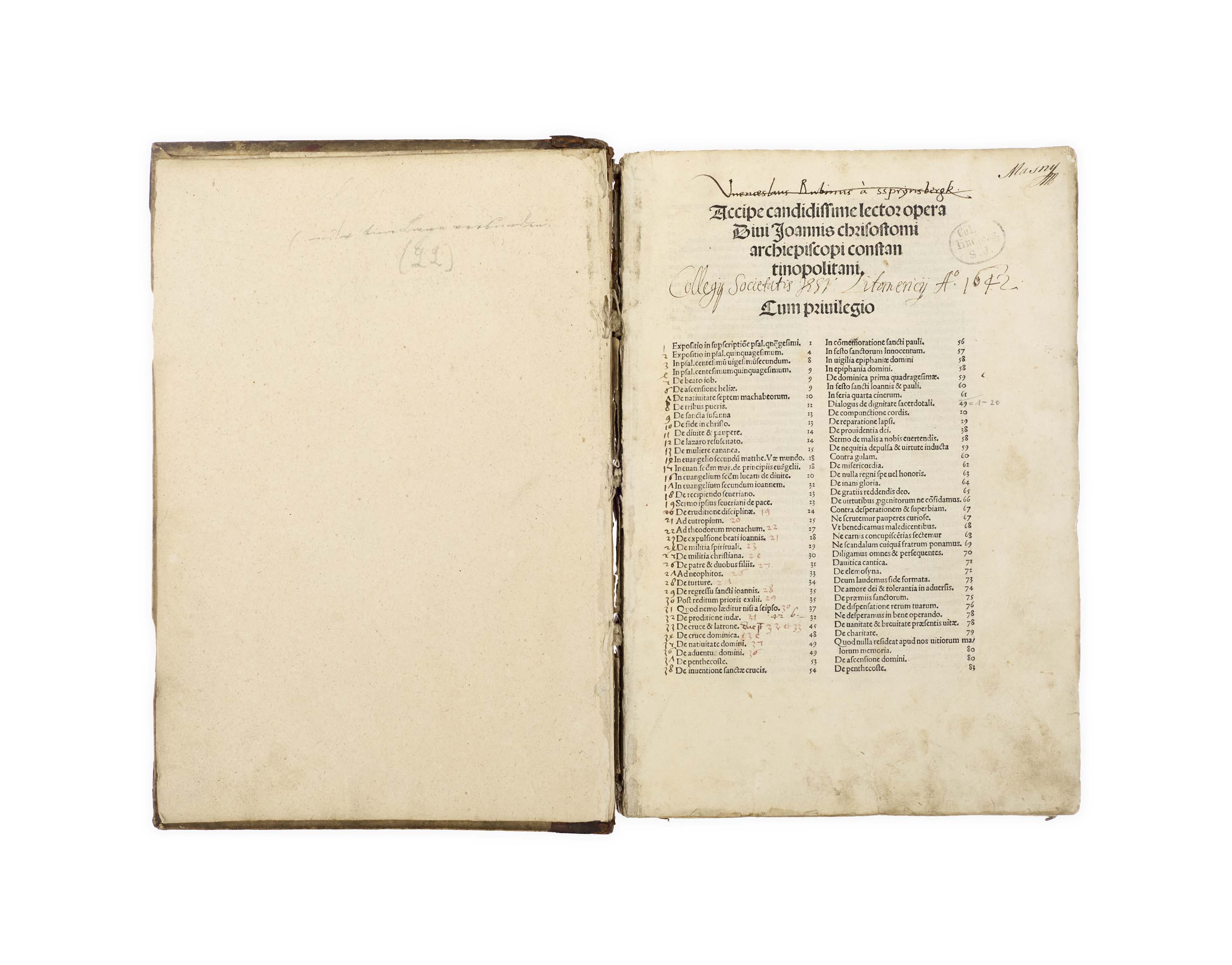
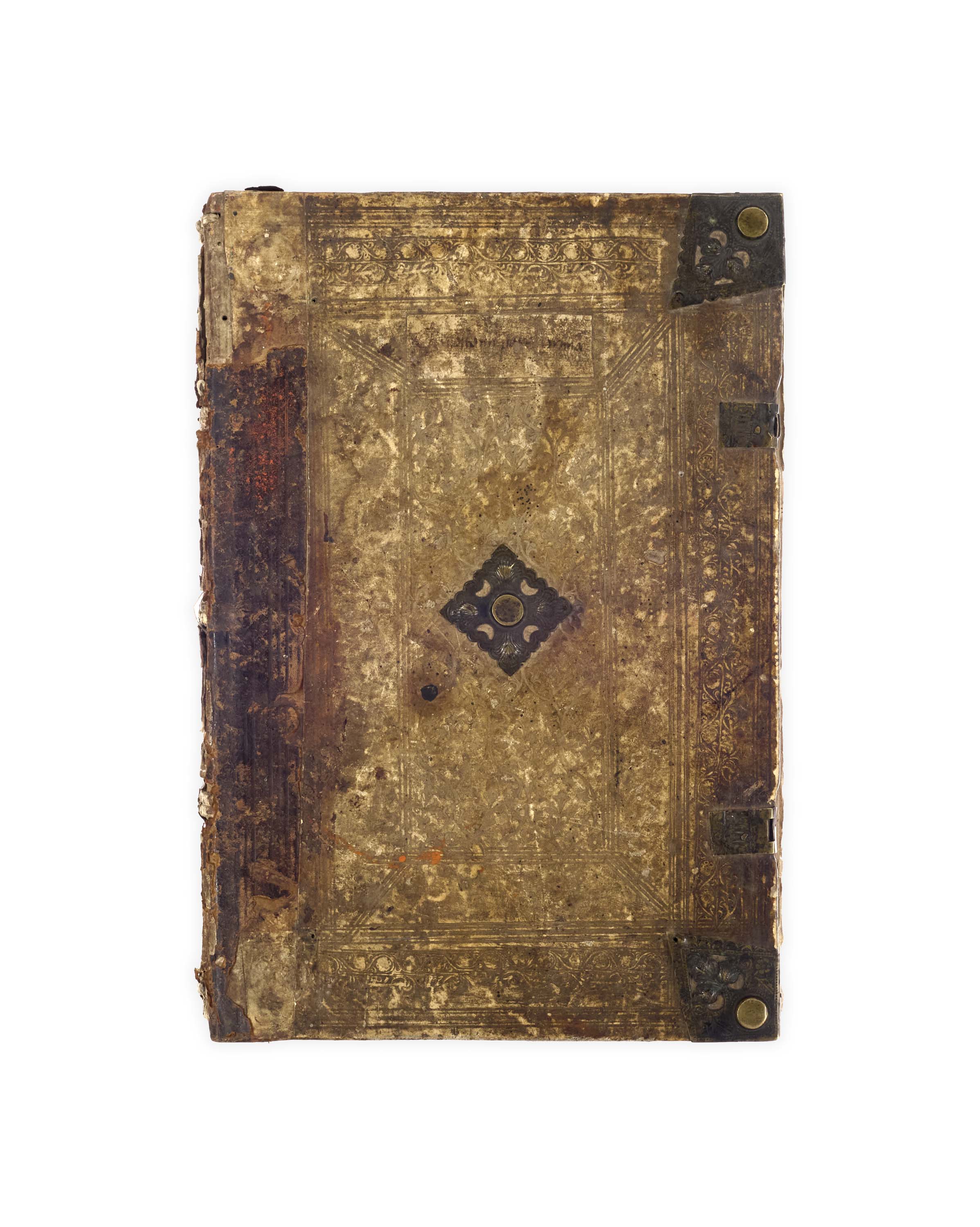
Vol. I only (of II), folio, ff. [x], 62, [8, manuscript index, blank], 94, ’97–104’ (i.e. 95–102), 140, [5, manuscript index]; quires LL and MM misbound; roman type with title-page and headlines in gothic, woodcut initials, the first two coloured in red and green, the first containing a portrait of a bishop, colophon to §9v; title-leaf tipped in and conjugate leaf loose, very occasional light marginal staining, otherwise a very good copy; bound in mid-sixteenth-century blind-stamped tawed sheep over wooden boards (most likely Saxon or Bohemian), a central panel of undulating leafy stems filled with a small foliate stamp with a heart-shaped base, outer border composed of two narrow roll tools, one floral, one foliate, with a rose stamp at corners, retaining three (of eight) brass cornerpieces, brass centrepiece to each board, remains of clasps to fore-edge, contemporary paper label with manuscript title to front board (faded), sewn on 3 split tawed thongs laced and pegged, with tawed Kapitalbünde; binding somewhat rubbed, spine covered in sheep at an early date, now worn and defective, slight traces of orange paint to front board, endpapers renewed; early sixteenth-century annotations in red and brown ink to almost every page of the first two-thirds of the volume, a few manicules, two substantial manuscript indexes in dark brown ink with red Lombard initials and initial-strokes; mid-sixteenth-century ownership inscription ‘Vuenceslaus Rubinus à ssprynsbergk’ to title-page, inscription of the Jesuits of Litomĕřice dated 1642 to title-page, early nineteenth-century oval ink stamp to title and small blue printed book-label ‘Biblioth. Mag. Coll. Linc. S. J.’ of the Jesuit College of Linz, nineteenth-century inscription ‘Masny’ to upper corner of title-page (see below).
The first collected edition of John Chrysostom’s sermons, a wide-margined copy with sixteenth-century Bohemian provenance in a contemporary pigskin binding with bosses, neatly annotated and with two extensive additional manuscript indexes dated 1506.
This copy of the first volume of Chrysostom’s homilies is the variant with the day of the month given in the colophon. Despite the privilege boldly stated on the title-page, a pirated edition appeared in Basel the following year. The dedication is signed by Thomas Januensis de Valerano, who freely rearranged the order of the homilies, and made use (for the most part) of translations that had already appeared in print. The publication was produced at the behest of the bishop of Padua, Pietro Barozzi, to whom the printer de’ Gregori addressed his preface; Barozzi possessed a fine library which included Greek books and manuscripts, including several by Chrysostom. There are further connections with Padua: Luca Bernardo and Severino de Pedipenne, monks of the Benedictine house of Santa Giustina, assisted with translations and the monastery library provided manuscript sources for some of the Greek text.
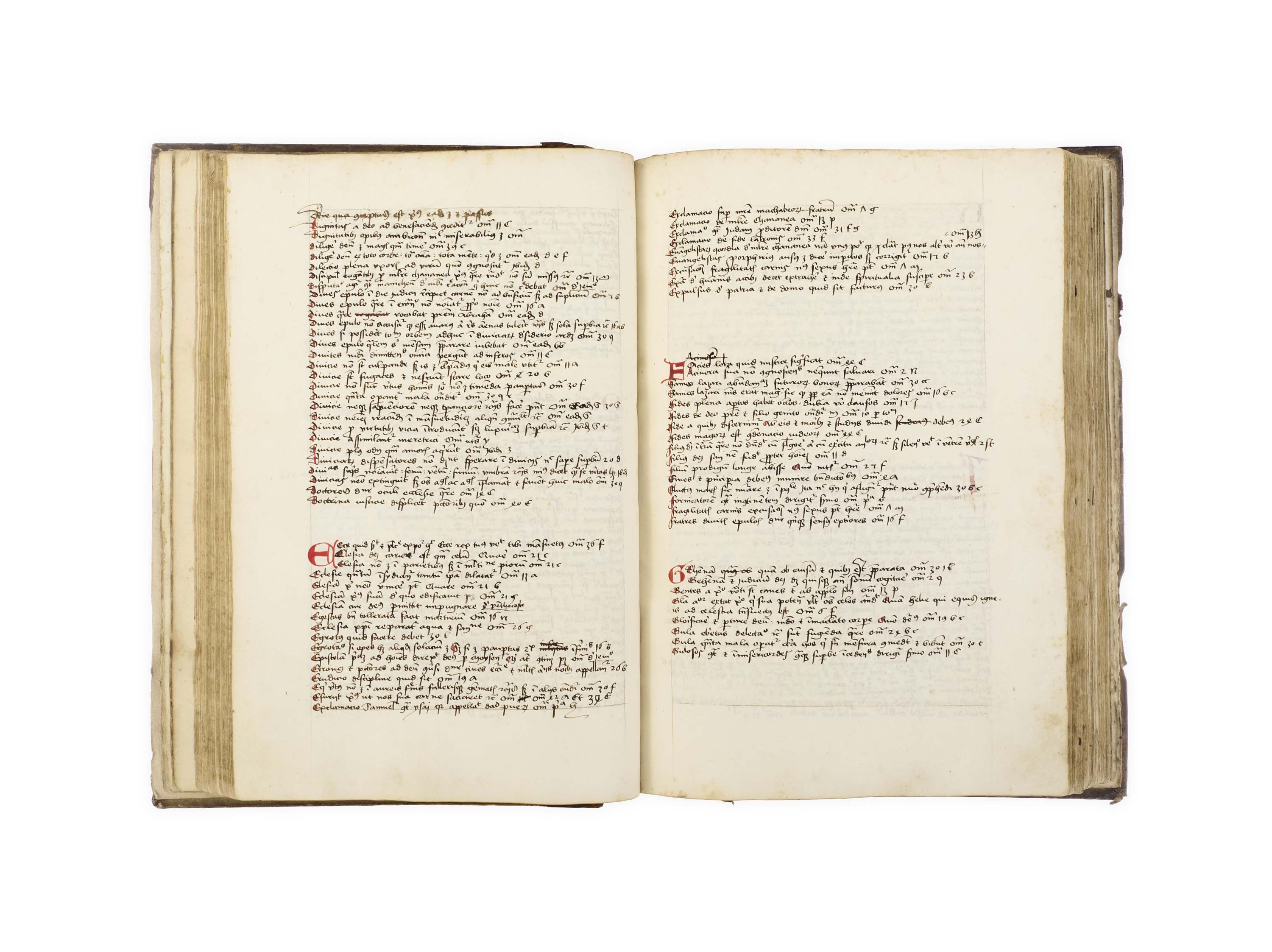
The annotations begin on the title-page, where the list of contents is provided with sequential numbering in both red and dark brown ink; the annotator has also added red letters down the inner margins of the text to provide an easy reference to other sections of the work. The annotations are in an elegant contemporary hand; rather than just repeating words from the text, they provide context or explanation. Their early date means that the annotator is unlikely to be the first named owner, Václav Rubinus of Šprinsberk, who was active in the middle of the sixteenth century.
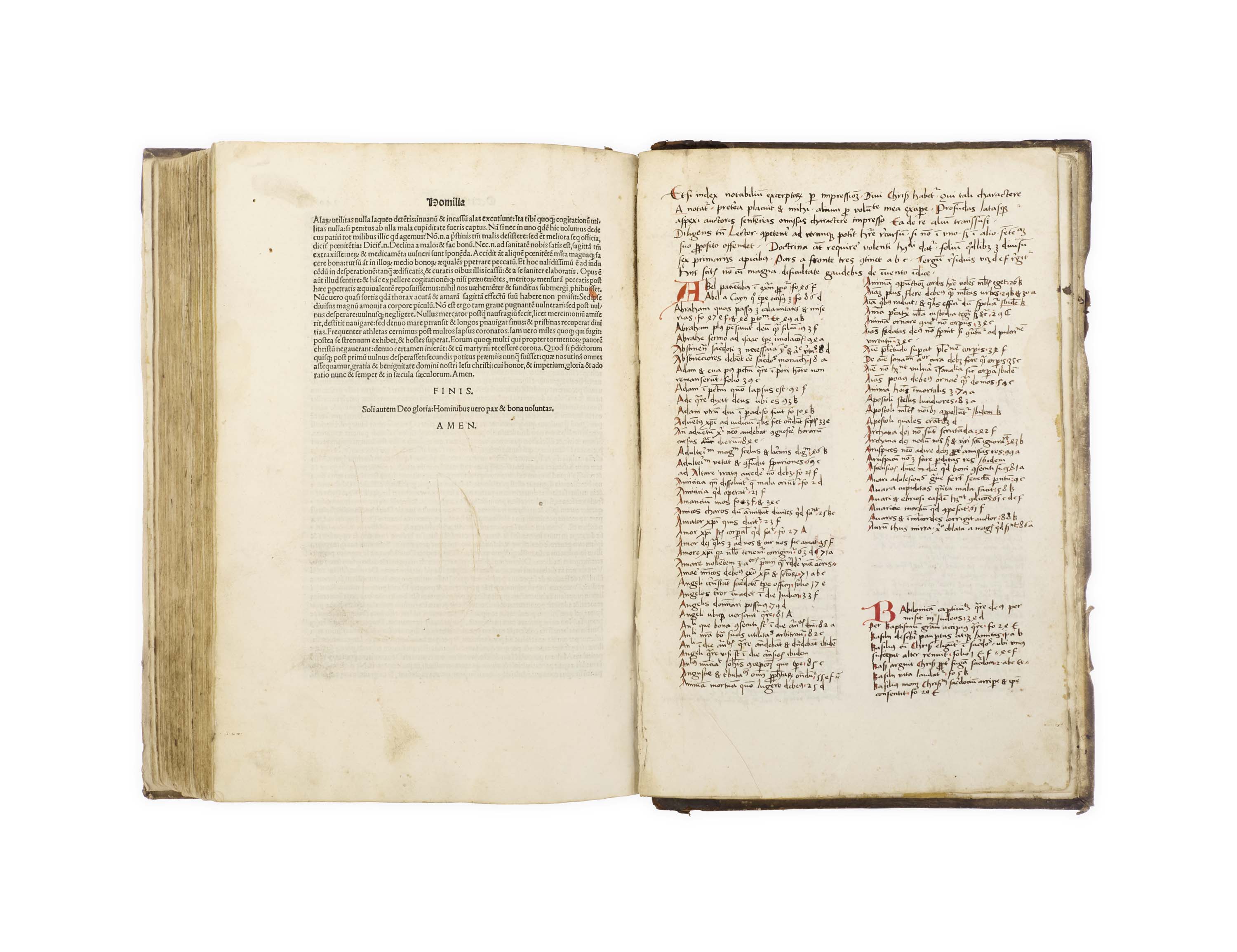
This copy has been supplied with two contemporary manuscript indexes. Between the first and second sections of text, an eight-leaf quire has been bound in, containing a fourteen-page manuscript index of subjects mentioned in the homilies, referenced by homily number and the red letters written next to the text (’om. 26a’, for example). The paper has a watermark of a crown surmounted by a cross, similar to Briquet 4890, 4891, 4892 and 4895, all dated to the late fifteenth century, Bavaria and Saxony. At the end of the volume another manuscript index has been provided, dated the octave of the Epiphany (which ends on 13 January) 1506, on paper watermarked with a bull’s head (Briquet 15873, located Leipzig, 1483); the introduction to the index notes that it contains items specifically of interest to the compiler and gives an explanation of the references; ‘without too much difficulty, you will rejoice in the creation of this index’.
Provenance:
1. Václav Rubinus of Šprinsberk. He also owned a copy of Budé’s De asse (1542, now in the Strahov library, Prague) which was bound in pigskin stamped with his arms and the letters VRAS; that mid-sixteenth century Prague binding also had a roll-tooled border with the heads of Reformers (Melanchthon, Erasmus, and Hus) indicating that Rubinus was most likely a Protestant.
2. The Jesuit college in Litomĕřice (Leitmeritz, now in the Czech Republic), established in 1643 (the order was suppressed in 1773). The remains of the spine labels, with the classification AI, plausibly belong to this period of ownership.
3. The Jesuit College of Linz, teacher’s library, established in 1629 in order to replace the Protestant school founded in the mid-sixteenth century.
4. ‘Masny’; although unidentified, this surname is usually Czech or Polish.
We have located copies of just this volume in Leeds, Senate House, and the National Library of Wales, and of both volumes in Yale, Boston College, and Corpus Christi Oxford.
Brunet III, col. 536. For both volumes, see EDIT16 CNCE 33769; USTC 762277.