Annotated at the University of Paris
CICERO, Marcus Tullius.
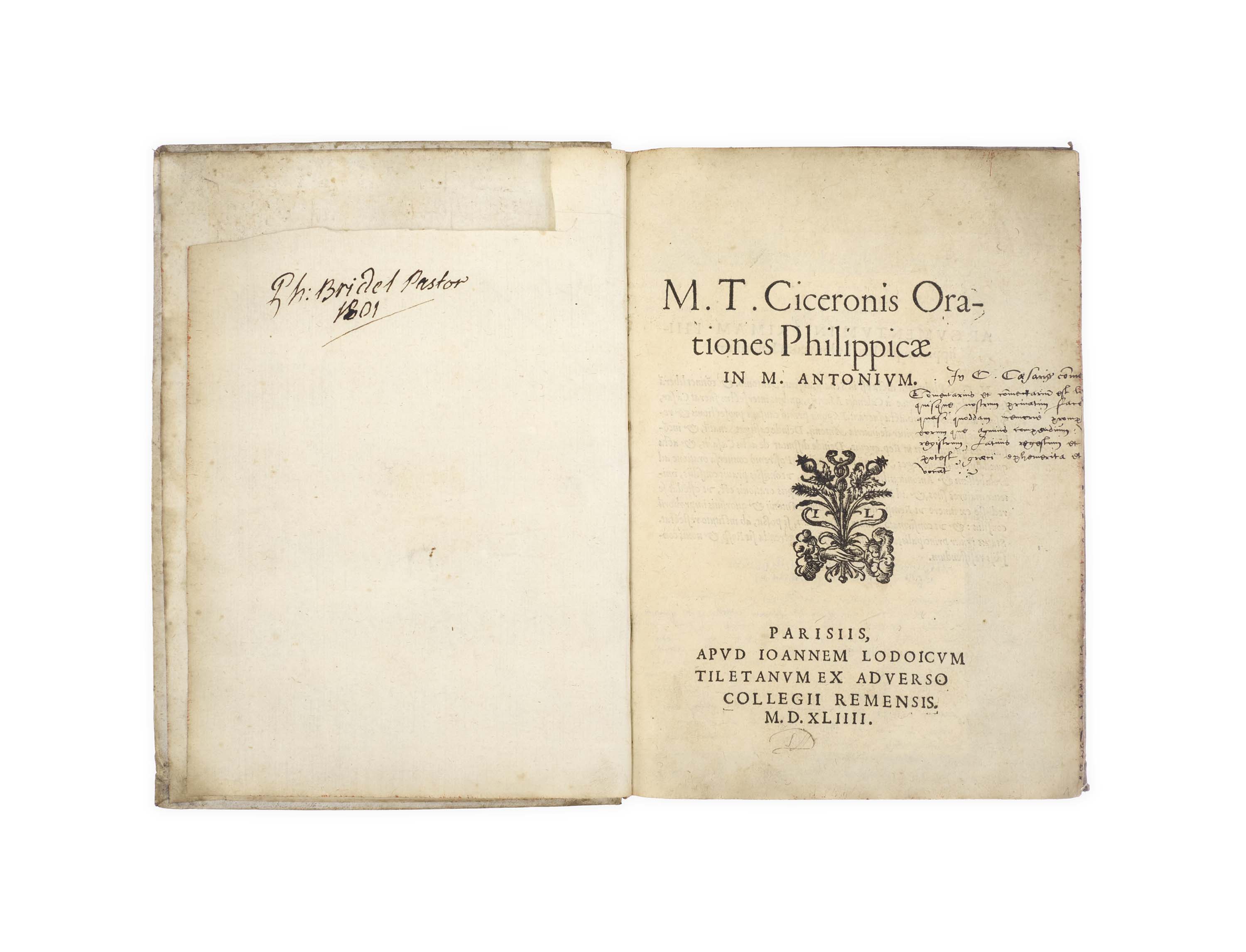
M. T. Ciceronis orationes Philippicae in M. Antonium. Paris, Jean Loys, 1544.
4to, ff. 20, [10 (pp. ‘21–40’)], ‘41–118’ (i.e. 31–108); woodcut printer’s device to title, one woodcut criblé initial, capital spaces with guide letters; small stain and marginal worming to ff. 2–4 (with loss of one character of running titles), occasional very light foxing; overall a very good copy in eighteenth-century vellum over boards, edges speckled red; a little worn, part of front free endpaper cut away at head; numerous contemporary interlinear annotations and marginalia to c. 40 pp. (somewhat cropped), ink ownership inscription ‘Ph: Bridel Pastor 1801’ to front free endpaper (see below).
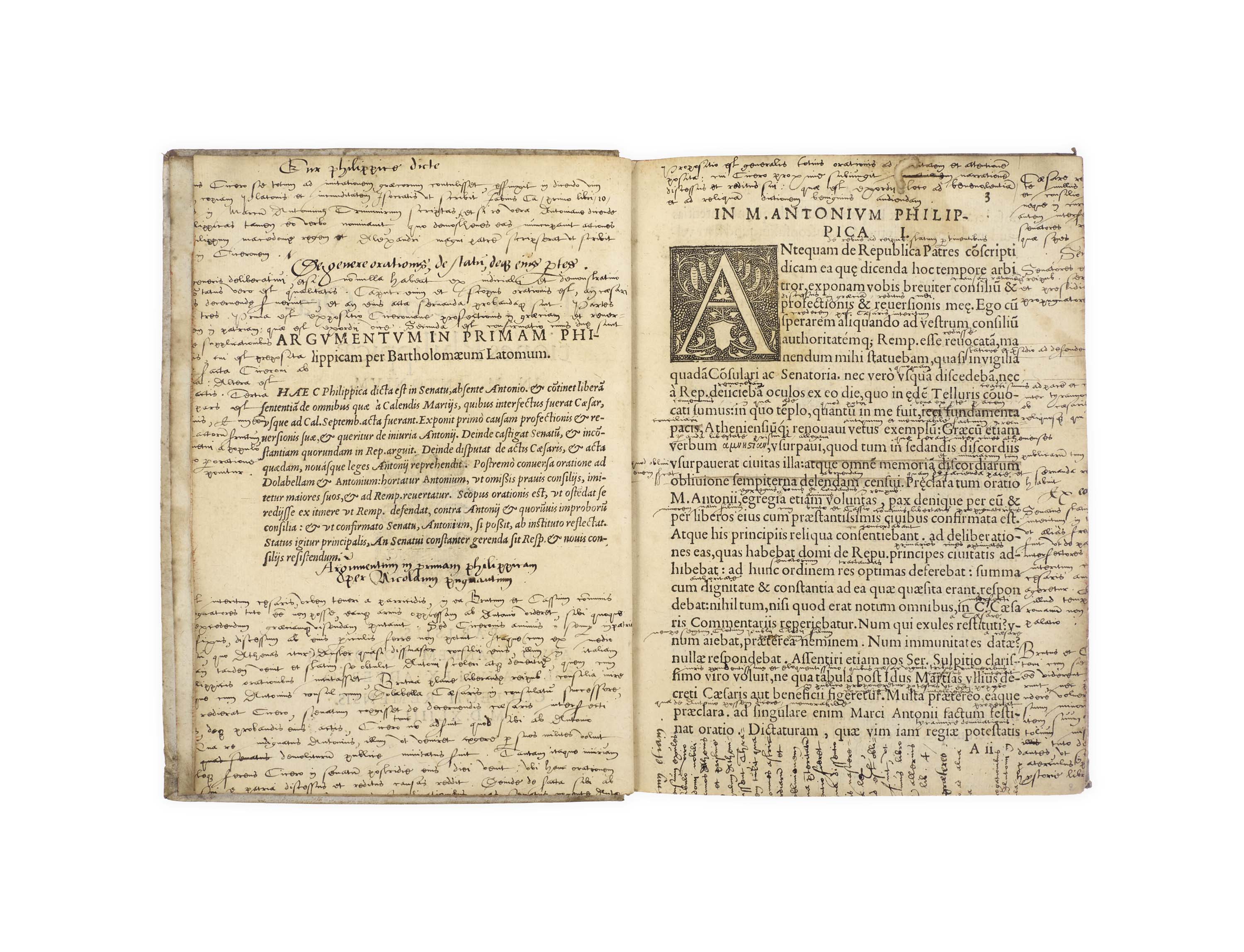
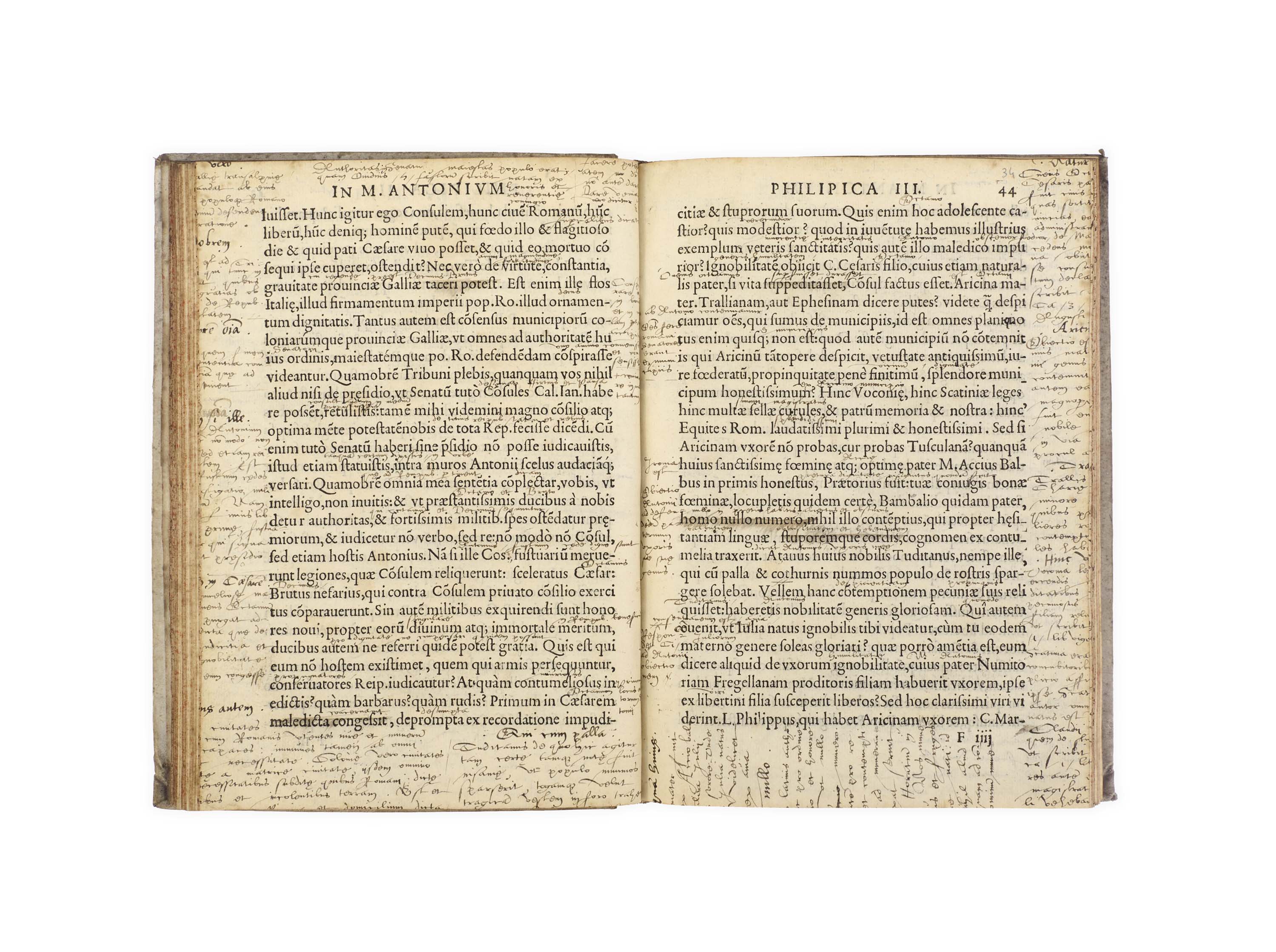
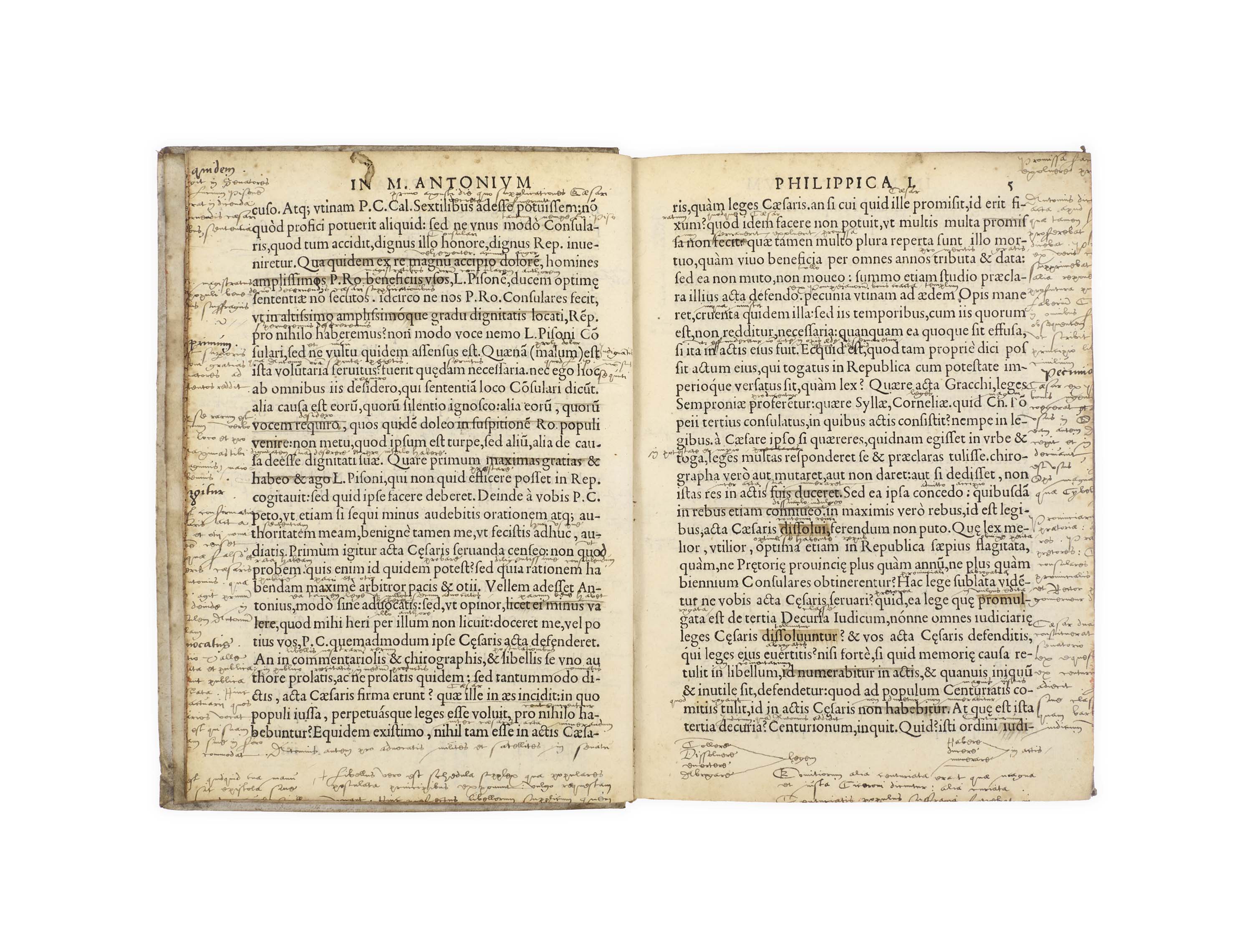
Extremely rare edition of Cicero’s Philippics edited by the humanist Bartholomaeus Latomus and printed specifically for the Parisian university market, this copy with profuse marginal and interlinear annotations to the first, third, and fourth speeches taken down by a contemporary student attending the lectures of Nicolaus Pugnantius (Nicolas Poignant).
The Philippics comprise fourteen speeches delivered by Cicero against Mark Anthony in 44–43 BC, jokingly named after the patriotic orations by Demosthenes attacking Philip II of Macedon. ‘In early sixteenth-century France Cicero seemed a perfect model to humanists who challenged scholasticism through a rhetoric embodying both philosophy and history. Admiration for Ciceronian style was accompanied by a moralizing civic humanism and a respect for Cicero, the philosopher, as the purveyor of Greek wisdom … Cicero was invoked to greatest effect in defining the nature of tyranny. Rulers who betrayed their trust or broke their contract with those who had created them to govern became enemies of the people, committed treason against the commonwealth, and ought to be punished’ (Salmon, ‘Cicero and Tacitus in Sixteenth-Century France’ in The American Historical Review, vol. 85, no. 2 (April 1980), p. 307).
This edition of the Philippics was edited by Bartholomaeus Latomus (?1485–1570), professor of eloquence at the Collège royale in Paris, and a great admirer of, and commentator upon, Cicero’s orations. It was published by Jean Loys (d. 1547, a former proofer and printer to Jodocus Badius) at his premises opposite the Collège de Reims – an ideal spot for selling university texts.
On the verso of the title-page our annotator provides a summary of the first Philippic ‘per Nicolaum Pugnantium’. Nicolaus Pugnantius, a scholar from Toul in northeastern France, served as procureur at the university of Paris in 1551 and then as recteur in 1553 (Rémi Jimenes, ‘Le monde du livre et l’Université de Paris (16e-17e siècles): l’apport des Acta rectoria’, Bulletin du bibliophile (2017), 2, pp. 270–291); he was licensed in theology in 1557 and made a master the following year (Mémoires de la société de l’histoire de Paris, tome XVIII (1891), p. 99). Two speeches delivered by him at the Sorbonne in 1557 survive at the Bibliothèque nationale. The annotations here are thus a valuable record of Pugnantius’ lectures on Cicero. They provide summaries and explanatory commentary, the marginalia picking out particular words and phrases for elaboration e.g. where Cicero refers in the first Philippic to a legation, an accompanying note begins ‘legationum tria erant genera …’, while an ironic passage in the third speech is explained as ‘exclamatio est ironica …’. There is an interesting schematic summary of Ciceronian language at the foot of f. 5r, with certain related words highlighted within the text itself. Occasional French translations are also given e.g. ‘garde menge’ (sic) for ‘cella penuaria’.
Provenance: with the ownership inscription of the Swiss pastor, patriot, and writer Philippe-Sirice Bridel (1757–1845), known as le Doyen Bridel.
Extremely rare: only one copy traced on OCLC, at the BnF.