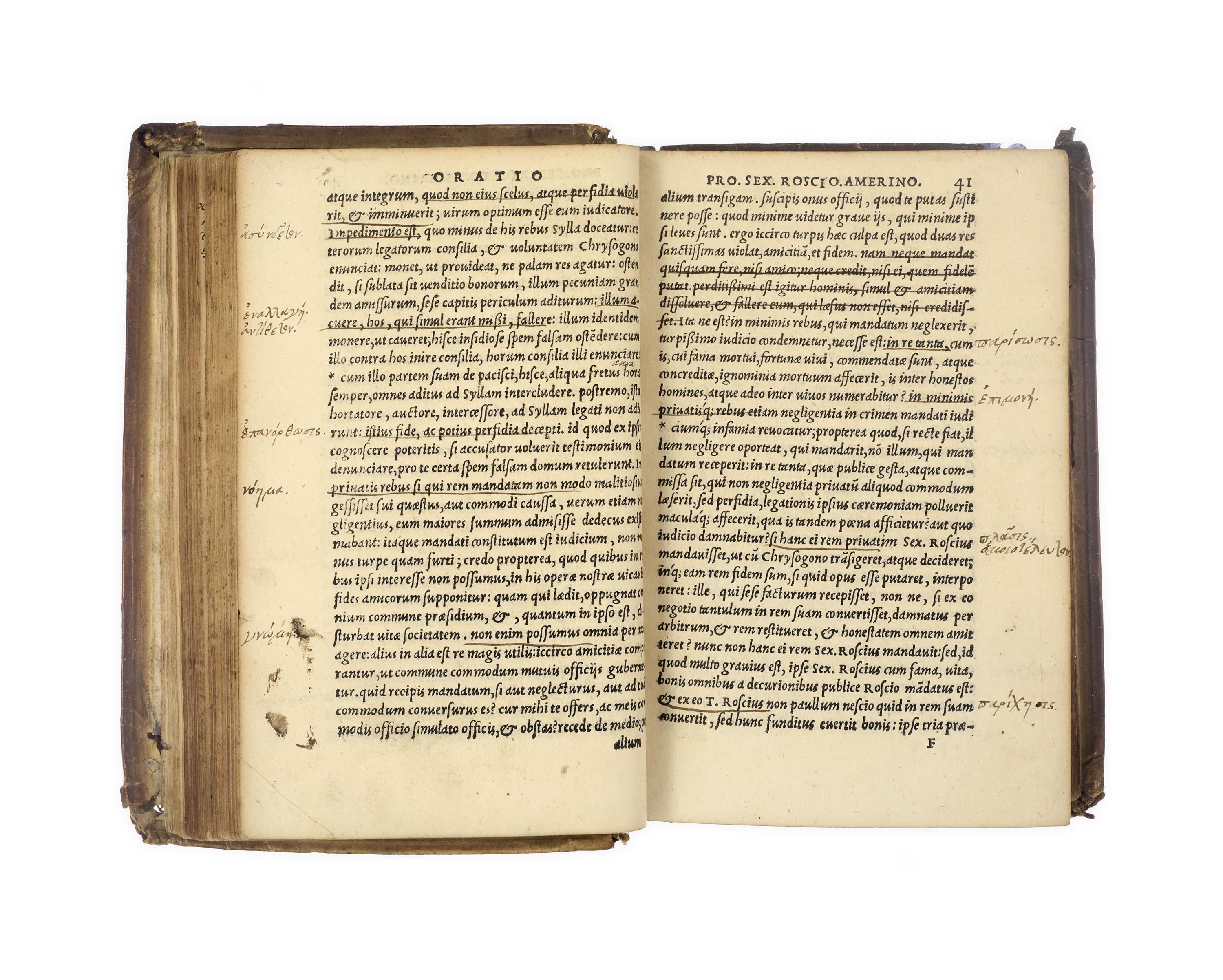
Aldine Cicero in German White Calf
CICERO, Marcus Tullius.
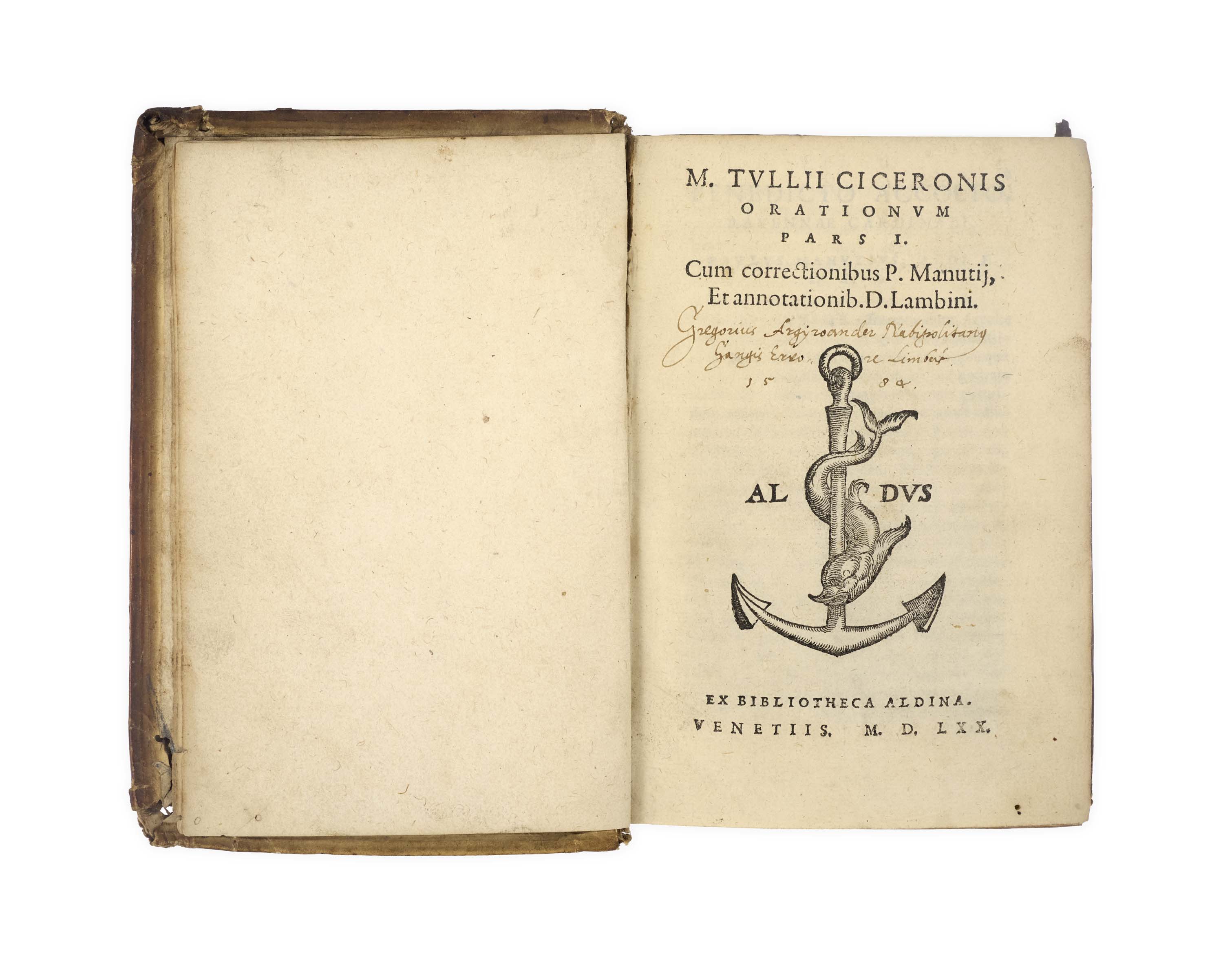
Orationum pars I. Cum correctionibus P. Manutii, et annotationib[us] D. Lambini. Venice, ‘ex bibliotheca Aldina’, 1570.
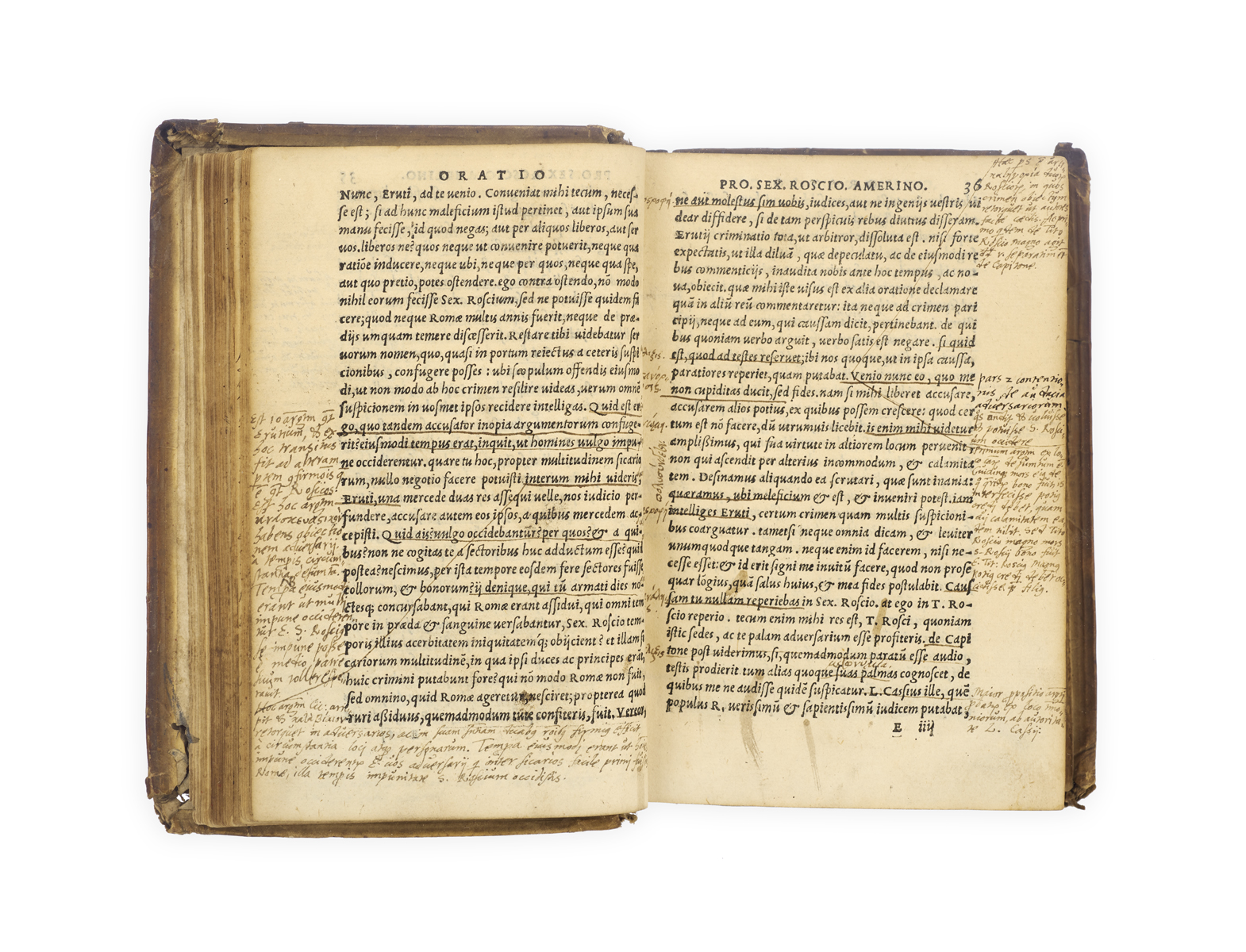
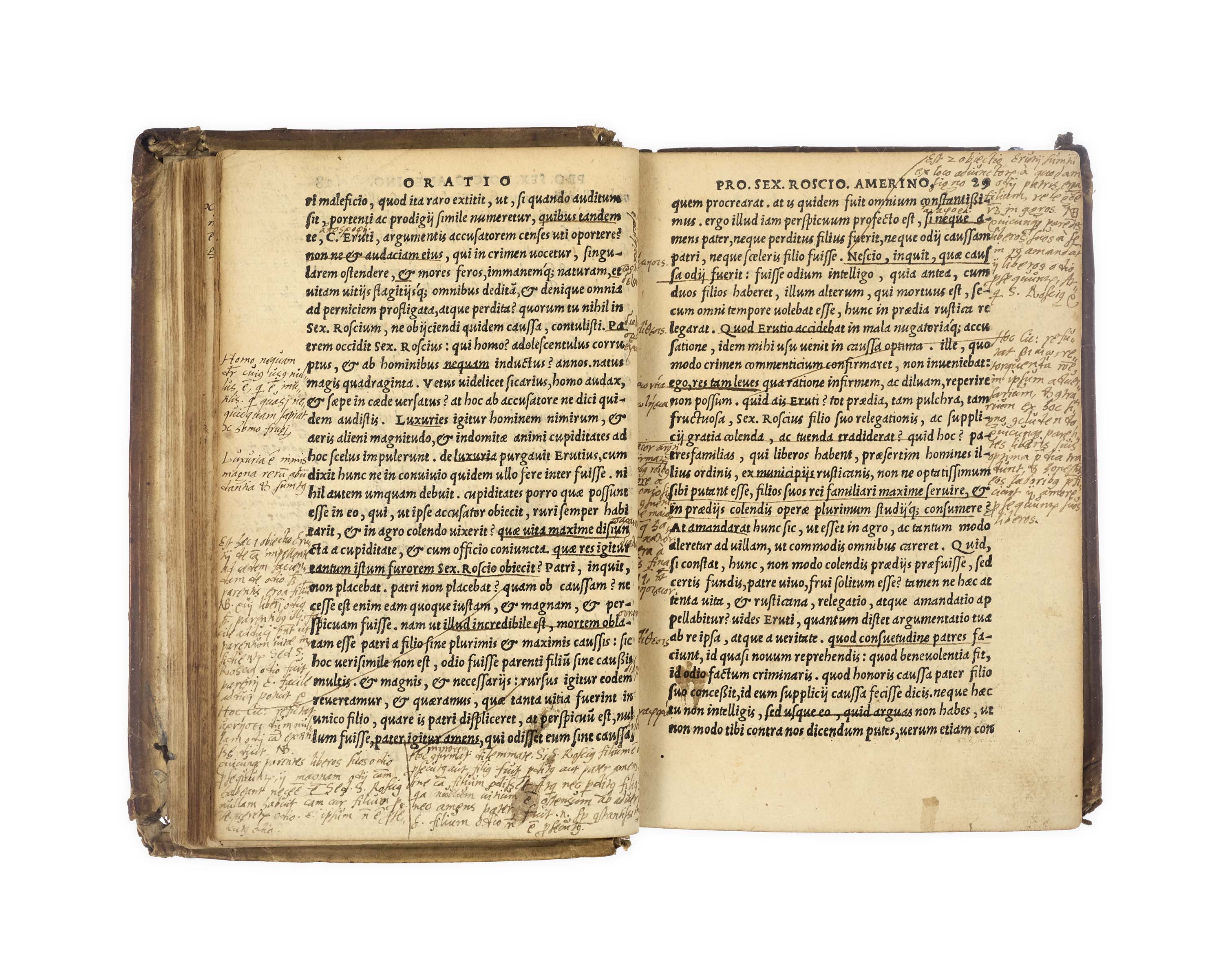
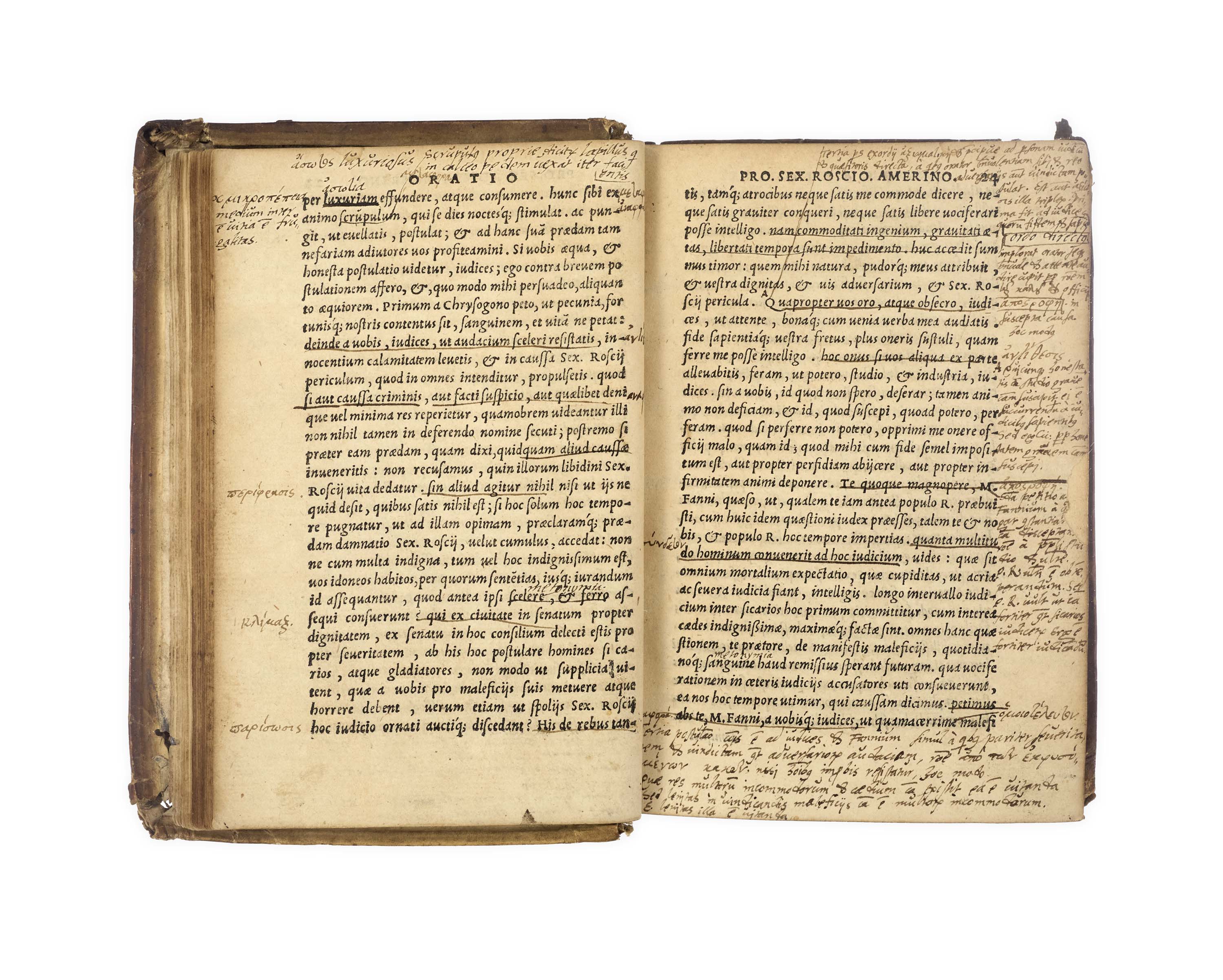
Vol. II only (of III), 8vo, ff. 236, [2, device and blank]; italic type, the dedicatory letter in roman type, woodcut Aldine device to title-page and penultimate leaf; a few quires lightly browned, small chip to foredge of C8, but a very good copy; bound in contemporary German blind-stamped white calf, panel-stamped centrepieces of Lucretia (EBDB p003378, with the initials ‘H B’) and Justice (EBDB p003379, with the date 1573), a border of a foliate roll-tool, front board lettered ‘SHST’ and ‘1573’ in blind, spine with blind-stamped arabesque tools, sewn on 4 double cords; soiled and rubbed, some worming, corners worn, headcap neatly repaired; late sixteenth- and early seventeenth-century manuscript annotations to c. 50 pp. (the first 42 pp. in the same hand; see below), a line of text, missing in the printer’s exemplar, has been added in manuscript to the head of F4v (below the printed note ‘Desunt non pauca’); inscription of Gregorius Argyroander of Nabburg to title-page dated 1584, inscriptions on front endpapers (some erased) including Sebastian […] and Christian Rudolph Roth of Bebenhus (see below).
Added to your basket:
Orationum pars I. Cum correctionibus P. Manutii, et annotationib[us] D. Lambini.
An unusual example of a white calf German binding on an Aldine Cicero, annotated in Greek and Latin.
The imprint ‘ex Bibliotheca Aldina’ was used by the Torresani brothers Andrea, Gerolamo and Bernardo from 1569 to 1589. Most of their productions were octavos in italic, using Aldus’s original 1501 types, as here. This is one volume from a complete set of Cicero’s works issued by the Torresano brothers in 1569–1570.
The fifty-two pages of Cicero’s second speech in defence of Sextus Roscius in 80 BC (C6v–F8r) are richly annotated in places; this was an early and famous case of Cicero’s, in which he defended Sextus Roscius against the accusation of parricide. The annotations are in both Greek and Latin; Greek is used for rhetorical terminology (‘προληπσις’, ‘κλιμαξ’), and Latin is used to expand or explain the structure and content of the speech. In the rest of the volume there is underlining and marginal marking in ink, and four short manuscript notes in the sections against Verres, the corrupt governor of Sicily whose prosecution in 70 BC launched Cicero’s political career. These speeches were considered to be models of oratory and featured regularly in school curricula. It is thus unsurprising that they are found heavily annotated here.
The two panel stamps on the binding are also found together on a volume in the Dombibliothek, Freising (Bavaria; EBDB w004754).
Provenance:
1. ‘SHST’, initials dated 1573 stamped on binding.
2. Gregorius Argyroander (or Silbermann) of Nabburg (Bavaria), inscription to title-page dated 1584 with the note ‘Gangis Errore Limbus’.
3. ‘Sebastianus M[...]ii G[...]ensis’, partly erased early seventeenth-century ownership inscription on front pastedown.
4. Christian Rudolph Roth, of Bebenhus (Bebenhaus or Bebenhausen?), seventeenth-century inscription on flyleaf with a quotation in Greek from Philippians 1:21: Εμοι το ζην ο Χριστος και το αποθανειν κερδος [For me, to live is Christ, and to die is gain].
EDIT16 CNCE 12420; Ahmanson-Murphy 1071; Cataldi Palau 225 (for all three volumes); Renouard 209/5.