Prayerbook with Pious Portraits
CILIA, Gelasius de.
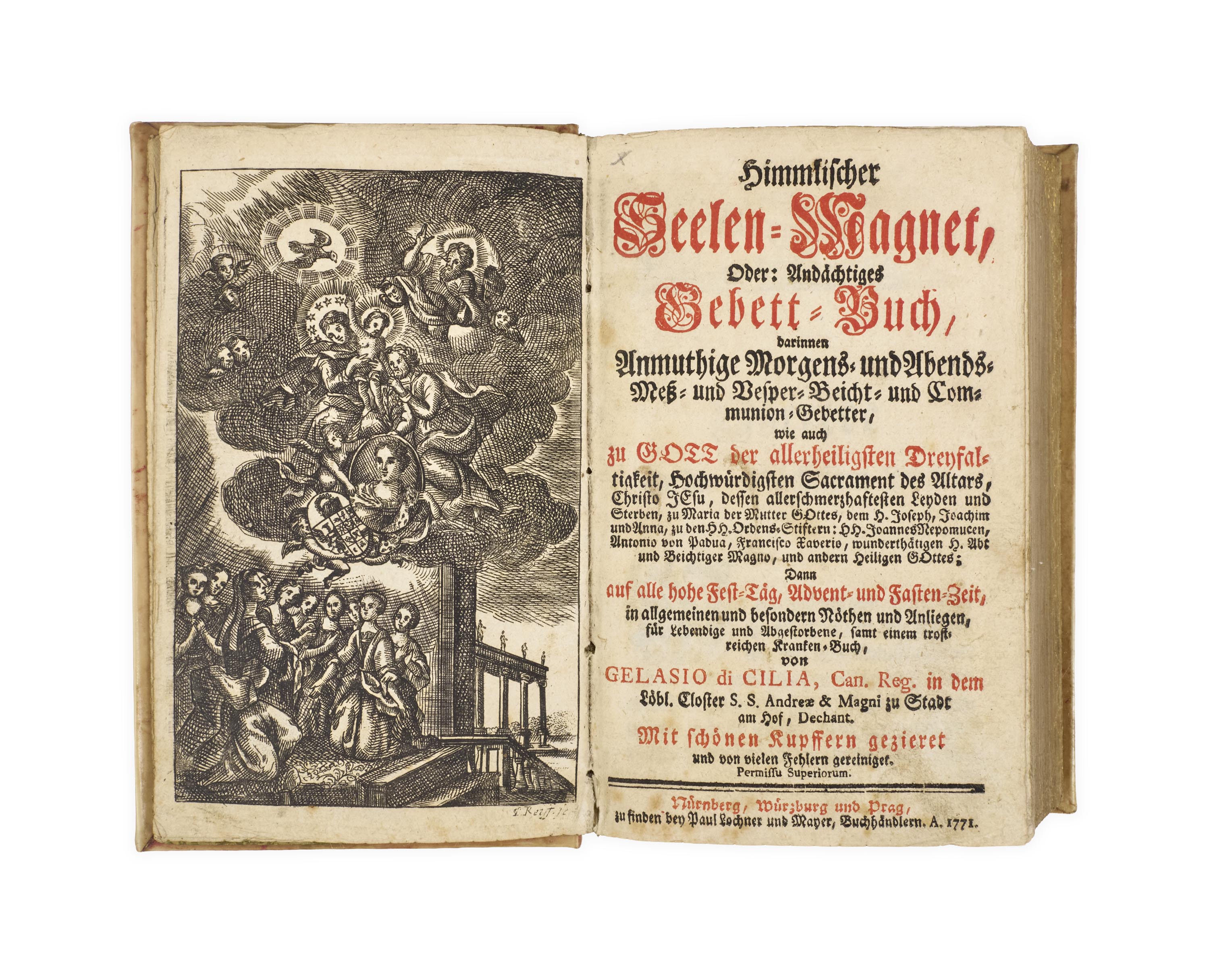
Himmlischer Seelen-Magnet, oder: Andächtiges Gebett-Buch, darinnen Anmuthige Morgens- und Abends- Mess- und Vesper- Beicht- und Communion-Gebetter ... von Gelasio di Cilia ... Mit schönen Kupffern gezieret und von vielen Fehlern gereiniget. ‘Nürnberg, Würzburg und Prag, zu finden bey Lochner und Mayer’, 1771.
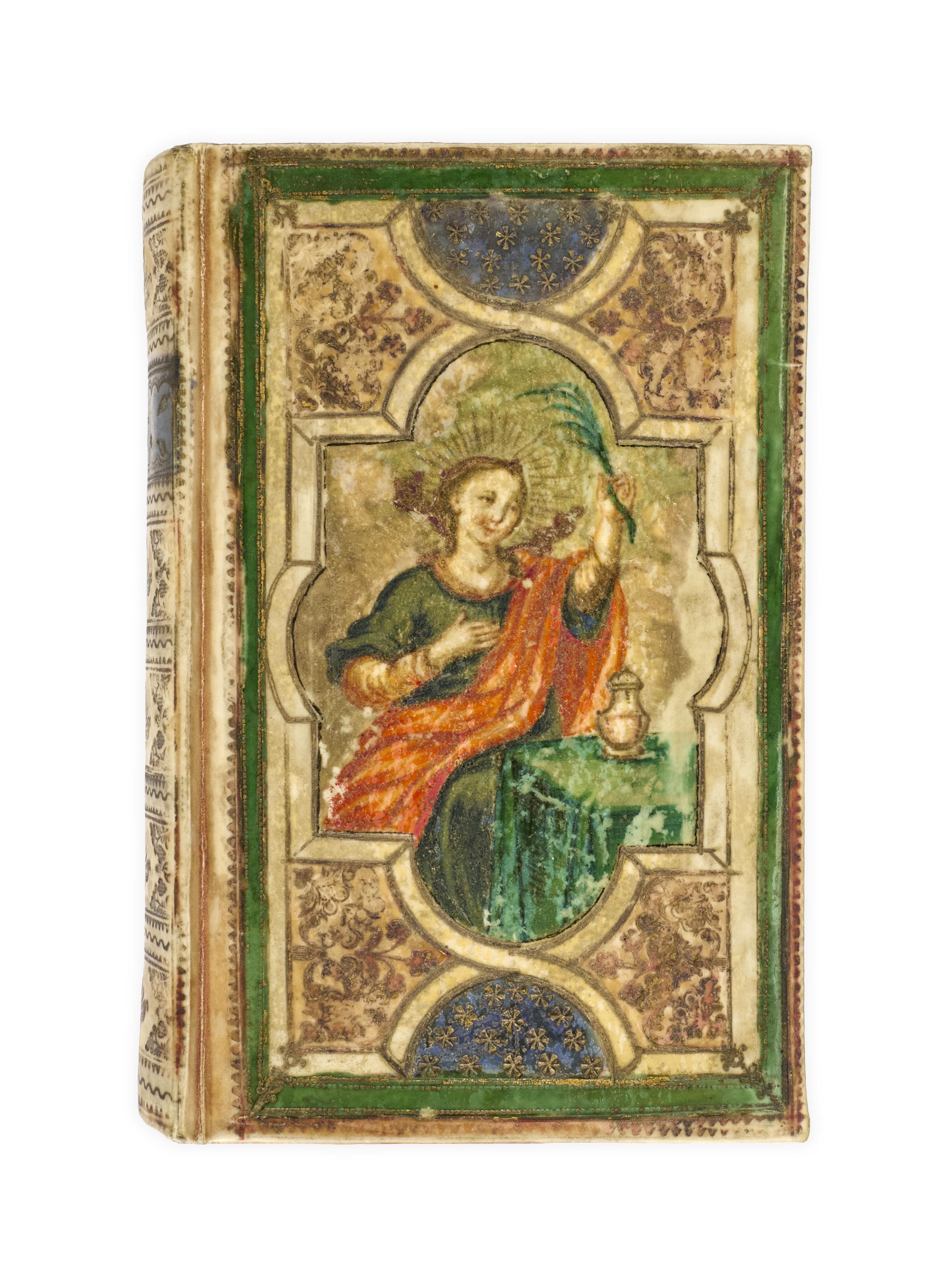
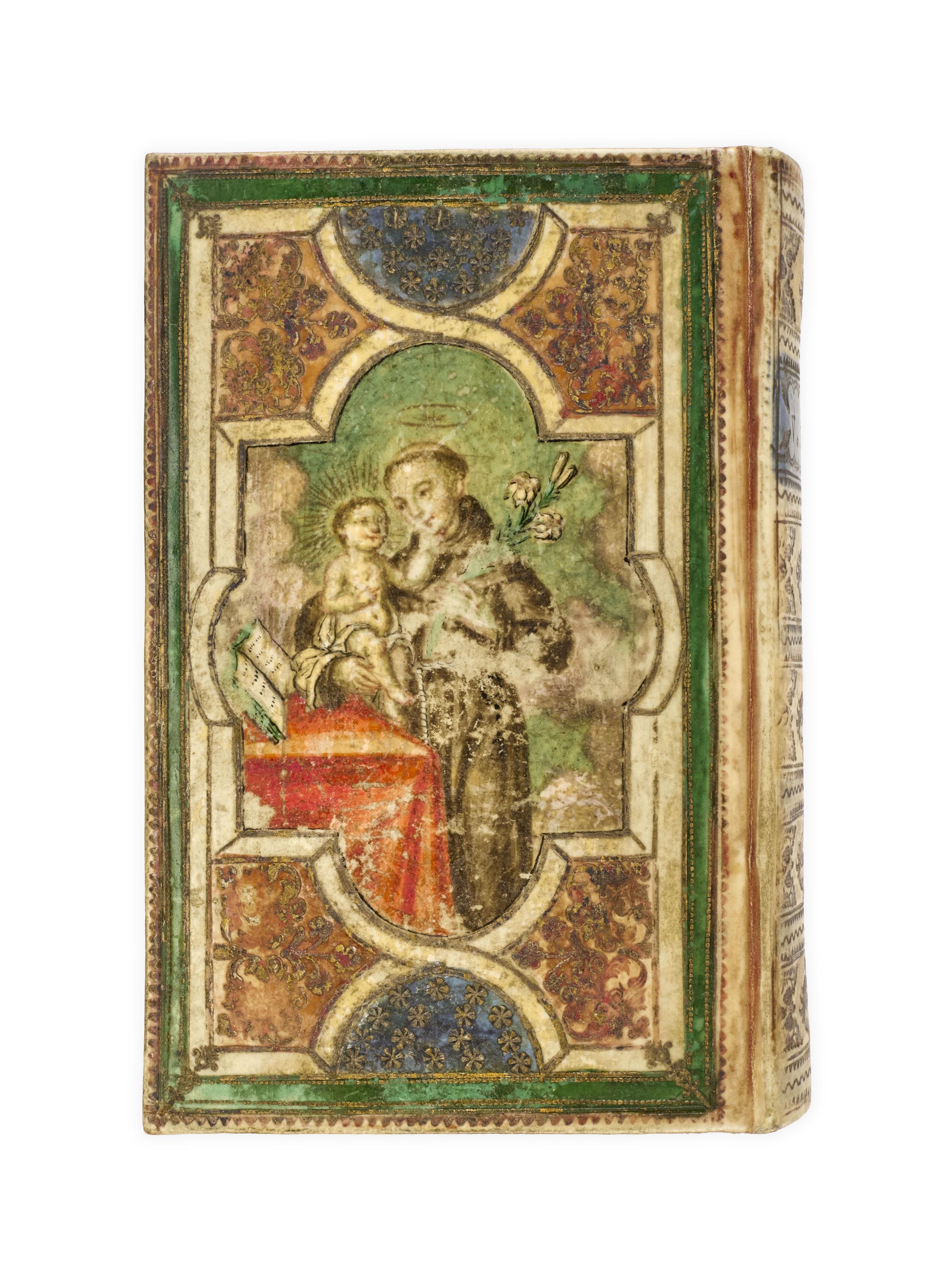
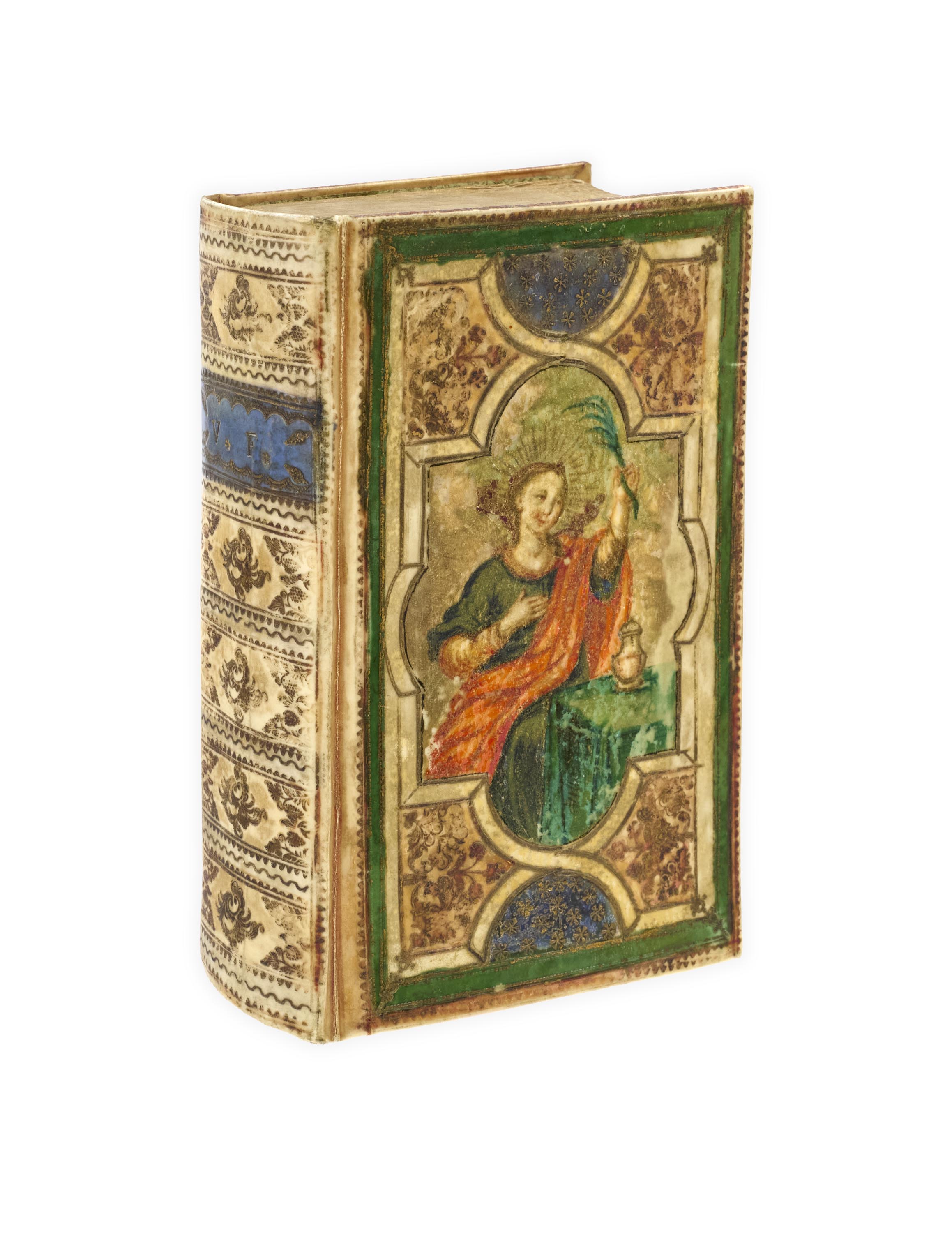
Two parts in one vol., 8vo, pp. [22], 822, 56, [8]; with engraved frontispiece and 13 engraved plates, title-page in red and black, second part with own divisional title, initials, head- and tailpieces; some light foxing and toning, small spots of wax to p. 39, a little creasing to corners at end; overall a good copy in a contemporary Bauerneinband of vellum over boards, covers tooled in gilt to a framing design and stained blue, green, and pink, central painted portrait of St Mary Magdalene to upper cover and of St Anthony of Padua to lower cover, flat spine gilt in compartments, one stained in blue and lettered ‘V. F.’, edges gilt and gauffered at ends, pale green gilt brocade endpapers; some rubbing touching the portraits, boards slightly bowed.
Added to your basket:
Himmlischer Seelen-Magnet, oder: Andächtiges Gebett-Buch, darinnen Anmuthige Morgens- und Abends- Mess- und Vesper- Beicht- und Communion-Gebetter ... von Gelasio di Cilia ... Mit schönen Kupffern gezieret und von vielen Fehlern gereiniget.
Rare edition of Gelasius de Cilia’s devotional manual in a remarkable Bauerneinband with painted portraits of St Mary Magdalene, with a palm branch and an ointment jar, and St Anthony of Padua, holding the infant Jesus and a lily before an open book.
Cilia (d. 1721) was an Augustinian canon who served as dean and then provost of St Mang in Regensberg. The first edition of his popular Himmlischer Seelen-Magnet was published in Nuremberg in 1715 and others followed at regular intervals through the eighteenth century.
The first part comprises morning and evening devotions, prayers for Mass, Confession, Communion, the Trinity, Christ’s Passion, and feasts associated with the Virgin Mary, and devotional exercises for various saints and Church feasts. The shorter second part, the Geistliche kleine Kranken-Practica, is specifically aimed at the infirm. The accompanying engraved plates include depictions of a king and his court kneeling before the host, the Agony in the Garden, a miraculous image of the crucified Christ and the Virgin in a Munich church, and the Three Magi, alongside saints including Benedict, Magnus of Füssen, and Francis Xavier.
An ostentatious but affordable style popularised in the late eighteenth century, Bauerneinbände or ‘peasant bindings’ such as this were fashionable among the working class, but attracted criticism on the grounds that they were acquired more for public display than for pious devotion: Gregorius, a near contemporary writer on binding, complains that ‘in these spoiled times, every peasant girl ... wants to have – purely for show – a hymn book with gilt edges’ (Foot, Bookbinders at Work (2006), p. 76).
No copies of this edition traced in the UK or US.