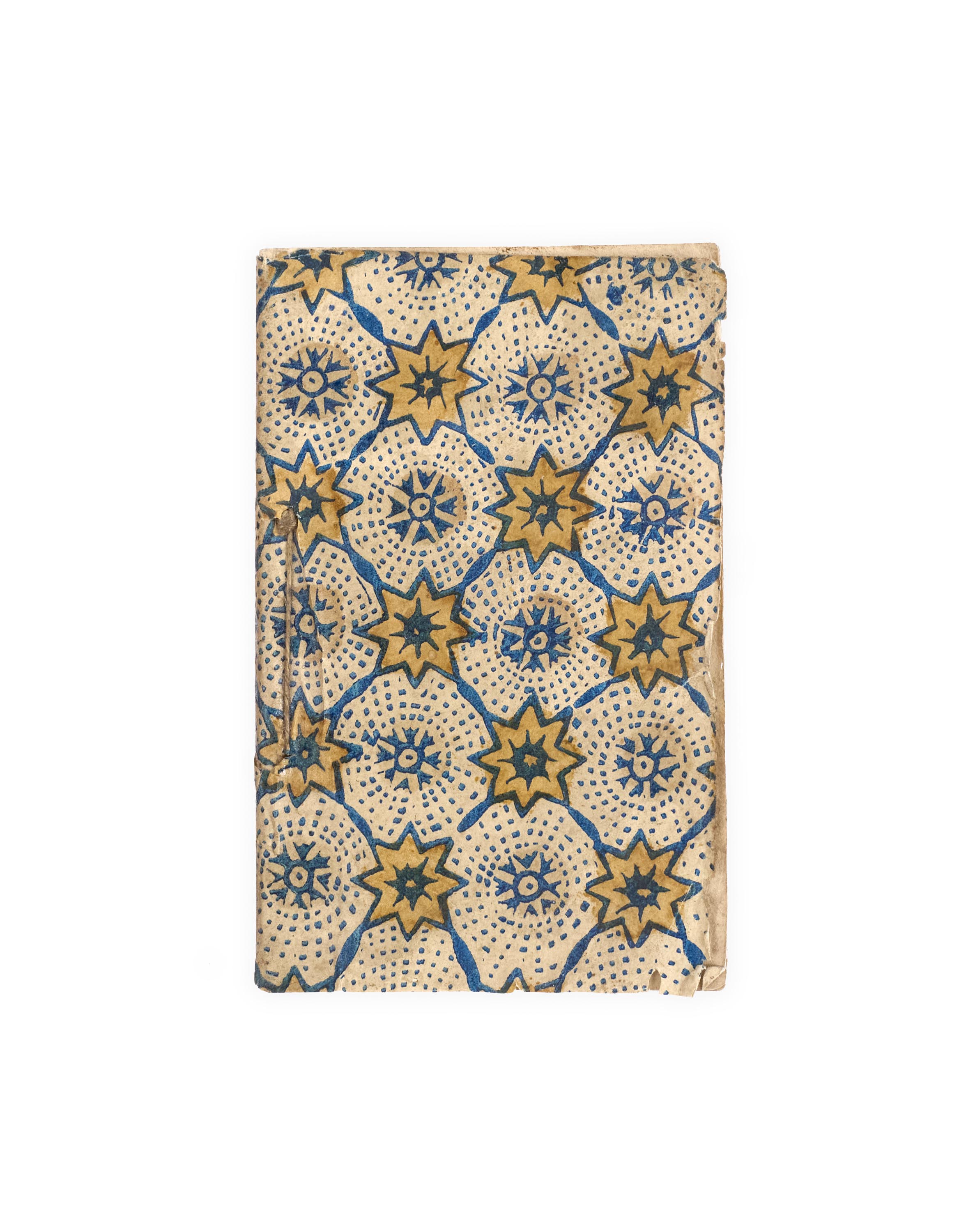
In Decorative Paper Wrappers
[CONFRATERNITY OF THE HOLY SACRAMENT.]
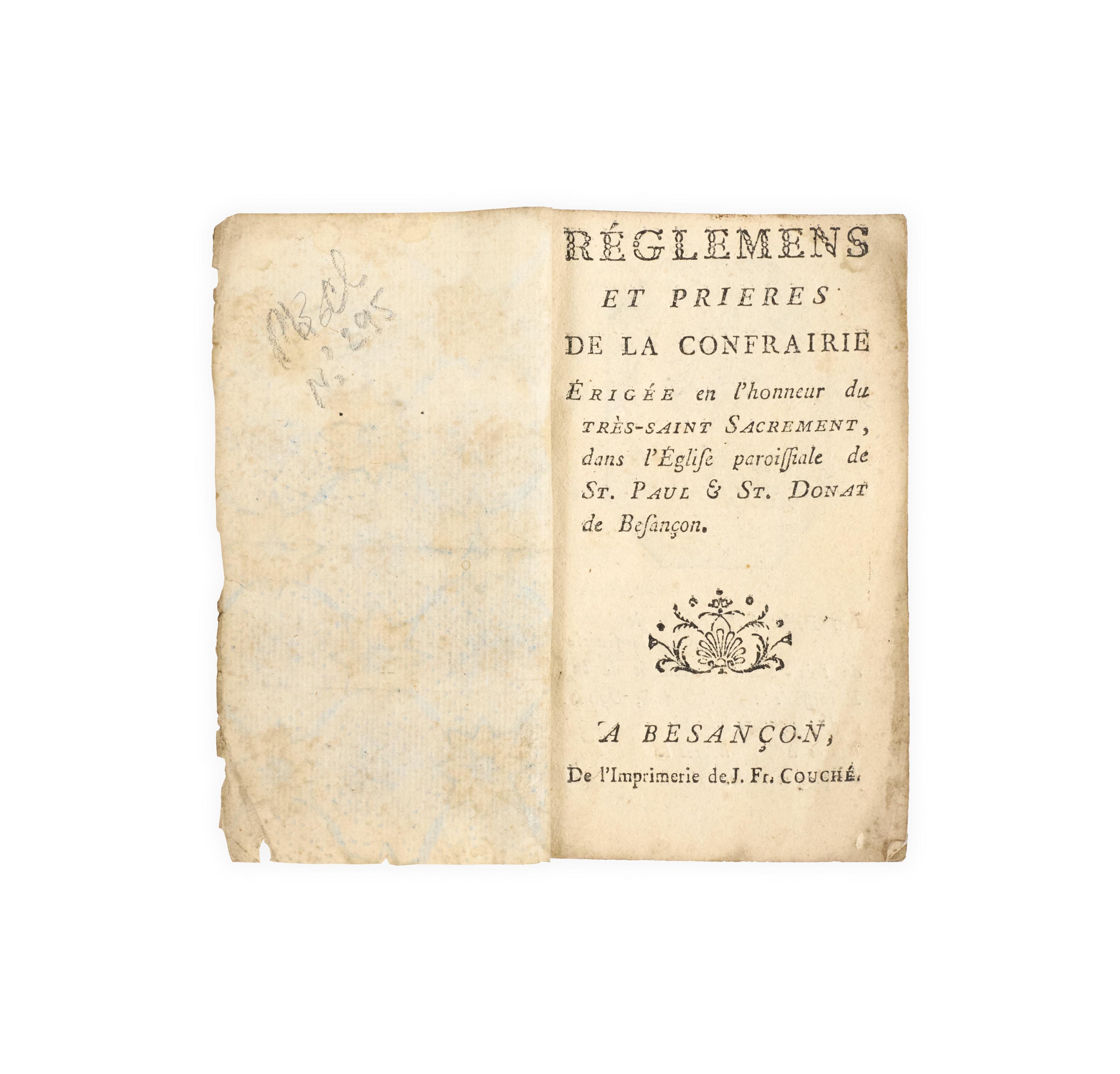
Réglemens et prieres de la confrairie érigée en l’honneur du très-saint sacrement, dans l’église paroissiale de St Paul et St Donat de Besançon. Besançon, Jacques-François Couché, [1780].
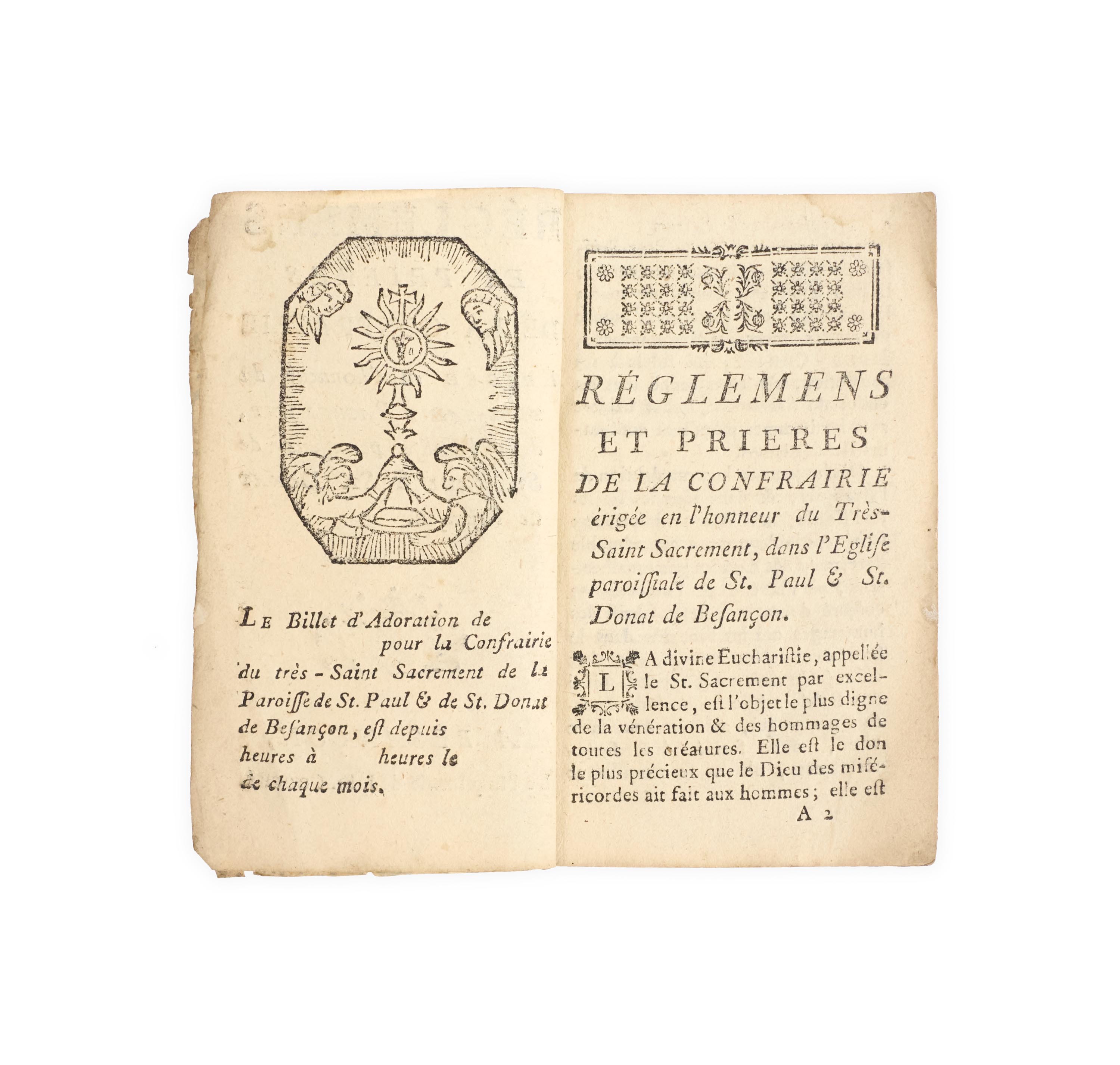
12mo, pp. 90; woodcut of a monstrance and angels to title verso; very slight dampstaining to upper outer corners, short, closed tear at foot of p. 49; very good, stab-stitched in contemporary decorative printed paper wrappers; some wear to edges and creasing, signs of repair with glue; preserved in a black morocco clamshell box by Boichot, spine lettered in gilt, transparent upper cover.
Added to your basket:
Réglemens et prieres de la confrairie érigée en l’honneur du très-saint sacrement, dans l’église paroissiale de St Paul et St Donat de Besançon.
Apparently unrecorded pocket-sized manual for the male and female members of a confraternity devoted to the Holy Sacrament established in 1780 in the church of St Paul and St Donatus at Besançon.
The text opens by describing the Eucharist as ‘the most worthy object of the veneration and homage of all creatures’, and ‘the most precious gift that the God of mercies has given to mankind’. According to the regulations, the confraternity was open to ‘persons of any age, sex, state, and condition’, and members were expected to take part in processions, accompany the Eucharist when carried to the sick, pray for other members and offer them help and consolation, celebrate Masses for the dead, elect officers (including a secretary to keep a catalogue of members), and pay a fee upon admission.
The second part of the volume contains various acts (of faith, adoration, humility, thanks, love, contrition, hope, and charity); meditations for each of the eight days of the octave of the feast of the Blessed Sacrament (on Christ as God, king, master, father, judge, friend, husband, and physician), each ending with several resolutions (to break bad habits, find a spiritual director etc.); and the litany of the Eucharist.
The text beneath the woodcut to title verso has spaces left blank to be filled with the name of the member of the confraternity.
No copies traced on OCLC or CCfr.