The Settala-Reina–Botfield Copy
[CRASTONUS, Johannes.]
[Lexicon Graeco-Latinum.] [Milan, Bonus Accursius, not after 1478.]
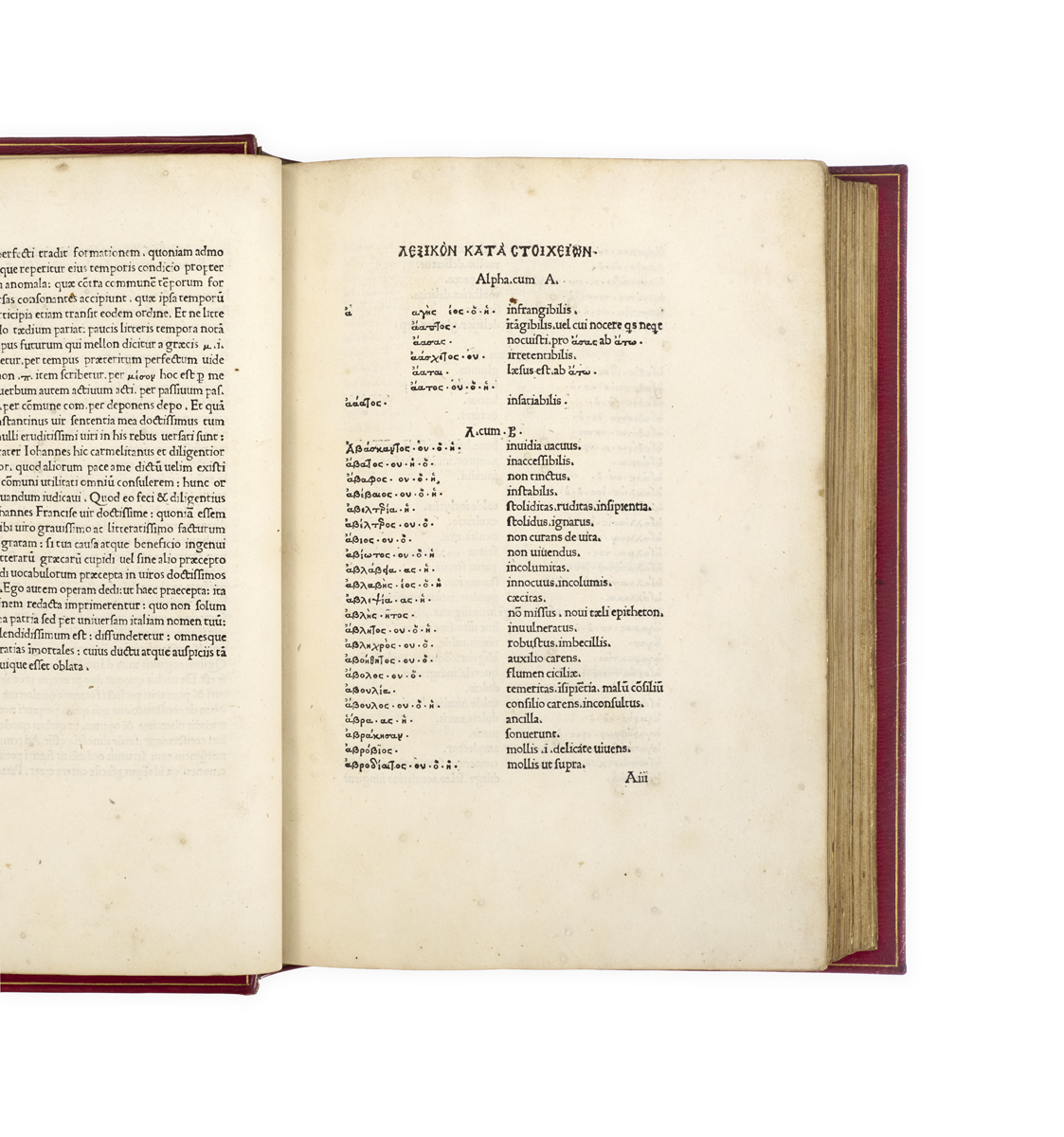
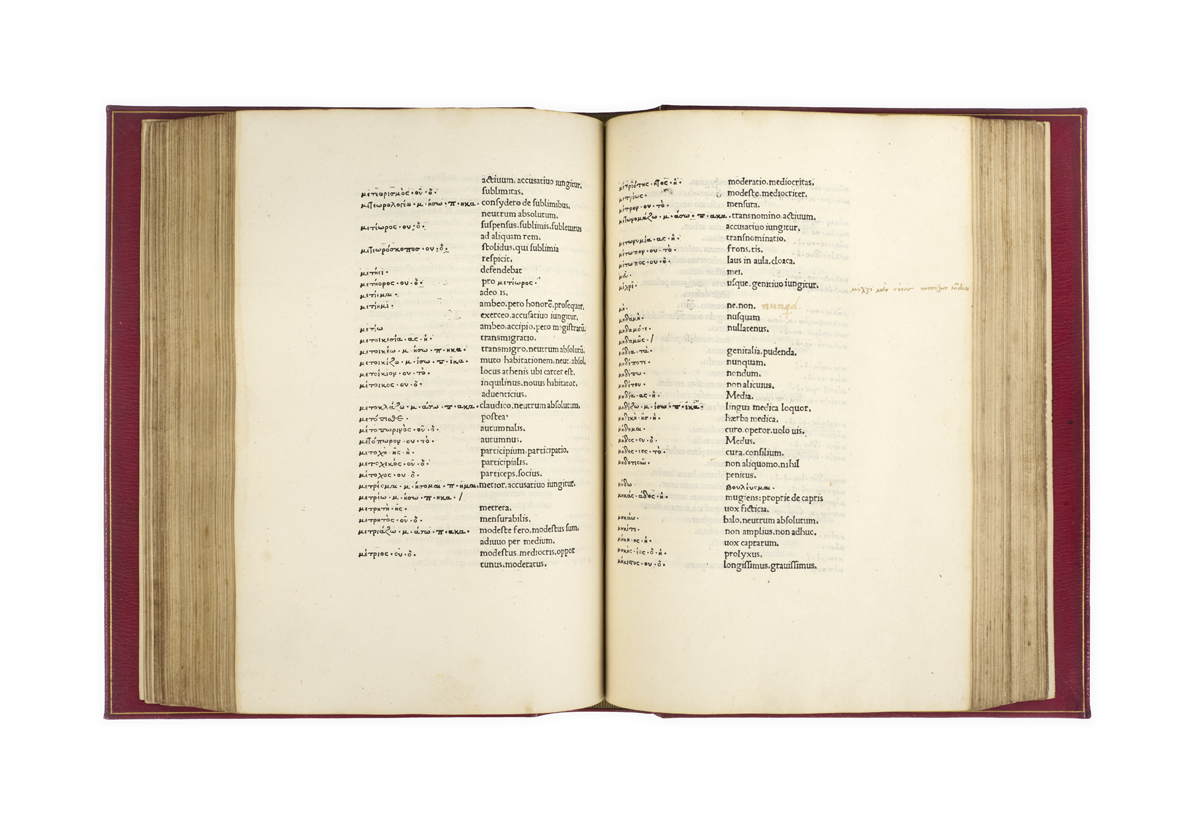
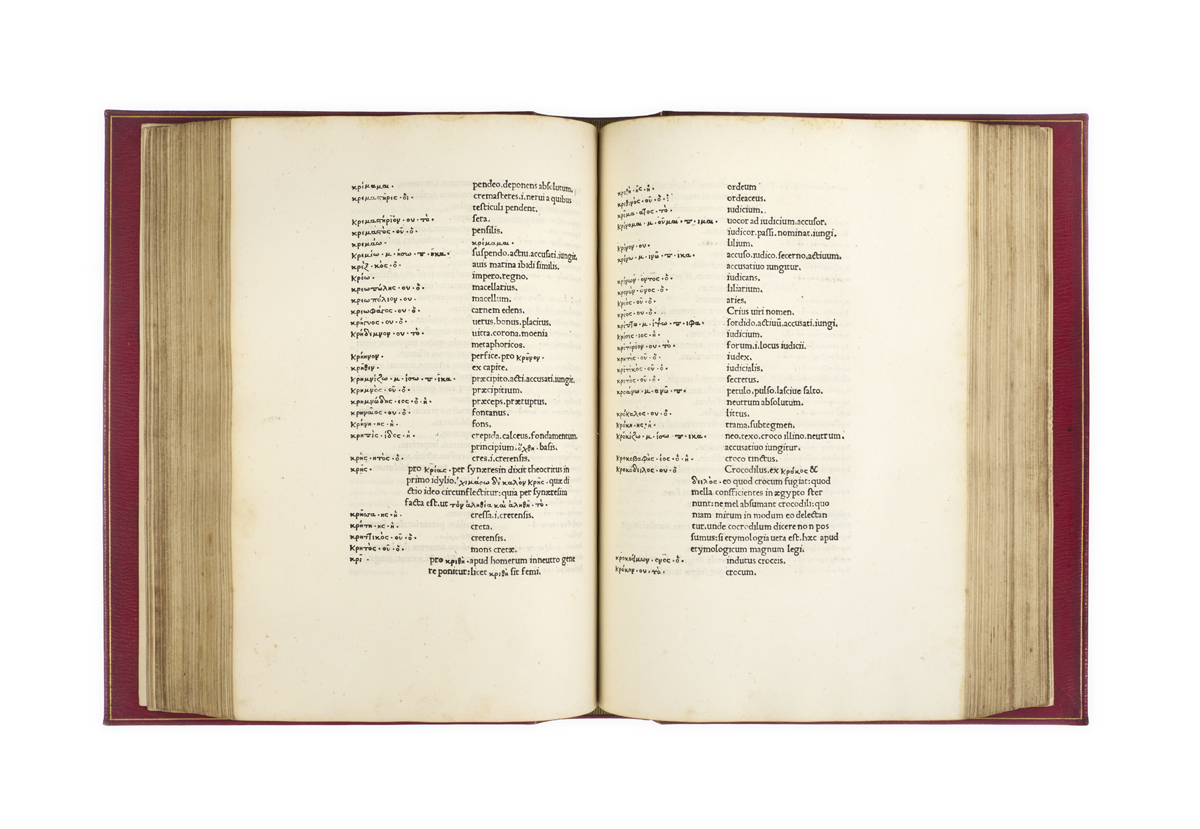
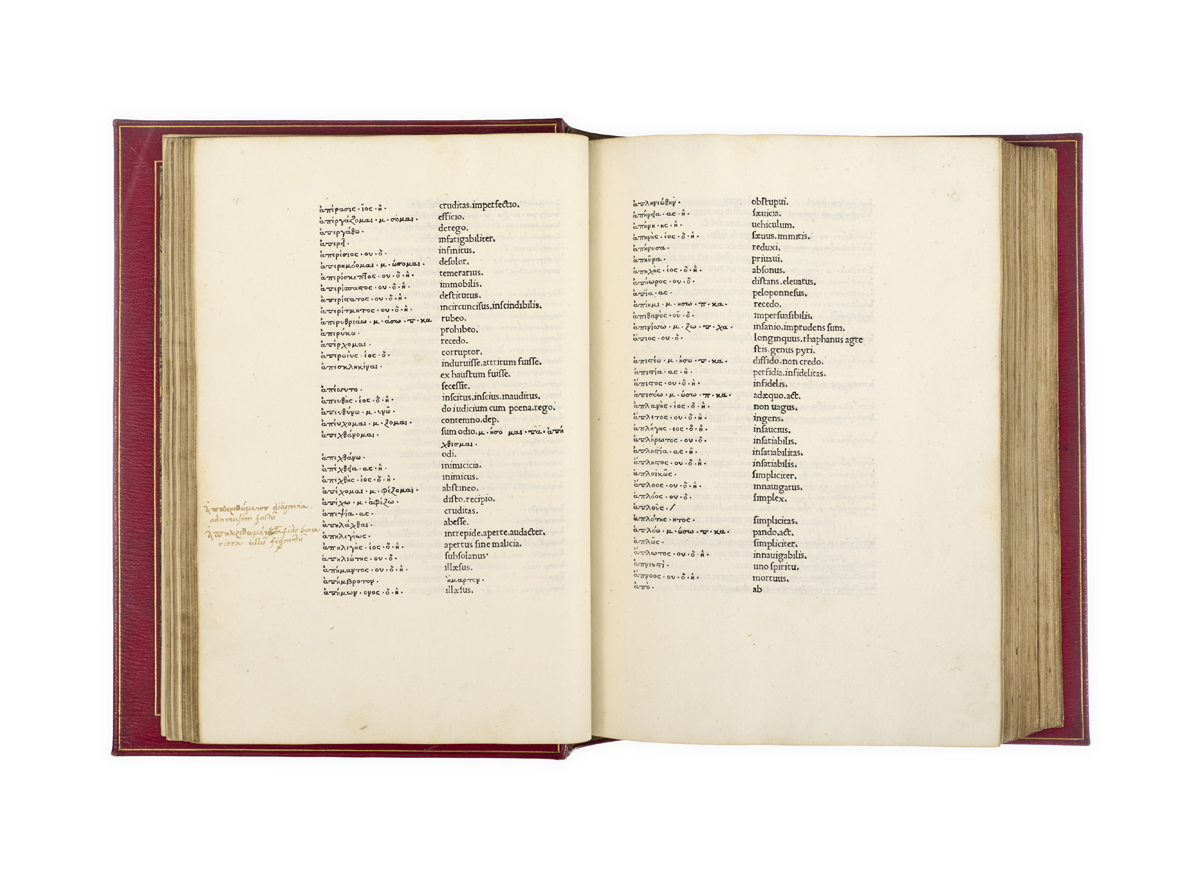
Folio, ff. [369]; A–O⁸ P¹⁰ Q–Z & zz AA–PP⁸ qq⁶ [A1 var.]; with both the preliminary blank A1 and the variant A1 (preface, bound at rear after qq6); press pin holes to outer corners, minute wormholes to first and last leaves (occasionally touching a letter), and closed tear to final leaf (all neatly repaired at the time of binding), occasional very light spotting and staining, nevertheless a beautiful copy; bound in nineteenth-century red straight-grained morocco by Charles Lewis, spine gilt-ruled in compartments and lettered directly in gilt, edges gilt, morocco joints, marbled endpapers; sixteenth-century ownership inscription of Ludovico Settala (see below) to A2ʳ (erased), a few contemporary annotations in Greek and Latin.
First edition of the earliest printed Greek lexicon, an outstanding copy of a rare landmark in the study of Greek.
Crastonus’ dictionary played a pivotal role in promoting Greek scholarship during the Renaissance, arguably more than any other work apart from Lascaris’s Erotemata. It appeared in three further editions in the fifteenth century, among them Aldus’s revised version of 1497.
This is likely to have been Accursius’ first publication. He acquired the Greek types for this project from Dionysius Paravisinus, who had published the first edition of Lascaris’s Greek grammar in Milan in 1476. The typeface was designed by the Greek calligrapher Demetrius Damilas and was most likely cut and cast under his supervision, though, as Barker has established, its design was based not on Damilas’ own hand, but on that of Michael Apostolis. ‘[The] great similarity to the Laskaris, and the uniformity of setting up, makes it probable that a compositor employed by Paravisinus had been engaged for the work by the printers of Bonus Accursius; it appears certain, indeed, that nowhere could a man be found who had experience in setting up Greek in type, except among those who had worked on the Laskaris’ (Proctor, p. 61). Staikos surmises that Damilas was indeed ‘the only printer capable of setting the type for the Greek texts in Accorsi’s publishing programme’ (p. 146). Accursius had been educated in humanities and Greek by Francesco Filelfo and Andronikos Kallistos in Milan and Pavia, and had been supported by Filelfo and Pietro de’ Medici in the setting up of a school in Pisa, before turning to teaching and publishing, in Milan, as a collaborator with Milanese printers first and then as the owner of his own press. Between 1476 and 1481 he published a dozen editions, seven of which were in Greek, supporting his teaching course.
By contrast, we know very little about the author or compiler, the Carmelite Johannes Crastonus. The designation ‘Giovanni Greco’ may have derived from his command of the Greek language, which itself is testified by his further known collaborations with Accursius: the editing of the 1480 Latin version of Lascaris’ Grammar and the 1481 Psalterium Graecum. Evidence from the prefatory letter from Accursius to the Treasurer of the Duchy of Milan suggests that the Greek lexicon was not produced entirely ex-novo, but rather derived from an existing glossary circulating in manuscript: Accursius there lists and praises all the improvements introduced by Crastonus (additions, corrections, a revised and more correct alphabetical order) on work which had been previously accomplished ‘less elegantly and less correctly’ (A2ʳ trans.).
The lexicon appears to have been extremely well received. In 1480, Accursius selected and reorganized material from it to produce a Latin–Greek vocabulary. This was published in royal half-sheet octavo format, and subsequently reprinted twice by Bertochus in chancery quarto.
The Gesamtkatalog notes copies with two variants of A1, found either blank or with Crastonus’s prefatory letter to the philosopher and physician Ferrarius; we have not traced any other copies bound with both, as here.
Provenance:
1. From the library of the Milanese polymath Ludovico Settala (1552–1633). A scientist, art collector, philosophy professor, and highly regarded physician, Settala distinguished himself in the medical field during the plagues which broke out in Milan in 1576 and then again in 1628–30; Alessandro Manzoni describes Settala in his novel The Betrothed as ‘one of the most active, intrepid, and … most highly esteemed officials’ during the plague of 1576 and as one of the earliest to recognise its resurgence in 1628–30. Settala wrote extensively on medicine (including much on the plague), philosophy, and natural history; among his works are a translation from the Greek into Latin, with commentary, of Hippocrates’ De aëribus, aquis et locis and Aristotle’s Problemata.
2. From the library of the Milanese jurist Francesco Reina (1772–1826); his large library was sold in five sales in Paris, 1834–1840 (Regnard-Silvestre).
3. Beriah Botfield, bought from Payne and Foss for 12 guineas, restored and bound in Charles Lewis’s workshop over thirty hours, charged to Botfield at one shilling per hour, binding cost £2. 12s (Botfield sale, Christie’s, 30 March 1994, lot 40).
ISTC lists only three copies in the US (Columbia, Illinois, Yale).
HC *5812; BMC VI 754 (IB. 26552 and 26552a); GW 7812; IGI 3250; Goff C-958; ISTC ic00958000. See Rogledi Manni, La tipografia a Milano nel XV secolo 353; Proctor, Printing of Greek, pp. 59–61; Barker, Aldus Manutius and the Development of Greek Script & Type in the Fifteenth Century, p. 31; Staikos, Charta of Greek Printing, pp. 142–143.