Beware: Cholera Is Coming
CUVIGLIA, Ambrogio.
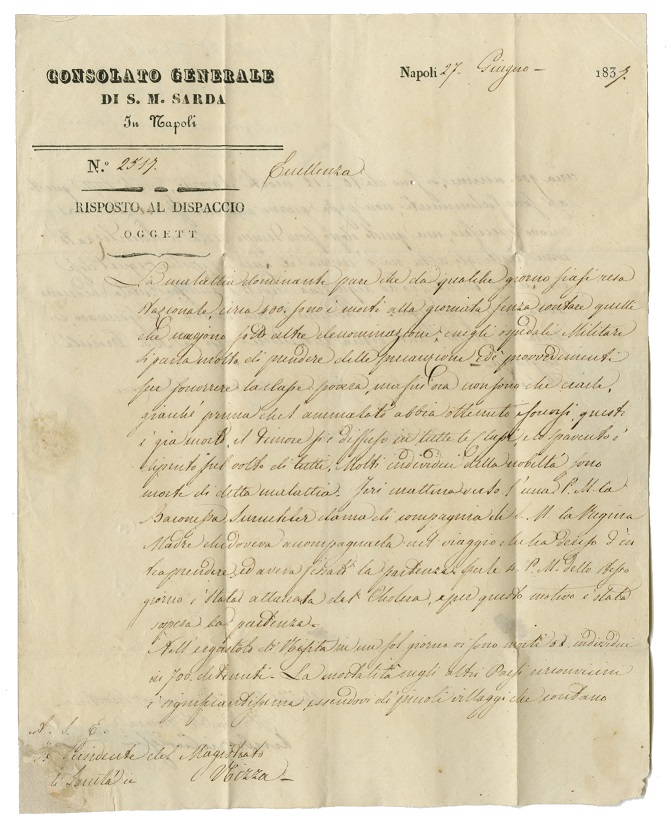
Letter signed (‘Ambrogio Cuviglia’) to Signor Presidente del Magistrato di Sanità in Nice (‘Nizza marittima’). Naples, 27 June 1837.
4to bifolium (27 x 21.5 cm), pp. [2] + integral address leaf; on paper headed ‘Consolato Generale di S. M. Sarda in Napoli’; neatly written in brown ink in a secretarial hand; summary of contents, address and ink stamps to last page; creases where folded for posting, neat repair to lower inner margin (not touching text); very good.
Added to your basket:
Letter signed (‘Ambrogio Cuviglia’) to Signor Presidente del Magistrato di Sanità in Nice (‘Nizza marittima’).
A fascinating letter reporting on the disastrous impact of cholera in Naples and the surrounding countryside in 1837, during the second global cholera pandemic (1829-51), and warning of the possible spread of the disease from one port to another. The letter was written from Naples by the consul general of the Kingdom of Sardinia to the magistrate in charge of public health at Nice, in south eastern France, which then formed part of the kingdom, being known as ‘Nizza marittima’.
The second cholera pandemic demonstrated the profound levels of ignorance in Europe, and elsewhere, of the cause, modes of transmission, and treatment of cholera. Even though the medical and public health authorities in Italy had several years to prepare for cholera’s arrival their preventive and therapeutic measures proved just as ineffective as elsewhere. It is estimated that there were over 32,000 cases of cholera in the city of Naples by July 1837 and that over 19,000 people died.
Cuviglia here provides important statistical data, stating that 400 people a day were dying from the disease, not counting those in military hospitals, with between 10 and 12 deaths per day in the surrounding villages, and 58 deaths occurring in a single day in a prison of 700 inmates. He reports that all classes were affected, from the poor to the nobility, and that new cures were spoken of every day, with onion and mint juice being the preferred ‘remedy’ of the moment. Under such hopeless conditions the population could only pray for deliverance. The disease was also causing emigration – leading inevitably to its spread.