
Cyprian Seen Through Seventeenth-Century Sensibilities
CYPRIAN, Saint; Desiderius ERASMUS, editor.
Opera [– Alter tomus operum]. Lyons, Sébastien Gryphe, 1550.
Two volumes in one, 8vo, pp. I: 466, [14], [2, blank], II: 456, [8]; woodcut printer’s device to both title-pages, variant device to final verso of vol. II, text in italics, woodcut initials; some show-through from annotations with occasional marginal ink corrosion (in a few instances causing small marginal losses), an occasional small stain, otherwise a very good copy; bound in eighteenth-century Iberian speckled sheep, spine gilt in compartments with gilt red morocco lettering-piece, edges speckled red, sewn on 4 cords of which 2 laced in; a few small scuffs; annotations in a seventeenth-century hand to c. 270 pp. (shaved) along with underlining and other reader’s marks in ink and pencil; eighteenth-century inscription of Fr. Diogo d’Attaide to title-page.
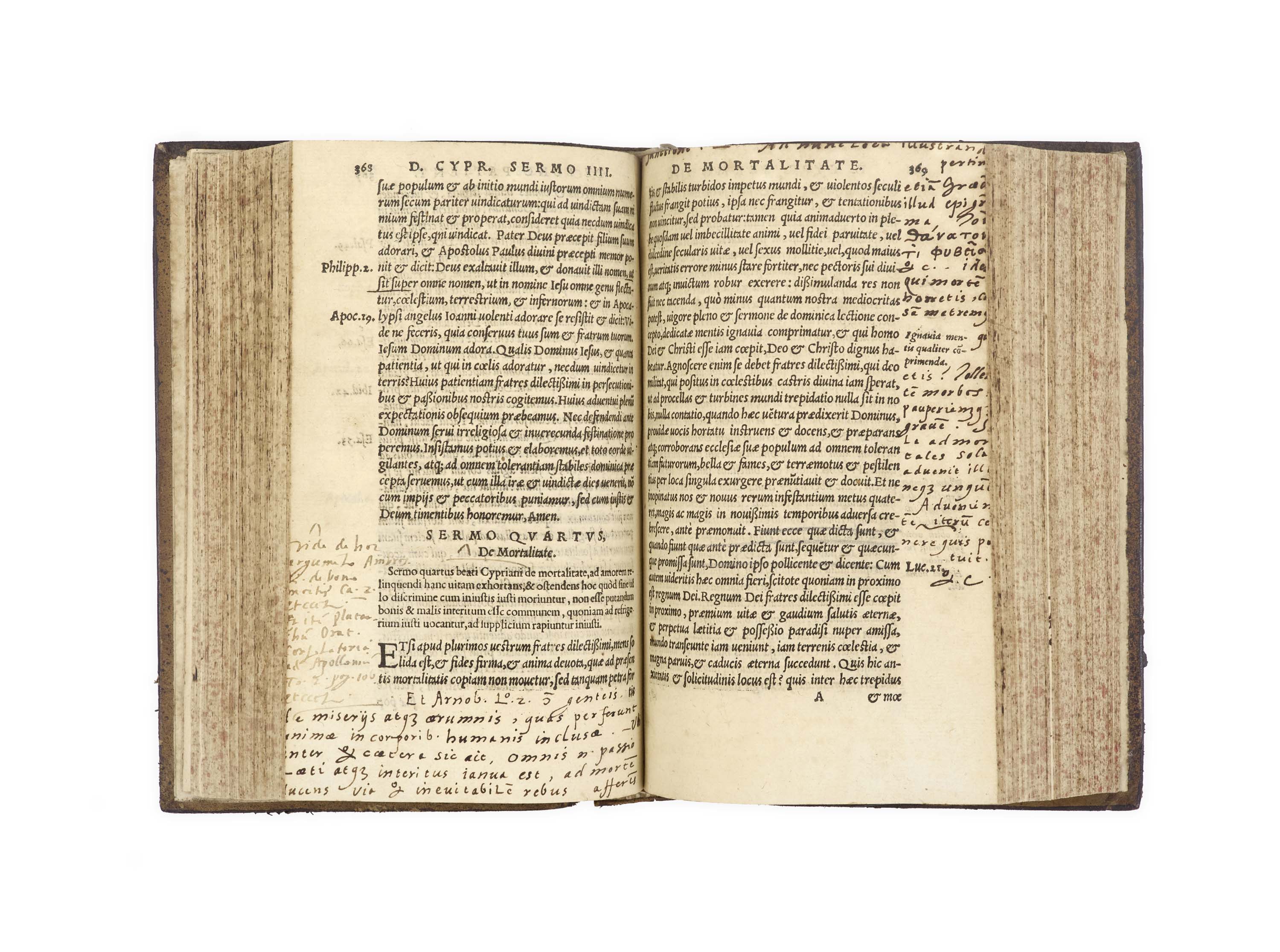
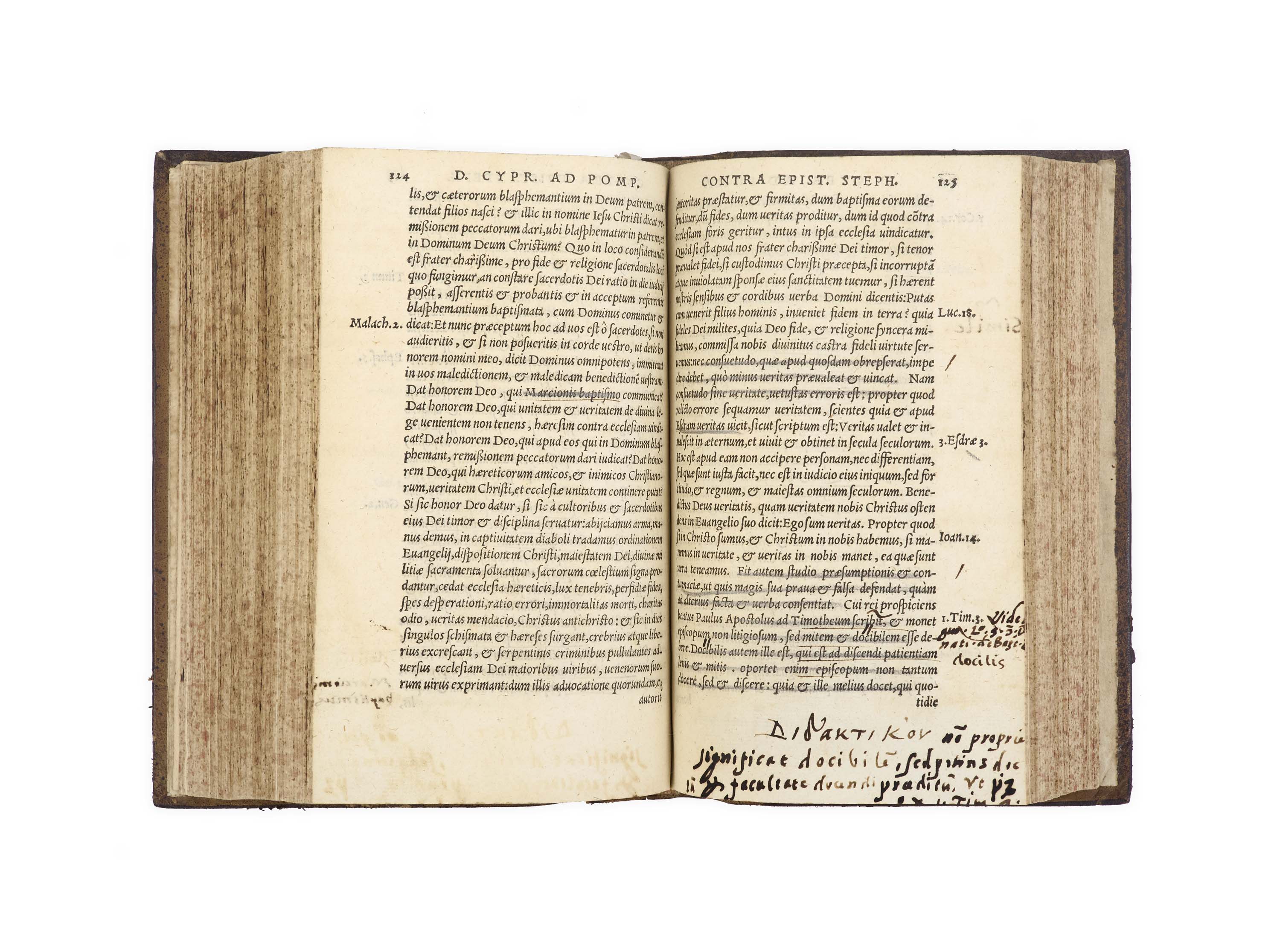
A richly annotated copy of the works of the third-century martyr and bishop of Carthage, St Cyprian, with later Portuguese provenance.
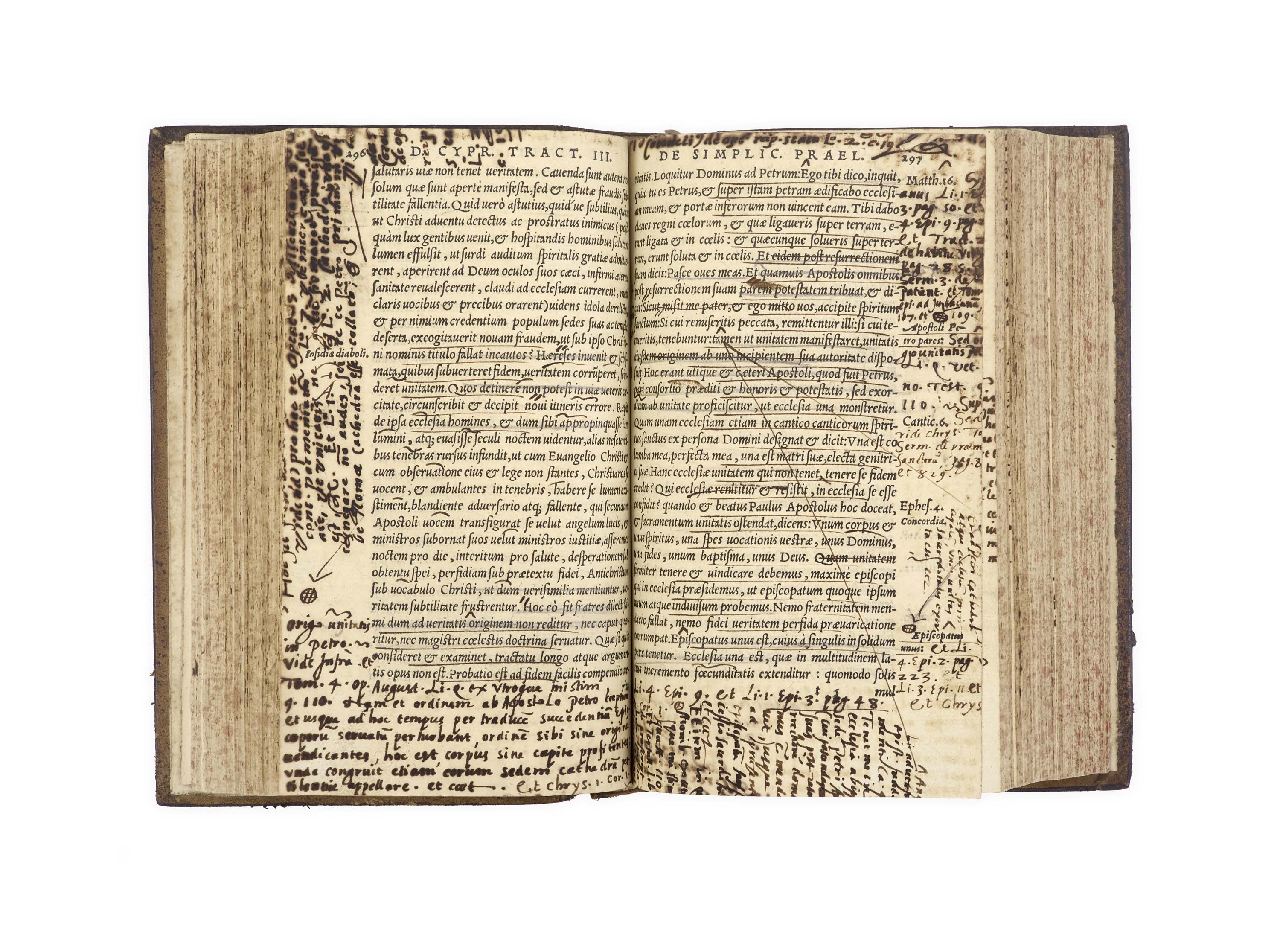
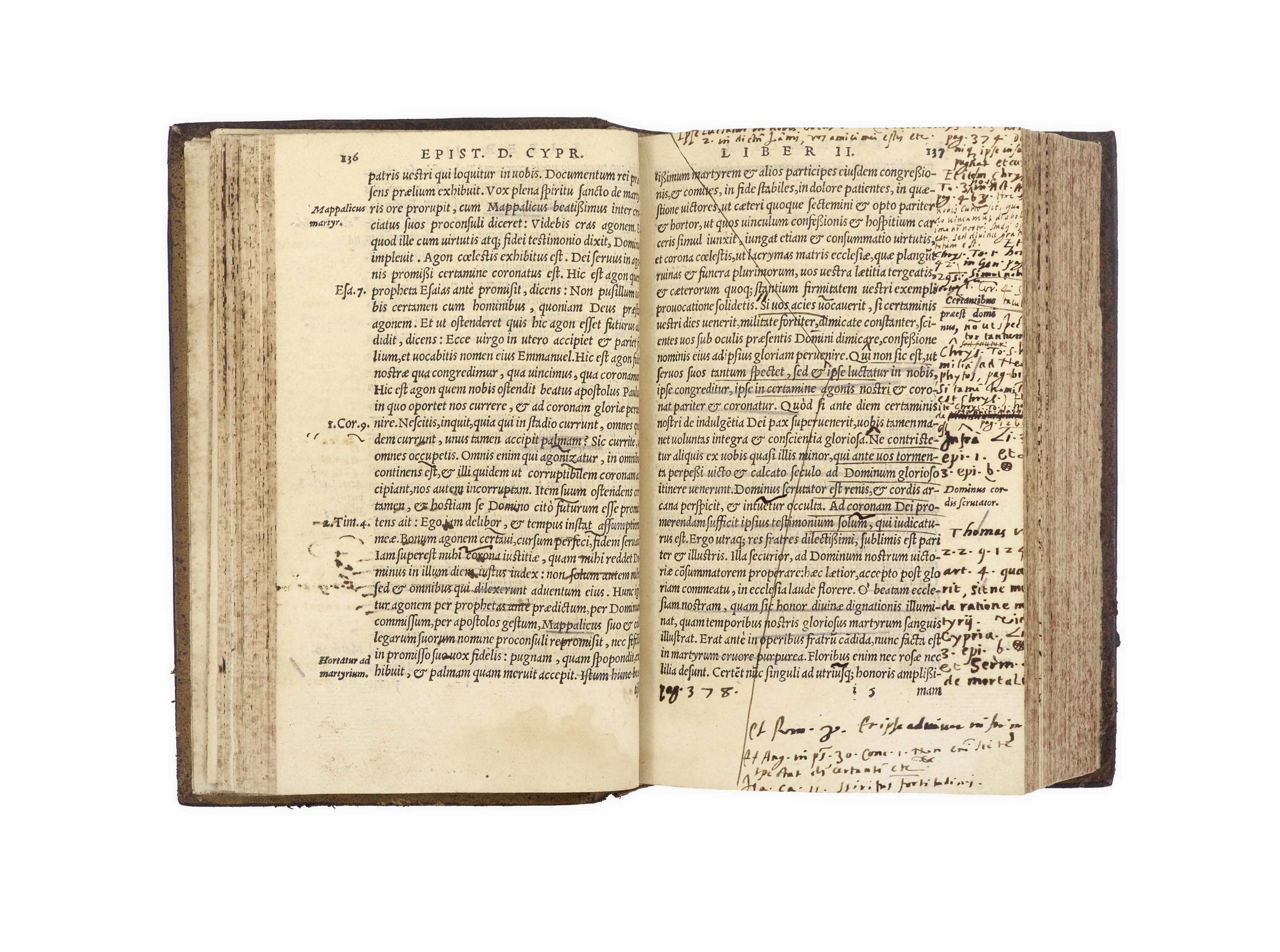
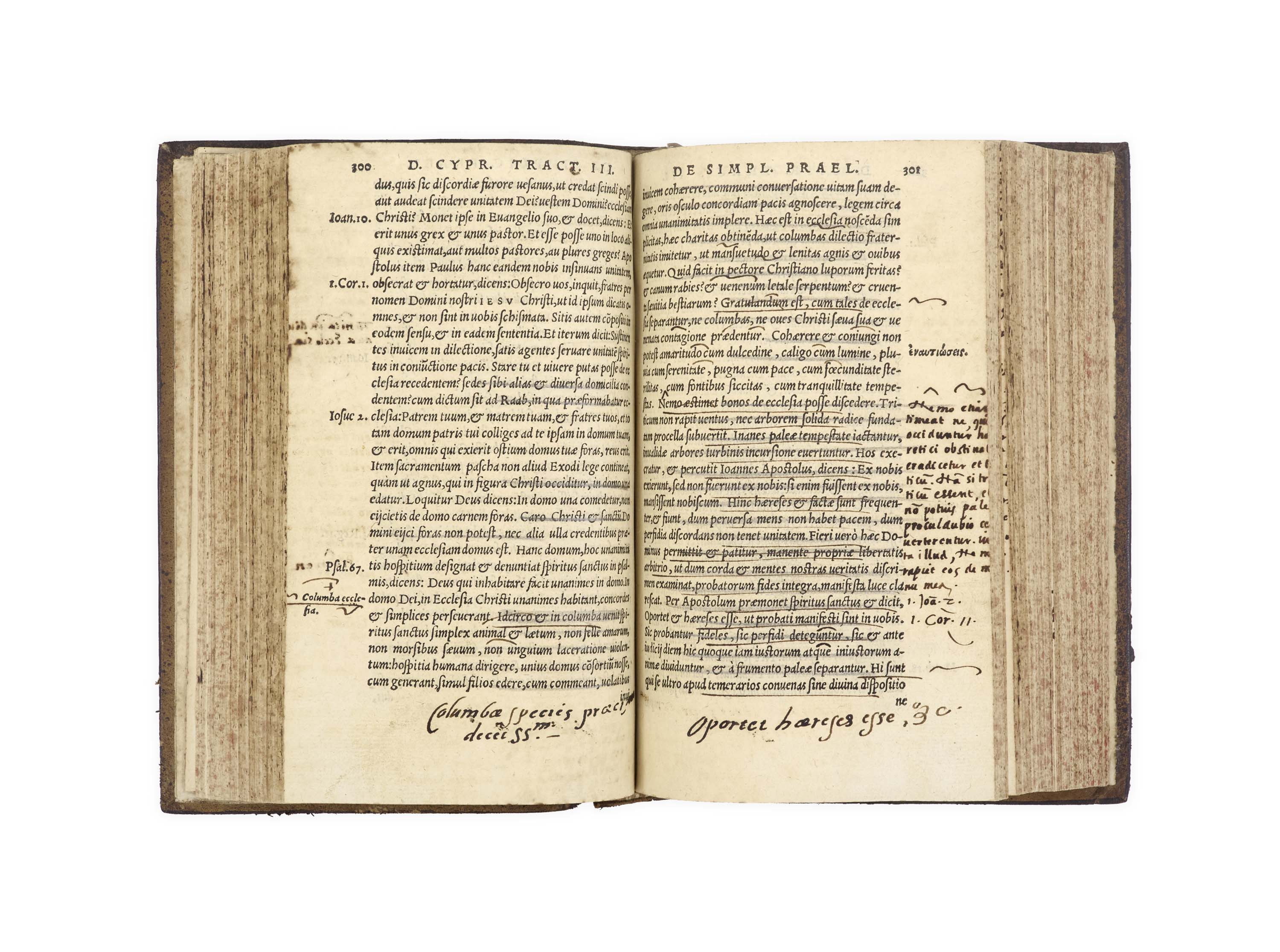
Cyprian (c. 210–258 AD) lived at an early period in the history of Christianity, before the Council of Nicaea (and subsequent councils) had defined orthodox beliefs. Some of the annotations here comment on Cyprian’s deviance from accepted doctrine: the treatise on the universality of the Church (pp. 294–314) has some dense annotations, and one page is crossed through with the note ‘Oportet haereses esse’ (these must be heresies, p. 301). The word ‘Exomologesis’ (public confession of sin and undertaking of penance) is noted in the margins several times, particularly in Cyprian’s letters. This practice was a contentious topic in Cyprian’s time. Among those who opposed it were the Novatianists, who, while not at first denying the power of the Church to absolve from sin, affirmed that the mortal sin of apostasy placed the sinner beyond the reach of that power. It is unsurprising that a seventeenth-century annotator should have focused on this practice, now more contentious than ever: Catholic practice had for centuries recommended the private, aural confession and a private penance, while Protestantism rejected the notion altogether – either would have found these passages provocative.
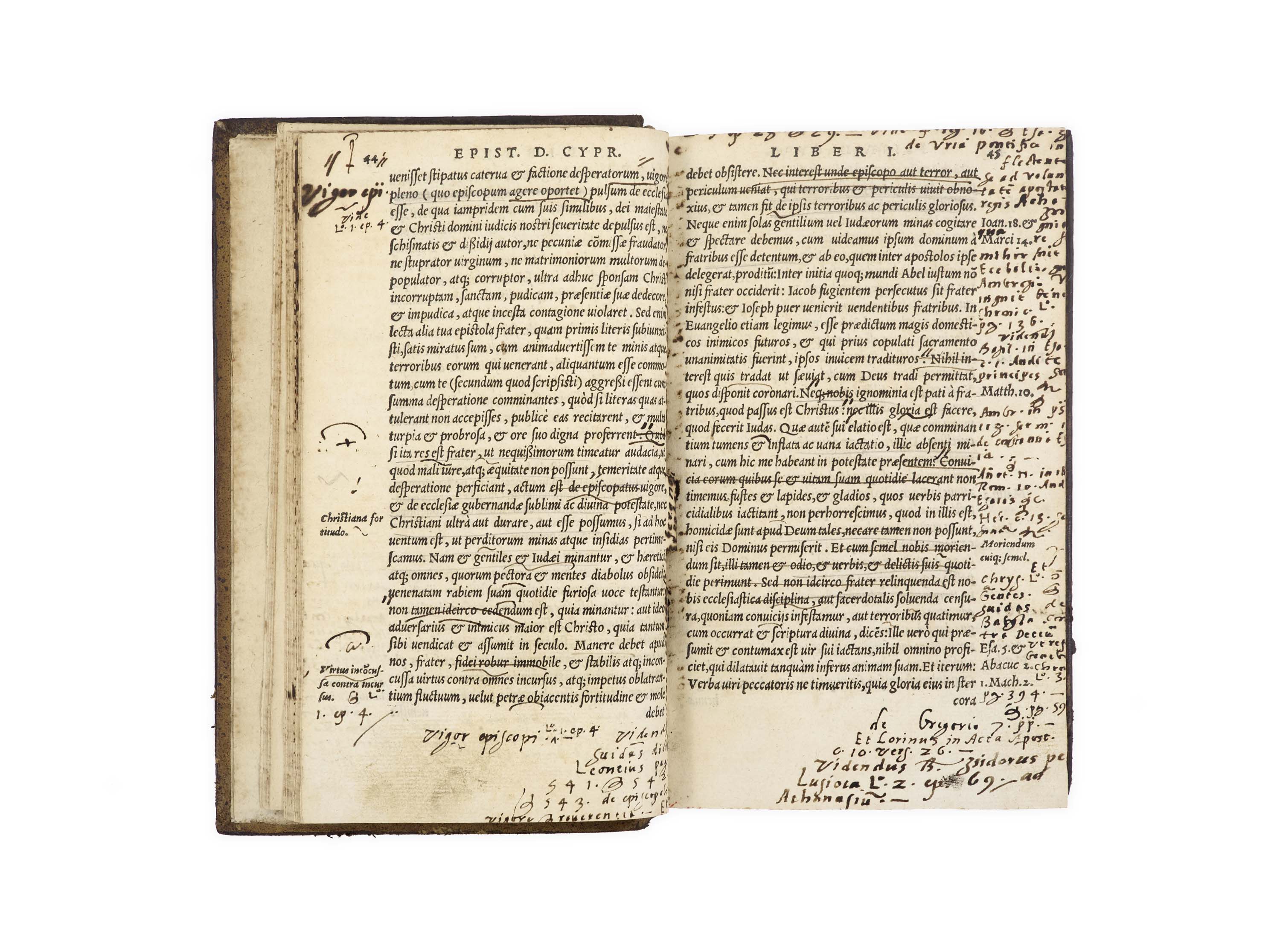
References to other works by Church Fathers either agreeing with or contradicting Cyprian are also noted in the margins, including Augustine, Arnobius, Cassiodorus, Tertullian, John Chrysostom, Gregory of Nazianzus, and Isidore, as well as references to passages in the Bible. While the annotations are predominantly in Latin, there are a few words of Greek, which was the language of the early Christian Church. More modern texts cited are Cesare Baronio (vol. I, p. 294) and the Flemish theologian Jacob Pamelius (1536–1587; vol. II, p. 422 and p. 455), whose edition of Cyprian was printed in 1566, and Jean Lorin (1559–1634), whose commentary on Acts was first published in 1605 (vol. I, p. 45). All this indicates a reader well-versed in patristics and contemporary theology.
The corner of g4 in vol. I has been folded over to preserve the neat early annotation (seemingly the only one in this hand) which clearly states that Cyprian has erred on the subject of baptism performed by heretics. In the treatise on the vanity of idols, the annotator has written ‘maleficia’ (witchcraft) next to the passage describing the physical torments inflicted on those who worship false gods.
USTC records two copies in the US, at Harvard and Yale, and three copies in the UK, at Cambridge University Library, the National Library of Scotland, and the British Library.
USTC 123042; Adams C 3159; Gültlingen V, 1118.