Politics and Love at the Court of Henri Iii
[DAMPMARTIN, Pierre de; Charles SOREL, editor.]
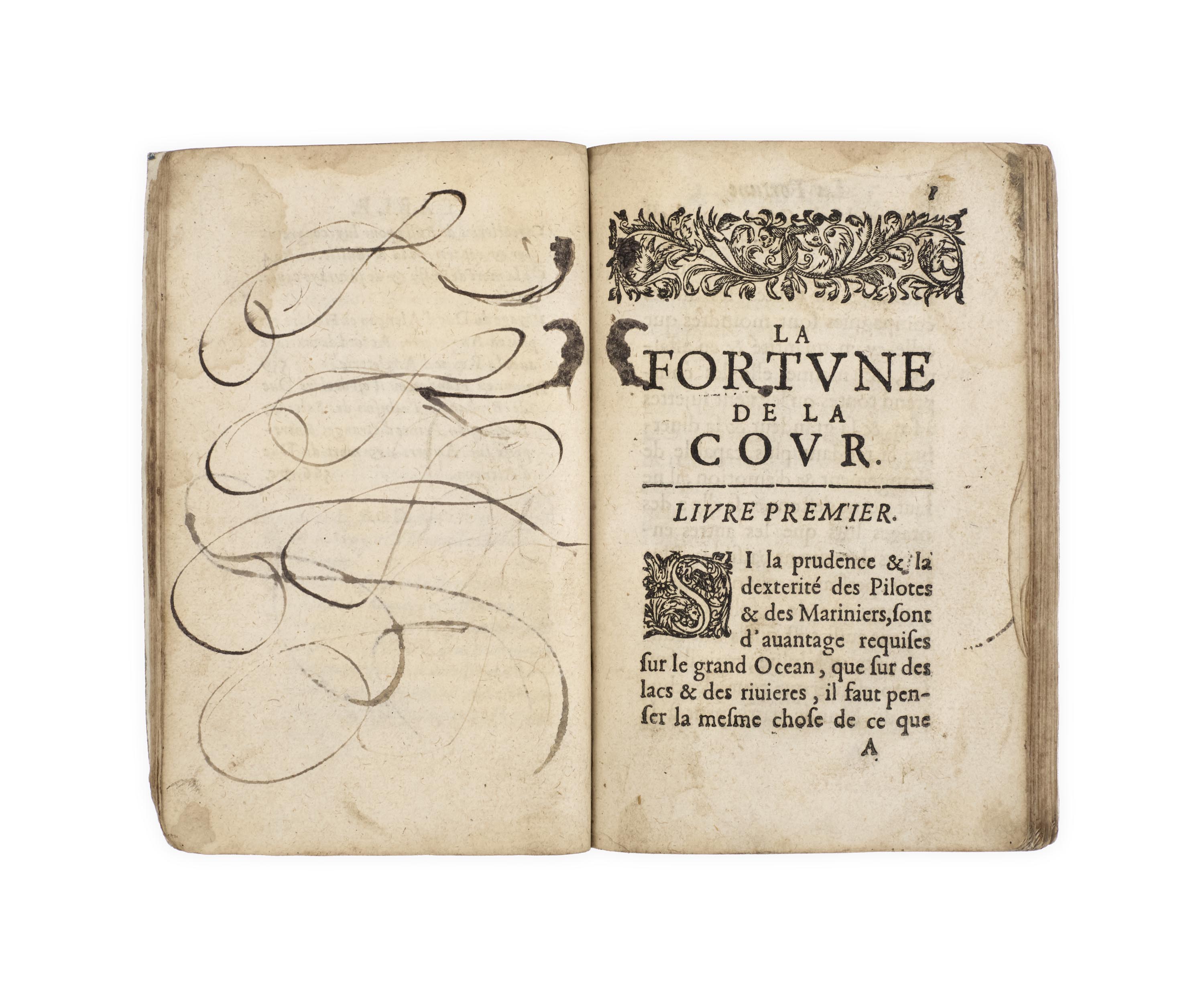
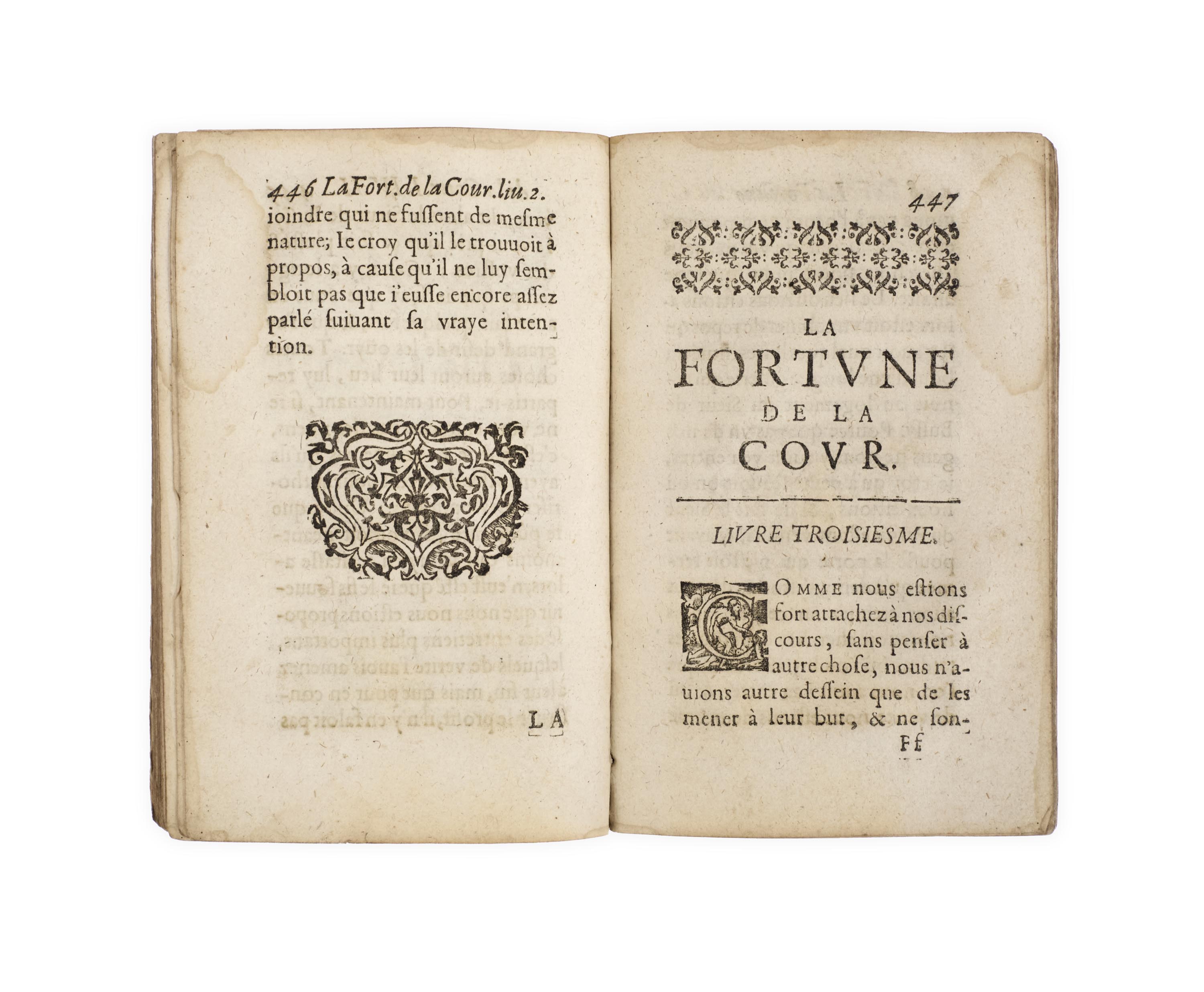
La fortune de la cour. Ouvrage curieux tiré des memoires d’un des principaux conseillers du duc d’Alençon frere du roy Henry III. Paris, Nicolas de Sercy, 1642.
8vo, pp. [xlvi], [1, blank], 85, ‘84–599’ (i.e. 86–601), [5]; bound without final blank 2P8; woodcut initials, woodcut and typographic head- and tailpieces; browned, dampstains to margins, title soiled and worn, closed tears to Q1–2; else a good copy in modern marbled wrappers; pentrials to prelims and final leaves.
Added to your basket:
La fortune de la cour. Ouvrage curieux tiré des memoires d’un des principaux conseillers du duc d’Alençon frere du roy Henry III.
Rare second edition, revised and expanded with several new discourses, of this important political treatise dating from the French Wars of Religion.
First published anonymously in 1592 as Du bonheur de la cour, this was the work of Pierre de Dampmartin (fl. 1585–1599), procureur général to François, duc d’Alençon (brother of Henri III), and later governor of Montpellier. Framed as a discussion between gentlemen in Alençon’s circle, the treatise covers ‘the religious and political quarrels of the sixteenth century, the nature of monarchical power, struggles within the aristocracy, and the rise of the bourgeoisie; the definition of “virtues”, “happiness”, and above all “the perfect courtier, whom one could likewise call the honnête homme of the court” are drawn up with the aid of both contemporary examples and leading personages drawn, for the most part, from the Lives of Plutarch: thus Alexander, Cato, Brutus, Augustus, Perseus, Aemilius Paullus, Caesar, Leonidas rub shoulders with Henri III, Coligny, Condé, Strozzi, Thomas More’ (Berriot, p. 41, trans.).
The work was revived and thoroughly revised fifty years later in the present edition by Charles Sorel (c. 1597–1674), ‘one of the most versatile and innovative French writers of the century, yet one of the least well known’ (NOCLF). Sorel, who misattributed the anonymous work to his uncle Pierre Sorel de la Neuville, modernised the prose throughout, adding also a preliminary discourse, the final part, and ‘quelques discours assez galans … touchant certaines amours de la cour’ (Barbier).
Rare outside continental Europe: OCLC finds only one copy in North America (Folger) and two in the UK (CUL, NLS).
USTC 6004858; Barbier II, col. 485 (cf. I, col. 445). See Berriot, ‘Quatre lettres inédites de Pierre de Dampmartin (1580)’, Réforme, Humanisme, Renaissance 27 (1988).