
A ‘Day of Public Murders’
[DANIEL, Yuli Markovich,]
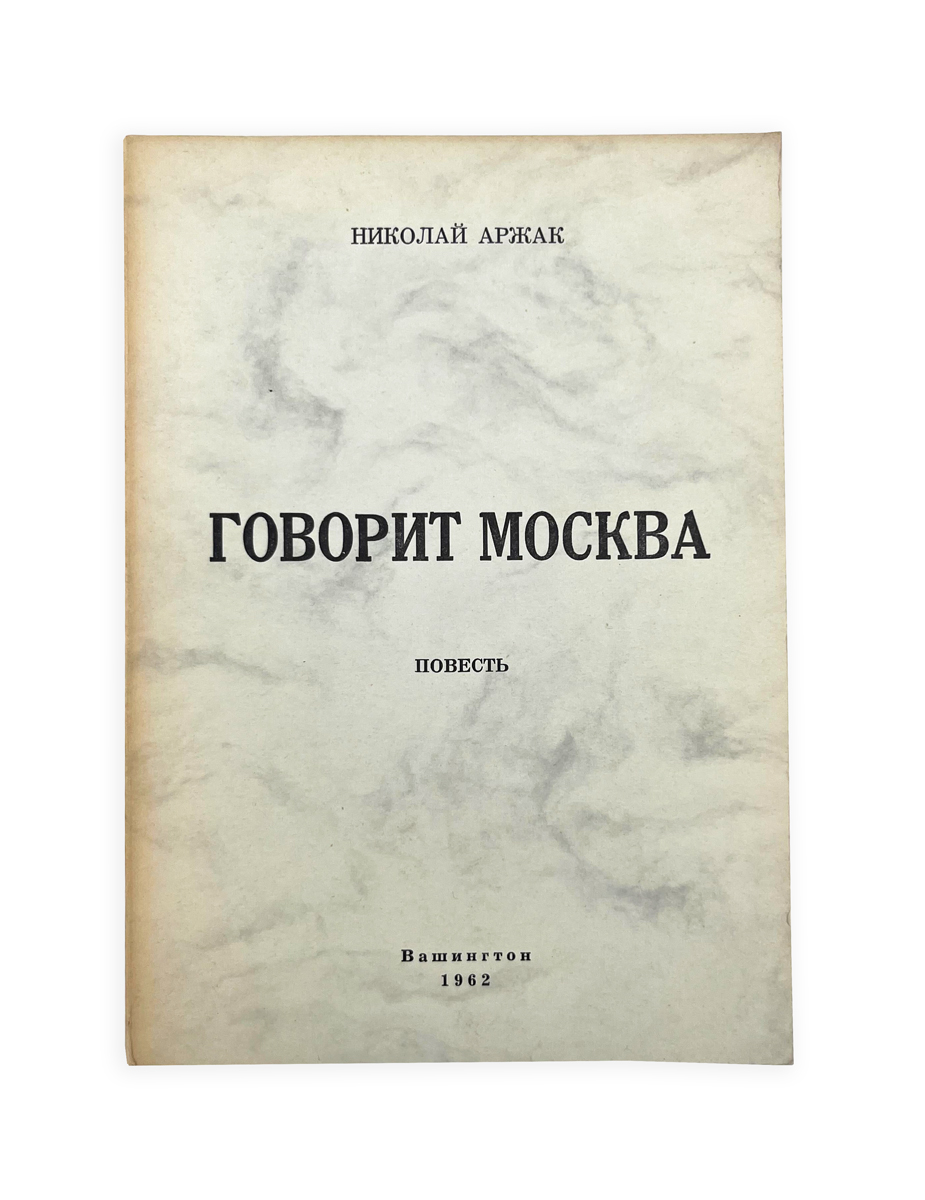
pseud. ‘Nikolai ARZHAK’. Говорит Москва. Повесть [Govorit Moskva. Povest’. This is Moscow Speaking. A Story]. Munich, I. Baschkirzew for Washington, D.C., B[oris] Filippoff, 1962.
8vo, pp. 61, [1 (blank)], [2 (publisher’s advertisements)]; a very good copy in the original printed wrappers; small bookseller’s ticket of Parkers of Oxford to inner front cover.
Added to your basket:
pseud. ‘Nikolai ARZHAK’. Говорит Москва. Повесть [Govorit Moskva. Povest’. This is Moscow Speaking. A Story].
First edition, smuggled out of the Soviet Union and published pseudonymously, of this dystopian work in which the government ‘declares a “Day of Public Murders” and permits random murder’ (Terras), one of the books which led directly to Daniel’s arrest and show trial in 1966 for ‘anti-Soviet activity’.
‘Daniel first attracted attention to himself in the 1960s when he used the pseudonym of Nikolai Arzhak to publish four satirical stories abroad without the permission of the authorities: “Hands”, “This is Moscow Speaking”, “The Man from MINAP”, and “The Atonement”’ (Terras). Daniel and his fellow writer Andrey Sinyavsky smuggled their writing out of the Soviet Union as samizdat and published their work in the West under pseudonyms, as here. The people of This is Moscow Speaking view the ‘Day of Public Murders’ as ‘nothing special. There’s “Artillery Day”, “Soviet Press Day”, “Day of Public Murders” – the police cannot be touched. Transport is working, so there will be order. The following day, a long editorial article appeared in Izvestia. It said very little about the event, but repeated the usual: “prosperity – by leaps and bounds – genuine democracy only in our country – all thoughts are made visible for the first time in history – the bourgeois press”’ (p. 4, trans.).
The preface by the Washington publisher Boris Filippoff (1905–1991), critiquing the actions of Communist leaders and of the injustice of Soviet show trials, eerily anticipates the Daniel–Sinyavsky trial four years later, in which both defendants pleaded not guilty but were sentenced to five and seven years in labour camps: ‘The premise of the story … is only an artistic device that allows one to imagine the behaviour and psychology of the people, its reaction to a new decree of the Soviet party elite. And is [the decree of] a ‘Day of Public Murders’ really so unrealistic?’ The trial would garner international attention and outspoken criticism from Auden, Arendt, Grass, Boll, Mailer, Greene, and others.