Presentation Copy to W. B. Tegetmeier
DARWIN, Charles.
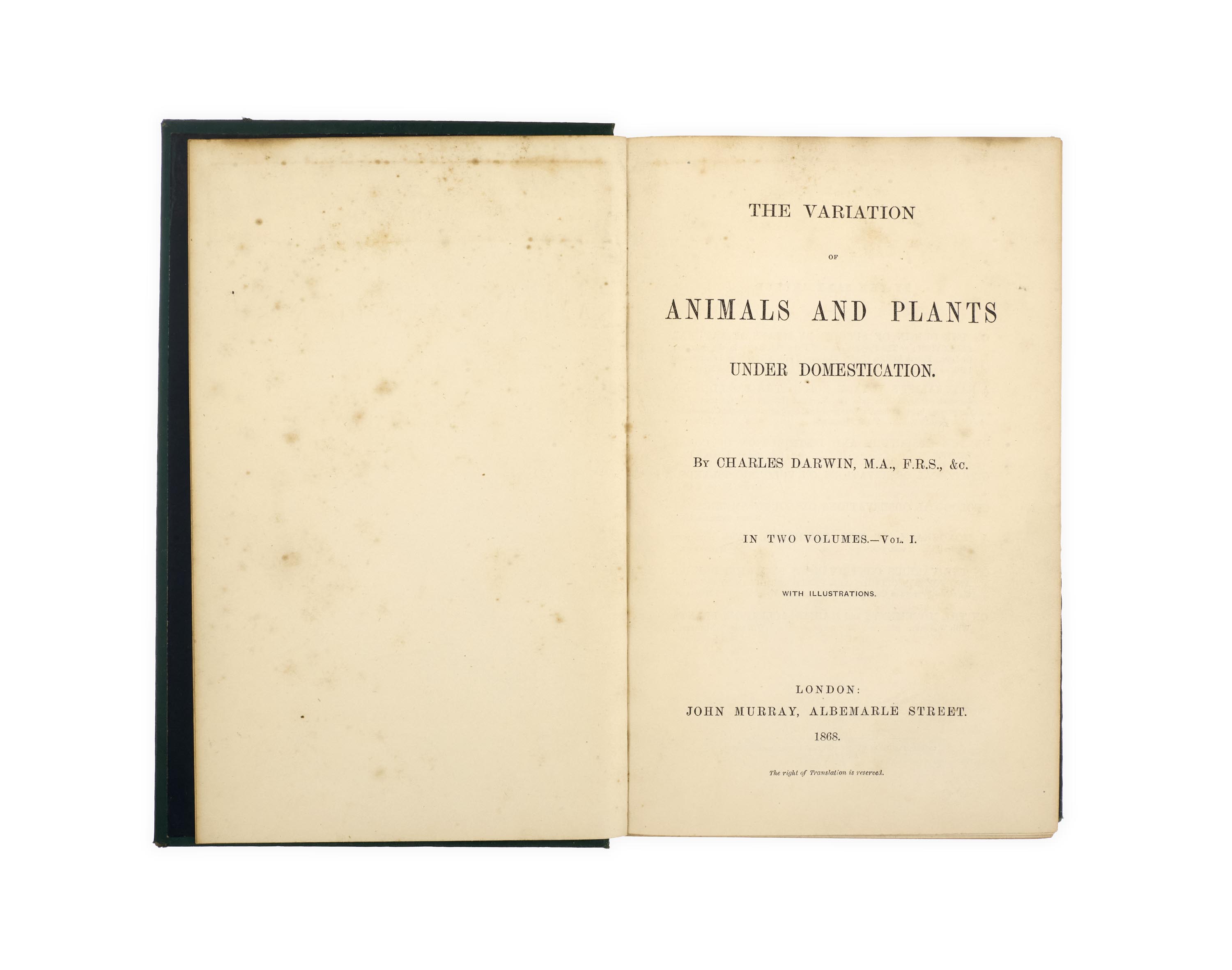
The Variation of Animals and Plants under Domestication. London, John Murray, 1868.
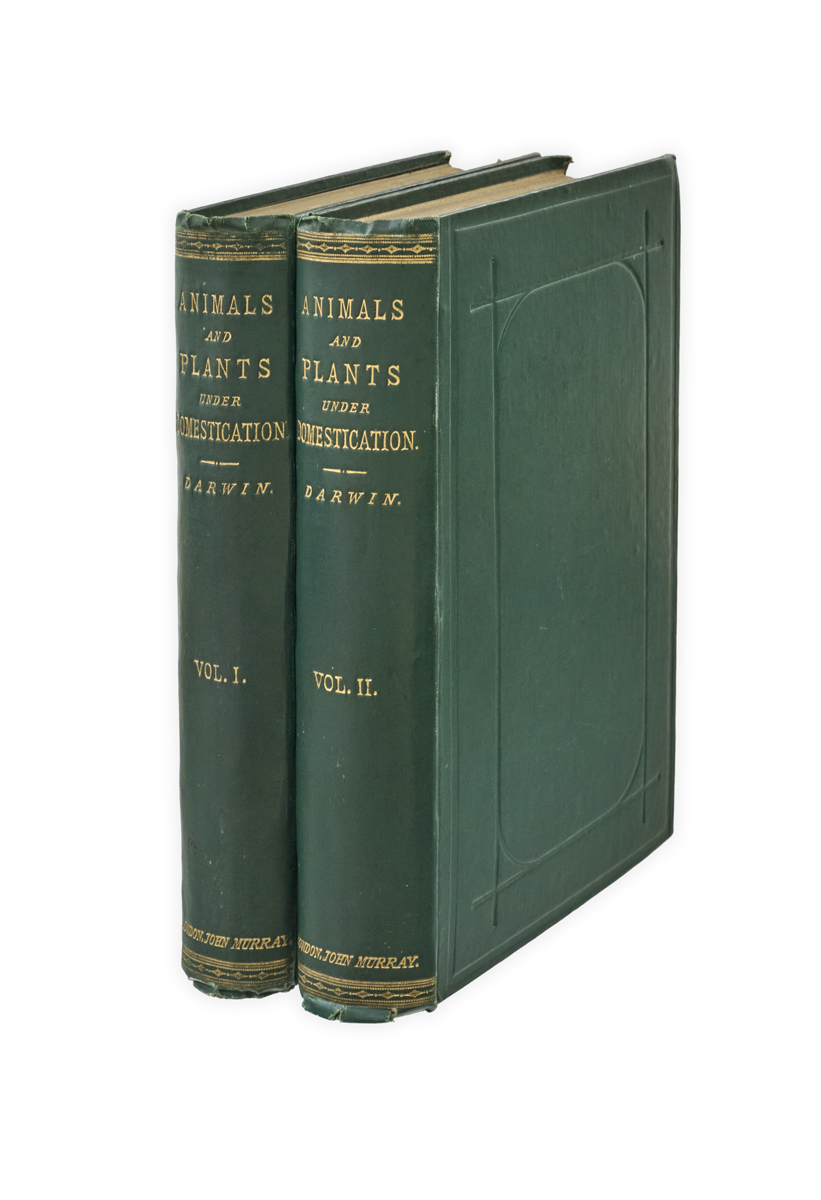
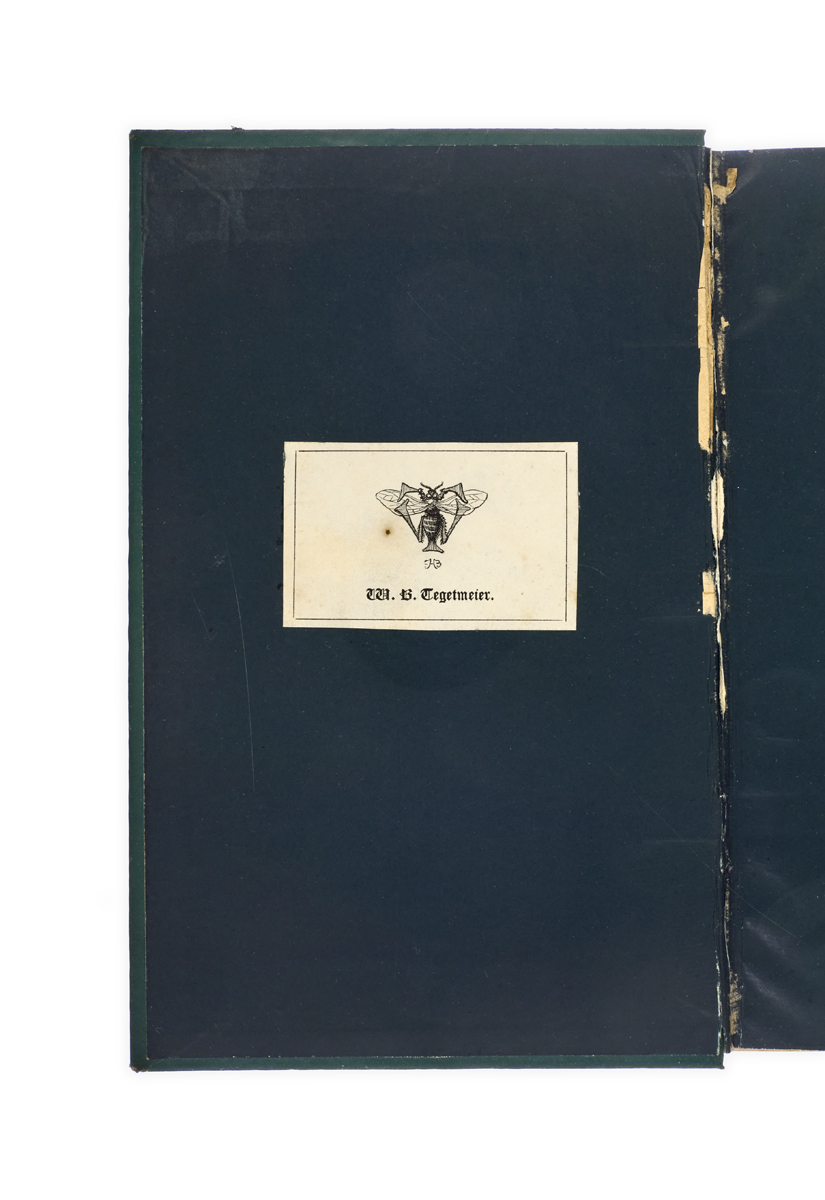
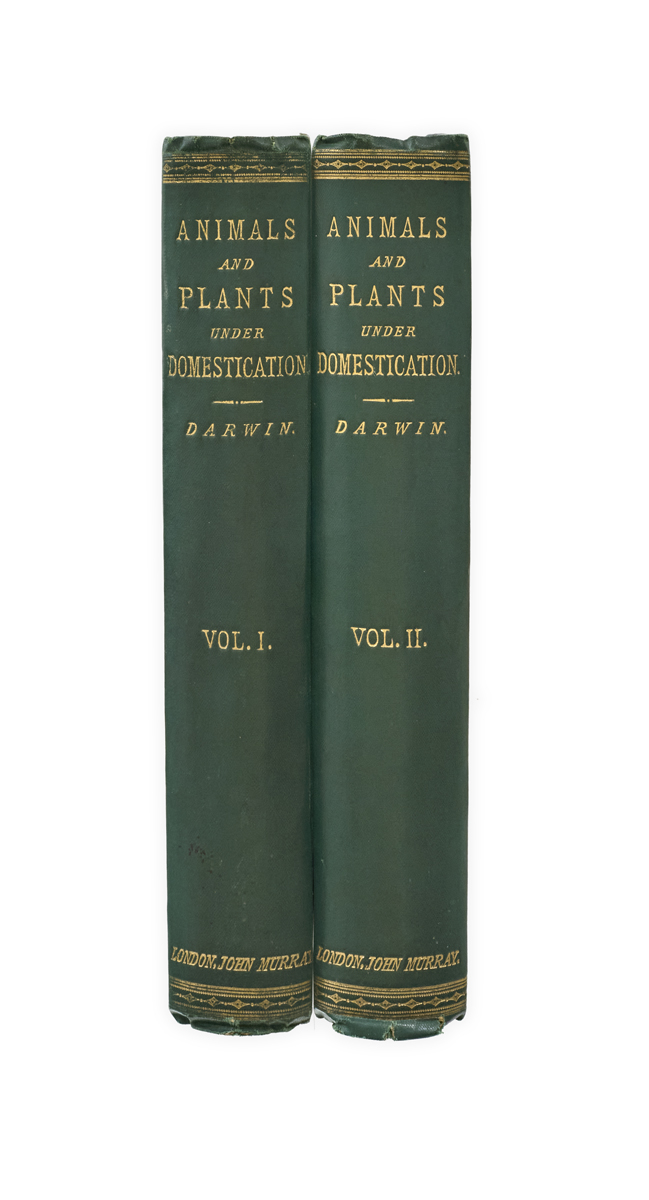
Two vols, 8vo (215 x 135 mm), pp. viii, 411, [1], 32 (publisher’s advertisements, dated April 1867); viii, 486, [2, publisher’s advertisements, dated February 1868]; illustrations in the text; small paper-flaws in final two advertisement leaves of vol. I (not affecting text), but an excellent, bright copy in the original publisher’s green cloth (as described by Freeman), with the ticket of Edmonds & Remnants; minor wear to extremities, paper adhesions along front inner hinge of vol. I where something once tipped in; from the library of William Bernhardt Tegetmeier, with his bookplates, his pencil markings in the text, a ‘List of Darwin Books’ he owned (including ‘Origin of Species, with presentation note’), and a letter addressed to him by the publisher Robert Cooke loosely inserted (see below).
First edition, first issue, an important presentation copy to the naturalist and journalist William Bernhardt Tegetmeier, who provided Darwin with detailed information on poultry breeding and other subjects and who arranged for artists to produce some of the book’s illustrations.
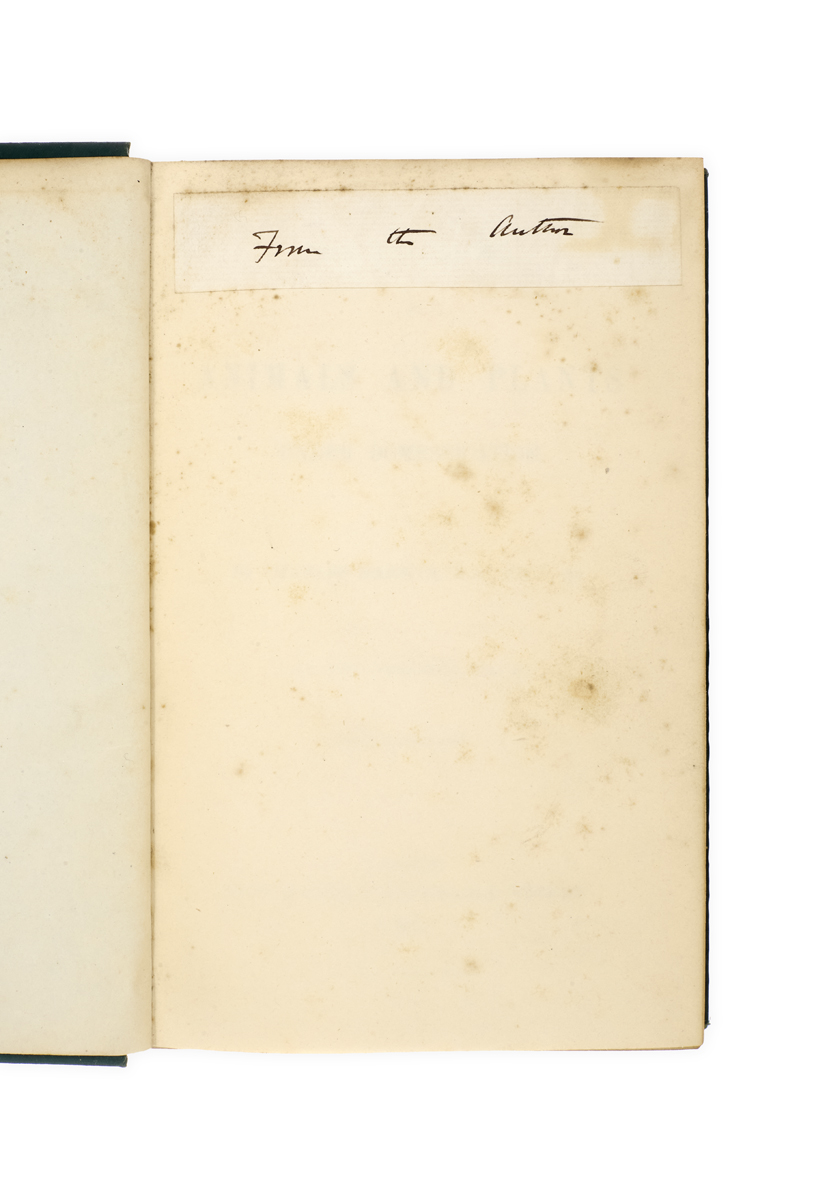
A paper slip on the flyleaf of volume one is inscribed in Darwin’s hand ‘From the author’. This was the usual method of denoting presentation copies of this book (for another example see Darwin’s century: the Jeremy Norman Collection, item 135). Presentation copies are further characterised by being slightly smaller than regular copies because they were specially prepared by having their edges trimmed properly by the binder. This was due to Darwin’s intense dislike of uncut edges, as Francis Darwin notes in the Life and Letters of Charles Darwin: ‘He wrote to the Athenæum on the subject, Feb. 5, 1867 … He tried to introduce the reform in the case of his own books, but found the conservatism of booksellers too strong for him. The presentation copies, however, of all his later books were sent out with the edges cut’ (vol. III, p. 36).
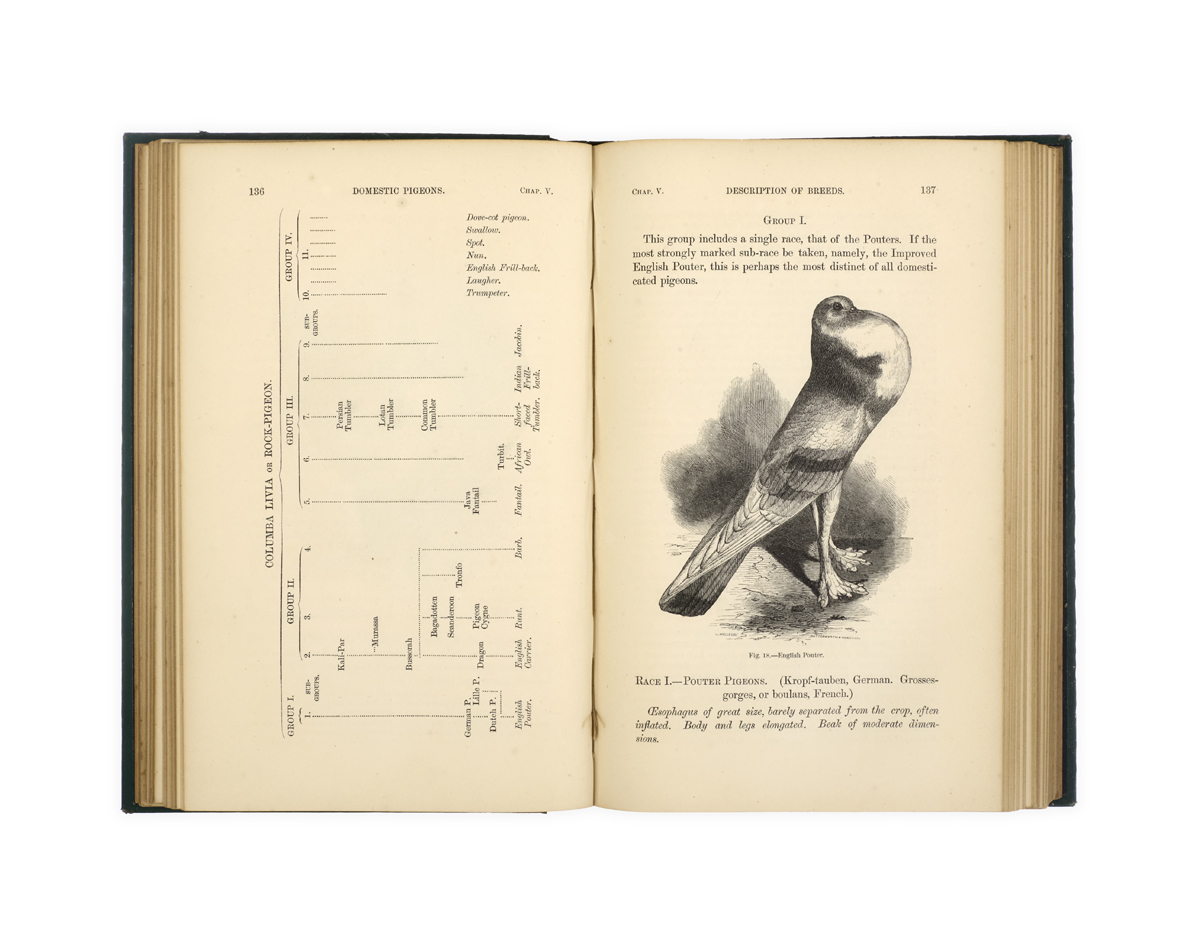
William Bernhardt Tegetmeier (1816–1912) was the son of a surgeon who had emigrated from the American colonies. In 1859 he began to write on natural history for the weekly Field and soon became its chief correspondent on poultry and pigeons, in which he had long been interested. He wrote the Poultry Book (1867) and Pigeons (1868) as well as standard works on pheasants and game birds. Tegetmeier was also a dedicated apiarist, building observation hives in his garden at Muswell Hill and experimenting on interbreeding and hive formation. In 1858 he demonstrated that bees constructed cylindrical cells which attained their characteristic hexagonal shape only when raised up in contact with one another, an observation cited by Darwin in his On the Origin of Species. Apart from arranging for artists to produce the splendid wood-engraved illustrations of pigeons and fowls in Variation, Tegetmeier was relied on by Darwin for providing accurate information on poultry breeding and other subjects: according to the index at the end of volume two he is cited 33 times by Darwin in the text.
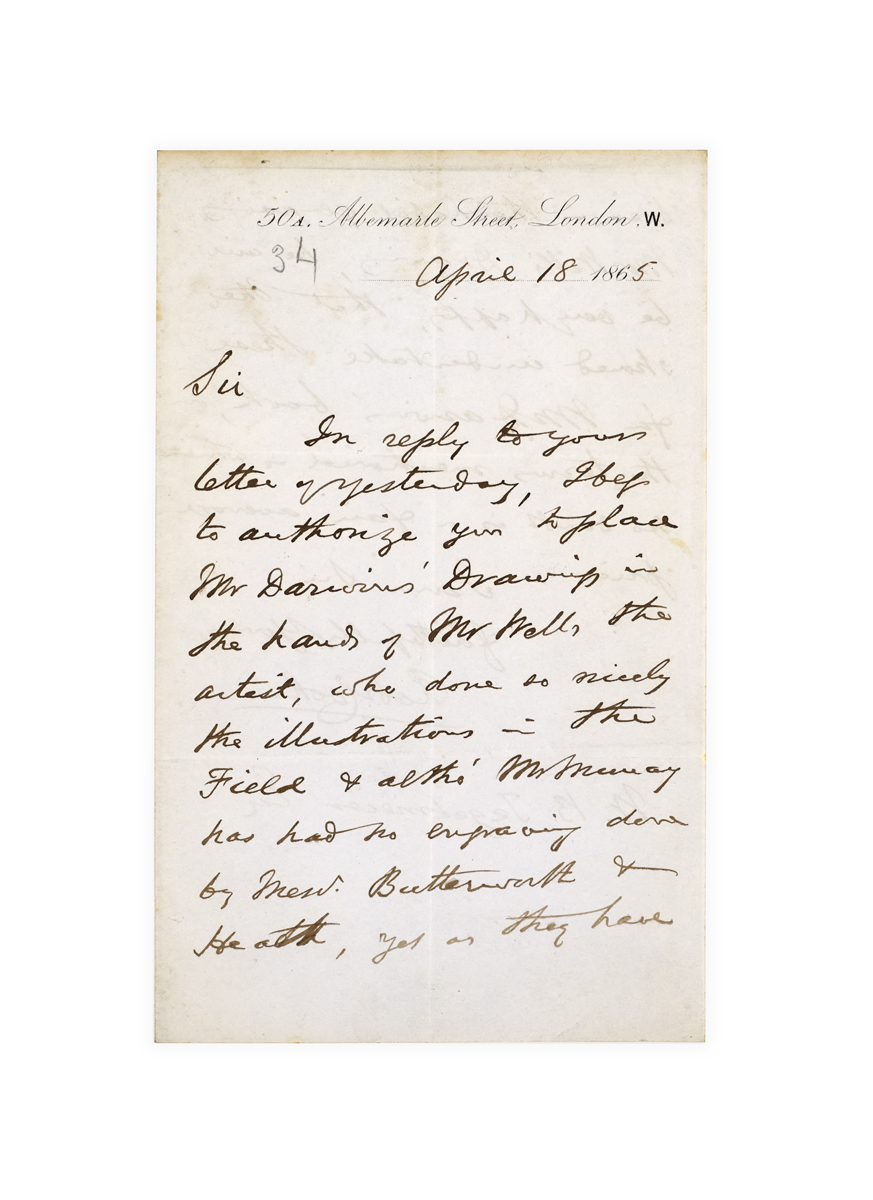
Loosely inserted is a letter to Tegetmeier from Robert Francis Cooke (1816–1891), a cousin of John Murray and a partner in his publishing company. Written on paper headed ‘50A, Albemarle Street, London, W.’ and dated 18 April 1865, it reads: ‘Sir, in reply to your letter of yesterday, I beg to authorize you to place Mr Darwin’s Drawings in the hands of Mr [Luke] Wells the artist, who done [sic] so nicely the illustrations in the Field & altho’ Mr Murray has had no engraving done by Messrs. Butterworth & Heath, yet as they have been in the habit of engraving Mr Wells’ Drawing, he will be very happy, that they should undertake these for Mr Darwin’s book, on the terms mentioned – which no doubt is a fair average price’. In a letter to Tegetmeier of 16 October 1866 Darwin wrote: ‘Very many thanks for all your kind assistance now completed. I have written to Mr. Murray to pay Mr. L. Wells when he calls for payment. I hope to begin printing in the beginning of next year but I can work only slowly. I need not say that one of the first copies shall be sent to you’ (Darwin Correspondence Project, letter no. 5244).
Darwin stressed in On the Origin of Species (1859) that he was publishing there an ‘abstract’, which ‘must necessarily be imperfect’, and was offering his ‘general conclusions’ only, without ‘references and authorities for my several statements’. He accordingly wrote three more books – The variation of animals and plants under domestication (1868), The descent of man (1871) and The expression of the emotions in man and animals (1872) – to elaborate various issues raised in the Origin. The variation of animals and plants developed in detail a subject that had been confined to one chapter in the Origin. ‘It contained his hypothesis of pangenesis, by means of which Darwin tried to frame an explanation of hereditary resemblance, inheritance of acquired characteristics, atavism, and regeneration. It was a brave attempt to account for a number of phenomena which were beyond the bounds of scientific knowledge in his day, such as fertilization by the union of sperm with egg, the mechanism of chromosomal inheritance, and the development of the embryo by successive cell division. His hypothesis of pangenesis could not therefore give a permanently acceptable account of the multitude of phenomena it was designed to explain. It was, however, a point of departure for particulate theories of inheritance in the later nineteenth century’ (Gavin de Beer, in DSB; see also Browne, Darwin: a Biography, II, pp. 200–6, 286–293).
The first issue was published in January, the second in February 1868. The two issues have considerable textual differences, but the easiest way to distinguish them is by the errata listed on p. vi of vol. I and p. viii of vol. II: in the first issue five errata are listed in six lines in vol. I and nine in seven lines in vol. II, whereas in the second a single erratum is listed in vol. I only. The publisher’s binding also differs, the spines of the first issue having a one-line imprint, those of the second normally having a two-line imprint.
Freeman 877; Freeman, Companion, p. 282; Norman 597 (second issue).