On Oxford, From His Autobiography
DE QUINCEY, Thomas.
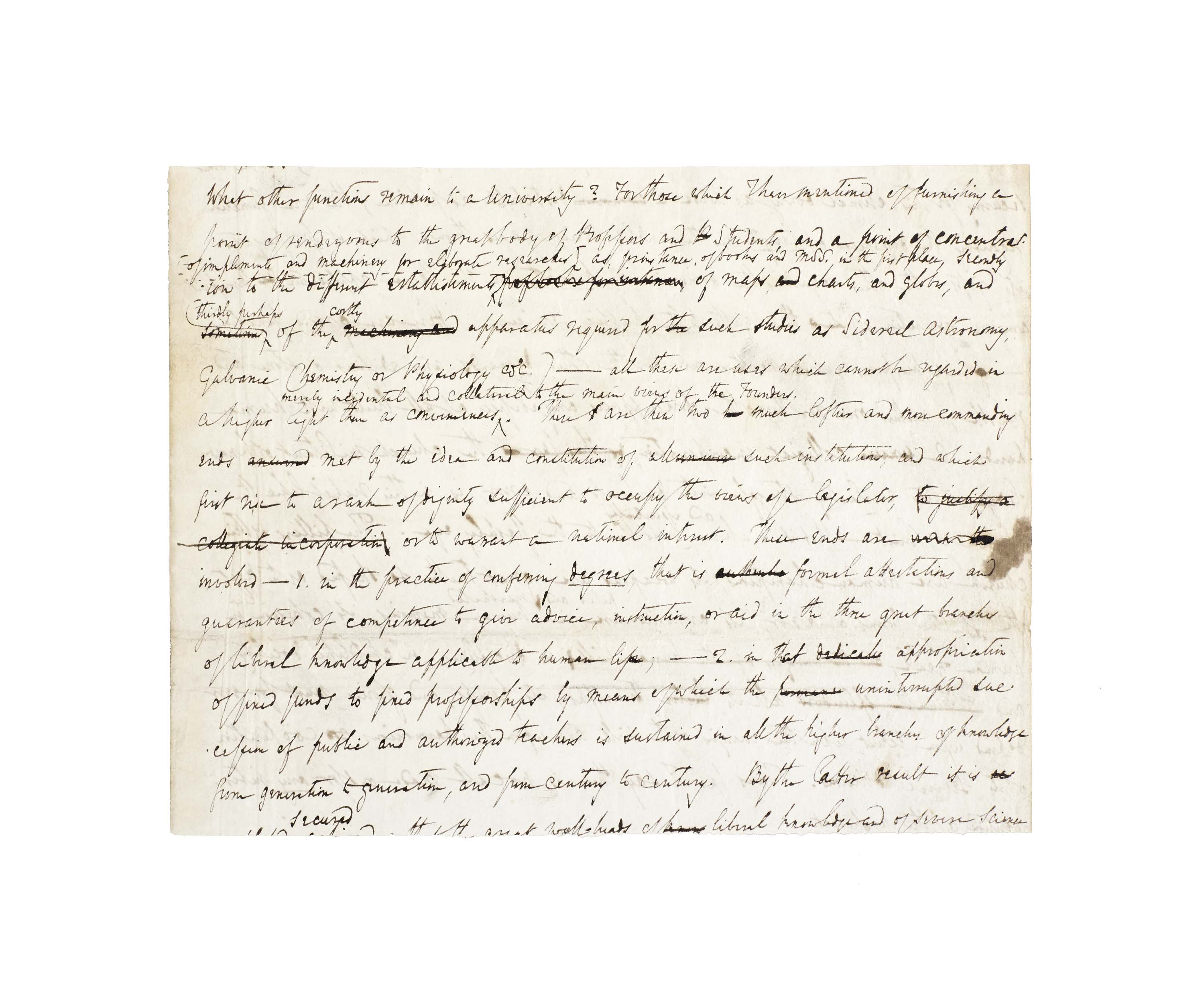
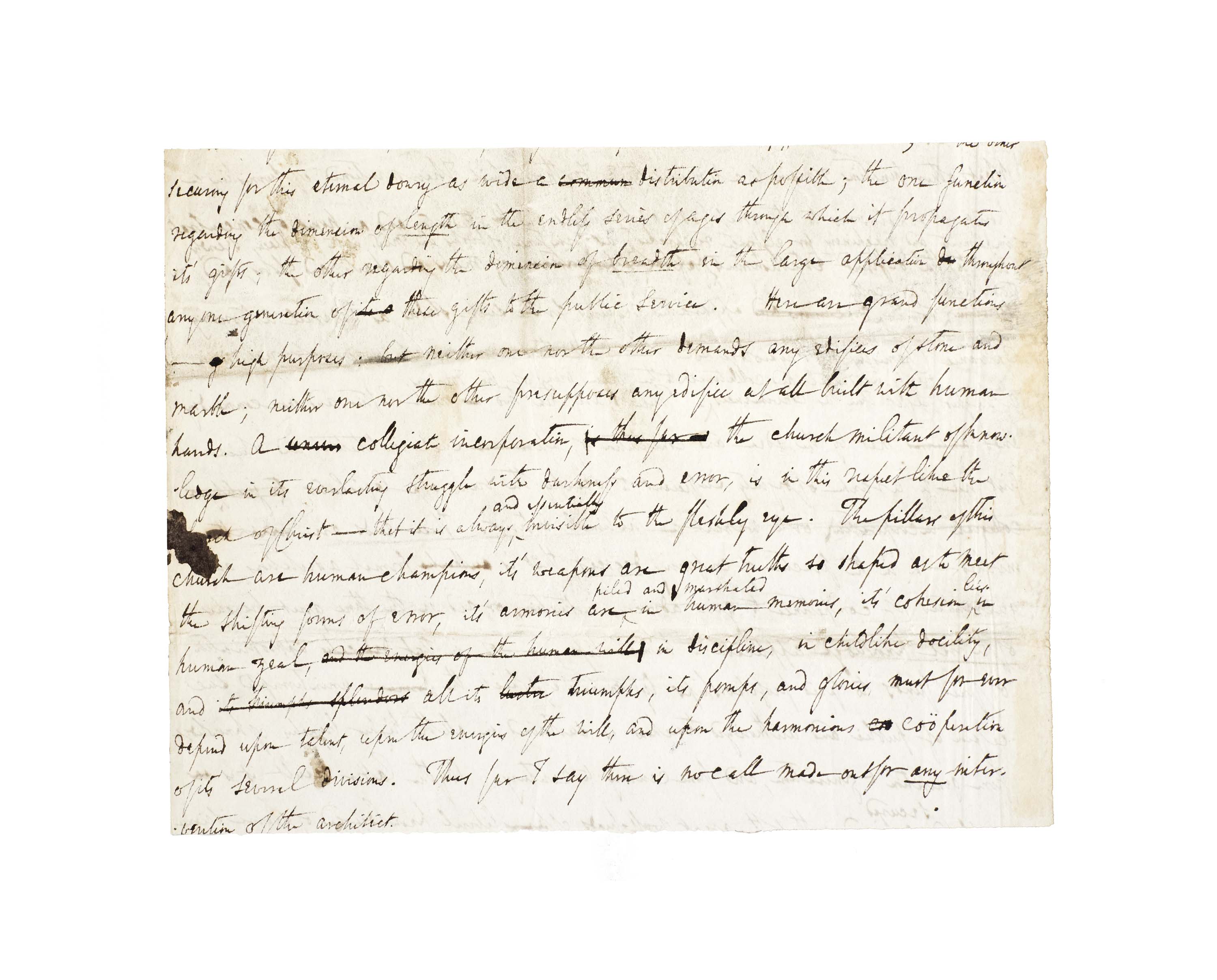
Autograph draft of two passages from his autobiographical essay ‘Oxford’, first published in Tait’s Magazine in February to August 1835 and reprinted by David Masson as Autobiography in Collected Writings (Edinburgh, 1889), II, pp. 9–78. Undated, c. 1835.
Manuscript on paper, oblong 8vo, 33 lines, with a number of revisions, written on both sides of a sheet that has been cut from a larger leaf (leaving traces of text at both top and bottom); formerly mounted along one edge and slightly creased and with a couple of blots but withal in very good condition.
Added to your basket:
Autograph draft of two passages from his autobiographical essay ‘Oxford’, first published in Tait’s Magazine in February to August 1835 and reprinted by David Masson as Autobiography in Collected Writings (Edinburgh, 1889), II, pp. 9–78.
An interesting autograph fragment with numerous authorial revisions. The essay as a whole is an ‘account of the system of Oxford life and education during the five years of De Quincey’s connexion with the University, with glimpses of himself’ (Masson, II, p. 2). The passages here form the beginning and ending of a long paragraph concerning the idea of a university (pp. 17–19 in Masson’s edition, with a lacuna of 14 lines in the middle because of the way the manuscript has been cut from a larger sheet).
The text begins: ‘What other functions remain to a University? … There are … loftier and more commanding ends answered met by the idea and constitution of all univers such institutions, and which first rise to a rank of dignity sufficient to occupy the views of a legislator, to justify a collegiate incorporation or to warrant a national interest. [One is] that dedicati appropriation of fixed funds to fixed professorships by means of which the uninterrupted succession of … teachers is sustained in all the higher branches of knowledge, from generation to generation, and from century to century …’. It ends (on the other side of the page): ‘Here are grand functions, high purposes; but neither one nor the other demands any edifices of stone and marble … A unive collegiate incorporation is thus far, the church militant of knowledge, in its everlasting struggle with darkness and error, is, in this respect, like the Church of Christ ... The pillars of this church are human champions; its weapons are great truths … ; its armouries are [piled and marshalled] in human memories … ; and its triumphs, splendours all its triumphs, its pomps, and glories, must for ever depend upon talent, upon the energies of the will, and upon the harmonious coöperation of its several divisions. Thus far, I say, there is no call made out for any intervention of the architect.’
IELM lists nine fragments from the various articles that make up Masson’s Autobiography but only one from ‘Oxford’, two quarto pages, at Cornell (IELM DeQ 7).