‘One of English History’s Most Dangerous Men’.
[DIGBY.]
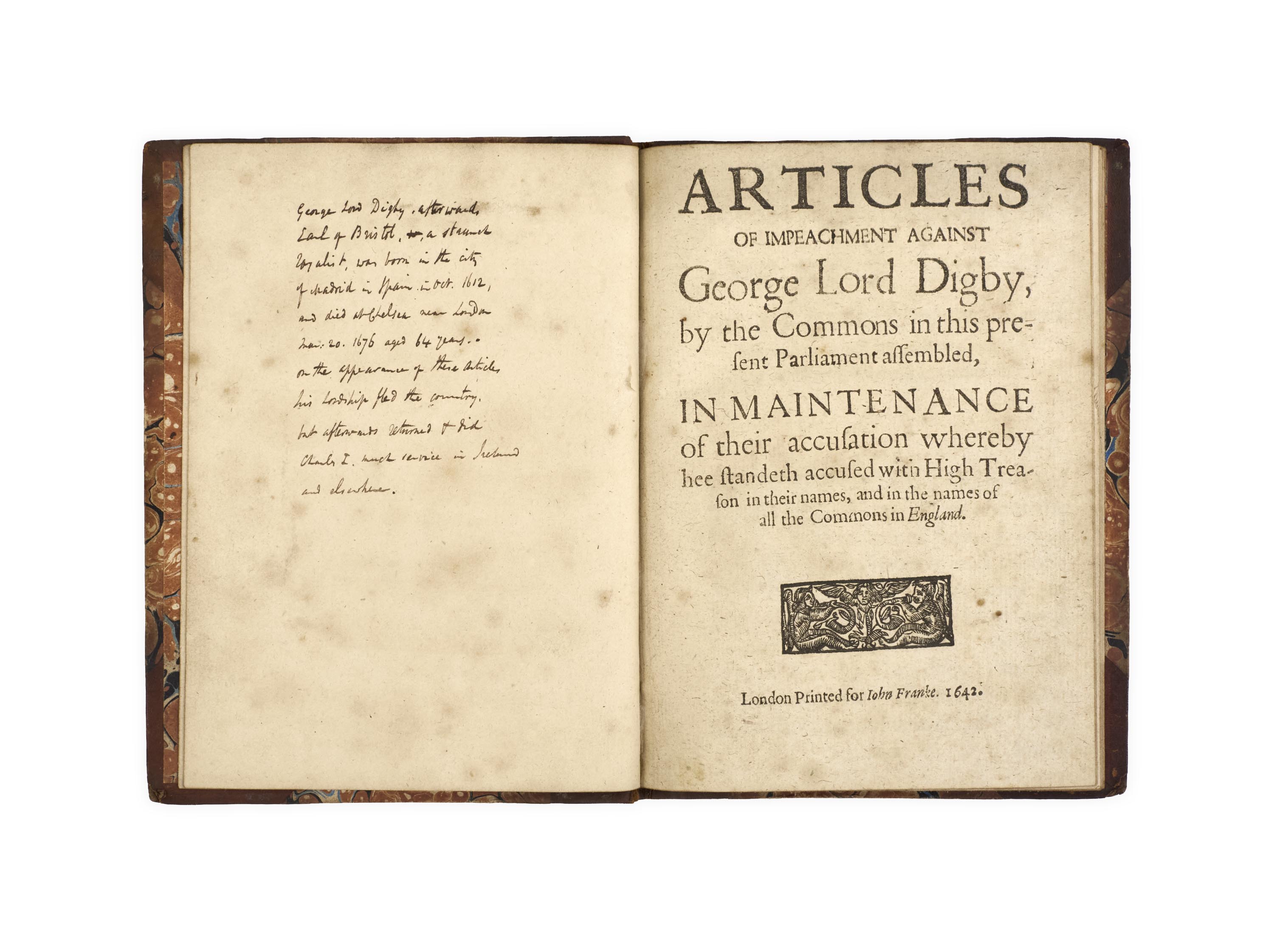
Articles of Impeachment against George Lord Digby, by the Commons in this present Parliament assembled, in Maintenance of their Accusation whereby hee standeth accused with High Treason in their Names, and in the Names of all the Commons in England. London, John Franke, 1642.
4to, pp. [2], 5, [1], with a woodcut device on the title-page, woodcut initial; a very good copy in nineteenth-century half calf, marbled paper sides; purchase note dated 1831 on front endpaper.
Added to your basket:
Articles of Impeachment against George Lord Digby, by the Commons in this present Parliament assembled, in Maintenance of their Accusation whereby hee standeth accused with High Treason in their Names, and in the Names of all the Commons in England.
First edition, scarce. ‘One of the foremost English examples of irresponsible brilliance’ (ODNB), George Digby (1612–1677) was the son John Digby, several times ambassador to Spain under James I – George was born and raised till the age of 11 in Madrid. A natural scholar with ‘cherubic blond good looks’, he was elected MP for Dorset in 1640 and led the early charges against Charles I, managing the impeachment of the Earl of Strafford. But he opposed Strafford’s attainder, for which he received the ire of Commons – he was rescued by the King through his elevation as Baron Digby of Sherborne and then his appointment as ambassador to France. ‘Digby did not proceed to France but became one of the most extreme of the king’s defenders in the Lords’, and his letters to friends encouraging Charles to avoid compromise with Parliament led to his impeachment on 26 February 1642. ‘He had become the stereotypical evil royal counsellor’ (ibid.), and was accused of endeavouring ‘to perswade the Kings Majesty to levey forces against his Majesties Liege Subjects within this Kingdome’ and ‘to raise a jealousie and desention between the King and his people’.
Digby later served in the Royal Army, proving an able administrator but a poor advisor – he was egocentric, flamboyant, careless, and self-destructive, ‘with a proportionate tendency to destroy all those, including monarchs, whom he carried along with him. In this sense, he was one of English history’s most dangerous men’ (ibid.).
There were two editions of the Articles published in 1642, the other for John Wright (along with another text). Both are very scarce in commerce, and this the rarer, with twelve copies in ESTC.
ESTC R21862; Wing A3853; McAlpin II, 100.