

Grammatically Greek, Literally Latin
DIOMEDES; Aelius DONATUS; Johann CAESARIUS, editor.
Grammatici opus, ab Iohanne Caesario, ita emendatum, Scholiisque illustratum, ut nulla porro labes insideat. Item Donati de octo orationis partibus, & Barbarismo libellus, ad eodem recognitus. Hagenau, Johann Setzer, 1526.
[bound with:]
GLAREAN, Heinrich Loriti. De ratione syllabarum brevis isagoge, qua nulla magis succincta esse poterit. Recognita iam ab eius authore. Basel, [(colophon:) Johannes Faber of Emmich, 1526].
[and:]
ERASMUS, Desiderius. De ratione studii, ac legendi, interpretandique autores libellus aureus … Officium discipulorum ex Quintiliano … Concio de puero Jesu … Expostulatio Jesu ad mortales … Carmina scholaria. [(Colophon:) Strasbourg, Johannes Hervagen, April 1524.]
[and:]
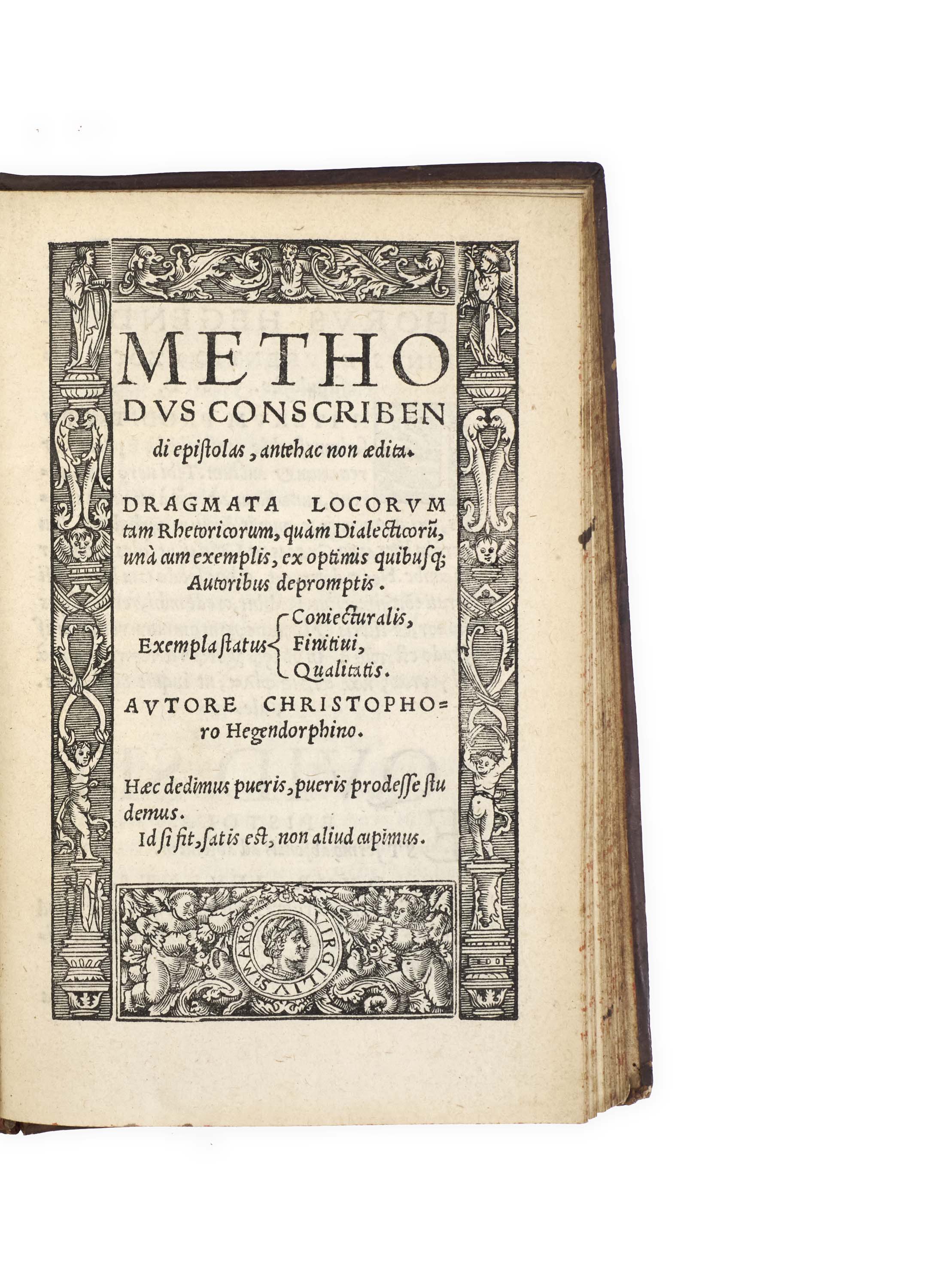
HEGENDORPH, Christoph. Methodus conscribendi epistolas, antehac non aedita. Dragmata locorum tam Rhetoricorum, quam Dialecticorum, una cum exemplis, ex optimis quibusque Autoribus depromptis. [Cologne], [(colophon:) Hero Fuchs, 1527].
Four works in one vol., 8vo, I: ff. [8], 208; title within woodcut border incorporating Setzer’s device, woodcut initials, text in italics with sections in Greek; II: ff. [16]; a–b8 (last leaf blank); III: ff. 31, [1, blank]; IV: ff. [24]; a–c8; title within woodcut border with medallion portrait of Virgil, woodcut initials; light damp-staining to start of volume, but very good copies; bound in late seventeenth-century English mottled calf, spine gilt in compartments, edges speckled red, endleaf with partial watermark of a horn within a cartouche (Churchill 315, seventeenth century), eighteenth-century paper shelflabels to head and foot of spine (the shelfmark also written in ink to inside lower cover); binding a little rubbed, short splits to joints; nineteenth-century armorial Macclesfield bookplate, with earlier paper shelflabels to spine, and armorial blindstamp to first two leaves.
Added to your basket:
Grammatici opus, ab Iohanne Caesario, ita emendatum, Scholiisque illustratum, ut nulla porro labes insideat. Item Donati de octo orationis partibus, & Barbarismo libellus, ad eodem recognitus.
A sammelband of four early sixteenth-century Latin grammars, from the Macclesfield Library at Shirburn Castle. The first work comprises two fourth-century Latin grammars, of which one is a rare complete survival from antiquity; this is bound with three early sixteenth-century schoolbooks on grammar and letter writing.
Diomedes was writing for a Greek audience, most likely for students aiming for a career in imperial Roman administration; his grammar was probably composed in 370–380 AD, and based partly on the grammars of Charisius and Donatus, and using other grammatical sources now lost, including Suetonius and Varro. One section of his text explains Latin words that do not conform to Greek models; there was a theory, proposed in the first century BC, that Latin was a dialect of Greek. This is one of several grammars edited by Johann Caesarius (c. 1468–1550), a teacher of Greek in Cologne and elsewhere; one of his pupils was Heinrich Glarean (1488–1563), the author of the second work in this volume. Both Glarean and Caesarius were close acquaintances of Erasmus, author of the third work, who dedicated his Latin translation of Gaza’s grammar to Caesarius.
Hegendorph (1500–1540) was a Protestant scholar and admirer of Erasmus; a prolific author, his manual on writing letters was first printed in 1522 and regularly reprinted thereafter (despite the claim on the title-page, ‘antehac non aedita’, this is not the first edition).
I: USTC 637623; VD16 D 1844. We have located four copies in North America: the universities of Toronto, Illinois, Wisconsin, and Indiana. II: USTC 631213; VD16 L2663. We have located just one copy in the UK (Glasgow), and none in the US. III: USTC 631250; VD16 E 3552. We have located just one copy in the US (Columbia) and four in the UK (St David’s, Sheffield, Cambridge, and Lambeth Palace Library). IV: USTC 674875; VD16 ZV 7539. We have not located any copies in the US or UK.