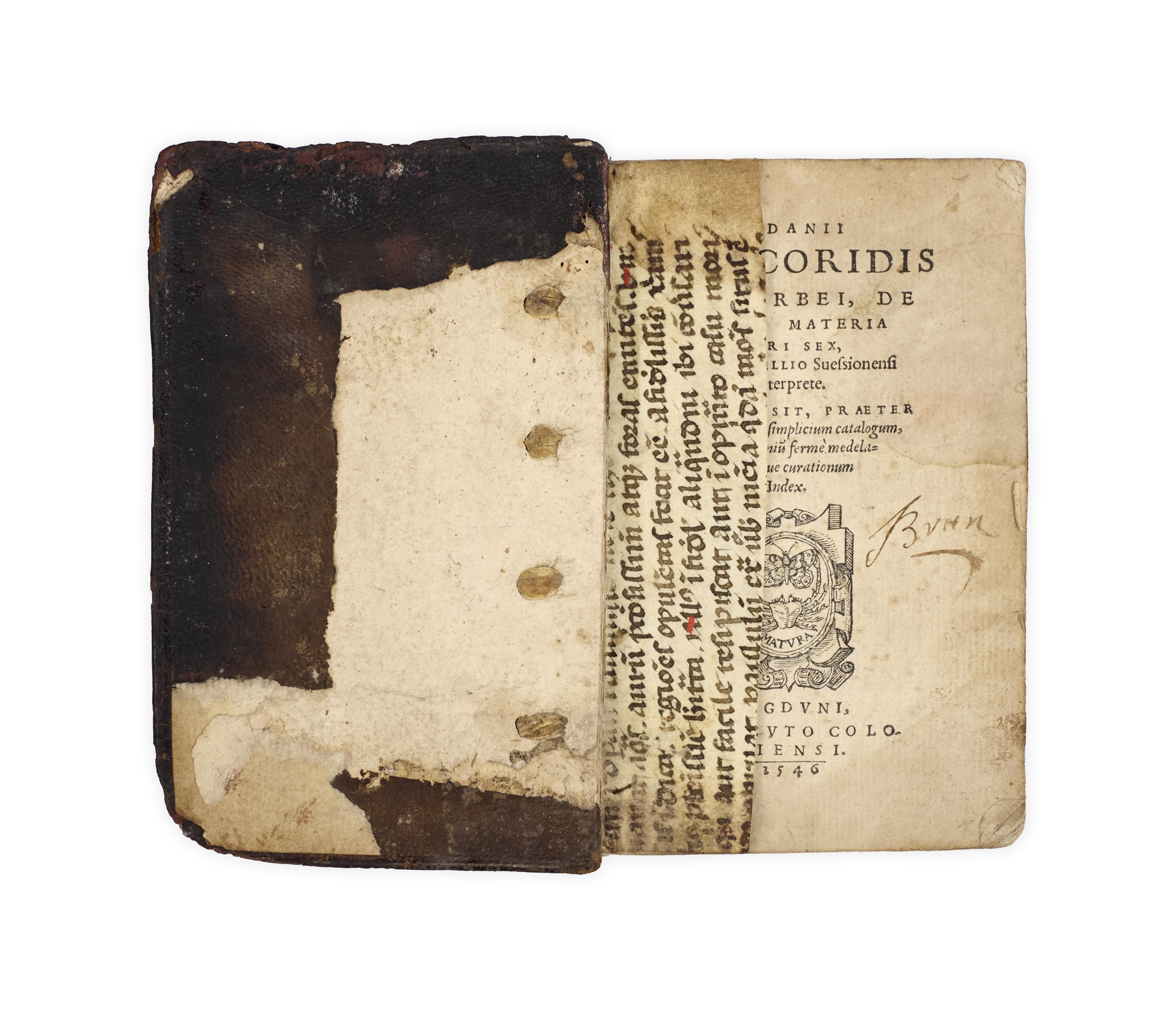
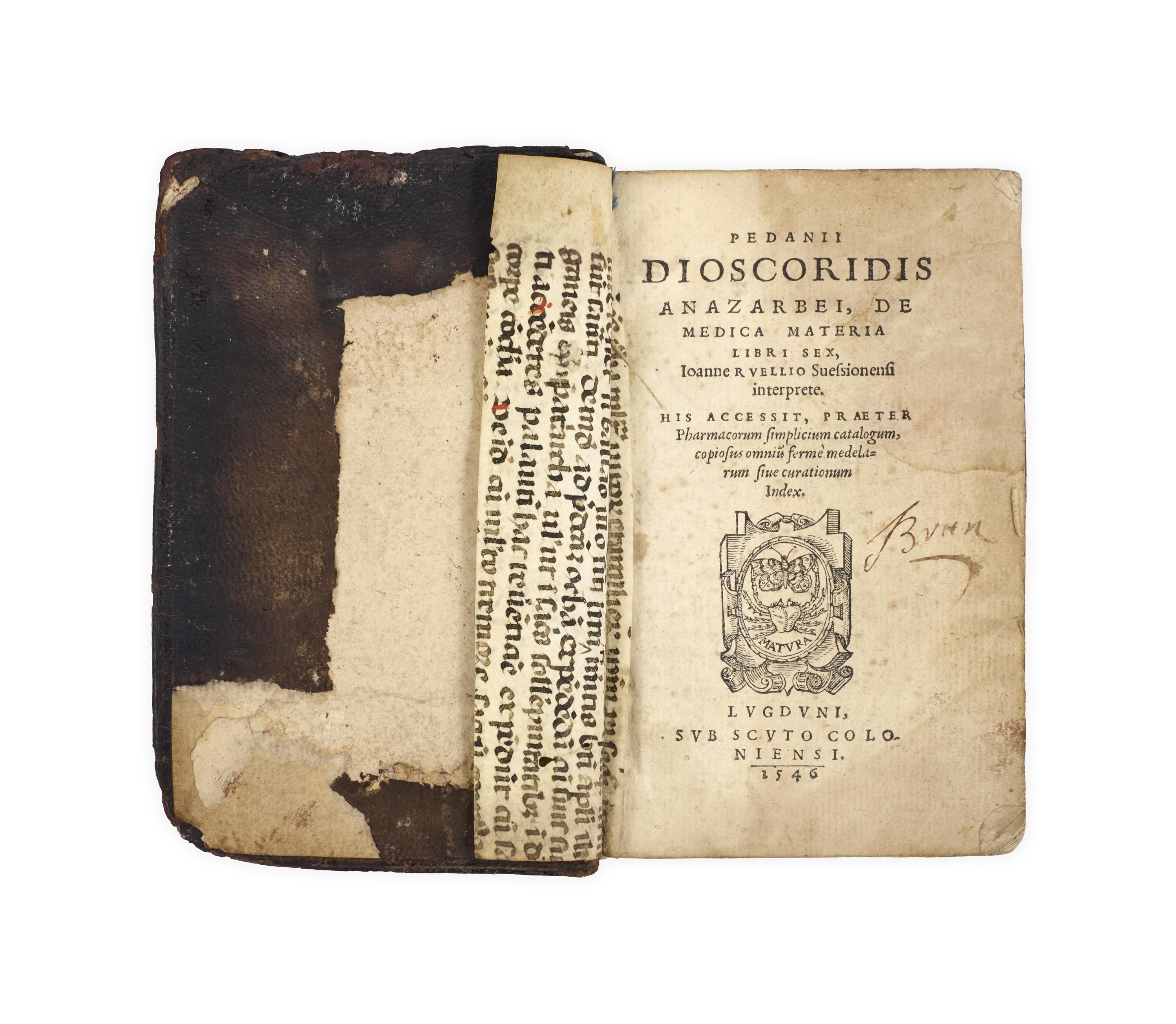
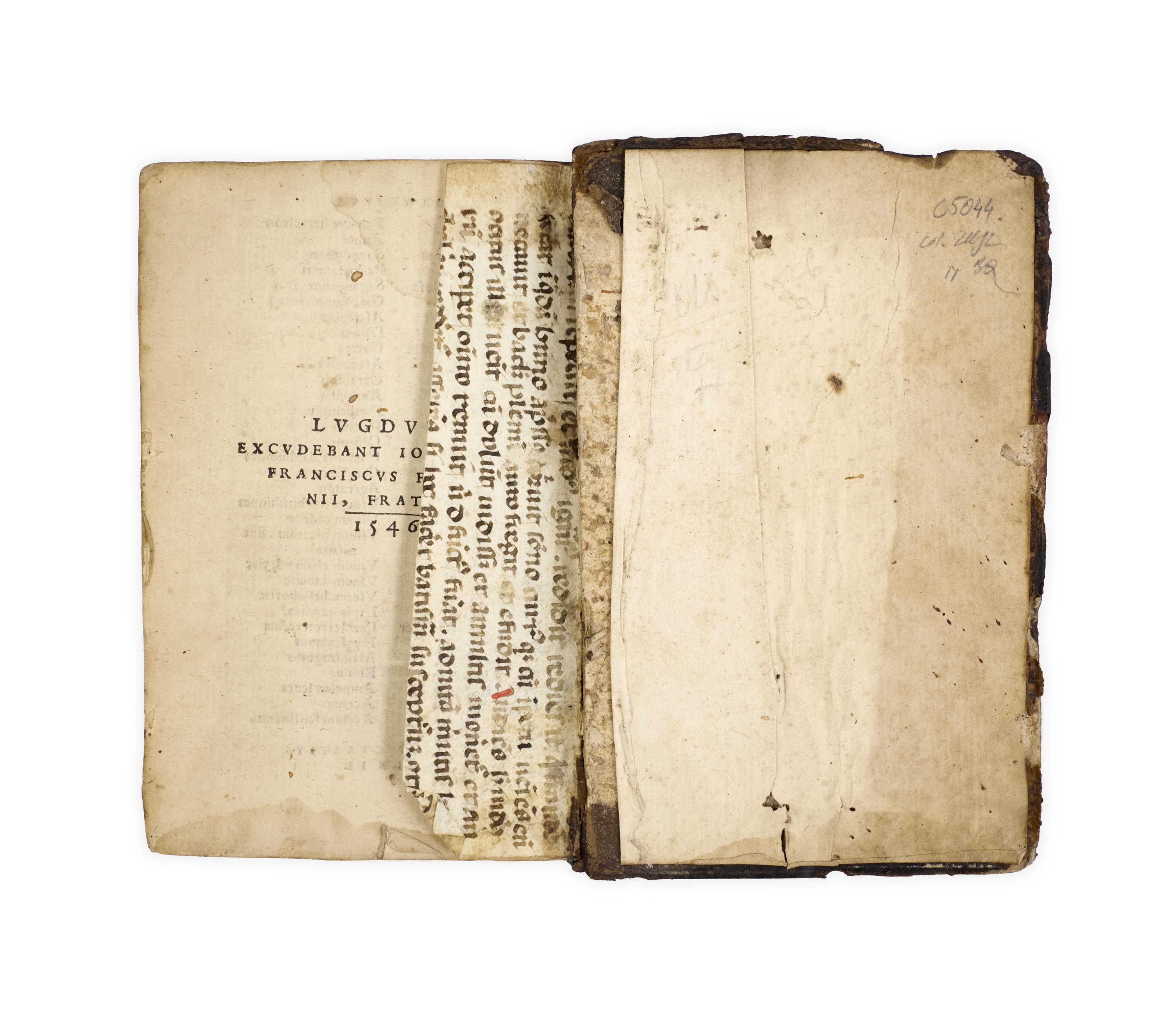
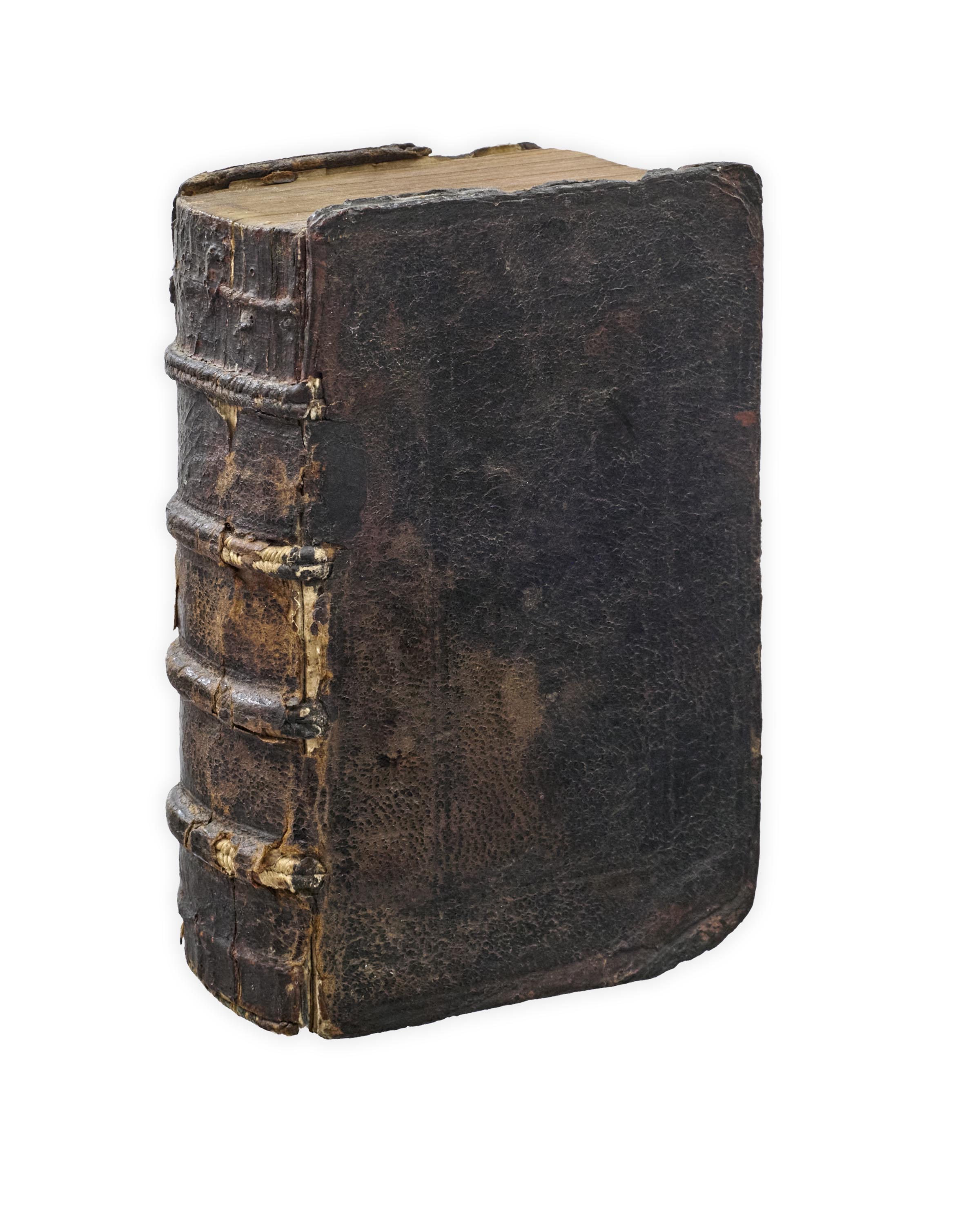
Figs for Boils, Henbane for Madness, Cedar for Ticks
DIOSCORIDES; Jean RUEL, translator.
De materia medica libri sex, Ioanne Ruellio Suessionensi interprete. His accessit, praeter Pharmacorum simplicium catalogum, copiosus omnium ferme medelarum sive curationum Index. Lyon, [(colophon:) Jean and François Frellon], 1546.
16mo, pp. [xxx], 543, [139]; woodcut printer’s device to title-page, woodcut initials; some light foxing or toning, occasional light staining, nevertheless a very good copy; bound in contemporary French (Lyon?) sheep over pasteboard, covers with small blind-stamped leafy centrepiece and a double frame of blind fillets, hinges reusing vellum strips from a fourteenth-century French manuscript (see below); binding worn and slightly defective, but sound, upper pastedown removed; inscription ‘Brun’ to title-page.
Added to your basket:
De materia medica libri sex, Ioanne Ruellio Suessionensi interprete. His accessit, praeter Pharmacorum simplicium catalogum, copiosus omnium ferme medelarum sive curationum Index.
A pocket-sized and practical edition of Dioscorides’ survey of seven hundred plants and their medicinal uses, with a comprehensive index of cures, a popular manual for medical students and practitioners; the first edition to contain the ‘Anonymus B’ commentary.
The translation of Dioscorides into Latin by Jean Ruel (1474–1537) was first printed 1516 by Henri Estienne. It became the standard version of this key medical text, which explained the plants and herbs to be used for various medicinal simples and compounds, along with clinical observations of their effectiveness. The original text comprised five books, and the sixth, on poisons, usually printed alongside Dioscorides’ text, is unlikely to be by the man himself. The sections of Notha (or glosses, containing alternative readings) and Adscripta (useful interpolations) have been combined and relegated here to an appendix, indicating that they were not considered part of Dioscorides’ original text. The sections of commentary which appear here for the first time are assigned to the ‘Anonymus B’ commentator (see Catalogus translationum et commentariorum, pp. 81–82).
The vellum fragments used in the binding come from a mid-fourteenth-century French manuscript of Jacobus de Voragine, Legenda aurea, containing sections of chapter III about St Nicholas (ed. Theodor Graesse, reprinted Osnabrück 1969, pp. 22–29).
Uncommon in the UK: we have traced just two copies (Edinburgh Royal Botanical Garden, Wellcome).
USTC 135992; von Gültlingen VIII, Jean & François Frellon 119; Catalogus translationum et commentariorum IV, Dioscorides, pp. 17 & 81–82.