DIRAC, Paul Adrien Maurice.
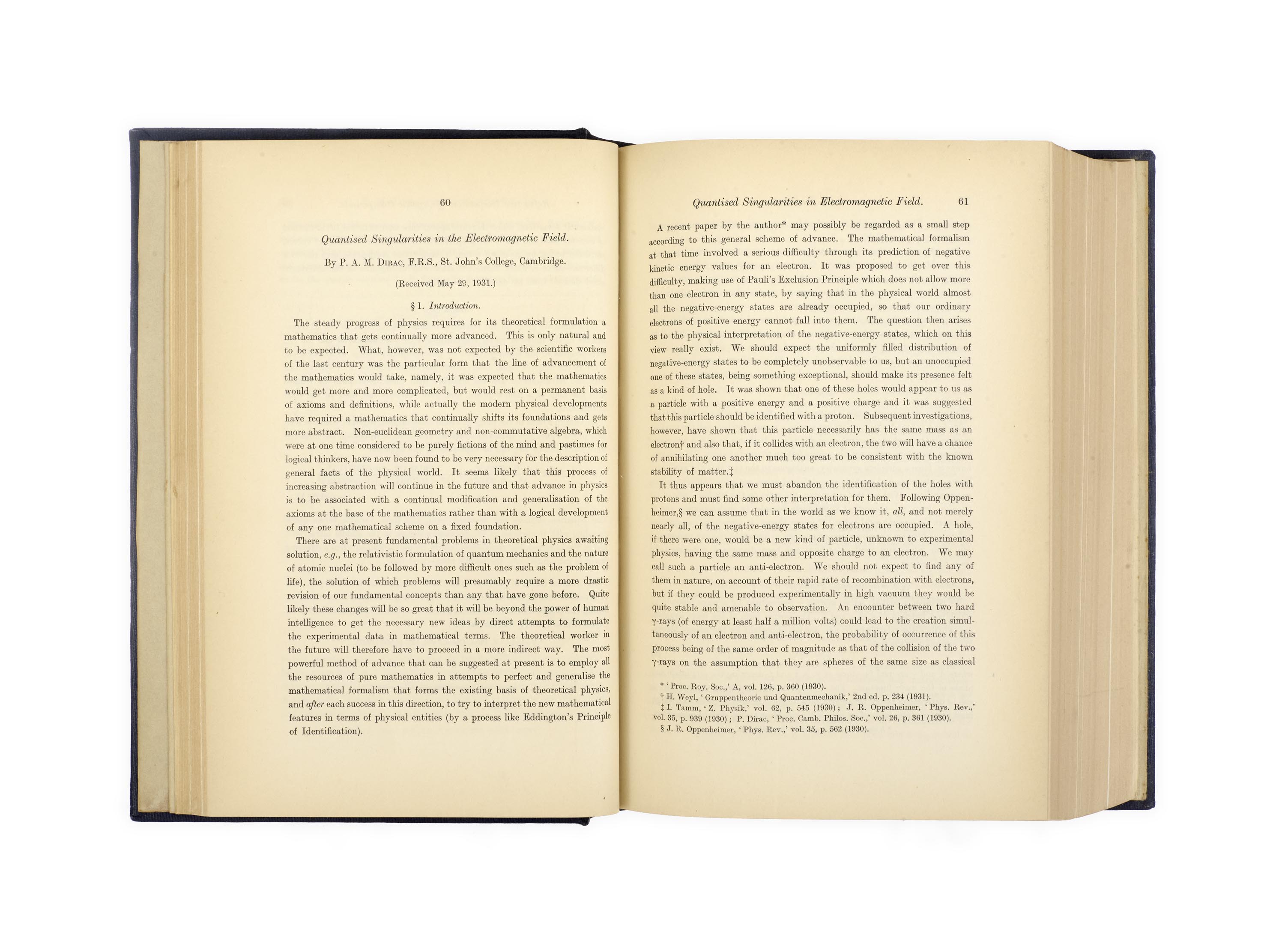
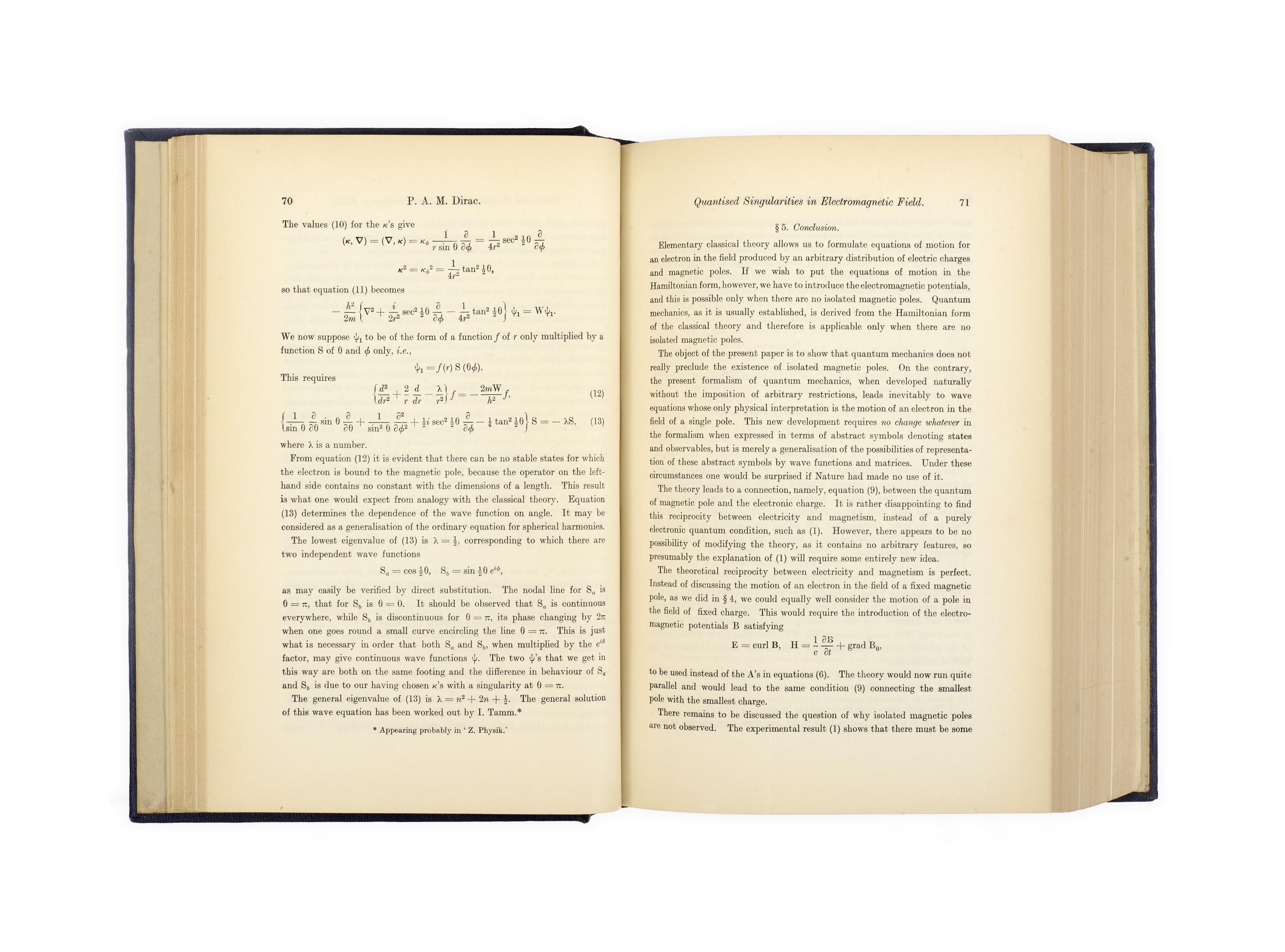
Quantised Singularities in the electromagnetic Field. In: Proceedings of the Royal Society of London series A containing Papers of a mathematical and physical Character vol. CXXXIII (pp. 60–72). London, Harrison and Sons for the Royal Society, October 1931.
8vo, pp. v, [1, blank], 695, [3], xiv; with 13 leaves of plates; a very good copy in blue cloth, gilt lettering to spine; bookplate of the library of the General Electric Company to front pastedown.
Added to your basket:
Quantised Singularities in the electromagnetic Field. In: Proceedings of the Royal Society of London series A containing Papers of a mathematical and physical Character vol. CXXXIII (pp. 60–72).
First edition of this remarkable paper by one of the twentieth century’s most important physicists. Famous for the Dirac equation and for predicting the existence of antimatter, Dirac shared the 1933 Nobel Prize in Physics with Erwin Schrödinger ‘for the discovery of new productive forms of atomic theory’ and held the Lucasian Chair of Mathematics at Cambridge University between 1932 and 1969.
‘“The quantum theory of the electron” marked a turning-point in modern physics and the Dirac equation was received enthusiastically … However, some of the consequences appeared strange, especially that the theory seemed to predict the existence of electrons with positive charge and negative energy. The difficulty was solved by Dirac in 1930–31 by a brilliant and imaginative interpretation of the negative energies formally occurring in the theory. He suggested the existence of positively charged “antielectrons” that would annihilate in collision with ordinary electrons, and at first believed that antielectrons were identical with protons. In a remarkable paper of 1931, “Quantised singularities in the electromagnetic field”, he realized that the idea did not work and instead predicted that the antielectron was a new kind of particle, with the same mass as the electron but opposite charge. The daring speculation was unexpectedly confirmed in 1932 when positive electrons (positrons) were discovered in the cosmic radiation. In his 1931 paper Dirac also suggested the existence of antiprotons – negatively charged protons – and isolated magnetic poles. Whereas the antiproton was eventually discovered (in 1955), the magnetic monopole has escaped discovery in spite of many attempts and some discovery claims’ (Helge Kragh in ODNB).