Provincial Poetry and Prose
DU BOURGET DE CHAULIEU, Nicolas.
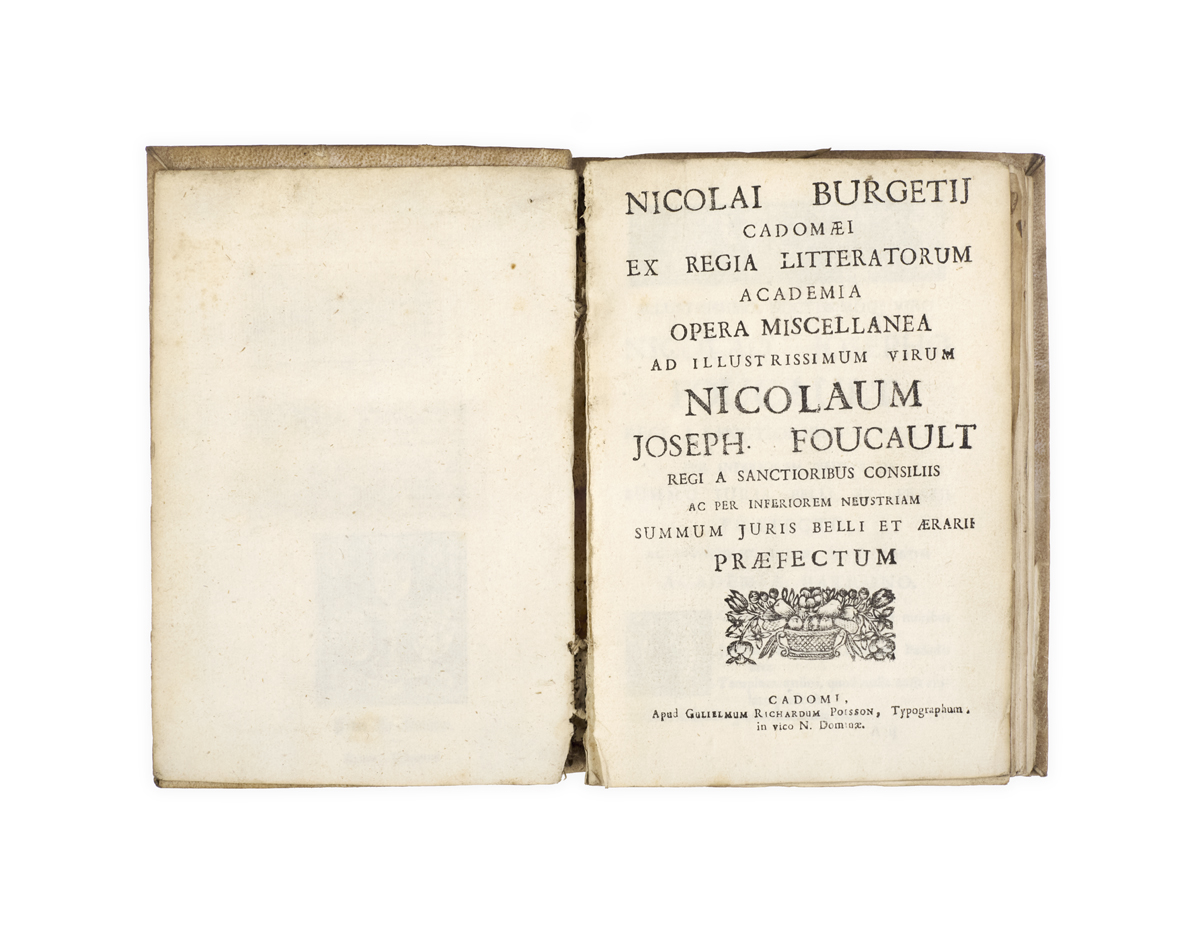
Nicolai Burgetii Cadomaei ex regia litteratorum academia opera miscellanea ad illustrissimum virum Nicolaum Joseph Foucault ... Caen, Guillaume Richard Poisson, [c. 1700].
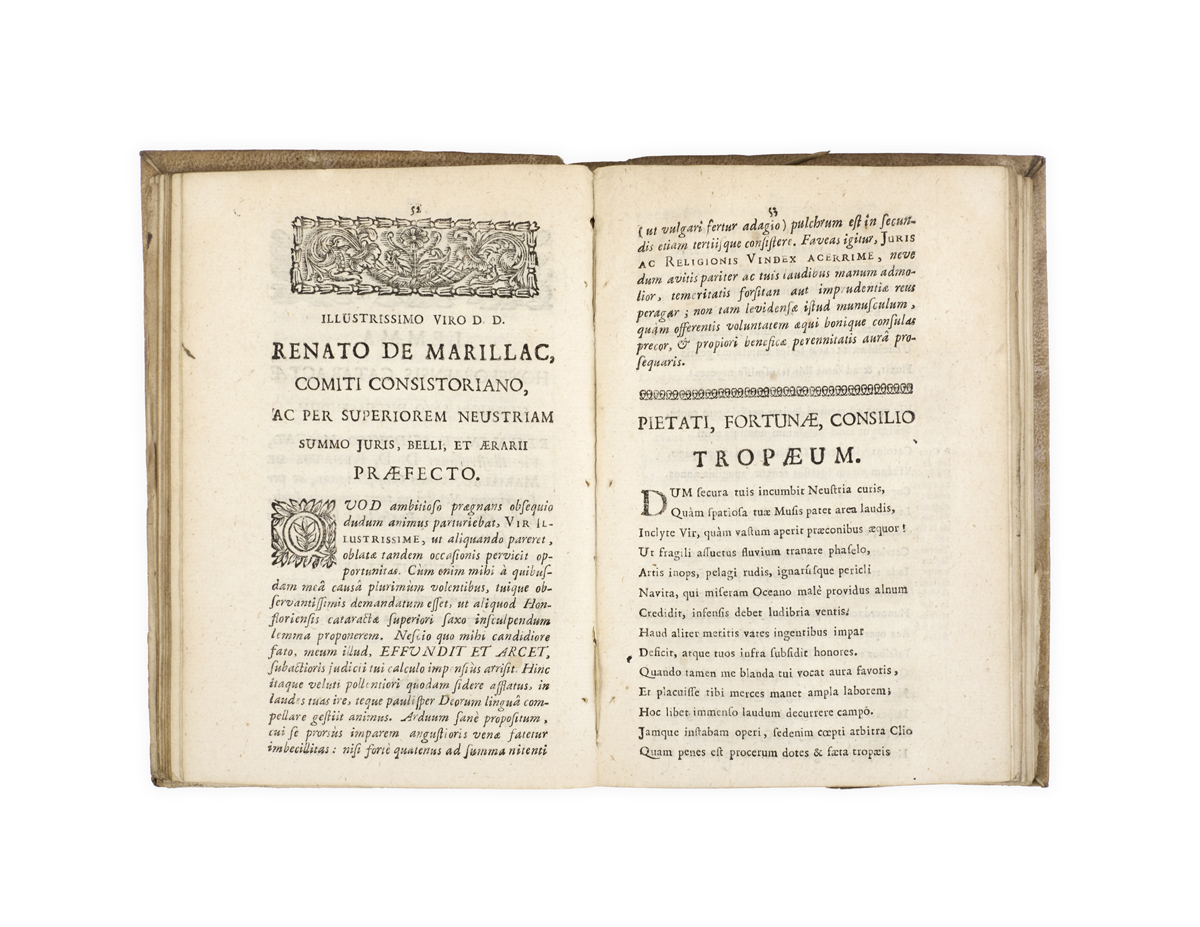
8vo, pp. [vi], 3-8, ‘7–198’ (i.e. 9–200), [2 (blank)]; woodcut ornament to title, woodcut initials, woodcut head- and tailpieces; title leaf and A7 coming loose, a little worming to inner margins, a few light marks, otherwise a very good copy; bound in contemporary vellum, spine lettered in ink, spine lined with printed waste paper; two old booksellers’ descriptions and bookplate of ‘Petri Le Verdier’ to front pastedown.
Added to your basket:
Nicolai Burgetii Cadomaei ex regia litteratorum academia opera miscellanea ad illustrissimum virum Nicolaum Joseph Foucault ...
Rare Caen edition of the Latin and French poetry and prose of Nicolas du Bourget.
A native of Caen, du Bourget (1642–1721) joined the Oratorians and devoted his early career to teaching; coming into an inheritance, however, he married and moved to Rouen, where he lived for thirty years, gaining a reputation as a poet.
The collection opens with dedicatory pieces to Nicolas-Joseph Foucault (1643–1721), Intendant de la généralité de Caen and a noted bibliophile. A curious set of Latin verses in honour of the Virgin Mary follows, inspired by a range of sources, including classical authors, Erasmus, Pope Leo the Great, the Book of Judith, and historical writers, and including a composition on papyrus. Other poetic pieces include a Latin idyll on the metamorphosis of Phyllis’ eyes into stars, verses in praise of Neustria (the western part of the Frankish Kingdom), epitaphs and epigrams, and prayers on salvation. Du Bourget’s prose includes essays in praise of patience, on God’s patience towards sinners, and on the progress, perfection, and decadence of Latin poetry.
The printer–publisher Guillaume Richard Poisson (1668–1719) trained under his father Jean, studied humanities and philosophy at the university of Caen, and worked for his mother before setting up on his own in 1694.
No copies traced in the UK, and only one in the US (Yale).