Translated by George Eliot’s Friend
‘ELIOT, George’, pseud. [i.e. Mary Ann EVANS]; F[rançois] D’ALBERT-DURADE, translator.
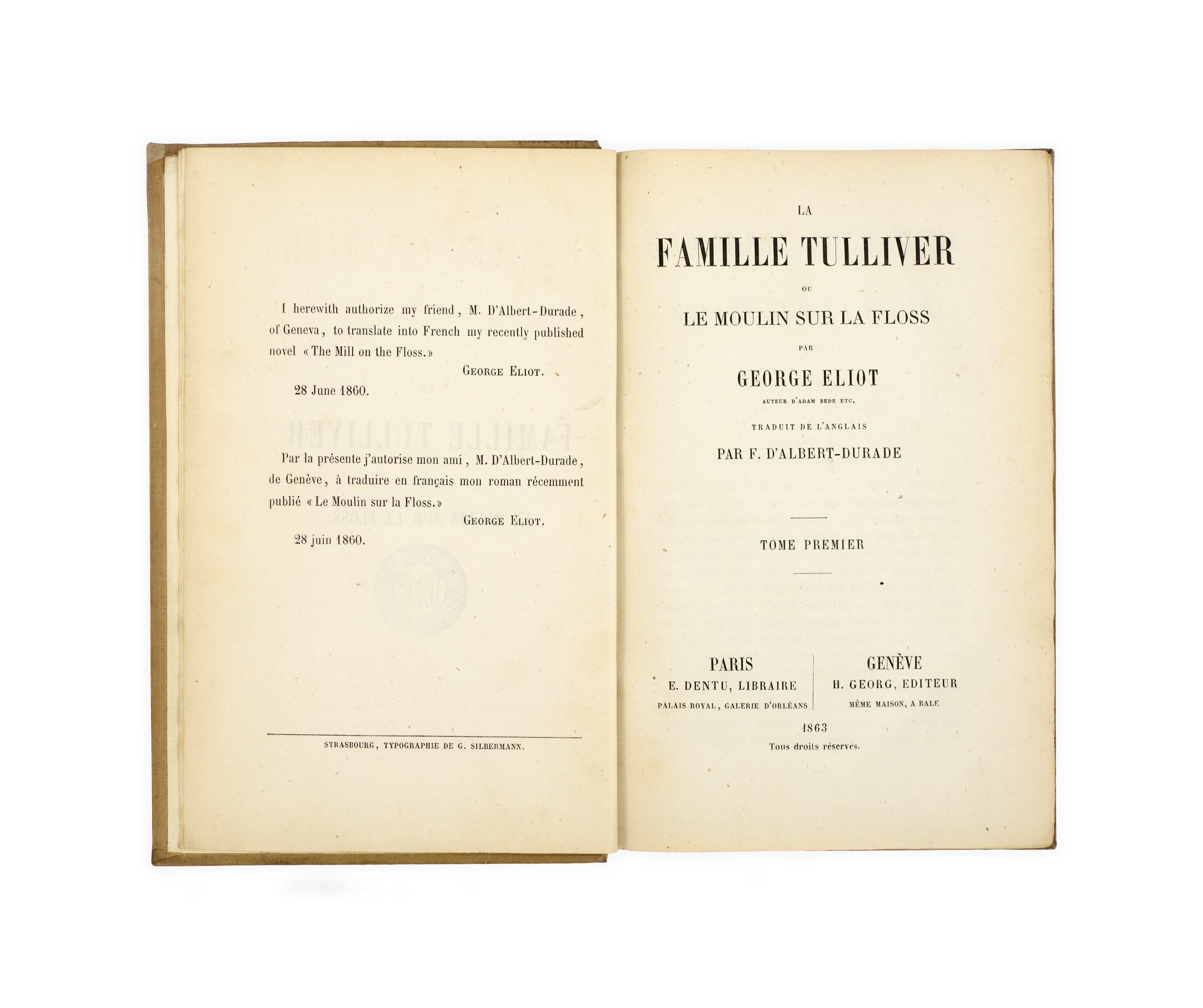
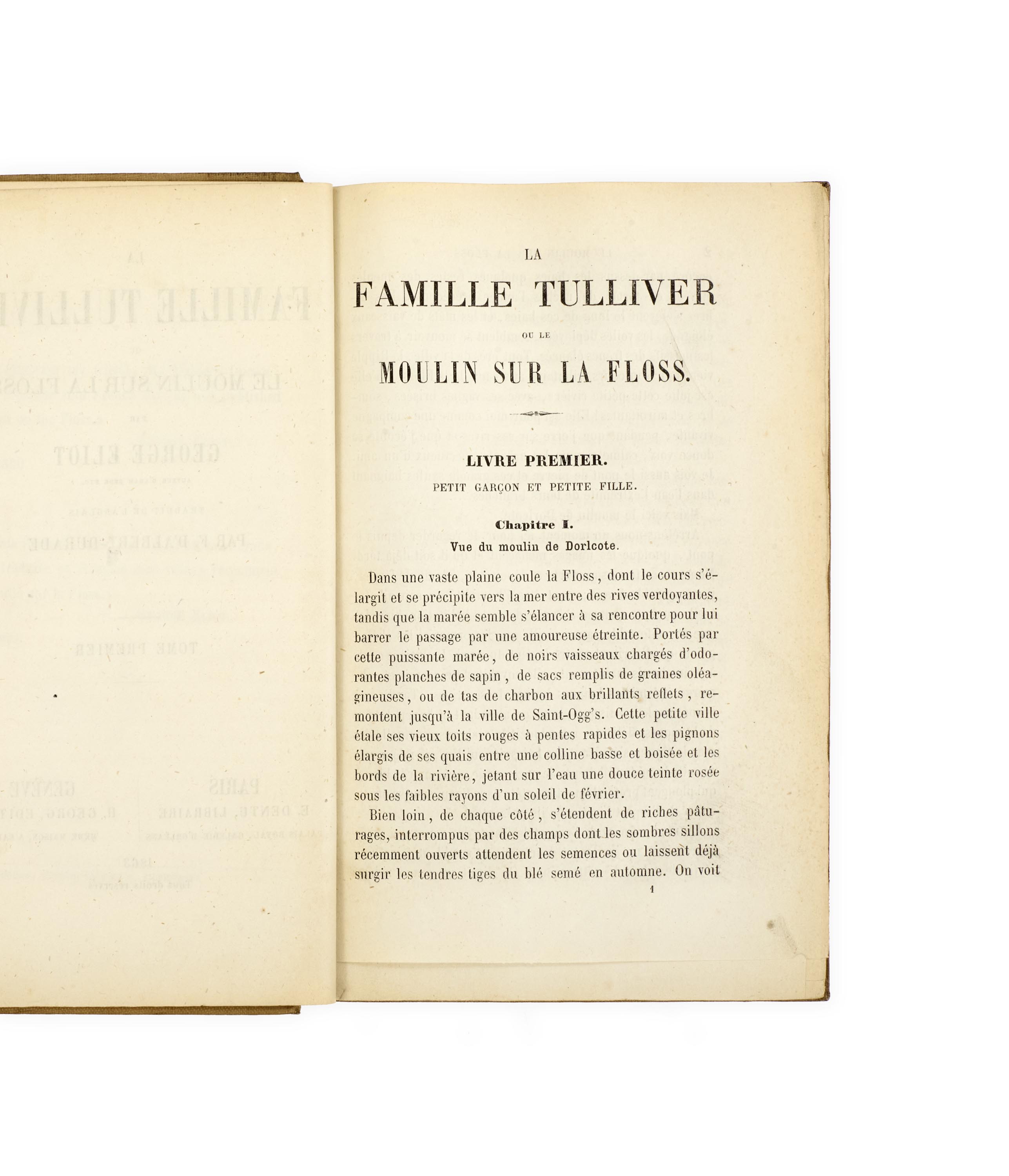
La famille Tulliver ou le moulin sur la Floss … Tome premier [– deuxième]. Strasbourg, G. Silbermann for Paris, E. Dentu, and Geneva, H. Georg, 1863.
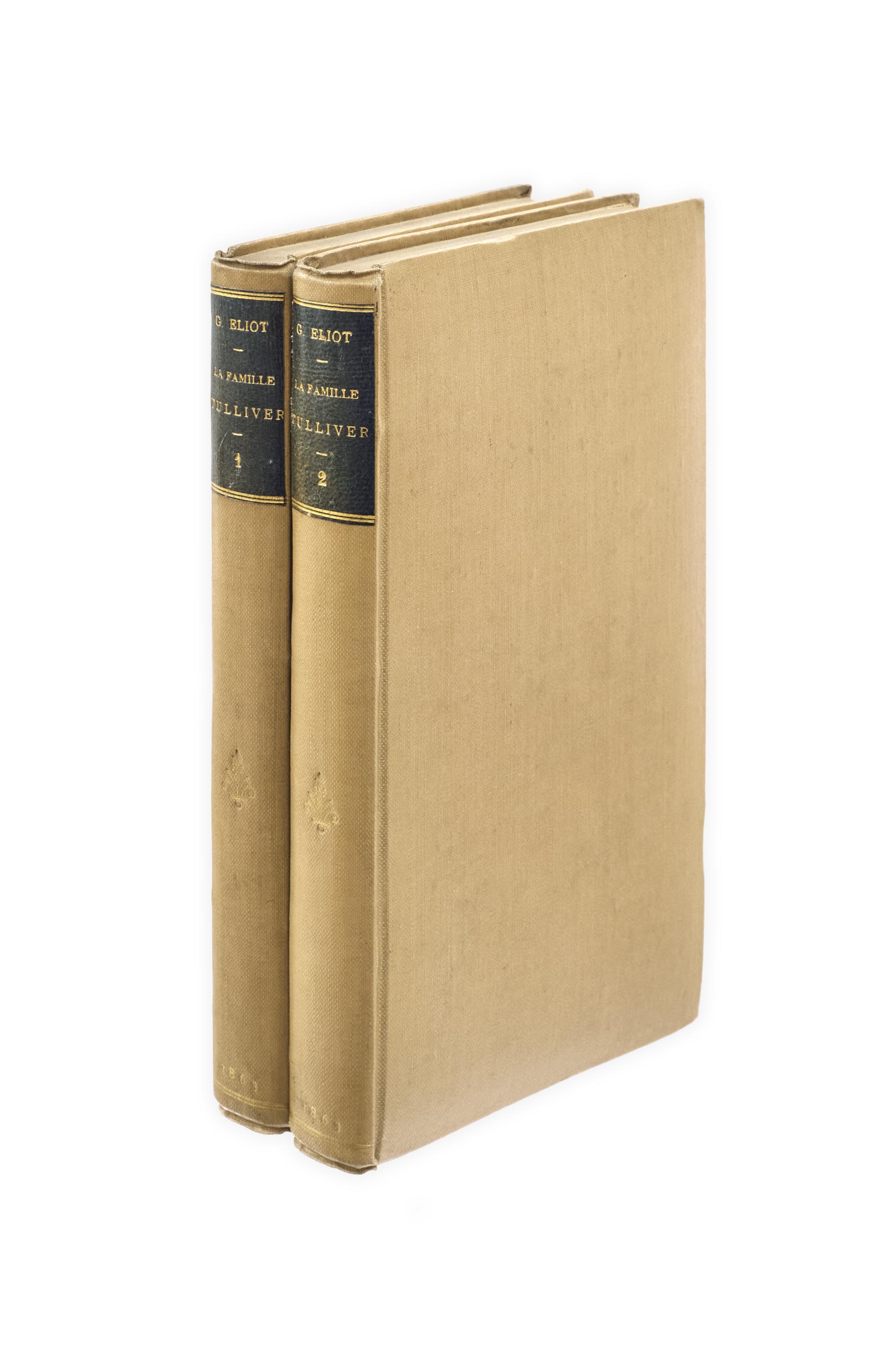
Two vols, 8vo, I: pp. [iv], 363, [1, contents]; II: pp. [iv], 363, [1, contents]; light foxing to first and final leaves; nonetheless a very good set in contemporary tan buckram, gilt green-morocco lettering-pieces to spines; spines and corners lightly bumped; contemporary circular ‘Manoir d’Aspremont’ ink stamps with initials RC to half-titles.
Added to your basket:
La famille Tulliver ou le moulin sur la Floss … Tome premier [– deuxième].
First edition in French, exceptionally rare, of George Eliot’s celebrated semi-autobiographical novel The Mill on the Floss, translated with her approval by her friend and correspondent François d’Albert Durade, with whom she had lodged in Geneva from October 1849 to March 1850, and who painted what is perhaps her most famous portrait.
Five days after her father’s funeral in June 1849, Eliot, then aged thirty, travelled to Switzerland with her friends Charles and Cara Bray, staying on in Switzerland long after they had returned to England. In Geneva, she ‘bravely took lodgings and spent a winter trying out her new found independence, and taking stock. A sympathetic family, the D’Albert Durades, took her in as a paying guest … [François] painted her portrait in February 1850, representing her as modest, pensive, long-faced, but pleasant looking. Mary Ann spent her time in Geneva reading, walking, learning mathematics, and continuing with a translation (never to be finished) of Spinoza’s Tractatus theologico-politicus which she had begun during her father’s illness’ (ODNB). In an October 1849 letter to the Brays, she describes François and his wife, the painter Julie d’Albert-Durade (née Covelle), whom Eliot affectionately called ‘Maman’, as ‘really clever people – people worth sitting up an hour longer to talk to’ (Cross ed. I, p. 166). François accompanied Eliot on her journey back to England five months later, and the two would exchange letters until the end of Eliot’s life (although Durade would destroy her letters to him shortly thereafter).
In an approbation to the half-title verso dated 28 June 1860 – less than three months after the publication of the first English edition, which had sold 4600 copies within four days – Eliot explicitly authorises her ‘friend, M. D’Albert Durade, of Geneva, to translate into French my recently published novel “The Mill on the Floss”’. The two saw each other for the last time that June, during Eliot’s visit to Switzerland with her husband, George Henry Lewes. Durade was also the translator of Eliot’s Adam Bede (1861), Silas Marner (1863), Romola (1878), and Scenes of Clerical Life (1884). On receiving a proof copy of his Famille Tulliver, Eliot fondly writes to Durade that she ‘shall glance at the pages, that I may imagine the translator more vividly by reading phrases which may have been in his mind – a little too often for his patience, perhaps, in the long business of revision and proof-correcting. Yet I hardly need any help in bringing you and Maman before me, and hearing the tone of the two voices’ (Cross ed. II, p. 265).
OCLC finds only two copies in the US (Morgan and Princeton) and none in the UK. Not in Library Hub.
Lorenz VIII, p. 376. See Cross ed., George Eliot’s Life as related in her Letters and Journals (1895–9).