Annotated Euclid
EUCLID; Jean MAGNIEN and Stephanus GRACILIS, editors.
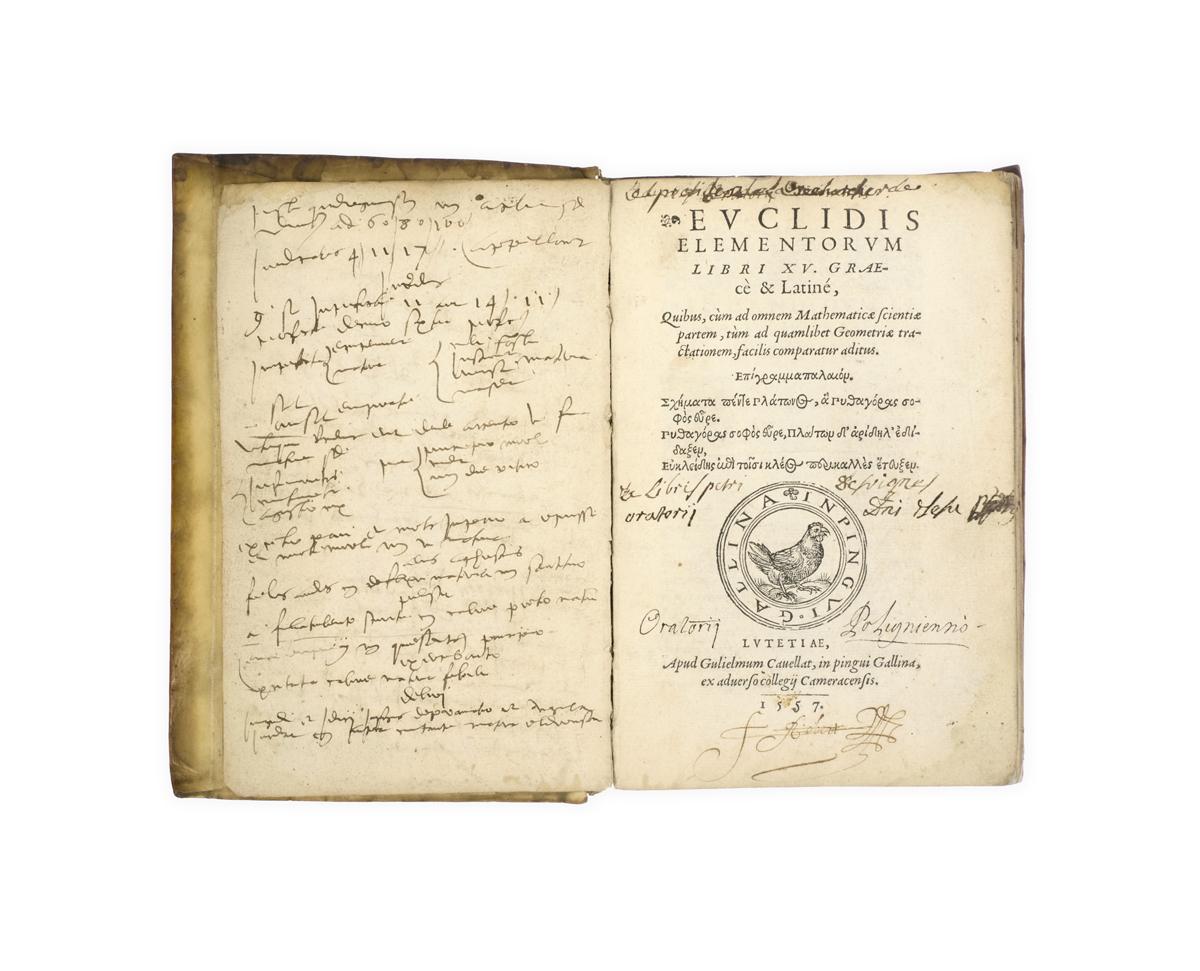
Euclidis elementorum libri XV Graece et Latine, quibus, cum ad omnem mathematicae scientiae partem, tum ad quamlibet geometriae tractationem, facilis comparatur aditus … Paris, Guillaume Cavellat, 1557.
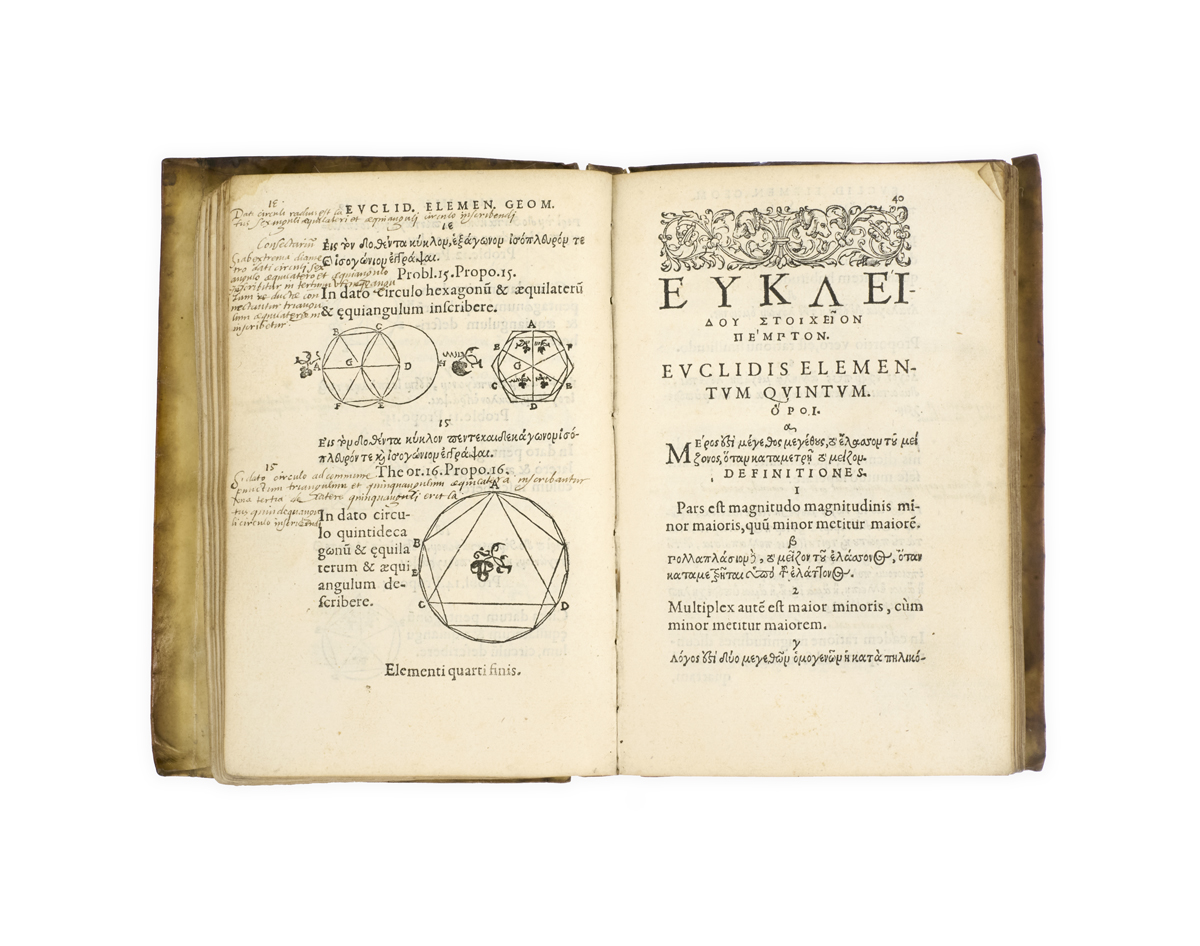
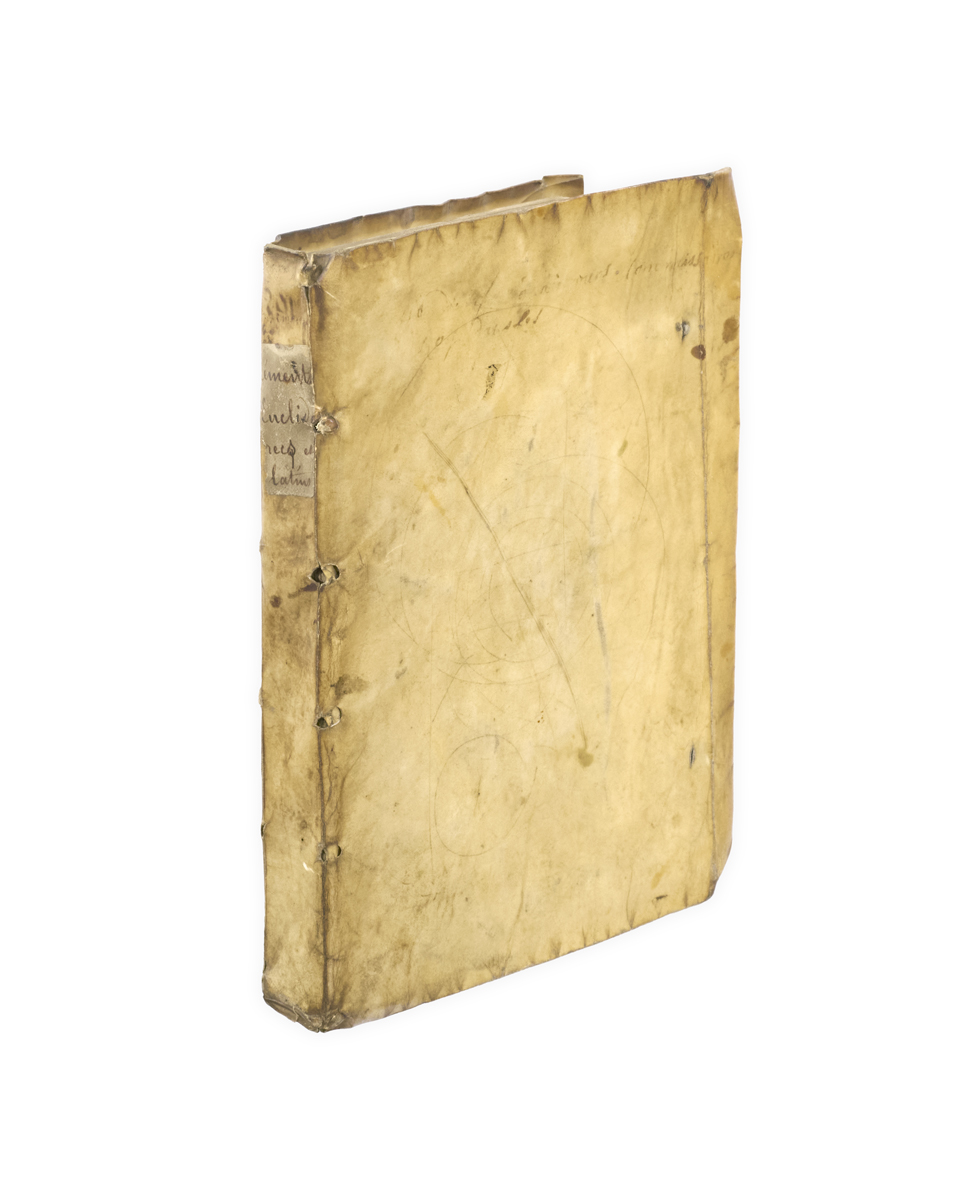
8vo, ff. [xvi], 88, ‘59–130’ (i.e. 89–160); text in Greek and Latin, woodcut printer’s devices to title-page and last page, woodcut diagrams throughout, woodcut initials and headpieces; very slight marginal dampstaining and toning, a few marks, last page dusty, but overall a very good copy; bound in contemporary vellum, yapp fore-edges, geometric patterns drawn with dividers on covers, ‘[…] Commissaire du Roy [?] […]’ in manuscript to front cover, later paper spine label, vestigial ties to fore-edge, sewn on 4 split tawed thongs laced in, endguards of manuscript waste on vellum, spine lined with printed waste on paper; somewhat worn and stained, upper hinge split, rear endpapers removed; early ownership inscriptions ‘Chabaud’, ‘ex libris Petri Desvignes oratorii Dni Jesu’, ‘Oratorii Poligniensis’ (Poligny), annotations in a handsome contemporary italic hand to 56 pp., and 3 pp. of notes in a contemporary cursive hand to front endpapers (see below); nineteenth-century printed book label of A. M. Faivre to inner front cover.
Added to your basket:
Euclidis elementorum libri XV Graece et Latine, quibus, cum ad omnem mathematicae scientiae partem, tum ad quamlibet geometriae tractationem, facilis comparatur aditus …
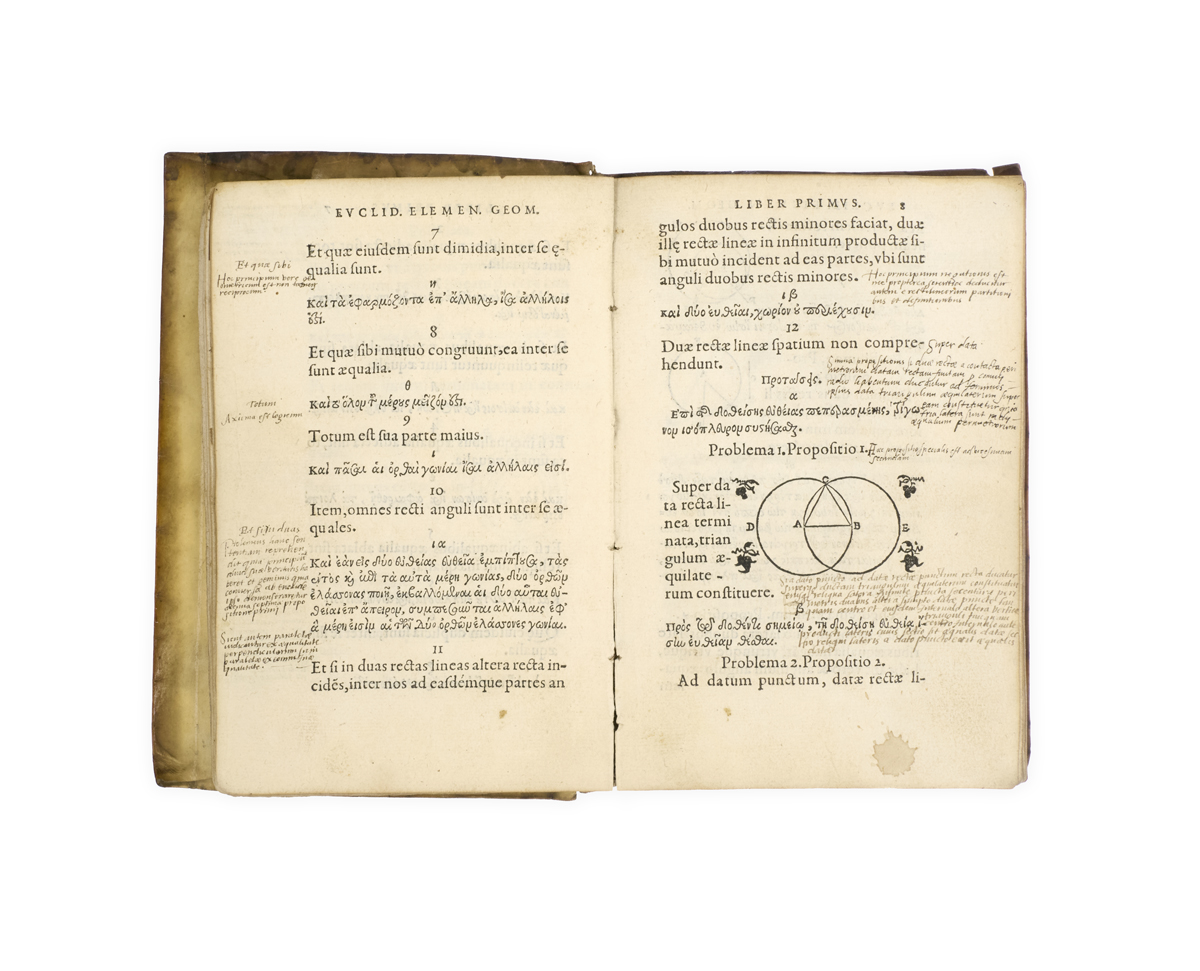
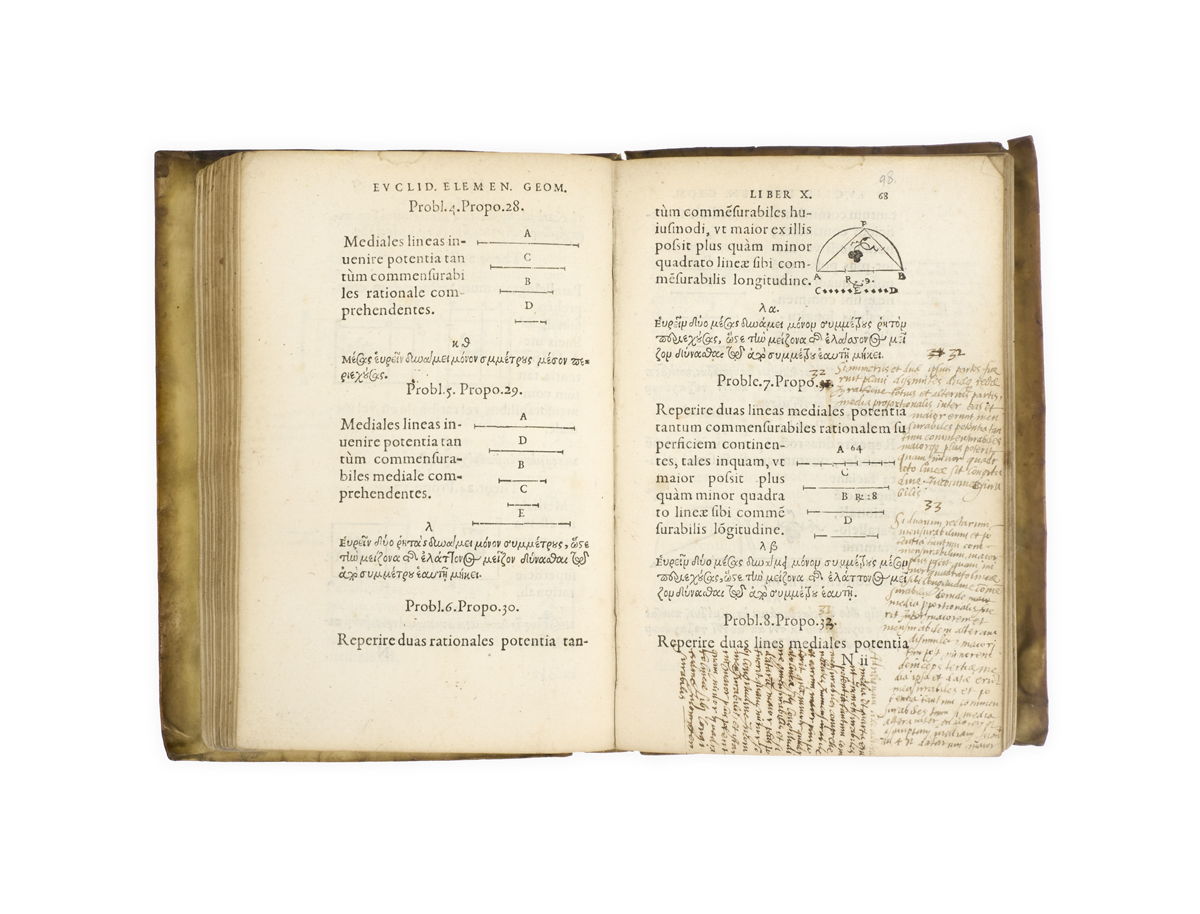
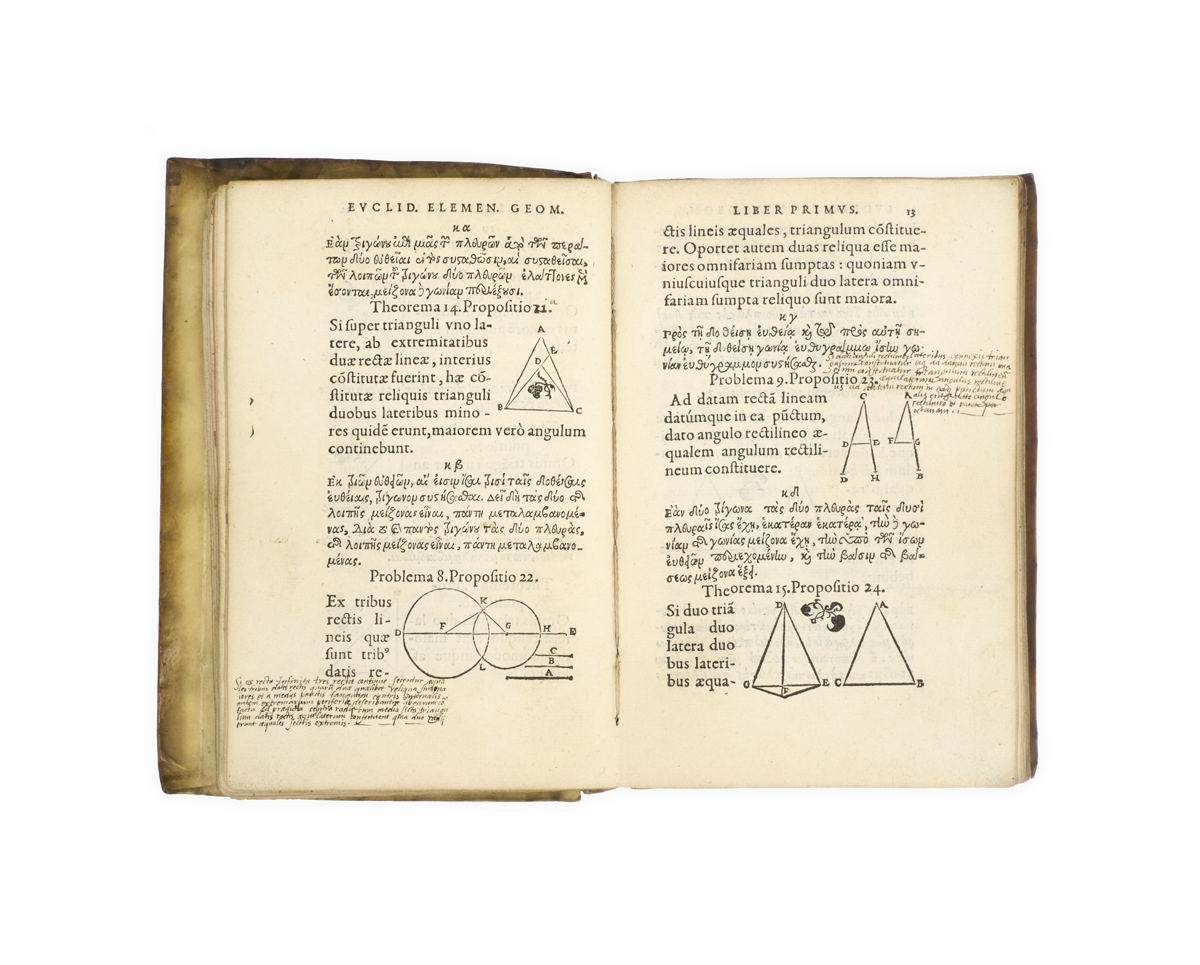
First edition of Euclid’s Elements as edited by Jean Magnien and Stephanus Gracilis, with woodcut diagrams throughout, this copy extensively annotated by a contemporary student.
The French mathematician and professor at the Collège royal, Jean Magnien (d. 1556), had projected an edition of Euclid’s Elements with the Parisian publisher Guillaume Cavellat, but the enterprise was stalled by Magnien’s premature death, prompting Cavellat to seek the assistance of Gracilis to bring the work to completion. The resulting edition contains Euclid’s propositions in Greek and Latin, but not the proofs.
The contemporary annotations, in an elegant italic hand, elaborate, occasionally at great length, upon the text. The content suggests that they were taken down by a student from a teacher. They begin with definitions of mathematics and its parts and show a particular interest in points, lines, triangles, rectangles, parallelograms, circles, proportions, and commensurability. Our annotator provides summaries at the opening of books VI and X and makes references to Aristotle, Ptolemy, and Philoponus. Further mathematical notes in a contemporary cursive hand appear on the front endpapers.
USTC 152265; Pettegree & Walsby, French Books 70021; Smith, Rara Arithmetica, p. 240; Steck III.56.